End-to-End Manufacturing Compliance Consulting
A supplier can look flawless on paper. Valid certificates, a modern-looking facility, and a quote that beats everyone else’s. Yet the same supplier can still derail a manufacturing project through hidden capacity constraints, weak process controls, undocumented subcontracting, or a quality system that exists in policy but not on the shop floor.
This is the gap that most vendor audits miss. They confirm that paperwork exists. They rarely confirm that the supplier can consistently deliver what the project actually needs. An end-to-end vendor audit compliance consulting ,closes that gap by treating supplier evaluation as an ongoing risk-control function rather than a one-time inspection.
Why a Checklist Approach to Vendor Audits Falls Short
Most vendor audit templates ask the same static questions: Does the supplier have ISO 9001? Is the factory license valid? Are safety records available? These are necessary checks, but they answer very little about whether the supplier can perform under real project conditions.
A checklist cannot tell a project team whether a supplier’s stated capacity is actually free capacity, whether their quality system catches defects before dispatch or after a customer complaint, or whether a single sub-supplier failure could stop their entire production line. These are among the supplier-related issues that can contribute to manufacturing project delays, and they often surface only when an audit is built around verified evidence rather than declared compliance.
Audit Depth Should Match Supplier Criticality, Not Supplier Count
Not every vendor deserves the same level of scrutiny. Applying a uniform, heavy audit to every supplier wastes time on low-risk vendors while under-auditing the ones that can actually damage a project. A risk-based structure is more effective:
- Low-criticality consumables: Basic documentation and supplier evaluation
- Standard components: Quality, capacity, and delivery performance checks
- Critical engineered equipment: Full technical, manufacturing, and quality audit
- Product-contact material suppliers: Quality, regulatory, and traceability audit
- Pharma or API suppliers: GMP, regulatory, and quality-system audit
- Safety-critical automotive components: Process capability plus customer-specific requirement checks
- Sole-source critical suppliers: Full operational, continuity, and financial risk review
This classification should happen before the audit is scheduled, not after. It determines audit duration, mandatory versus optional documentation, and whether the review is remote, on-site, or a hybrid of both.
Criticality itself should be scored on more than spend value. A more useful view weighs four factors together: business impact if the supplier fails, likelihood of failure based on track record, substitutability if an alternative source exists, and recovery difficulty if a replacement has to be qualified mid-project. A low-value component from a sole-source supplier, or a mid-value part with no qualified alternative, can carry more project risk than a high-value item available from five vendors. Building the classification around these factors, rather than purchase order size alone, is what makes a risk-based program defensible when a project team has to justify why one supplier was audited in depth while another received a lighter review.
How to Manage This as a Program, Not a One-Off Exercise
A few structural decisions turn this into something repeatable across dozens or hundreds of suppliers:
- Maintain a supplier master list with criticality tags, updated as vendors are onboarded or their scope changes.
- Set audit frequency by risk tier, so critical and sole-source suppliers are reviewed more often than low-risk, high-availability ones.
- Standardise evidence requirements per tier, so documentation adequacy isn’t decided case by case.
- Separate the audit function from procurement negotiation, so findings aren’t softened by pressure to close a purchase order.
- Track findings and CAPA status centrally, so recurring issues across suppliers or cycles stay visible.
Speak With An Expert: https://www.imarcengineering.com/contact?service=vendor-audits-and-compliance-checks
When Suppliers Should Be Audited Across the Project Lifecycle
Supplier risk does not stay constant. It changes shape at every stage of a manufacturing project, which is what “end-to-end” should actually mean.
- At prequalification, before a supplier is added to the approved vendor list, the audit should verify engineering capability, technical documentation, certifications, infrastructure, past project experience, and financial and business-continuity indicators.
- During procurement, the focus shifts to specification compliance, manufacturing capability, quality controls, testing facilities, inspection and test plans, traceability, lead-time capability, and subcontracting controls.
- During manufacturing and installation, the priorities become equipment readiness, documentation completeness, FAT readiness and SAT support capability, calibration status, installation support, spare-parts availability, and warranty or AMC coverage.
- During operations, the audit turns into ongoing monitoring: repeat quality performance, delivery reliability, non-conformance history, change management discipline, and CAPA closure rates.
- At requalification, typically triggered by a fixed review cycle, a process change, or a quality incident, the supplier’s approved vendor list status is reassessed against current performance rather than the original qualification data.
Treating these as five distinct checkpoints, rather than a single pre-order inspection, is what actually protects a project across its full duration.
What Auditors Should Actually Verify
A contemporary supplier audit needs to look well beyond certificates:
| Audit Dimension | What to Verify |
| Technical capability | Machinery, engineering resources, process competence |
| Production capacity | Installed capacity, utilisation, available capacity and bottlenecks |
| Quality systems | Inspection, testing, non-conformance handling and traceability |
| Regulatory compliance | Applicable licences, certifications and statutory requirements |
| Documentation | SOPs, specifications, certificates and test records |
| EHS | Safety systems, environmental controls and emergency readiness |
| Supply reliability | Lead times, delivery performance and continuity planning |
| Financial stability | Business continuity and relevant financial risk indicators |
| Sub-supplier risk | Dependence on critical third parties and outsourced processes |
| CAPA discipline | Ownership, deadlines and verified effectiveness |
Suppliers tied to BIS-certified or regulated products deserve particular attention here. For these suppliers, the audit should go beyond checking whether certificates are available and assess whether relevant manufacturing infrastructure, process controls, and testing arrangements continue to support applicable certification requirements.
Industry-Specific Priorities That a Generic Audit Misses
A single checklist cannot serve pharma, automotive, and industrial equipment suppliers equally well. Each sector carries its own dominant risk:
- Pharmaceuticals: GMP compliance, documentation, validation records, quality agreements
- Food processing: Hygiene systems, food safety controls, traceability
- Chemicals: Process safety, hazardous-material handling, environmental compliance
- Automotive: Process capability, IATF and customer-specific requirements, traceability
- Electronics: Component quality, ESD controls, testing rigor
- Industrial equipment: Fabrication quality, inspection discipline, FAT documentation
- Consumer goods: Capacity consistency, packaging integrity, delivery reliability
For pharmaceutical manufacturing suppliers where Schedule M requirements are applicable, the audit should consider relevant expectations covering manufacturing activities, quality systems, personnel, premises, equipment, and calibration. For automotive suppliers, the audit needs to check both the base quality management system and the specific customer requirements that apply to that OEM, since these can differ significantly between manufacturers.
What Happens After Findings Are Identified
A common and costly mistake is treating the audit report as the final deliverable. A weak process stops at “audit, report, file.” A stronger process continues:
Audit finding → risk classification → root-cause analysis → corrective action → evidence review → effectiveness verification → supplier status decision → re-audit schedule
Without this closing loop, audit findings tend to repeat across cycles because no one verifies whether a corrective action actually fixed the underlying process, rather than just the symptom that was caught during inspection. Effectiveness verification, not the corrective action plan itself, is what determines whether a supplier’s risk rating should genuinely improve.
Two practices make this loop work in the field. First, findings should be classified by severity and risk significance, not treated as a single flat category, so a missing signature isn’t tracked with the same urgency as a calibration lapse, and a low-severity gap pointing to systemic document-control failure isn’t underrated. Second, CAPA closure should require objective evidence, such as a revised process record or a retest result, rather than a supplier’s written assurance. Approval status should move only after that evidence is reviewed, not as soon as a plan is submitted.
How IMARC Engineering Can Help
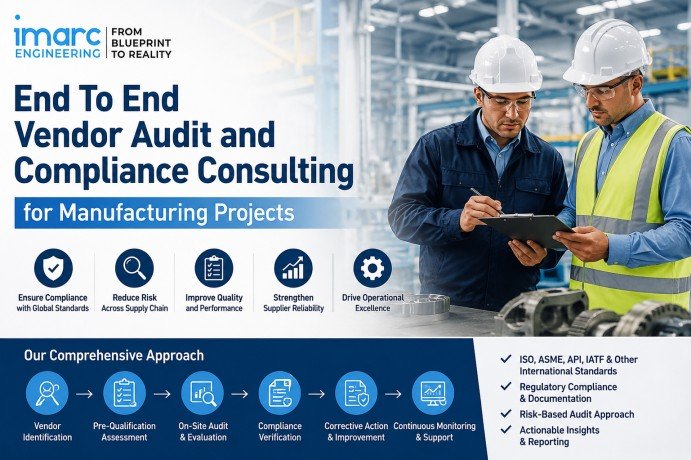
IMARC Engineering supports manufacturing companies and EPCM teams with end-to-end vendor audit and compliance consulting, structured around supplier criticality rather than a one-size-fits-all checklist. This includes:
- Supplier criticality classification and audit-tier planning
- On-site technical, quality, and EHS audits
- Documentation review and financial/business-continuity risk checks
- CAPA structuring, effectiveness verification, and requalification management
The goal is to make vendor evaluation a continuous project-assurance system, not a one-time compliance exercise before a purchase order is placed.
Conclusion
Vendor audits succeed when they answer a more demanding question than “does this supplier have the right certificates?” They should confirm whether a supplier can consistently meet the technical, quality, regulatory, and delivery requirements a specific project depends on, at every stage from development through operations. Matching audit depth to supplier criticality, tailoring priorities to the sector, and closing the loop on corrective actions turns vendor auditing from a paperwork exercise into a genuine safeguard against project delays, quality failures, and compliance exposure.
Contact Us:
IMARC Engineering
Phone: +91-120-433-0800
Email: sales@imarcengineering.com
India: C-130, Sector 2, Noida, Uttar Pradesh 201301
LinkedIn: https://www.linkedin.com/showcase/imarc-engineering/
About the Author