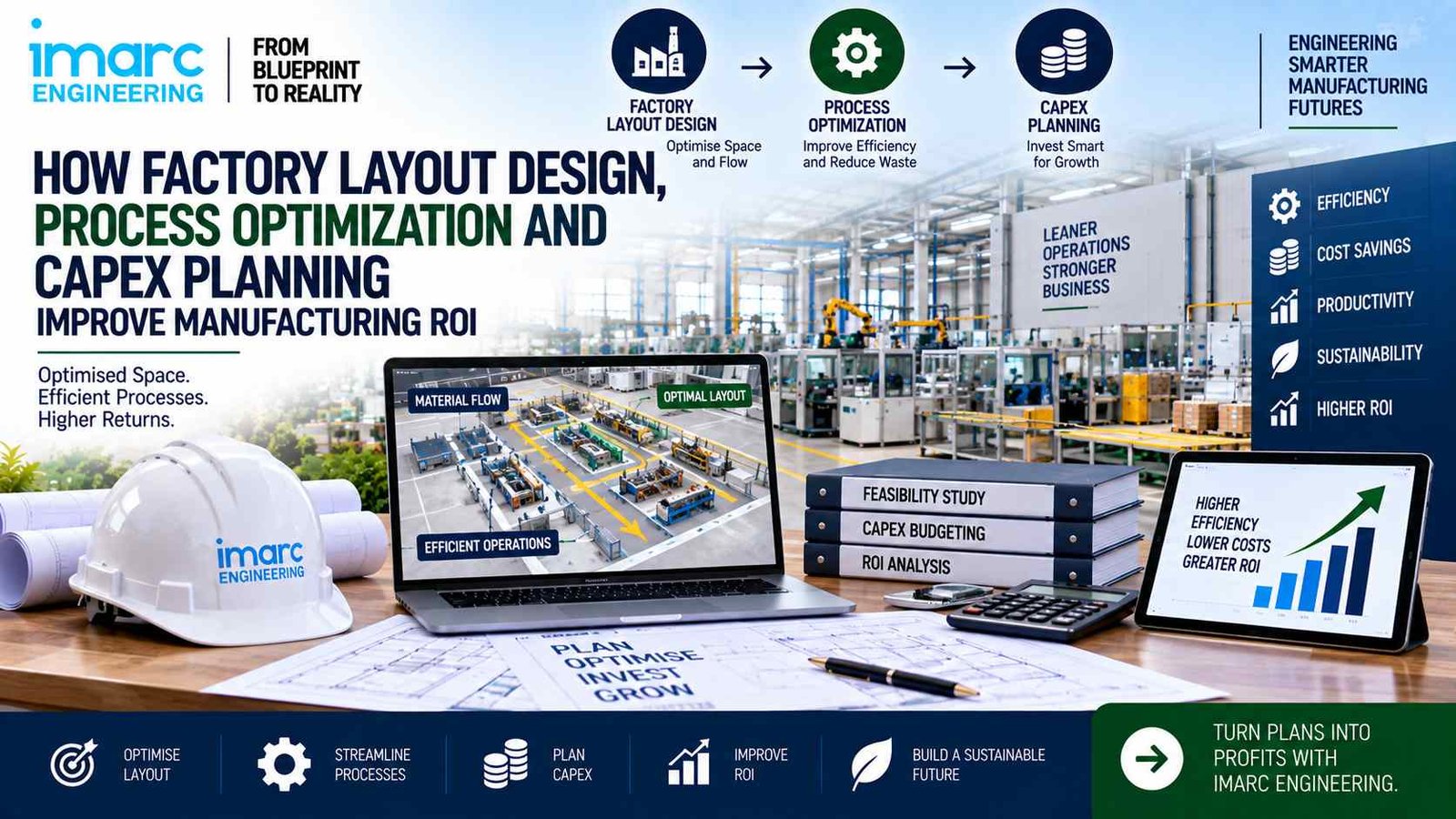
Many manufacturers assume that a well-planned factory floor is enough to guarantee smooth operations and healthy margins. In practice, layout is only one part of a larger equation. A plant can have generous aisle widths and clearly marked zones and still lose money to bottlenecks, rework, and equipment that was purchased before anyone studied whether it was actually needed.
Poor layout increases material handling time and manpower movement. Uncontrolled process variation adds rework, scrap and inconsistent output between shifts. Unplanned capital expenditure compounds both problems by locking in fixed costs that do not match real production requirements. Reviewing these areas together, starting with a structured Factory Layout Design assessment, can improve production performance and equipment utilisation before any additional capital is committed.
For plant heads, project managers and investors, the more useful question is not how much floor space is needed or which machine to buy next, but how layout, process performance and capital planning perform together. This article looks at how these three decisions influence manufacturing ROI, and outlines a practical way to evaluate them before committing capital.
Why Factory Layout, Process Optimization and CAPEX Must Be Planned Together
Layout, process performance and capital spending are often reviewed by different teams, on different timelines, using different assumptions. This separation is one of the most common reasons manufacturing investments underperform.
- Layout determines how far material, work-in-progress and people travel during production, which directly affects cycle time and labour cost.
- Process inefficiencies such as rework, waiting and unbalanced lines raise operating cost regardless of how good the layout looks on paper.
- Poor planning in either area often leads to unnecessary equipment or infrastructure investment that would not have been needed with better flow.
- Manufacturing ROI depends on both the initial capital cost and the ongoing operating performance of the plant, not on capital cost alone.
- A decision made in one area, such as adding a machine, can create new problems in another, such as congestion at the next process step.
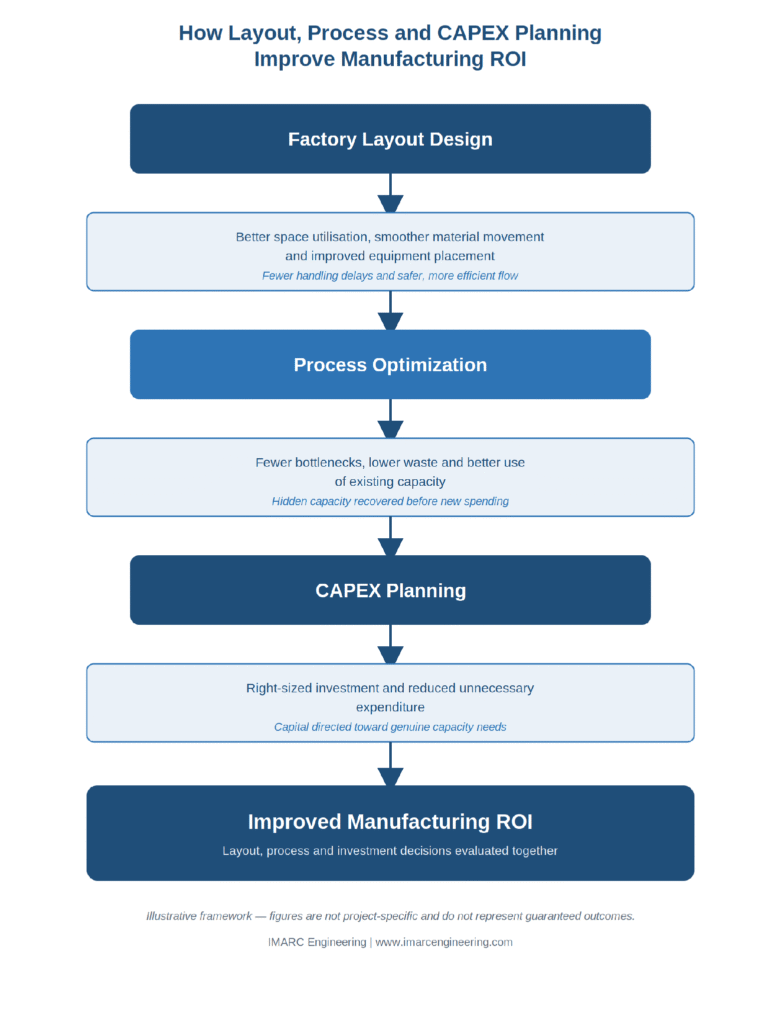
Treating these three decisions as connected, rather than sequential, gives manufacturers a more accurate picture of where the real returns are likely to come from.
How Factory Layout Design Influences Manufacturing ROI
Factory Layout Design shapes almost every cost driver on the shop floor, from how materials move to how safely people work around equipment. Its influence extends well beyond the appearance of the plant.
- Space utilisation across production, storage and staging areas, and whether it supports or restricts output
- Equipment placement relative to the sequence of operations, rather than convenience during installation
- Material and personnel movement patterns, including distance travelled and points of congestion
- Work-in-progress accumulation caused by uneven flow between successive process steps
- Safety clearances and maintenance access around machines, panels and utility lines
- Utility routing for power, compressed air, water and ventilation across the production area
- Overall production flow from raw material receipt through processing to dispatch
- Clear definition of raw material, production, finished goods and dispatch zones
- Flexibility to accommodate future expansion or a change in product mix without a complete redesign
The best layout is not necessarily the one that uses the least floor space. A layout that saves space but restricts material flow, safety access or future flexibility can raise operating costs well beyond any initial saving. Effective Factory Layout Design supports safe, efficient and scalable operations, not just compact ones.
How Process Optimization Improves Plant Performance
Even a well-designed layout cannot compensate for inefficient processes. Process Optimization for Manufacturing looks at how work is actually performed, rather than how it is assumed to be performed.
- Identifying where production bottlenecks consistently occur, rather than treating them as isolated incidents
- Reducing waiting time and unnecessary movement by operators and material handlers
- Improving line balancing so that no single process step limits overall output
- Reducing changeover time between products or batches
- Controlling rework, scrap and rejection rates through better process control
- Standardising work methods so output does not depend on individual operator experience
- Improving consistency between shifts, which is often a hidden source of variation
- Increasing utilisation of existing equipment before assuming more capacity is needed
- Recovering hidden capacity that already exists within current assets and manpower
Many manufacturers discover meaningful capacity within their existing plant once these inefficiencies are addressed through structured Process Optimization and Lean Consulting. This is one of the reasons process review should generally precede, not follow, a decision to invest in new equipment.
[Infographic: How Factory Layout Design, Process Optimization and CAPEX Planning Improve Manufacturing ROI]
The Role of CAPEX Planning in Improving Manufacturing ROI
CAPEX Planning for Manufacturing Plants determines whether capital is directed toward genuine production needs or toward assumptions that may not hold once the plant is running.
- Defining the actual capacity requirement based on realistic demand, not best-case projections
- Separating essential investment from optional upgrades that can be deferred
- Comparing the cost of new equipment against improving or better utilising existing assets
- Including installation, utilities, civil work and commissioning costs in the estimate, not just equipment price
- Accounting for training, validation and production ramp-up time before full output is reached
- Evaluating lifecycle cost, including maintenance and energy consumption, rather than purchase price alone
- Avoiding overinvestment based on production assumptions that do not reflect actual operating conditions
Capital planning that accounts for these factors tends to produce more reliable outcomes than estimates based on equipment cost alone. A detailed CAPEX/OPEX Planning Support review can help separate essential spending from optional upgrades before a budget is finalised.
A Practical Framework to Improve Manufacturing ROI
Manufacturers evaluating layout changes, process improvements or capital investment benefit from a structured, repeatable sequence rather than isolated decisions.
- Define production and business objectives for the change under consideration
- Study the existing factory layout and how it is currently being used
- Map material, manpower and information flow across the plant
- Identify process losses and capacity constraints within current operations
- Quantify the cost of these inefficiencies in terms of time, material and labour
- Develop alternative layout and process scenarios for comparison
- Estimate CAPEX for each scenario, including indirect and commissioning costs
- Compare expected operational benefits against the investment required for each option
- Select the most feasible option based on this comparison, not on equipment preference alone
- Implement the change, then monitor and validate the results against the original objectives
This sequence keeps layout, process and CAPEX decisions connected, so that each option is evaluated on the same basis before capital is committed.
Key Metrics to Evaluate Before Approving Plant Changes
Objective metrics give manufacturers a clearer basis for approving or rejecting a proposed layout, process or CAPEX change, rather than relying on judgement alone.
- Production throughput and cycle time
- Overall Equipment Effectiveness, where applicable to the process
- Changeover time between products or batches
- Scrap, rejection and rework rates
- Material handling distance and frequency
- Work-in-progress levels between process steps
- Floor-space utilisation across production and storage areas
- Labour productivity per shift or per unit produced
- Utility consumption relative to output
- Maintenance downtime and its impact on schedule adherence
- CAPEX per unit of added capacity
- Payback period based on realistic production assumptions
- Operating cost per unit before and after the proposed change
The most relevant metrics depend on the industry, the process involved and the maturity of the plant. A greenfield project and a mature brownfield facility will not prioritise the same indicators.
Common Mistakes That Reduce Manufacturing ROI
Several recurring mistakes appear across manufacturing plants of different sizes and industries, often reducing the return on investments that looked reasonable on paper.
- Expanding floor space without first studying process flow
- Buying new equipment before identifying where the actual bottleneck lies
- Designing layouts around machine dimensions rather than the full production sequence
- Ignoring utilities routing and maintenance access during layout planning
- Using ideal production capacity, rather than achievable capacity, in financial calculations
- Forgetting installation and commissioning costs when estimating CAPEX
- Overlooking future expansion requirements when finalising a layout
- Underestimating the cost of operator movement and material handling
- Treating CAPEX as the only relevant cost, while ignoring operating cost impact
- Failing to validate results against objectives after a change is implemented
Most of these mistakes are avoidable with a structured review before capital is approved, rather than corrections made after the investment is already in place.
When Manufacturers Should Seek External Plant Planning Support
Internal teams often manage day-to-day operations effectively, but certain situations benefit from an independent, structured review of layout, process and capital plans.
- Greenfield plant development, where decisions made early affect the entire operating life of the facility
- Brownfield expansion within an existing footprint that has space and flow constraints
- Major layout redesign driven by a change in product mix or production volume
- Introduction of a new product line into an existing plant
- Planned capacity expansion beyond current production levels
- Persistent production bottlenecks that internal teams have not been able to resolve
- High material handling costs relative to output
- Repeated CAPEX overruns on previous projects
- Lower than expected returns from recently installed equipment
- A need for an independent assessment before a major investment decision is finalised
These situations do not always require a complete redesign. In many cases, a focused review of specific problem areas is sufficient to identify where returns can be improved.
How IMARC Engineering Supports Better Plant Investment Decisions
IMARC Engineering works with manufacturers on Manufacturing Plant Design and investment decisions across several related areas, without treating any single service in isolation.
- Factory layout and spatial planning aligned with production flow and future expansion needs
- Process optimization to identify bottlenecks, reduce waste and improve line balancing
- CAPEX and OPEX planning support to separate essential investment from optional upgrades
- Manufacturing plant planning for greenfield and brownfield projects
- Production flow assessment across raw material, production, storage and dispatch areas
- Industrial engineering inputs on equipment placement, utilities and safety access
- Project feasibility and implementation support during execution and ramp-up
This combined approach reflects the way these decisions actually affect a plant in practice, where a layout choice, a process gap and a capital estimate are rarely independent of one another.
Planning a new manufacturing plant, layout redesign or capacity expansion?: https://www.imarcengineering.com/contact?service=plant-layout-and-process-flow-design
Manufacturing Sector Context
India’s manufacturing sector continues to receive policy support and investment through initiatives such as the Production Linked Incentive schemes. These developments make efficient plant planning, process control and disciplined capital allocation increasingly important for manufacturers.
Separately, the Production Linked Incentive schemes across 14 sectors attracted actual investment of over ₹2.40 lakh crore by 31 March 2026, according to the Press Information Bureau. This level of industrial investment increases the importance of disciplined layout planning, process control and capital allocation as manufacturers expand capacity.
Key Areas to Evaluate Before Investing in Manufacturing Plant Improvements
The table below summarises the questions that are worth answering before approving a layout change, process improvement or capital investment.
| Evaluation Area | Questions to Consider |
|---|---|
| Factory Layout | Does the current layout support smooth material and manpower flow, or does it create congestion and backtracking? |
| Process Efficiency | Where do bottlenecks, waiting time and rework actually occur, and how much output do they cost? |
| Existing Capacity | Is the existing equipment and shift pattern being used to its real potential before new capacity is considered? |
| Equipment Investment | Is new equipment the only option, or can process changes and better utilisation recover some of the required output? |
| Utilities | Can existing power, water, compressed air and HVAC systems support the proposed change without major rework? |
| Space Utilisation | Is available floor space being used efficiently, including provision for WIP, staging and future expansion? |
| Operating Cost | How will the change affect labour, material handling, utility consumption and maintenance cost per unit? |
| CAPEX Requirement | Does the estimate include installation, civil work, utilities, commissioning, training and ramp-up, not just equipment price? |
| ROI | Has the payback period been calculated using realistic production assumptions rather than ideal capacity? |
| Scalability | Will the proposed layout and equipment selection accommodate future volume or product changes without a full redesign? |
Conclusion
Manufacturing ROI rarely improves through a single decision made in isolation. Factory Layout Design, Process Optimization for Manufacturing and CAPEX Planning for Manufacturing Plants influence the same underlying costs, and evaluating them together gives a more accurate picture of where returns will actually come from.
Manufacturers planning a new facility, an expansion, a layout redesign, a process improvement initiative or a significant capital investment can benefit from reviewing these three areas jointly before finalising budgets. IMARC Engineering supports manufacturers with factory layout planning, process optimization and CAPEX/OPEX evaluation for greenfield and brownfield manufacturing projects. Contact IMARC Engineering to discuss a specific layout, process improvement or plant investment requirement.
Contact Us:
IMARC Engineering
Phone: +91-120-433-0800
Email: sales@imarcengineering.com
India: C-130, Sector 2, Noida, Uttar Pradesh 201301
LinkedIn: https://www.linkedin.com/showcase/imarc-engineering/
About the Author