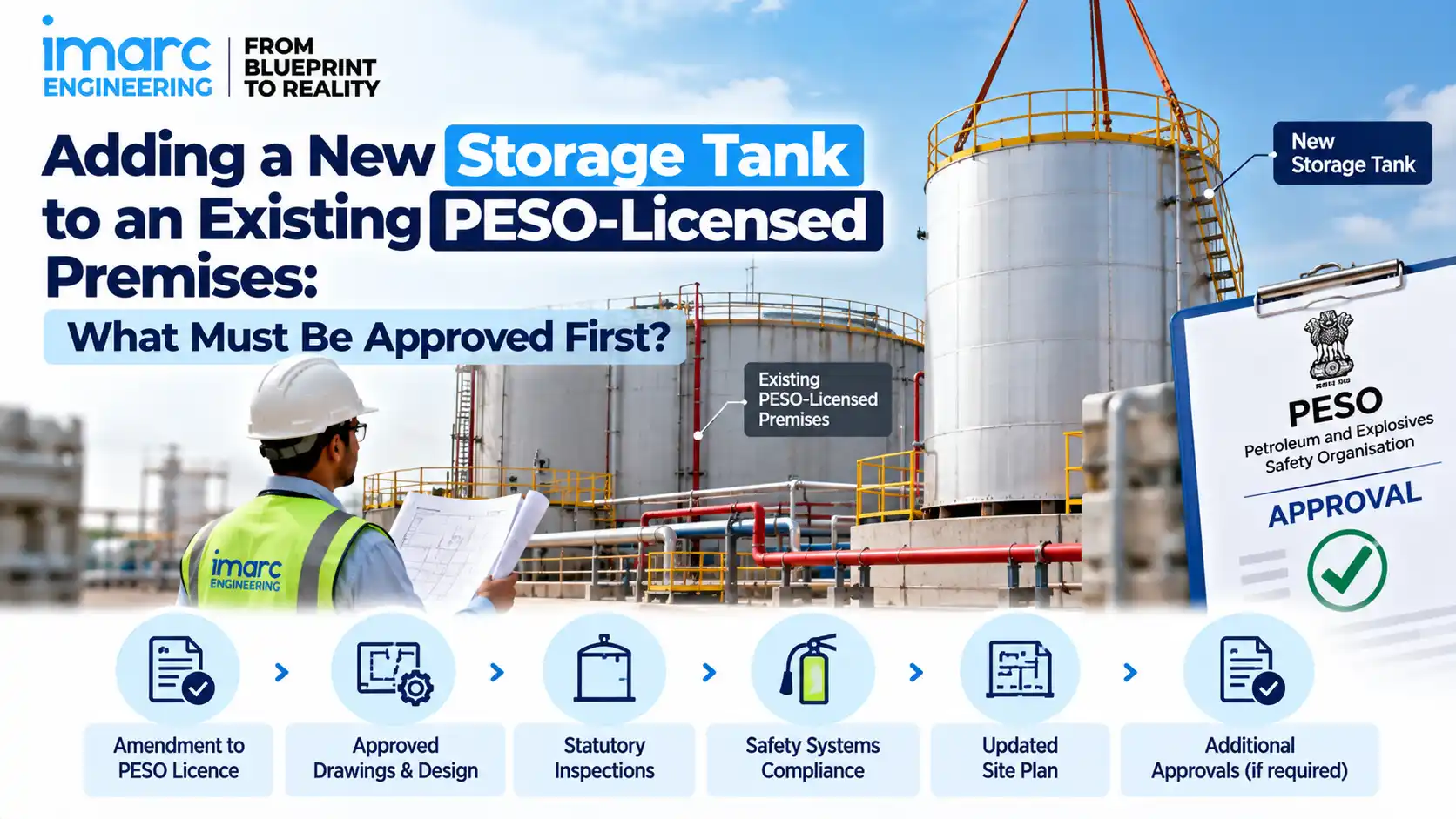
A manufacturer holds a PESO licence for a petroleum storage area and needs more capacity. The obvious solution is one more tank, but the best spot on site is not shown on the layout attached to the licence. The project team is unsure whether the existing licence already covers it.
That question needs an answer before civil work begins. Under Rule 146 of the Petroleum Rules, 2002, alterations to licensed premises need written approval of the drawings first, and Rule 147 deals with the licence amendment afterwards. Manufacturers planning PESO licence amendments for capacity expansion should confirm the approval sequence before starting work.
Why Adding a Tank Can Affect an Existing PESO Licence
A licence under the Petroleum Rules is tied to an approved plan of the premises. The plan signed by the licensing authority is attached to the licence and forms part of it (Petroleum Rules, 2002). A new tank changes what that plan shows: storage capacity, tank position, pipelines, access and safety layout.
Short answer: do not assume the existing licence covers the new tank. Check the approved plan and licence conditions first, then confirm the approval route with the licensing authority.
First establish scope. The Rules cover “petroleum”, meaning liquid hydrocarbons and certain flammable mixtures, classified by flash point: Class A below 23°C, Class B from 23°C to below 65°C, and Class C from 65°C to below 93°C (PESO: requirement of licence). Petroleum with a flash point not below 93°C is outside these provisions (PESO guidelines). Other storage, such as compressed gas or pressure vessels, is governed by different rules.
The exact requirements therefore depend on the stored substance, the licence form and conditions, and the proposed change.
Rule 146: What Must Be Approved Before Alteration?
Rule 146 is titled “Prior approval necessary for alterations in the licensed premises”. As published in the Petroleum Rules, 2002:
- Written approval first. No alteration is to be carried out until drawings showing it have been approved in writing by the licensing authority (sub-rule 1).
- What is submitted. Rule 146 requires three copies of a properly drawn plan showing the proposed alteration in distinct colours, along with the reasons for the alteration. The applicable filing requirements and fee should be verified against the current official rules and PESO instructions.
- Scrutiny. The licensing authority examines the plan before deciding (sub-rule 3).
- Amendment afterwards. Once the sanctioned alteration is carried out, the licence holder applies for amendment of the licence (sub-rule 4).
PESO’s own FAQs on the Petroleum Rules, 2002 confirm that Rule 146 applies to alterations in licensed premises, and say additions are shown in red and deletions in yellow when seeking approval. Licence conditions printed on the forms also address alterations to a tank or pump position and tank replacement (licence forms), so read the conditions on your own licence.
Adding a tank changes the approved plan, so treat it as an alteration question and confirm the approval route in writing with the licensing authority named for your licence.
What Should the Revised Tank Layout Show?
Statutory requirement: the plan must show the proposed alteration distinctly and give reasons. The technical content comes from the provisions of the Rules that apply to your petroleum class and installation, so check those chapters rather than relying on a generic template.
Engineering recommendation: assess and show the following clearly:
- Existing and proposed tank positions, marked on the last approved drawing.
- Capacity and product details, including petroleum class and tank dimensions.
- Separation distances and access, from boundaries, buildings, other tanks and vehicle routes, against the applicable provisions.
- Pipelines and transfer arrangements, including filling, dispensing and vents.
- Safety provisions the Rules require for your installation, such as fire protection and electrical arrangements.
- A difference statement: what changes between the approved drawing and the proposal, and why.
What Should Manufacturers Check Before Submitting Drawings?
☐ Current licence. Form, validity, product class, approved quantity and printed conditions.
☐ Approved drawings. The latest approved or amended plan, not an older copy.
☐ Proposed tank specifications. Capacity, product, dimensions, materials and fabrication details.
☐ Site conditions. Actual layout against the approved plan, including any earlier unrecorded changes.
☐ Safety provisions. Clearances, fire-fighting and electrical arrangements for the new layout.
☐ Application procedure. Licensing authority, forms, fees and filing channel as currently published by PESO.
☐ Supporting documents. Whatever the authority requires with the application, confirmed in advance.
Before You Add a Storage Tank to a PESO-Licensed Site
The sequence below shows the order in which the approvals usually fall. Your route may differ.
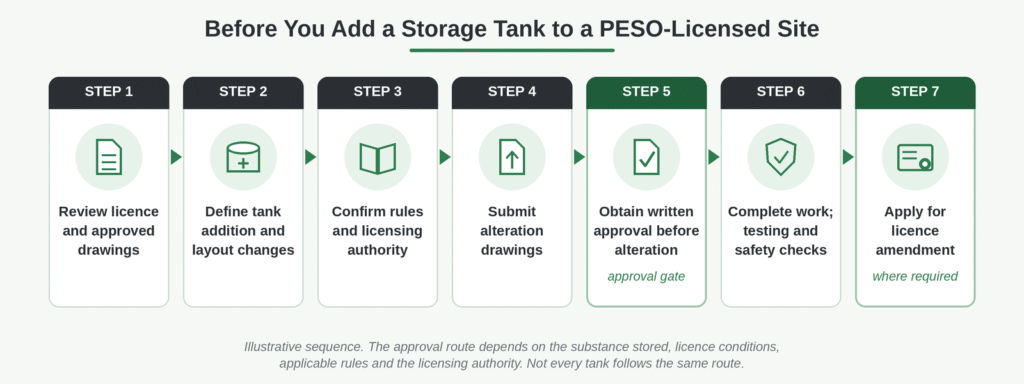
Infographic 1: Illustrative approval sequence for adding a tank.
Common Planning Mistakes That Can Delay a Tank Expansion
- Assuming the licence covers the new tank. The licence relates to the approved plan, so a new tank can leave the site and the licence record out of step.
- Starting construction first. Rule 146 puts written approval ahead of alteration, so work begun earlier may need to be revisited.
- Unclear drawings. If proposed changes are not distinguished from the existing layout, the authority may need clarification or resubmission.
- Ignoring site conditions. Distances, access and safety provisions that look workable on paper may not match the ground.
- Treating steps as interchangeable. Approval, testing, commissioning and licence amendment are separate steps, each with its own purpose.
The consequences depend on the authority’s assessment of each case. They can include rework, revised drawings and a licence that does not reflect the installed tank.
Storage Tank Expansion: Approval and Verification Checklist
Use the table as a verification guide. Actual requirements must be confirmed for your specific installation.
| Project stage | What the project team should verify |
|---|---|
| Before design | Existing licence, approved layout and proposed storage change |
| Drawing preparation | Tank location, capacity and applicable engineering details |
| Before alteration | Required written approval and submission requirements |
| Implementation | Conformity with the approved plan |
| Before licence amendment: verify applicable testing and certificates | Applicable testing, certificates and supporting documents |
| Project closeout | Updated licence and approved records, where required |
Table 1: Project stage and verification focus.
Rule 147: What Happens After the Approved Alteration?
Prior approval under Rule 146 permits the alteration. Rule 147, “Amendment of licence”, updates the licence afterwards. A licence may be amended by the authority empowered to grant it, and the Petroleum Rules, 2002 list what the amendment application includes for an alteration already carried out:
- Three copies of the plan showing the alteration sanctioned under Rule 146.
- The prescribed amendment fee.
- A certificate of testing of the tank or tanks, if required under Rule 126.
PESO’s FAQs note a drawing colour convention for each stage, with black used for the Rule 147 amendment drawing. Amendment is a formal application, not an automatic result of completing the work. Check the current rule text, forms and filing channel on peso.gov.in before applying.
How IMARC Engineering Can Help
Tank additions work best when engineering and regulatory planning are coordinated early. IMARC Engineering’s regulatory approval and licensing service lists PESO licensing for flammable storage, licence amendments for capacity expansion, and regulatory liaison and query resolution. Its PESO licence page covers existing licence holders seeking capacity expansion or amendments.
For a tank expansion, that can mean reviewing project assumptions, proposed layouts and documentation, and checking which approval requirements apply before drawings are filed. IMARC Engineering states it does not guarantee approvals or timelines, which rest with the authorities.
Planning a tank addition at a PESO-licensed site? Discuss your proposed layout and approval requirements with IMARC Engineering: https://www.imarcengineering.com/contact?service=regulatory-approval-and-licensing&subservice=peso-license
Explore Our Related Insight: How to Get a PESO License in India: Requirements, Documents, Application Process, and Compliance
FAQs
Can a new storage tank be added to an existing PESO-licensed premises without checking the approved layout?
No. The approved plan forms part of the licence, so check it first and confirm the approval route before any work.
Is prior approval required before altering licensed premises?
Under Rule 146 of the Petroleum Rules, 2002, no alteration is to be carried out until the drawings are approved in writing by the licensing authority.
What is the difference between alteration approval and licence amendment?
Alteration approval (Rule 146) comes before the work. Licence amendment (Rule 147) comes after the sanctioned alteration is carried out and updates the licence.
What should a manufacturer check before submitting revised drawings?
Check the licence and conditions, the last approved drawing, the tank specifications, site conditions, safety provisions and the current application procedure.
Do the same PESO requirements apply to every industrial storage tank?
No. They vary with the substance, its class, the governing rules, the licence form and the change proposed. Confirm applicability before relying on this route.
Conclusion
Treat a tank addition as a sequence, not a single step. Verify the existing licence and approved plan, identify the rules that apply to your substance, obtain written approval under Rule 146 before altering the premises, and complete the amendment and testing formalities before treating the project as complete.
Contact Us:
IMARC Engineering
Phon:e +91-120-433-0800
Email: sales@imarcengineering.com
India: C-130, Sector 2, Noida, Uttar Pradesh 201301
LinkedIn: https://www.linkedin.com/showcase/imarc-engineering/
About the Author