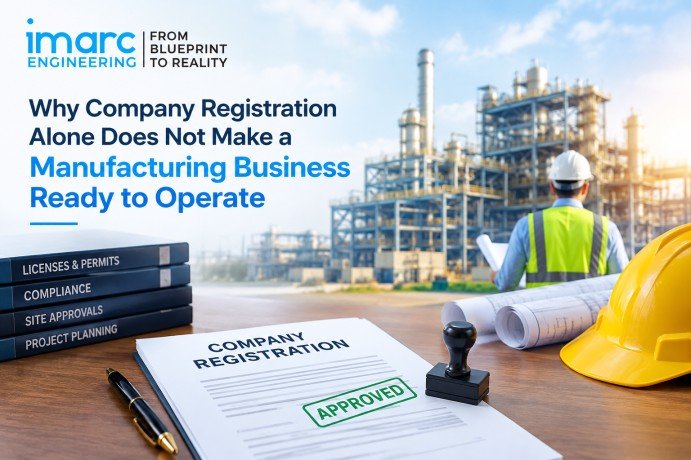
For entrepreneurs planning manufacturing business setup in India, company incorporation is only the first milestone. Many founders reach it with a sense of relief. The company is incorporated, the certificate is in hand, and a business bank account is open. It feels as though the hardest legal step is complete. In practice, the harder part has only just begun. This gap between legal formation and operational readiness is where costly delays, rework and stalled capital tend to originate. Understanding it early protects your investment.
Registering a company creates a legal entity. It does not authorise that entity to build a factory, install machinery, manufacture a regulated product, or begin commercial production. Those permissions depend on the site, the process, the product and the workforce, and they are issued by different authorities at different stages.
This article explains why company registration for manufacturing business and operational readiness are separate milestones, which areas deserve investigation after registration, and how to sequence them. By the end, you can judge what your project still needs before you commit capital to machinery.
What Company Incorporation Legally Establishes
Incorporation, typically through the Ministry of Corporate Affairs, gives your business a separate legal identity. The company can own property, enter contracts, open bank accounts, raise capital and employ people. The certificate of incorporation is the evidence of this status.
What it does not do is assess your proposed factory. The process does not examine whether your plot permits industrial use, whether your building is approved, whether your process generates emissions or effluent, or whether your product falls under mandatory certification. A company formed with a broad manufacturing objective can therefore exist for months while its proposed plant remains unapproved, unbuilt or unsuitable.
Think of incorporation as establishing who is allowed to do business. Manufacturing readiness answers a different question: whether this specific facility may carry out this specific activity.
Why Incorporation Does Not Authorise Every Factory Activity
Corporate status is general, while factory permissions are activity-specific. A company assembling electronic components and a company making industrial coatings may follow an identical incorporation process, yet their infrastructure, environmental controls and safety obligations differ considerably.
Four separate questions are often confused:
- Can the company exist and transact? Incorporation answers this.
- Can the site host the activity? Land-use, building and utility checks answer this.
- Can the factory operate? Environmental, factory, fire and labour requirements answer this.
- Can the product be sold? Product standards and sector rules answer this.
Treating a yes to the first as a yes to the rest is the root of most post-incorporation delays. The National Single Window System lists company incorporation alongside distinct approvals such as factory licensing and sector-specific permissions, which itself shows these are different procedures.
A valid certificate of incorporation does not, by itself, establish that the proposed site can be developed for manufacturing or that all requirements for electricity connection, factory operation and product sales have been satisfied. These must be checked against the applicable rules and project circumstances.
Approvals and Readiness Areas to Investigate After Registration
The following areas commonly need attention. Treat this as a framework for investigation, not a universal checklist; not every factory needs every item.
- Land and zoning: Confirm industrial use is permitted at the site, and check lease or ownership conditions and any land conversion requirements.
- Building and occupancy: Building-plan approval, construction permissions, and completion or occupancy requirements.
- Environmental compliance: Consent to Establish, Consent to Operate, environmental clearance and waste authorisations, where applicable to your activity.
- Factory and worker safety: Factory registration or licensing, machinery safeguards and safety provisions.
- Fire and utilities: Fire approvals, electrical installation requirements, water, drainage, power, and boilers or pressure systems where used.
- Product regulation: Requirements for food, pharmaceuticals, medical devices, chemicals, electronics or other regulated goods. BIS certification, for example, is compulsory only for products under mandatory schemes.
- Tax and trade: GST registration, invoicing, and import-export requirements where relevant.
- Workforce: Applicable employment registrations and contractor requirements, checked against current legislation and state rules.
The Invest India investor checklist, dated 2020, separates pre-establishment approvals from pre-operation approvals, a useful way to think about timing, though each item should be checked against current rules. The NSWS Know Your Approvals tool can generate an indicative list, though it advises independent verification.
Approval sequencing should be confirmed before each relevant project activity begins. Depending on the process and applicable rules, environmental consent may be required before establishing the facility and/or before starting operations. Building, occupancy, factory and sector-specific requirements also have their own triggers and prerequisites. Verify current requirements with the competent authority rather than assuming that all approvals can be obtained after construction.
Why Requirements Differ by Industry and Location
Two factories with identical investments can face very different approval journeys. Several factors drive the difference.
- State rules. Land, building, factory, fire and pollution-control administration involve state-level bodies, each with its own procedures and timelines.
- Process and product. Pollution-control classification depends on what you make and how. Industrial licensing applies only to specified activities, and mandatory certification applies only to notified products.
- Scale and workforce. Thresholds under labour and safety laws depend on employee numbers and the nature of the work.
Rules also change. The Ministry of Environment, Forest and Climate Change announced amendments to its uniform consent guidelines in January 2026, a reminder that older approval lists may be outdated. Verify current requirements with the relevant authority before relying on any checklist, including this one.
A food processing unit, a chemical plant and a metal fabrication workshop will each face a different mix of obligations, even within the same state.
Common Mistakes Manufacturers Make After Incorporation
Certain errors appear repeatedly in manufacturing projects.
Choosing a site before confirming suitability. A lease signed on rent and location alone can lock a founder into premises that do not permit the intended activity or lack utility capacity. Confirm land use, building condition and power availability before committing to an unconditional lease or purchase.
Buying machinery before the facility is ready. Delivery of equipment does not mean the plant can run it. Floor loading, foundations, electrical demand, ventilation, compressed air, drainage, exhaust and fire protection must be planned first. Late discovery can trigger civil modifications, utility upgrades and equipment relocation.
Treating permissions as later paperwork. Some consents are needed before construction or production begins, not after. Leaving them until the project is nearly complete risks idle assets and missed launch dates.
Ignoring product-level requirements. A finished product may still need certification, labelling compliance or sector approval before it can be marketed.
Confusing permission with preparedness. Approvals do not supply trained operators, maintenance plans, calibrated instruments or tested utilities. Much of this is good operating practice rather than statutory licensing, yet it decides whether production starts smoothly.
Behind most of these mistakes is poor early coordination between incorporation, site development, procurement and regulatory applications.
Consider a hypothetical company that incorporates, leases a building and orders machinery, then finds the electrical connection inadequate and the building needing changes. The result would be idle equipment, extra civil spending and delayed deliveries. This scenario is illustrative, not a measured average.
How to Build an Approval Roadmap for Manufacturing Business Setup in India
A repeatable approach is to treat incorporation as the start of a four-gate project plan.
Gate 1: Business and product definition. Specify the legal entity, products, processes, capacity, materials and target markets, domestic or export.
Gate 2: Site and engineering feasibility. Verify land-use suitability, building requirements, utilities, process layout, environmental implications and major infrastructure needs.
Gate 3: Approval and compliance planning. Prepare an approval register based on applicability. For each item, record:
- the requirement and why it applies,
- the responsible authority,
- prerequisites such as drawings, test reports or earlier approvals,
- the project milestone at which it is needed,
- the owner and current status,
- renewal or ongoing conditions.
An illustrative extract, not a universal legal checklist:
| Proposed activity | Applicable approval | Prerequisite | Responsible person | Milestone |
| Powder-coating line | Environmental consent, if applicable | Process description, site plan | Project manager | Before establishing the facility |
| Boiler installation | Boiler approval, if used | Equipment drawings | Plant engineer | Before commissioning |
Gate 4: Commissioning and production readiness. Confirm permissions are in place, installations are complete, personnel are trained, quality and safety systems are active, and pre-production trials have succeeded.
Before making major, difficult-to-reverse capital commitments, resolve the key site, process, infrastructure and approval dependencies. Where procurement must proceed in parallel, document the outstanding assumptions, technical interfaces and risks before placing orders. Do not begin commissioning until Gate 3 shows every applicable pre-operation item closed. The register also keeps compliance from becoming a one-time exercise, since renewals are tracked beside initial approvals.
Speak With An Expert: https://www.imarcengineering.com/contact?service=company-incorporation
Final Pre-Production Readiness Checklist
Before the first commercial batch, confirm each of the following:
- Applicable permissions and consents are obtained and their conditions understood.
- Power, water, compressed air and drainage are installed, tested and sized for the production line.
- Machinery is installed, commissioned and trial-run successfully.
- Fire protection, safety systems and emergency response arrangements are in place.
- Operators and supervisors are trained, with approved work instructions.
- Preventive maintenance plans and calibrated instruments are ready.
- Raw material suppliers are qualified and inbound material is available.
- Quality inspection procedures and documentation are established.
- Product certification or sector requirements are met for the intended market.
How IMARC Engineering Can Help
IMARC Engineering supports manufacturers by connecting regulatory planning with facility development. We help identify applicable licences and approval dependencies, coordinate site feasibility and engineering design, align equipment procurement with infrastructure requirements, track project milestones and documentation, and coordinate installation, commissioning and operational handover. This integrated approach helps founders work from one project plan instead of disconnected advisory streams, reducing avoidable rework before commercial production begins. If you are planning a plant, an early conversation can clarify what your project requires.
Conclusion
Company registration establishes the legal foundation of a manufacturing business in India, but a factory becomes ready to operate only when its site, infrastructure, applicable approvals, equipment, workforce and operating systems are prepared for the intended activity. By mapping these requirements early and coordinating them through one project plan, manufacturers can reduce avoidable rework, make better investment decisions and approach commercial production with greater confidence and fewer surprises. Treat incorporation as the beginning of the setup process, not its completion.
Contact Us:
IMARC Engineering
Phone: +91-120-433-0800
Email: sales@imarcengineering.com
India: C-130, Sector 2, Noida, Uttar Pradesh 201301
LinkedIn: https://www.linkedin.com/showcase/imarc-engineering/
About the Author