Identifying Material ESG Risks in Manufacturing
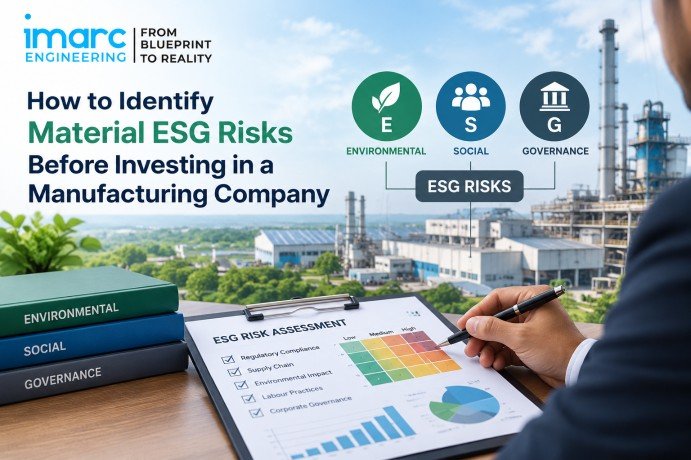
A manufacturer can show clean financials and an attractive sustainability report, yet carry a contamination liability, an expired consent or a safety weakness that surfaces only after closing. ESG due diligence for manufacturing companies exists to find these exposures early. This guide explains how investors, lenders and acquisition teams can separate routine compliance gaps from material ESG risks, which evidence to request, and how to turn findings into decisions on valuation, conditions and post-investment priorities. It draws on IFRS S1 and the IFC Environmental, Health, and Safety Guidelines, adapted for manufacturing sites.
Why Conventional Due Diligence Often Misses ESG Risks
Financial due diligence reviews what has been recorded; ESG risk often lives in what has not. Liabilities may be missing from provisions because nobody has tested the soil, cost a pollution-control upgrade or investigated a near-miss. Teams also work to tight timelines and rely on management presentations, which describe intended practice rather than daily reality on site.
Finally, findings sit across legal, technical and financial workstreams, so no single adviser sees the whole picture. Engineering-led ESG compliance services help close that gap by surfacing risks early and giving the deal team evidence it can price.
What Makes an ESG Risk Material to an Investor?
An ESG issue is material when its consequences are significant for the specific investment, not simply because it appears on a checklist. IFRS S1 frames this around risks that could reasonably affect a company’s cash flows, access to finance or cost of capital. For manufacturers, that might be an expired environmental consent threatening production, or groundwater contamination creating remediation liability.
Investors should weigh two things together: severity, meaning how serious the environmental, human or governance consequence could be, and investment impact, meaning the effect on cash flow, asset value, financing or growth. A missing permit may cost little to fix quickly, yet become expensive if it halts a critical production line. Looking at both prevents serious problems slipping past a deal team simply because nobody has attached a number to them.
The Three ESG Risk Categories to Examine
Environmental risks cover air emissions, wastewater, hazardous waste, energy and carbon exposure, water dependence, legacy contamination, chemical storage and physical climate risks such as flooding or extreme heat.
Social risks include workplace injuries, machine guarding, process safety, contract labour conditions, wages, working hours, supply-chain human-rights concerns and community complaints about pollution or noise.
Governance risks include unsupported sustainability claims, weak board oversight, corruption, poor internal controls, incomplete incident reporting and undisclosed related-party dealings. Governance determines whether management can be trusted to surface the other two.
A Ten-Step Framework for Identifying Material ESG Risks
- Define the scope. Confirm which entities, sites, utilities, contractors and key suppliers fall inside the transaction, and clarify the holding period.
- Screen for industry-specific exposure. Map processes against likely hazards; the IFC General Manufacturing guideline is a useful starting point.
- Verify legal compliance. Review permits, consents, inspection reports, notices and open corrective actions, and check that approvals cover current processes and installed capacity.
- Inspect the facility. Send qualified specialists to compare documented procedures with reality, looking for bypassed treatment systems, poor chemical segregation, disabled safeguards and maintenance backlogs.
- Examine incident history. Review several years of exceedances, accidents, complaints and audit findings, asking whether management found root causes and verified that problems did not recur.
- Validate ESG data. Reconcile reported energy, water, emissions and waste figures against utility bills, production volumes, waste manifests and monitoring reports.
- Assess suppliers. Investigate raw-material suppliers, waste handlers and outsourced labour whose failures could disrupt inputs, customer qualification or compliance.
- Quantify consequences. Estimate remediation, upgrade costs, downtime and liabilities, documenting assumptions where exact costs are unknown.
- Rank by materiality and urgency. Separate deal blockers from risks manageable after acquisition. A strong overall score should never offset an unresolved fatal hazard.
- Convert findings into conditions. Record evidence, exposure, owner and deadline for each finding, then decide whether to proceed, reprice, require remediation before closing or add contractual protections.
Documents to Request During Due Diligence
A management presentation is not evidence. Ask for original records, where applicable to the site, and compare them with observations:
- Environmental compliance: clearances, consents, inspection reports, monitoring results and regulatory notices.
- Pollution and waste: effluent treatment records, waste manifests, hazardous-waste authorisations and spill logs.
- Climate and energy: electricity and fuel bills, emissions inventories and energy audits.
- Water: abstraction permissions, consumption records, wastewater balances and contingency plans.
- Safety: accident registers, investigations, risk assessments, training records and maintenance logs.
- Labour: payroll, working-hour records, contractor documentation and grievance registers.
- Governance: board minutes, internal audit reports, whistleblowing records and related-party disclosures.
- Financial exposure: provisions, remediation estimates, insurance claims and litigation records.
Exact requirements depend on jurisdiction, industry and deal structure, so legal counsel should confirm which approvals and records apply to the specific operation.
How to Prioritise Material ESG Risks
An illustrative scoring aid can help organise findings. Rate each issue from 1 to 5 for severity, likelihood, financial exposure and control weakness, then multiply the four scores. Example bands: 256 and above critical, 81 to 255 high, 21 to 80 moderate, and below that lower.
This is a screening tool, not a validated ESG methodology or industry standard. The bands are author-defined, and multiplication assumes relationships that have not been established. Any potentially fatal hazard, serious regulatory breach or major unquantified contamination liability must be escalated regardless of score.
Worked Example: An Unresolved Wastewater Issue
An investor evaluating a plant finds recurring wastewater compliance problems, which management calls routine maintenance. The team compares monitoring results with production records, examines inspection findings and commissions an engineering assessment. Three consequences emerge: capital expenditure to restore reliable treatment, possible production interruptions if compliant operation cannot be maintained, and uncertainty over the cost and timing of corrective work. Scored 4, 3, 4 and 4, the issue gives 192, a high priority.
The case shows the chain from technical evidence to operational consequence, financial exposure and investment decision. The investor then obtains an independent cost estimate, confirms the legal position and models the financial effects, including downtime and recurring compliance spending. Depending on the findings, the response may be repricing, remediation before closing or a documented post-acquisition plan.
Red Flags That May Reveal Hidden Liabilities
Pay close attention when stated performance conflicts with operational evidence:
- Approvals that do not match actual capacity, equipment or processes
- Repeated incidents despite earlier corrective-action promises
- Metrics that cannot be reconciled with bills or monitoring records
- Deferred spending on pollution control, fire safety or worker protection
- Weak contractor oversight
- Green claims without baselines or evidence
- Complaints or enforcement omitted from initial disclosures
- Resistance to site access or independent verification
One red flag is not a reason to reject a deal; it signals that the underlying cause, potential consequences and feasibility of remediation need investigating before a decision is made.
How ESG Findings Should Influence the Investment Decision
Different risks demand different responses. Inherited exposures, such as historical contamination, may justify specialist testing and repricing. Ongoing problems, such as repeated exceedances, call for immediate controls and verification. Future risks, such as expansion in a water-stressed area, belong in the business plan. Minor, documented gaps can sit in a post-closing action plan, while serious unresolved liabilities may warrant renegotiation, closing conditions or withdrawal. Contractual protections allocate risk but do not remove regulatory obligations.
View Related Insight: https://www.imarcengineering.com/blog/sebi-brsr-esg-reporting-guide-india
ESG Due Diligence Considerations in India
Requirements vary by state, sector and project category, so verify each site against the applicable framework: clearances, pollution-control consents, effluent and waste compliance, hazardous chemical handling, groundwater permissions, factory safety and conditions attached to capacity expansions. SEBI’s BRSR framework applies to relevant listed entities, and its 28 March 2025 circular made value-chain disclosures voluntary for the top 250 listed entities from FY 2025-26. Confirm the target’s current listing status, obligations and reporting period; private companies may still face customer and lender expectations.
Common Mistakes to Avoid
Several errors repeat across deals, and all are avoidable. Treating ESG as a scoring exercise lets a strong average hide one severe hazard. Relying on certificates without checking that they match actual operations gives false comfort. Reviewing only the target company, and ignoring contractors and suppliers, leaves exposure outside the frame. Starting too late is equally costly: findings that arrive days before signing leave little room to quantify, negotiate or walk away..
How IMARC Engineering Can Help
Effective ESG due diligence needs environmental specialists, plant engineers, safety professionals and compliance experts working alongside financial and legal advisers. IMARC Engineering supports investors and manufacturers through ESG compliance consulting and advisory, helping identify operational gaps, review technical and regulatory risks, assess corrective actions and make informed investment decisions. Our engineering management experience means findings are grounded in how plants actually operate, not just how documents describe them. Contact IMARC Engineering today to discuss the scope your specific transaction requires.
Speak With An Expert: https://www.imarcengineering.com/contact?service=esg-compliance
Conclusion
Material ESG risks rarely appear in a company’s sustainability report. They emerge when investors compare management’s claims with permits, plant conditions, incident records and financial exposure. By defining scope, verifying compliance, inspecting the site, validating data and ranking risks by severity and cost, you can clearly see what could actually go wrong. The goal is not a perfect ESG profile but an informed decision, with every material finding translated into price, contractual conditions or action before any capital is committed.
Frequently Asked Questions
1. What is ESG due diligence in manufacturing?
It is the evidence-based review of environmental, social and governance exposures that could affect a manufacturer’s value, operations or liabilities, using documents, data and site inspection rather than management statements alone.
2. Which risks create the greatest financial exposure?
Contamination liabilities, permit failures that interrupt production, serious safety hazards and costly compliance upgrades. Exposure depends on the plant’s processes, location and control quality.
3. Can a company with valid permits still have material risks?
Yes. Permits may not match actual capacity or processes, conditions attached to them may be breached, and operating practice may differ from documentation. Valid paperwork is a starting point, not proof of control.
4. When should ESG due diligence begin?
At the earliest stage, findings can still influence price, structure and conditions. Findings that arrive days before signing leave little room to negotiate or walk away
Contact Us:
IMARC Engineering
Phone: +91-120-433-0800
Email: sales@imarcengineering.com
India: C-130, Sector 2, Noida, Uttar Pradesh 201301
LinkedIn: https://www.linkedin.com/showcase/imarc-engineering/
About the Author