Setting up an agave processing plant in India presents a compelling investment case for entrepreneurs and institutional investors targeting premium spirits, natural sweeteners, and plant-based ingredients. Demand is anchored by the alcoholic beverage industry, food and beverage, nutraceuticals, biofuel and bio-based materials, and cosmetics and personal care. Agave feeds tequila and mezcal, syrup, inulin, and fibre-based products, which makes it critical to several segments of the economy at once.
India offers clear advantages for this type of investment: rising urbanisation, expanding infrastructure, and the Make in India initiative all support domestic manufacturing. Maharashtra and Goa are already seeing agave-based spirits launched for consumers, which signals a receptive market. With growing interest in premium and natural products, India is a strategically sound base for agave production.
The investment case rests on policy support, cost-competitive production, and steady demand from spirits, sweeteners, and nutraceuticals. Gross margins of 40–50% and net margins of 20–30% point to healthy profitability, and break-even viability improves as capacity utilisation rises.
What is Agave?
Agave is a succulent plant native primarily to Mexico and parts of the southwestern United States, cultivated for its carbohydrate-rich core, known as the piña. It contains fructans, which can be hydrolysed into fermentable sugars or processed into natural sweeteners. Agave products are valued for their natural origin, low glycemic index in syrup form, and versatility across beverage, food, and bio-industrial applications.
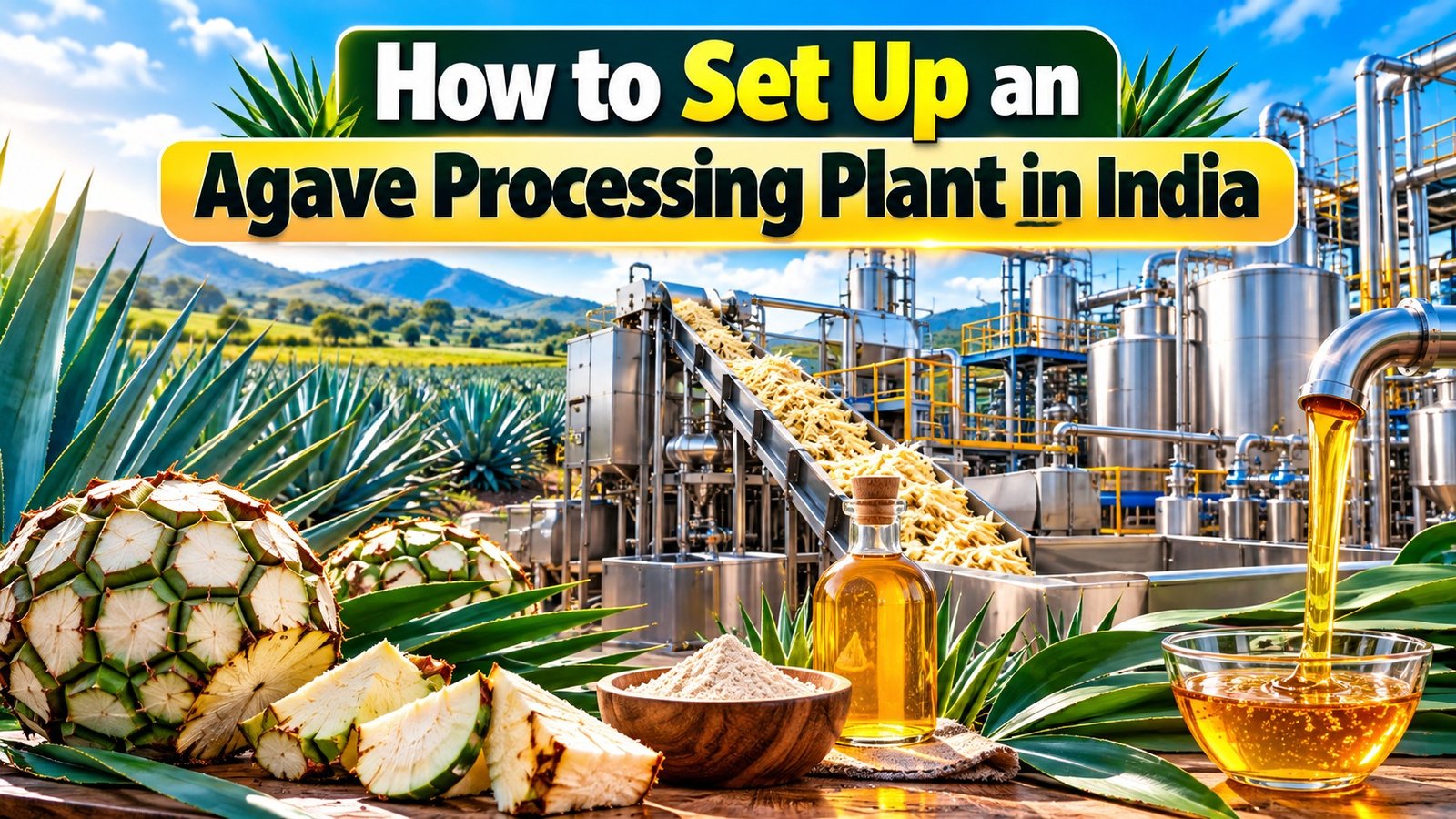
Blue agave (Agave tequilana) is primarily used for tequila, while other species are used for mezcal and syrup. Agave processing runs through cultivation and harvesting, leaf removal, cooking, crushing and juice extraction, fermentation, distillation, filtration and refining, packaging, and storage. The end-use industries served include the alcoholic beverage industry, food and beverage, nutraceuticals, biofuel and bio-based materials, and cosmetics and personal care.
Cost of Setting Up an Agave Processing Plant in India
The total cost of an agave processing plant depends on capacity, technology, location, automation, and regulatory compliance.
1. Capital Expenditure (CapEx)
Land and site development covers land registration, boundary development, and related charges, and investors can compare SEZ and industrial estate options for infrastructure access. Civil works include the processing shed, laboratory, storage areas, and administrative block. Machinery accounts for the largest share of CapEx, and the scale of production and level of automation determine its total cost. Key machinery required includes:
- Cooking ovens or autoclaves
- Crushing mills
- Fermentation tanks
- Distillation columns
- Filtration and refining systems
- Bottling and packaging lines
Other capital costs include effluent treatment, pre-operative expenses, commissioning, and import duties where equipment is sourced abroad.
Request a Sample Report for In-Depth Market Insights: https://www.imarcgroup.com/agave-processing-plant-project-report/requestsample
2. Operational Expenditure (OpEx)
Raw materials are the largest cost head at 65–75% of total operating expenses. The requirement covers agave piñas, water, enzymes/yeast, and barrels for spirits, and long-term supplier contracts help stabilise pricing and secure steady supply. Utilities such as electricity, water, and steam account for 15–20% of OpEx. Other operating costs include transportation, packaging, salaries and wages, repairs and maintenance, depreciation, and taxes. By the fifth year, total operating costs are expected to rise substantially because of inflation, market fluctuations, supply chain disruptions, and higher material costs.
3. Plant Capacity
The proposed agave processing plant is designed for an annual capacity of 10,000–50,000 MT, balancing economies of scale with operational flexibility. Capacity can be customised to investor requirements, and profitability improves with higher capacity utilisation.
4. Profit Margins and Financial Projections
Financial projections are built on realistic assumptions for capital investment, operating costs, capacity utilisation, pricing trends, and demand outlook. The project shows gross profit margins of 40–50% and net profit margins of 20–30%. Investors can assess viability through ROI, NPV, IRR, payback period, and the profit and loss account, which together show long-term sustainability.
Why Set Up an Agave Processing Plant in India?
Premium Spirits Demand. Tequila and mezcal consumption continues to drive agave processing investments. Tequila production reached around 495.8 million liters in 2024, requiring 1.8 million tons of agave, while exports reached 400.3 million liters.
Natural Sweeteners Growth. Rising health awareness supports agave syrup as an alternative to refined sugar. Growth in functional foods and nutraceuticals also supports inulin demand, alongside the shift toward plant-based and sustainable ingredients.
Policy and Regulatory Tailwinds. The Make in India initiative encourages domestic manufacturing. Market growth remains influenced by regulatory frameworks governing geographical indications, and IMARC’s report reviews the regulatory landscape, financial assistance, and certifications to help investors plan approvals.
Cost-Competitive Manufacturing. Land, construction, utility, and labour costs shape the economics, so site selection near agave piñas, water, and target markets keeps distribution costs low. A multi-product value chain of syrup, spirits, fibre, and byproducts also diversifies revenue streams.
Active Industry Investment. In December 2025, Maya Pistola Agavepura launched Cabrón Destilado de Agave in Maharashtra and Goa, in a 750 ml bottle at 40% ABV, priced at ₹1,610 in Goa and ₹2,200 in Maharashtra. In August 2025, GOONDA introduced El Goonda agave-based spirits alongside Goonda Energy drinks, in partnership with Karan Tacker.
Local Supply Chain Preference. Sourcing agave piñas from nearby suppliers reduces transportation costs and supply chain risk. Proximity to target markets further lowers distribution costs for beverage and food buyers.
Manufacturing Process – Step by Step
The agave manufacturing process uses a multi-step sequence of unit operations as the primary production method:
- Cultivation and Harvesting: Agave piñas are grown and harvested as the core raw material.
- Leaf Removal: Leaves are removed to isolate the carbohydrate-rich core.
- Cooking: Piñas are cooked in ovens or autoclaves to convert fructans into fermentable sugars.
- Crushing and Juice Extraction: Crushing mills extract the juice.
- Fermentation: Fermentation tanks convert the sugars using enzymes or yeast.
- Distillation: Distillation columns produce tequila and mezcal.
- Filtration and Refining: Filtration and refining systems produce agave syrup.
- Packaging and Storage: Bottling and packaging lines prepare products for dispatch to end-use industries.
Key Applications
Agave products serve five major industries:
- Alcoholic Beverage Industry: Primary raw material for tequila and mezcal, requiring controlled fermentation and distillation.
- Food and Beverage: Agave syrup is a natural sweetener in beverages, baked goods, and health-oriented foods.
- Nutraceuticals: Agave-derived inulin is used in functional foods and dietary supplements.
- Biofuel and Bio-based Materials: Agave biomass is explored for bioethanol and sustainable materials.
- Cosmetics and Personal Care: Agave extracts are used in skincare and haircare for moisturising and conditioning.
Leading Manufacturers
The global agave industry includes several multinational players with extensive capacities and diverse portfolios:
- Wholesome Sweeteners Inc.
- Now Foods
- Ciranda Inc.
- Global Goods Inc. (Agave In The Raw)
- Malt Products Corporation
- Sisana Sweeteners
- The Groovy Food Company
- Domino Foods, Inc.
- Tierra Group
Timeline to Start the Plant
- Feasibility study and project report preparation
- Land acquisition and site development
- Regulatory approvals and environmental clearances
- Factory licence and fire safety compliance
- Machinery procurement and installation
- Raw material supplier agreements and supply chain setup
- Trial production and quality testing
- Commercial production launch
Licences and Regulatory Requirements
Starting an agave processing plant in India requires several approvals:
- Business registration (Proprietorship, LLP, or Pvt Ltd)
- Factory Licence under the Factories Act
- Environmental Clearance from State Pollution Control Board
- GST Registration
- Fire Safety NOC
- Effluent Treatment Plant (ETP) operational clearance
- Occupational Health and Safety compliance
Key Challenges to Consider
- High Capital Requirements: Machinery, land, and site development demand substantial upfront funding.
- Raw Material Price Volatility: Agave piñas, enzymes/yeast, and barrels drive costs, and agricultural cycles and climate conditions influence supply.
- Regulatory Compliance: Zoning, environmental, emission, and geographical-indication rules must be met.
- Competition: Established players such as Wholesome Sweeteners Inc., Now Foods, and Domino Foods, Inc. compete across the value chain.
- Skilled Manpower: Quality control, monitoring systems, and traceability documentation need trained staff.
Frequently Asked Questions
1. How much does it cost to set up an agave processing plant in India?
Cost depends on capacity, technology, and location. Machinery forms the largest share of CapEx, and the detailed breakdown is in the report.
2. Is agave processing profitable in India in 2026?
The project shows gross margins of 40–50% and net margins of 20–30% under normal operating conditions.
3. What machinery is required for an agave plant in India?
Cooking ovens or autoclaves, crushing mills, fermentation tanks, distillation columns, filtration and refining systems, and bottling and packaging lines.
4. What licences and approvals are required to start an agave plant in India?
Business registration, Factory Licence, environmental clearance, GST registration, Fire Safety NOC, ETP clearance, and occupational safety compliance.
5. What raw materials are needed for agave manufacturing? Agave piñas, water, enzymes/yeast, and barrels for spirits.
6. What are the environmental compliance requirements for an agave plant in India?
Effluent treatment systems, adherence to emission standards, and compliance with local zoning and environmental regulations.
7. What is the best location to set up an agave plant in India?
A site with easy access to agave piñas, water, and target markets, backed by reliable transport, utilities, and waste management.
8. What is the break-even period for this type of plant in India?
It depends on capacity utilisation and costs, and the report’s payback analysis covers the timeline in detail.
9. What government incentives are available for manufacturers in India?
Incentives vary by state and project, and the report covers financial assistance and regulatory requirements.
Key Takeaways for Investors
An agave processing plant investment draws on demand from spirits, natural sweeteners, nutraceuticals, biofuel, and cosmetics. Financial viability holds across capacities of 10,000–50,000 MT per year, with 40–50% gross margins and 20–30% net margins. Tequila production of around 495.8 million liters in 2024 and North America’s 35% share of the global agave market show the scale of the opportunity. With premiumisation and plant-based ingredient trends continuing, demand for agave products looks set to remain durable.
About the Author