In May 2026, the All India Transporters Welfare Association (AITWA), which represents about 65% of organised logistics providers, warned that freight rates would rise 2.5-3% immediately after a diesel price hike. On a ₹100 crore annual freight bill, that adds ₹2.5-3 crore.
Warehousing is moving the other way. Developers completed nearly 25 million sq ft of Grade A space in H1 2026 against about 22 million sq ft of leasing, according to Colliers. Manufacturers that redesign their networks now can use that supply to negotiate better terms.
Capturing both opportunities needs a network view, not a single-line cost cut. A logistics optimization consultant in India can benchmark your cost stack, redesign the footprint, and sequence changes so savings hold. Structured programmes typically cut logistics spend by 10-25% over 12-24 months.
What Does It Mean to Optimize a Logistics Network?
Optimizing a logistics network means redesigning the warehouses, transport lanes, modes, and carrier arrangements that move product from plant to customer, so total cost is lowest for the required service level. It treats freight, warehousing, and inventory as one system instead of three separate budgets.
The cost base has three main blocks:
- Freight: at least half of total logistics cost for most Indian manufacturers
- Warehousing: typically 15-25% of total logistics cost
- Inventory carrying cost: typically 15-25% of inventory value per year
What Are the Six Stages of Logistics Network Optimization?
Treat the stages as gates. Completing each before starting the next produces stronger results than running everything in parallel.
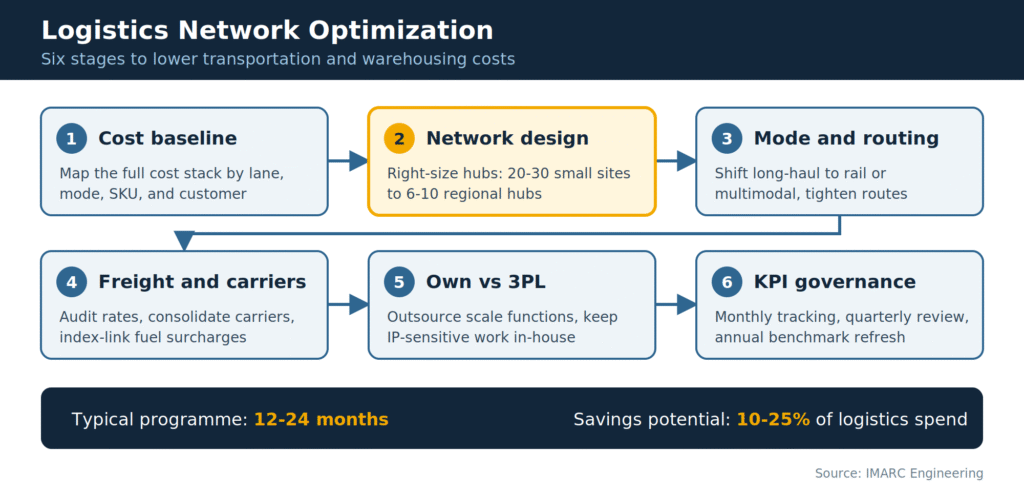
Sequence matters. Re-tendering carrier rates on a poorly designed network can leave 60-70% of the available savings untouched, which is why network design comes before carrier negotiation.
How Can Manufacturers Reduce Transportation Costs?
- Shift long-haul flows to rail: above roughly 800-1,000 km, rail or rail-road multimodal often beats all-road on cost and reliability, and Trucks-on-Trains on the Western DFC has handled 545 rakes and over 3 lakh tonnes
- Optimise routes: load consolidation, backhaul use, and hub-and-spoke secondary distribution typically save 5-12% of freight without changing carriers, and routing software for fleets of 50+ vehicles typically pays back in 6-9 months
- Cut fuel use: fuel is 35-55% of road freight cost, and telematics-led driver behaviour management saves 5-10% of fuel within 6-12 months
- Index-link fuel surcharges: AITWA’s Fuel Adjustment Factor applies from 20 May 2026, so agree a transparent, capped formula tied to diesel prices instead of accepting ad hoc increases
- Consolidate carriers: fewer carriers concentrate volume and strengthen negotiating leverage
How Can Manufacturers Reduce Warehousing Costs?
The largest opportunity sits in network structure, not inside any single warehouse. Most networks were built before GST and have not been redesigned since.
- Consolidate the footprint: replacing 20-30 small state warehouses with 6-10 mechanised regional hubs typically lowers total warehousing cost by 15-30%
- Optimise slotting: placing fast movers near dispatch cuts picker travel by 20-40%
- Add WMS and mechanisation: racking, conveyors, and system-directed picking raise throughput per sq ft and improve stock accuracy
- Cross-dock high-velocity SKUs: predictable products bypass storage entirely
- Cut energy cost: LED lighting, rooftop solar, and natural ventilation reduce energy cost by 15-25% with a 2-3 year payback
- Use shared warehousing: it converts CapEx to OpEx for seasonal or non-core categories
How Much Can Each Lever Save?
The table below summarises typical savings by cost line.
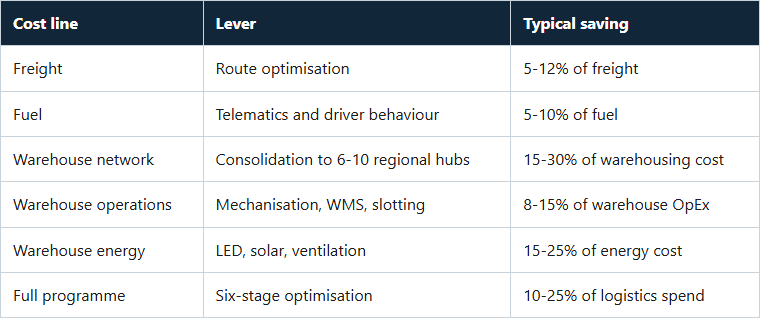
By segment, SME manufacturers typically save 8-15% over 6-12 months, while FMCG manufacturers typically save 10-20% over 12-18 months.
What Does the 2026 Warehousing Market Mean for Network Decisions?
- Supply is ahead of demand: Colliers reports about 25 million sq ft of Grade A completions (up 27%) against about 22 million sq ft of leasing (up 12%) in H1 2026
- Demand is concentrated: Delhi NCR and Chennai accounted for over 45% of leasing, and Bhiwandi, Farukh Nagar, and NH 48 together took over one-third
- Manufacturers lead occupancy: Knight Frank data shows manufacturing at 46% of leasing (17 million sq ft) and 3PLs at 30% in H1 2026
- Rents are firming: Pune is the costliest market at ₹28.7 per sq ft per month, Mumbai and NCR rose 5%, and Bengaluru and Ahmedabad rose 6%
The implication is practical. Negotiate longer terms in rising markets, and look beyond saturated clusters, since Ahmedabad and Kolkata leasing grew 30% and above.
What Mistakes Should Manufacturers Avoid?
- Re-tendering carriers before redesigning the network
- Selecting a 3PL on the lowest bid instead of a structured scorecard
- Buying WMS or routing software before fixing master data and SOPs
- Leaving inventory carrying cost out of the scope
- Compressing transitions, when major changes need 3-6 months of parallel running
- Treating optimisation as a one-off project, since savings erode within 18-24 months without governance
How IMARC Engineering’s Expertise Can Help in Logistics Optimization
IMARC Engineering supports manufacturers from diagnostics to governance:
- Cost diagnostics and baselining by lane, mode, SKU, and customer
- Network design and warehouse footprint planning
- Mode-shift and routing analysis
- Freight rate benchmarking and audit
- 3PL evaluation and contracting
- KPI dashboards and governance setup
Consult With Our Team: https://www.imarcengineering.com/contact?service=logistics-optimization
Conclusion
Lower logistics cost comes from redesigning the network, not squeezing individual rates. Manufacturers that baseline costs, consolidate warehouses, shift long-haul freight to rail, and index-link fuel charges can cut spend by 10-25% while protecting service levels. With diesel-linked freight pressure rising and Grade A warehouse supply outpacing leasing in 2026, the window to renegotiate footprint and terms is open. Those who act deliberately will turn logistics from an overhead into a durable margin advantage.
Frequently Asked Questions
1. How much can logistics network optimization save?
Structured programmes typically cut logistics spend by 10-25% over 12-24 months.
2. What share of logistics cost is warehousing?
Warehousing is typically 15-25% of total logistics cost, while freight is at least half.
3. When does rail beat the road for manufacturers?
On long-haul flows above roughly 800-1,000 km, rail or rail-road multimodal often beats all-road on cost and reliability.
4. Should manufacturers consolidate warehouses after GST?
Usually yes. Most mid-to-large manufacturers move to 6-10 regional hubs, but the right number depends on service levels and lane data.
Contact Us:
IMARC Engineering
Phone: +91-120-433-0800
Email: sales@imarcengineering.com
India: C-130, Sector 2, Noida, Uttar Pradesh 201301
LinkedIn: https://www.linkedin.com/showcase/imarc-engineering/
About the Author