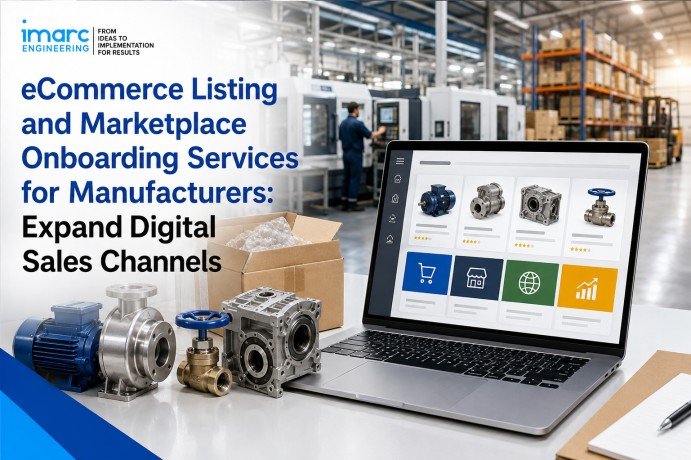
eCommerce Growth for Manufacturers
Most manufacturers do not struggle to make good products. They struggle to describe them in a form that an online marketplace, and a busy buyer, can understand. This guide explains what eCommerce listing and marketplace onboarding services for manufacturers involve, where companies commonly go wrong, and how to build digital sales channels that support, rather than compete with, your distributors.
Manufacturers often have detailed product knowledge, but converting technical specifications into clear, marketplace-ready information can be challenging. eCommerce listing and marketplace onboarding services help organize product data, create accurate listings, meet platform requirements, and improve product discoverability. A structured approach allows manufacturers to expand digital sales channels while maintaining consistency, compliance, and healthy relationships with existing distributors.
What Marketplace Onboarding Means for Manufacturers
Onboarding is often mistaken for opening a seller account, which is the shortest step. The real work is preparing your product portfolio so it can be listed accurately, approved without delays and found by the right buyers: channel selection, documentation, catalogue digitization, listing creation, inventory alignment and ongoing maintenance.
Why Manufacturers Are Expanding Into Digital Sales Channels
The traditional route runs from manufacturer to distributor, dealer and customer. It still works, but it limits visibility. You rarely know who is searching for your product, and buyers outside your dealer footprint may never find you.
Online channels add parallel routes to market: marketplaces, B2B platforms, your own website and ONDC-connected applications. The aim is additional discovery, not replacing dealers. No channel guarantees sales; a well-prepared catalogue gives you access and discoverability, and results depend on pricing, product fit and upkeep.
Where Manufacturers Commonly Get Stuck
1. Scattered Product Information
Data is usually spread widely across PDFs, spreadsheets, catalogues and manuals, with no single verified version. Teams often discover conflicting model numbers or outdated specifications only after listing.
2. Large SKU Counts
Manual listing of hundreds of SKUs causes duplicated effort, mismatched variants, incorrect specifications and missing attributes, and errors multiply with every platform.
3. Engineer-Written Specifications
A specification written for an engineer is not automatically clear to a buyer comparing five similar products.
4. Marketplace-Specific Requirements
Categories, attribute structures, image standards and approvals differ on every platform.
5. Listed but Not Found
Generic titles, wrong categories, incomplete attributes and missing identifiers leave live products invisible to the buyers searching for them.
eCommerce Listing and Marketplace Onboarding Services
1. Marketplace and Channel Assessment
Comparing channels against product type, order value, shipping needs, buyer segment and category restrictions, so effort goes where it is most likely to pay off.
2. Seller Account and Documentation Support
Coordinating registration, business and brand documents and category approvals, and flagging likely rejections before submission.
3. Product Catalogue Digitization
Consolidating brochures, spreadsheets and ERP exports into one structured master catalogue with a consistent SKU hierarchy and product taxonomy.
4. Product Listing Creation and Optimization
Writing marketplace-optimized titles, descriptions and bullet points that serve buyers first, following a clear pattern of brand, product type, key specification and model.
5. Attribute and Variant Mapping
Mapping dimensions, materials, ratings and certifications to each platform’s required fields.
6. Product Feed and Inventory Preparation
Aligning price, availability and SKU mapping across channels, so listings stay accurate as stock and pricing change.
7. Listing Error Resolution and Ongoing Optimization
Correcting errors and disapprovals before they affect visibility.
At the catalogue-audit stage, we compare the ERP SKU list against datasheets, images, model numbers and marketplace-required attributes, flagging missing fields before submission.
How to Choose the Right Digital Sales Channel
- Consumer marketplaces: suit standardized, ready-to-ship products
- B2B marketplaces: suit industrial goods, bulk orders and quotation-led buying
- Google Merchant Center: a product-data platform that can distribute structured product information across eligible Google surfaces
- ONDC: an open digital commerce network reached through participating seller and buyer applications, subject to onboarding and category requirements
- Own website: gives control over product information, brand and enquiries, but requires traffic acquisition and maintenance
Marketplaces bring existing buyer traffic and faster entry, but involve fees, platform rules, competition and limited customer data. Your own website offers greater control and a direct customer relationship. Choose channels that match your products, buyers and operational capacity, rather than uploading the same catalogue everywhere.
B2B vs B2C Product Listing Requirements
Consumer products emphasize price, images, features, reviews, delivery and variants. Buyers decide quickly and rely on visual and social proof.
Industrial products usually need technical specifications, capacity, tolerances, material, compatibility, certifications, MOQ, lead time, datasheets and a quotation process. Buyers compare suppliers carefully, and often request a quote before ordering.
Building a Manufacturer’s Master Product Catalogue
A master catalogue typically holds:
- SKU, brand, product name, model number and category
- Technical specifications, dimensions, materials and ratings
- Applications and compatibility
- Images and documents
- Warranty, certifications and MOQ
- Pricing, inventory and shipping details
Gathering these fields once, in one place, prevents the same product being described differently on each platform.
SKU, Model Number, GTIN and MPN
These are not interchangeable. A SKU is an internal inventory identifier, a model number is your product designation, a GTIN is a standardized trade identifier where applicable, and an MPN is a manufacturer-assigned part number. Keep them consistent across every channel.
A Practical Seven-Stage Marketplace Onboarding Process
- Catalogue audit: review SKUs, specifications, images and compliance information
- Suitability assessment: map products to channels, categories and buyers
- Catalogue structuring: define taxonomy, attributes, variants and identifiers
- Listing creation: develop titles, descriptions and image requirements
- Marketplace onboarding: complete registration, approvals and submission
- Feed and inventory integration: synchronize price, stock and SKUs
- Monitoring: track errors, visibility and customer queries
Starting with the audit matters, because fixing data before listing is far cheaper than correcting live listings across several platforms.
Speak With An Expert: https://www.imarcengineering.com/contact?service=ecommerce-listing-and-marketplace-onboarding
How to Create Product Listings Buyers Can Trust
Write listings like reliable data sheets, not advertisements. State specifications with units, name applications plainly, include compatibility and installation notes, and avoid unsupported claims. Buyer-friendly titles sit on top of structured technical attributes, and both should match across channels.
Before: Industrial Pump 5HP Model ABC
After: ABC Industrial Centrifugal Pump, 5 HP, 3-Phase, Cast Iron, Model XYZ
| Attribute | Example |
| Product Type | Centrifugal Pump |
| Power | 5 HP |
| Phase | 3-Phase |
| Material | Cast Iron |
| Application | Industrial Water Transfer |
| MOQ | 1 Unit |
Expanding Online Without Disrupting Distributors
Distributor conflict is a common and reasonable objection. Online channels work best when roles are defined in advance. Manage it through:
- Territory and pricing policies
- Channel-specific SKUs or assortments
- Different MOQs
- Lead routing and enquiry allocation
- Clearly defined channel roles
Marketplaces can then handle enquiries and new regions while distributors keep their established territories.
What to Prepare Before Onboarding
Typical project inputs include:
- ERP product export and existing catalogue
- Technical datasheets and product images
- Pricing matrix and inventory information
- GST, PAN, bank and brand documents
- Compliance certificates
How to Measure Digital Sales Channel Performance
- Catalogue completeness and listing approval rate
- Search visibility for specification-based queries
- Qualified enquiry rate and cost per enquiry
- Enquiry-to-order conversion and average order value
- Regional demand, repeat orders and cancellations
Review these monthly at first. Repeated rejections in one category, or strong interest from one region, show where to refine listings or expand next.
Starting With a Controlled Catalogue Pilot
A manufacturer can start with a manageable pilot, such as 50–100 well-documented SKUs on one channel, learn how enquiries and returns behave, then extend gradually. This limits risk, exposes data gaps early and lets your team build repeatable processes before volumes grow. Larger catalogues can also be phased gradually by product line, category or region.
Marketplace Compliance for Manufacturing Products
Not every product suits every marketplace. Expect possible:
- Category approvals and extra documentation
- Labelling and safety requirements
- Brand authorization papers
- Barcode or GTIN requirements, with exemptions or alternative identification processes on some platforms for certain products
Chemicals, food and regulated equipment need particular care. Checking eligibility early prevents wasted effort and account issues later.
View Related Insight: https://www.imarcengineering.com/blog/how-manufacturers-can-sell-on-amazon-flipkart-and-meesho-in-india
Industries We Support
We support industrial machinery, automation components, automotive parts, electrical and electronics, packaging, building materials, tools and hardware, renewable-energy equipment and consumer goods. Regulated categories are included only where marketplace restrictions can be accurately explained and met.
How IMARC Engineering Can Help Manufacturers
Unlike a general listing provider, IMARC Engineering begins with your product architecture, technical specifications, SKU structure and applicable compliance requirements. We then convert that information into structured, marketplace-ready content, assess suitable channels for your buyers, and support onboarding, listing creation and ongoing optimization. This engineering-led approach, rooted in product knowledge, keeps products described accurately rather than generically, and builds a well-documented, marketplace-ready catalogue your team can maintain confidently as your online presence grows over time, across every channel you choose.
Conclusion
Expanding into digital sales channels is far less about uploading products and more about preparing them properly for buyers. Accurate, structured data, sensible channel selection and honest attention to compliance determine whether listings are approved, discovered and trusted. Manufacturers who invest in the catalogue first find every later channel easier to add. If you are ready to build that foundation for your business, IMARC Engineering can help you plan it carefully, step by step, with clear priorities and realistic expectations.
Frequently Asked Questions
1. What is the difference between marketplace onboarding and product listing?
Onboarding covers account setup, approvals and channel readiness; listing is creating the product content itself.
2. Can manufacturers sell industrial products online?
Yes, where the category is permitted and listings carry the technical detail, documents and quotation options buyers need.
3. Can one catalogue manage multiple marketplaces?
Yes. A master catalogue can be adapted to each platform’s format and distributed selectively, based on your products and capacity.
4. How should industrial products be listed differently?
Lead with specifications, certifications, MOQ and quotation options rather than price and reviews.
5. Can product data connect to ERP or inventory systems?
Often yes, through product feeds or integrations, depending on your ERP, inventory systems and the platform involved.
6. Can marketplace onboarding handle large catalogues?
Yes. Standard attribute templates and a structured master catalogue make thousands of SKUs manageable.
Contact Us:
IMARC Engineering
Phone: +91-120-433-0800
Email: sales@imarcengineering.com
India: C-130, Sector 2, Noida, Uttar Pradesh 201301
LinkedIn: https://www.linkedin.com/showcase/imarc-engineering/
About the Author