A wrong material quantity on a Bill of Materials rarely stays a paperwork problem. It becomes a shop-floor shortage, a rush purchase order at a premium price, an understated costing sheet, or a production schedule reworked mid-month. Many delays blamed on ‘supplier issues’ can trace back to a BOM that did not correctly capture what the product actually requires.
A Bill of Materials is not simply a list of parts. It connects engineering design intent with manufacturing execution, procurement, inventory, and costing. When it is incomplete, outdated, or inconsistent across departments, every downstream function inherits the error. This is why manufacturers, plant owners, and project teams increasingly look for specialised Bill of Materials (BOM) Preparation Consultants in India — professionals who structure, validate, and standardise BOMs so engineering, procurement, costing, and production planning work from one accurate data set. This article looks at what a professionally prepared manufacturing BOM should contain, how it should be validated, and where BOM preparation services in India fit into the wider cycle of costing, procurement, inventory, and production planning.
Why Accurate BOM Preparation Matters for Indian Manufacturers
The BOM is the reference point every planning function draws from: material planning uses it to decide what to buy, finance to estimate cost, procurement to place orders, production to plan work orders, and quality to confirm grade and specification. When the BOM is accurate, these functions stay aligned. When it is not, each department starts correcting it independently — procurement keeps a private spreadsheet, production keeps a shadow list of “what we actually use” — and no single BOM can be trusted as the source of truth. For companies implementing or upgrading ERP/MRP systems, this misalignment becomes especially visible, since the system can plan only as accurately as the BOM data it is given.
What Should a Manufacturing BOM Include?
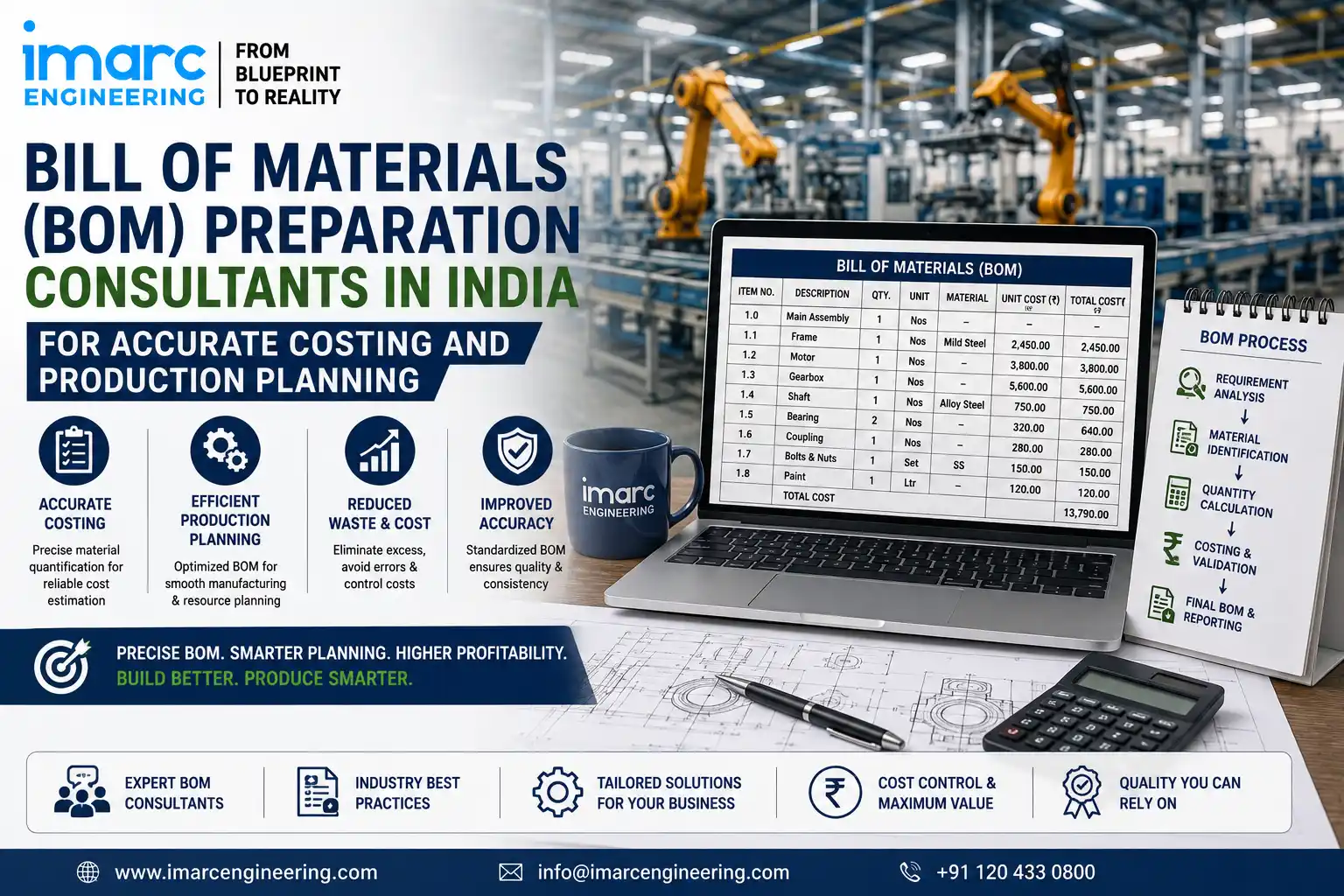
The structure below shows what a manufacturing BOM is expected to carry, from the finished product down to ERP readiness.
Depending on the industry, a manufacturing BOM typically records: product name/code and revision, part number, item description, material type and grade, dimensions, quantity per unit, UOM, drawing reference, BOM level, parent-child grouping, make-or-buy status, supplier information, lead time, MOQ, approved alternates, scrap/yield factor, revision number, effective date, approval status, and inspection requirements where relevant. Not every field applies to every product, but each field included should be complete and verified.
BOM Structure: Single-Level vs Multi-Level
A single-level BOM lists only the immediate components going directly into a finished product — suited to simple assemblies with no intermediate manufacturing stage. A multi-level BOM breaks the product down through several layers: the parent item, its sub-assemblies, and the raw materials feeding each sub-assembly. For example, an electrical control panel (parent item) may contain a wiring harness sub-assembly built from cable, connectors, and terminal blocks; a single-level BOM would show only the harness, while a multi-level BOM shows every layer beneath it. This matters for manufacturers with intermediate production stages or in-house sub-assembly, since costing and material planning can then be done accurately at each stage.
Engineering BOM vs Manufacturing BOM
An Engineering BOM (EBOM) reflects the product as designed, organised around design structure and specifications from CAD or design documentation. A Manufacturing BOM (MBOM) reflects the product as actually built, organised around assembly sequence and the materials and consumables the shop floor consumes — including fasteners or process items not shown on the drawing. These two views often differ, which is normal, but only if reconciled before production release; otherwise components get ordered but never used, or used but never ordered, distorting costing and procurement accuracy.
How BOM Preparation Supports Accurate Costing
Product costing is built up from the BOM, but it helps to be precise about what the BOM captures. A BOM primarily provides the material cost of a product — raw materials, purchased components, and sub-assemblies, multiplied by required quantities, adjusted for scrap or yield loss, and rolled up through each BOM level. Where relevant, it may also carry packaging cost and landed-cost elements such as freight or import duty.
BOM material cost is not the same as total manufacturing cost — labour, machine time, and overhead sit outside the BOM and are added separately. What the BOM provides is the accurate material cost base, and since material is typically the largest single component of product cost, an error in quantities, specifications, or pricing flows directly into a distorted estimate. A BOM not periodically revised for pricing will understate or overstate margins until a financial review flags it.
How BOM Supports Procurement and Inventory Planning
A properly structured BOM answers the questions procurement and inventory teams need for every production run: what to purchase, how much, by when, which components are critical or long-lead, and which are made in-house versus outsourced. Combined with the production demand plan and inventory data — supplier lead time, MOQ, safety stock, actual versus theoretical consumption — the BOM drives material requirements planning: what to procure and when. Where BOM quantities or specifications are wrong, the result is material shortages that stall production, or excess inventory that ties up working capital.
For a broader look at how BOM accuracy feeds into manufacturing planning and cost control, see IMARC Engineering’s earlier article on how BOM preparation improves manufacturing planning and cost control.
How BOM Supports Production Planning
Production planning depends on the BOM to translate a production order into a material and component requirement for a given quantity and batch size. Work orders are generated against the BOM, and scheduling assumes the listed materials will be available at the right time. A BOM reflecting only engineering intent, without shop-floor practice, creates a gap between planned and actual consumption. Manufacturing BOMs benefit from periodic reconciliation against shop-floor feedback — comparing what the BOM says should be consumed with what is actually drawn from stores — so scheduling reflects manufacturing reality rather than a theoretical ideal.
BOM Quantity, Scrap and Yield Validation
Some of the most consequential BOM errors sit in the smaller technical details of quantity calculation rather than missing components: quantity per unit/batch, process loss, scrap allowances, yield percentages, cutting loss, a justified rejection allowance, moisture loss, formulation tolerance in chemical or food products, packaging consumption, process consumables, and UOM conversion/rounding rules. These factors are industry- and process-dependent, and none should be applied as a fixed figure across products or plants. Reconciling actual consumption against the BOM’s stated quantities periodically is the most reliable way to catch drift.
BOM Revision, Alternatives and Change Control
Products change — a supplier is replaced, a specification updated, a design revision released — and the BOM must change with them in a controlled way. A disciplined revision process records the revision number and date, the change description, old versus new component or quantity, the effective date, and required approvals from engineering, production, procurement, and quality as relevant, plus how existing inventory of the replaced item is treated and when the change reaches the ERP/MRP system. Uncontrolled revisions — one department updating its copy without notifying others — are a common source of procurement ordering the wrong revision or production building to an outdated specification.
BOM and ERP/MRP Integration
For manufacturers running or implementing an ERP or MRP system, the BOM needs to align with the item master, material codes, and UOM conventions used — a clean BOM master with revision control, inventory data, and lead-time/MOQ fields, supporting purchase planning, work orders, MRP runs, and cost roll-up. ERP integration is not a requirement for every manufacturer — many smaller operations run well on controlled spreadsheets — but where an ERP/MRP system is in use or planned, an ERP-ready BOM avoids the system-held BOM and the working BOM drifting apart.
Common BOM Preparation Problems
- Missing components or consumables — incomplete purchase orders, last-minute shortages.
- Wrong quantities or incorrect UOM — over- or under-procurement, inventory imbalance.
- Duplicate part numbers or incorrect material grade — ambiguity in what was ordered or used.
- Outdated specifications versus current drawings — incoming material rejection.
- Uncontrolled revisions across departments — teams working from different versions.
- Incorrect scrap/yield assumptions or EBOM–MBOM mismatch — distorted costing, material use.
- BOM/ERP mismatch, outdated cost data, or multiple uncontrolled spreadsheets — no version can be trusted.
BOM Validation Checklist Before Release
☐ Product code, revision, components, and part numbers verified
☐ Specifications, grades, and quantities verified; UOM standardised
☐ BOM hierarchy checked; make/buy classification confirmed
☐ Scrap/yield validated and alternates approved, where applicable
☐ Supplier, lead-time, and cost data updated; drawings cross-checked
☐ Engineering, manufacturing, procurement, and quality review completed
☐ ERP/MRP data aligned, change control completed, BOM formally approved
When Should Manufacturers Hire BOM Preparation Consultants?
Not every manufacturer needs external support — companies with stable products and adequate engineering bandwidth often manage well on their own. Professional consultants tend to add the most value when launching a new product, setting up a new plant or expanding a brownfield facility, managing complex multi-level products or variants, correcting known BOM inaccuracies, preparing data ahead of an ERP/MRP implementation, facing frequent engineering changes, resolving a mismatch between BOM cost and actual cost, or lacking internal bandwidth for a structured BOM cleanup.
| BOM Requirement | What Needs to Be Validated | Consultant Support |
|---|---|---|
| Product structure | Product, assemblies, sub-assemblies | BOM hierarchy development |
| Materials | Grade, specification, dimensions | Material specification |
| Quantities | Quantity, UOM, loss/yield | Quantity calculation |
| Costing | Material price and cost roll-up | Cost estimation |
| Procurement | Supplier, lead time, alternatives | Supplier inputs |
| Inventory | Stock and material requirements | BOM/MRP alignment |
| Changes | Revision and effective dates | Change management |
| ERP/MRP | Item codes and BOM structure | ERP-ready BOM |
| Compliance | Applicable sector requirements | Documentation alignment |
How IMARC Engineering Supports Bill of Materials Preparation
IMARC Engineering’s BOM preparation work is structured around the requirements covered above: product analysis and BOM structure definition, material specification and quantity calculation, process-loss and yield considerations, cost estimation and roll-up, supplier identification, standardised documentation, change management, multi-level BOM development, ERP-ready formatting, and BOM verification against drawings and production data — a BOM that functions as a single, verified source of truth for engineering, procurement, costing, and production planning.
Need a structured BOM for a new product, plant, or manufacturing process? Discuss your BOM preparation requirements with IMARC Engineering: https://www.imarcengineering.com/contact?service=bill-of-materials-preparation
Contact Us:
IMARC Engineering
Phone: +91-120-433-0800
Email: sales@imarcengineering.com
India: C-130, Sector 2, Noida, Uttar Pradesh 201301
LinkedIn: https://www.linkedin.com/showcase/imarc-engineering/
About the Author