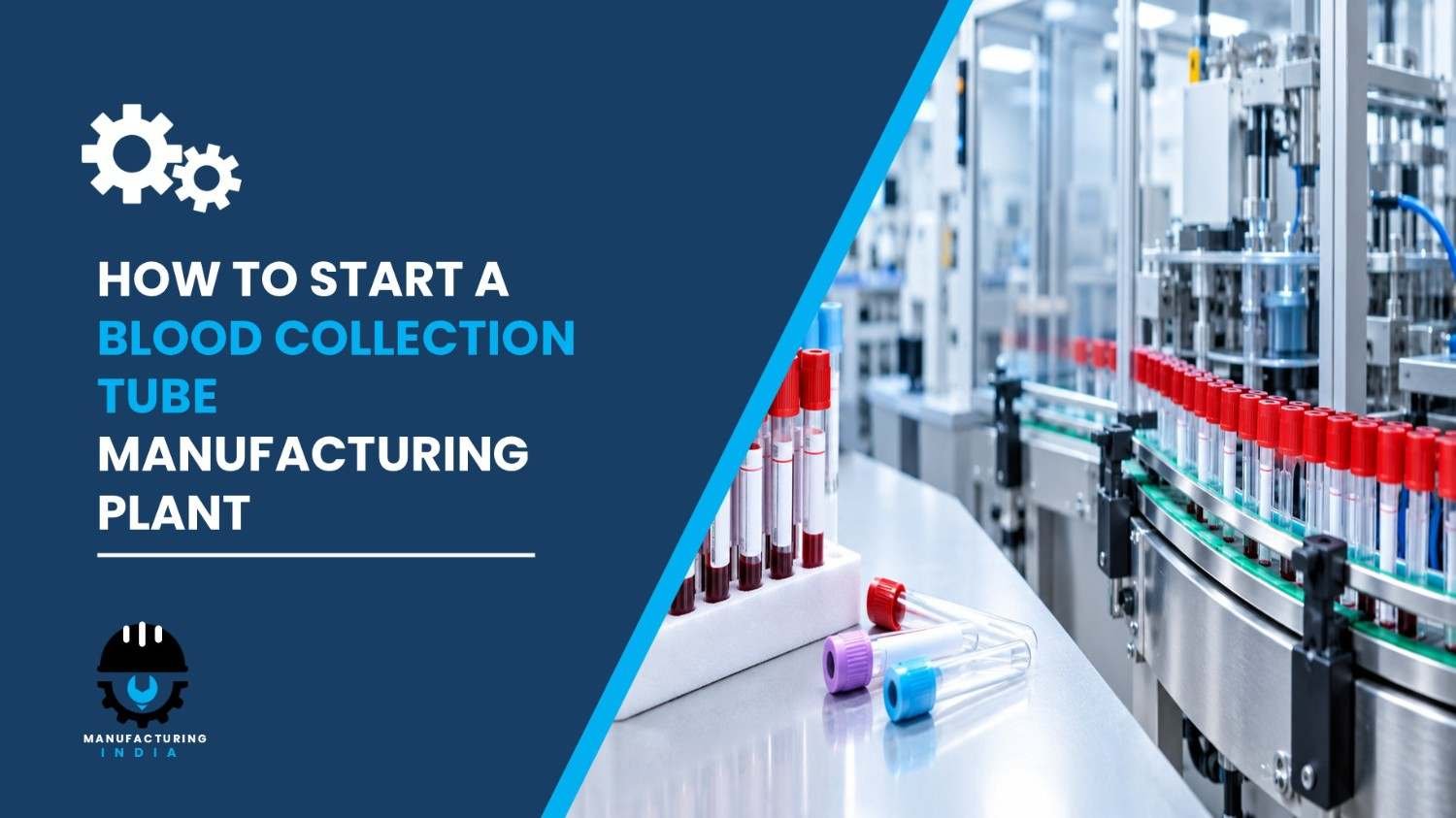
A blood collection tube manufacturing plant setup in India presents a compelling investment case for entrepreneurs looking at healthcare consumables. Demand comes from healthcare, diagnostic laboratories, hospitals, clinical research and pharmaceutical users. These tubes are essential consumables in clinical diagnostics, enabling safe, sterile and accurate sampling across hospitals, laboratories, blood banks and research institutions.
India offers a supportive backdrop for this opportunity. Government initiatives aimed at strengthening healthcare systems, expanding diagnostic laboratories, improving disease surveillance and encouraging domestic medical device manufacturing, including Make in India and Production Linked Incentive schemes for medical devices, indirectly support demand. Hospitals, diagnostic chains and distributors increasingly prefer dependable domestic suppliers, and industrial hubs such as the Oragadam Industrial Corridor in Chennai already host large-scale tube production. Policy support, a localising supply chain and steady diagnostic demand make India strategically sound for this production.
The investment case rests on policy support through Make in India and PLI schemes, demand from diagnostics, hospitals and research, and healthy economics, with gross margins of 40-50% and net margins of 15-20%. With raw materials at 45-50% of OpEx and a flexible capacity range of 50-200 million tubes a year, the project offers a clear route to break-even for quality-focused manufacturers.
What is Blood Collection Tube?
A blood collection tube (or vacutainer tube) is a sterile, vacuum-sealed, plastic or glass container used by healthcare professionals to collect, transport and process blood samples for laboratory analysis. It is a closed system, which ensures safety and precision in blood collection. The tubes contain specific chemical additives, such as anticoagulants, clot activators or gels, designed to preserve blood integrity or help separate blood into plasma and serum.
Colour-coded caps indicate the additive inside, so the correct tube is used for each test, for example EDTA for CBC and Sodium Citrate for coagulation. The blood collection tube manufacturing process relies on precision tube forming, chemical additive treatment and vacuum sealing. The tubes serve healthcare, diagnostic laboratories, hospitals, clinical research and pharmaceutical users, covering venous blood collection, laboratory testing, specimen preservation, serology, hematology and clinical chemistry analysis.
Cost of Setting Up a Blood Collection Tube Manufacturing Plant in India
The cost of a blood collection tube manufacturing plant depends on capacity, technology, location, automation and regulatory compliance.
1. Capital Expenditure (CapEx)
Machinery costs account for the largest portion of total capital expenditure. Land and Site Development forms a substantial part of the investment, covering land registration, boundary development and related charges. The site, whether in an industrial estate, an SEZ or an industrial corridor, should offer easy access to PET/glass, rubber stoppers, additives and labels, proximity to target markets, reliable utilities and waste management, and compliance with zoning rules.
Civil Works and Construction should provide separate areas for raw material storage, production, quality control and finished goods storage, with space reserved for future expansion. Key machinery required includes:
- Glass tube forming machines
- Automatic assembly lines
- Blood collection needle assemblers
- Vacuum filling systems
- Spray-drying coaters for additives
- Sterilizers
- Labeling machines
- Final packaging units
All machinery should be corrosion-resistant and meet industry standards. Other Capital Costs include effluent treatment systems, pre-operative expenses, commissioning and any applicable import duties.
Request a Sample Report for In-Depth Market Insights: https://www.imarcgroup.com/blood-collection-tube-manufacturing-plant-project-report/requestsample
2. Operational Expenditure (OpEx)
Raw Material Cost is the largest line, at 45-50% of OpEx. Inputs include PET/glass, rubber stoppers, additives (EDTA, heparin) and labels, and long-term contracts with reliable, nearby suppliers help stabilise pricing and ensure steady supply. Utility Cost covers electricity, water and steam, and accounts for 12-15% of OpEx.
Other Operating Costs include transportation, packaging, salaries and wages, repairs and maintenance, depreciation and taxes. By the fifth year, total operating cost is expected to rise substantially because of inflation, market fluctuations, higher material prices and supply chain disruptions.
3. Plant Capacity
The proposed facility is designed for annual production of 50-200 million tubes, enabling economies of scale while keeping operations flexible. Capacity can be customised to investor requirements, and profitability improves with higher capacity utilisation.
4. Profit Margins and Financial Projections
Under normal operating conditions, gross profit margins typically range between 40-50% and net profit margins between 15-20%. A complete financial analysis covers ROI, net present value (NPV), internal rate of return (IRR), payback period, liquidity, profitability, and sensitivity and uncertainty analysis.
Why Set Up a Blood Collection Tube Plant in India?
Expanding Diagnostic Testing Demand: Rising healthcare expenditure, expansion of diagnostic testing, preventive health screening, chronic disease monitoring and growing laboratory automation drive steady consumption.
Chronic Disease Burden: The International Diabetes Federation predicts that diabetes cases will keep rising year after year, reaching 853 Million by 2050. Rising chronic disease prevalence increases the need for routine testing.
Policy and Regulatory Tailwinds: Make in India and Production Linked Incentive schemes for medical devices encourage domestic manufacturing.
Cost-Competitive Manufacturing: The sector is less capital-intensive than complex medical devices, with moderate but justifiable entry barriers.
Active Industry Investment: In September 2024, Kriya Medical Technologies launched the ICHOR Medical Molding System, a fully automated system designed to produce 250 million blood collection tubes each year, at its facility in the Oragadam Industrial Corridor, Chennai.
Local Supply Chain Preference: Hospitals, diagnostic chains and distributors prefer domestic suppliers for consistent availability, regulatory compliance and cost stability.
Manufacturing Process – Step by Step
The blood collection tube manufacturing process uses precision tube forming, chemical additive treatment and vacuum sealing as the primary production method.
- Raw Material Receipt: PET/glass, rubber stoppers, additives (EDTA, heparin) and labels are received against requirements set by the mass balance.
- Precision Tube Forming: Glass tube forming machines shape the tubes.
- Additive Treatment: Spray-drying coaters apply chemical additives such as anticoagulants, clot activators or gels.
- Assembly: Automatic assembly lines fit the rubber stoppers and complete each tube.
- Vacuum Filling and Sealing: Vacuum filling systems create the vacuum seal inside each tube.
- Sterilisation: Sterilizers ensure the tubes are sterile.
- Labelling: Labeling machines apply labels, and colour-coded caps indicate the additive.
- Quality Assurance and Technical Tests: Quality assurance criteria, technical tests, SOPs and traceability records are applied at every stage.
- Packaging and Dispatch: Final packaging units prepare finished tubes for dispatch to hospitals, diagnostic laboratories, clinical research and pharmaceutical users.
Key Applications
These tubes serve healthcare, diagnostic laboratories, hospitals, clinical research and pharmaceutical users.
- Clinical Diagnostics: Collection and preservation of blood samples for routine laboratory testing such as biochemistry, hematology and serology.
- Hospitals and Healthcare Facilities: Safe, sterile sample collection for patient diagnosis, monitoring and treatment decisions.
- Research and Biotechnology: Sample collection for clinical research, biomarker studies and pharmaceutical development.
- Blood Banks and Pathology Laboratories: Storage, transport and processing of samples for screening, compatibility testing and disease detection.
Leading Manufacturers
Several multinational companies with extensive production capacities lead the global market, including:
- Becton, Dickinson and Company (BD)
- Greiner Bio-One
- Terumo Corporation
- Sarstedt AG & Co. KG
- QIAGEN
Timeline to Start the Plant
- Feasibility study and project report preparation
- Land acquisition and site development
- Regulatory approvals and environmental clearances
- Factory licence and fire safety compliance
- Machinery procurement and installation
- Raw material supplier agreements and supply chain setup
- Trial production and quality testing
- Commercial production launch
Licences and Regulatory Requirements
Starting a blood collection tube manufacturing unit in India requires several approvals:
- Business registration (Proprietorship, LLP, or Pvt Ltd)
- Factory Licence under the Factories Act
- Environmental Clearance from State Pollution Control Board
- GST Registration
- Fire Safety NOC
- Medical device and quality approvals (ISO, CE, CDSCO)
- Effluent Treatment Plant (ETP) operational clearance
- Occupational Health and Safety compliance
Key Challenges to Consider
- High Capital Requirements: Machinery takes the largest share of CapEx.
- Raw Material Price Volatility: PET/glass, rubber stoppers, additives (EDTA, heparin) and labels form 45-50% of OpEx, so long-term supplier contracts matter.
- Regulatory Compliance: Medical-grade manufacturing, sterilisation protocols, vacuum calibration, additive chemistry precision and approvals such as ISO, CE and CDSCO demand discipline.
- Technology or Innovation Pressure: Advances in tube material, safety and preservation techniques, along with vacuum-sealed and user-friendly designs, raise the bar.
- Competition: Established players such as BD, Greiner Bio-One, Terumo Corporation, Sarstedt AG & Co. KG and QIAGEN operate at scale.
- Skilled Manpower: Optimised processes and staff training help control operating costs and maintain quality standards.
Frequently Asked Questions
How much does it cost to set up a blood collection tube manufacturing plant in India?
The cost depends on capacity (50-200 million tubes a year), technology, location and automation, with machinery as the largest share of CapEx and raw materials at 45-50% of OpEx.
Is blood collection tube manufacturing profitable in India in 2026?
Yes. Gross margins typically range between 40-50% and net margins between 15-20%, supported by steady diagnostic demand.
What machinery is required for a blood collection tube plant in India?
Glass tube forming machines, automatic assembly lines, blood collection needle assemblers, vacuum filling systems, spray-drying coaters for additives, sterilizers, labeling machines and final packaging units.
What licences and approvals are required to start a blood collection tube plant in India?
Business registration, Factory Licence, Environmental Clearance, GST, Fire Safety NOC, ISO, CE and CDSCO approvals, ETP clearance and occupational safety compliance.
What raw materials are needed for blood collection tube manufacturing?
PET/glass, rubber stoppers, additives (EDTA, heparin) and labels.
What are the environmental compliance requirements for a blood collection tube plant in India?
The plant needs effluent treatment systems, adherence to emission standards, compliance with zoning laws and environmental regulations, and monitoring systems that detect leaks or deviations.
What is the best location to set up a blood collection tube plant in India?
The best site offers easy access to raw materials, proximity to target markets and strong infrastructure. The Oragadam Industrial Corridor in Chennai is one example of an established location.
What is the break-even period for this type of plant in India?
It depends on capacity utilisation, with the 40-50% gross margin and 15-20% net margin shaping the payback period, which a detailed financial analysis models.
What government incentives are available for manufacturers in India?
Make in India and Production Linked Incentive schemes for medical devices encourage domestic manufacturing.
Key Takeaways for Investors
This investment offers a sound opportunity, backed by demand from healthcare, diagnostic laboratories, hospitals, clinical research and pharmaceutical users. Financial viability holds across the 50-200 million tube capacity range, with gross margins of 40-50% and net margins of 15-20%. The global blood collection tube market was valued at USD 6.50 Billion in 2025 and is expected to reach USD 11.39 Billion by 2034, exhibiting a CAGR of 6.43% from 2026 to 2034. With diagnostic testing, chronic disease monitoring and healthcare infrastructure all expanding, demand for these tubes is set to stay strong for years to come.
About the Author