
A new manufacturing plant can reach production readiness faster than its commercial network can be built. Machinery may be installed and trial runs may be scheduled, but the company still needs to decide which markets to enter first, how many distributors the expected demand can support, which territories need local coverage, how much stock partners should carry and whether the network can absorb the plant’s planned output.
A plant can build capacity faster than a company can build market coverage. Distributor network planning connects plant capacity with market demand, territory coverage, inventory and customer delivery before commercial production begins. It is a planning discipline, not a last-minute sales task.
This is different from choosing individual partners. Distributor Partner Identification in India focuses on finding and evaluating potential partners. This article covers the step before that: designing the distribution network so the right partners can be identified, territories can be structured and the plant’s output can reach the market.
When Should Distributor Planning Begin?
Distributor planning should begin during late-stage plant planning, well before the first commercial batch, so market coverage, inventory and logistics decisions can be aligned with the production ramp-up.
Appointing distributors before construction is not necessary for every plant. The right timing depends on:
- the product and its sales cycle
- customer type
- regulatory requirements
- geographic footprint
Planning early matters because several decisions take time:
- Territory choices affect warehousing and freight routes.
- Inventory ties up working capital.
- Distributors may need product training.
- Licensing or handling requirements can limit who is eligible.
Launch markets also need prioritising before any commitments are made.
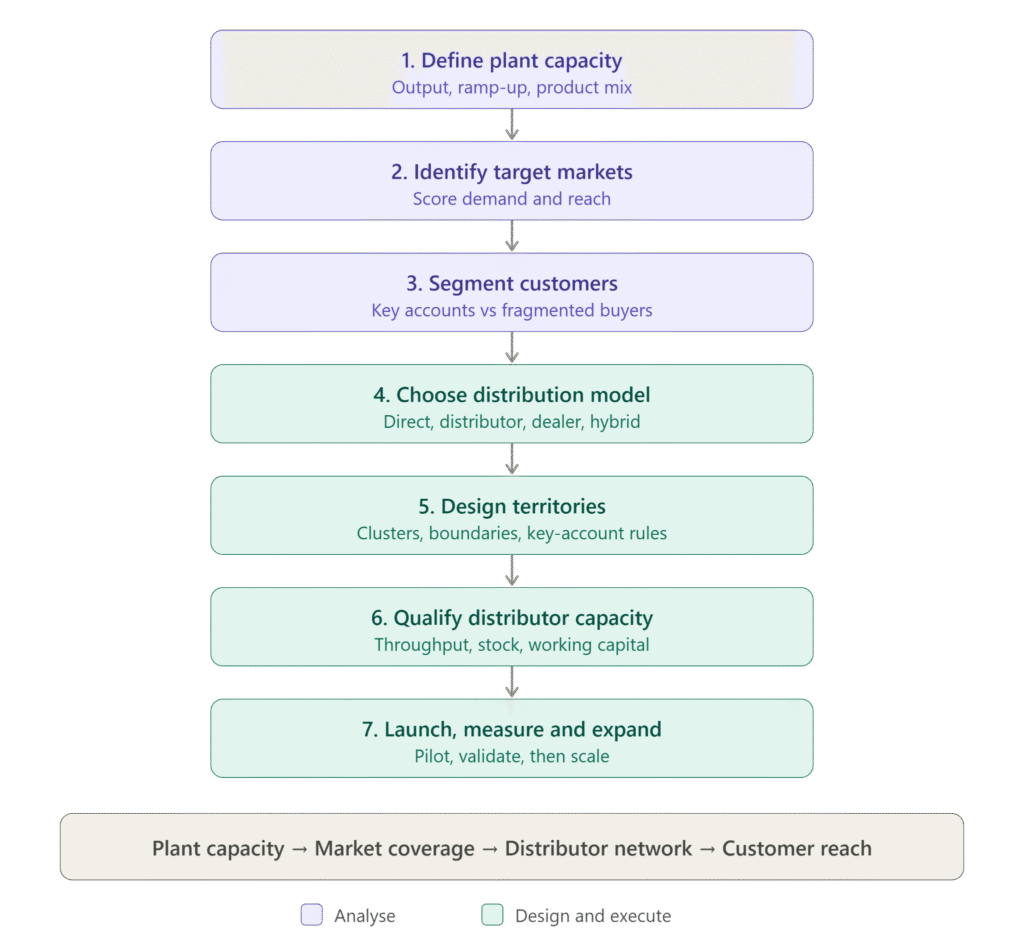
Start With the Plant, Not the Map
Network design should follow the plant’s commercial assumptions. Designing the network first and then fitting output into it usually leaves either unsold stock or unserved demand.
Begin with these inputs:
- Production: installed capacity, expected utilisation, ramp-up curve, product mix and planned expansion.
- Customers: industrial buyers, institutional buyers, OEMs, EPCs, dealers, retailers, regional businesses and, where relevant, exports.
- Product traits: shelf life, storage needs, hazardous handling, technical support, after-sales service and value-to-weight ratio.
The last point matters more than most teams expect. A high-value, low-volume product can tolerate long distribution distances. A bulky, low-value product often cannot.
For context, an NCAER study for DPIIT estimates India’s logistics cost at 7.97% of GDP, for FY 2023–24. That is a national average. Your product’s freight burden may differ sharply, so model it for your own goods.
Identify Priority Markets First
Rank markets before appointing anyone. A practical planning framework scores each candidate region on:
- demand potential and growth
- customer concentration
- competitor presence
- distance from the plant and logistics feasibility
- infrastructure
- regulatory requirements
- availability of capable distributors
- service requirements
Think of market attractiveness as demand, customer concentration, growth, logistics feasibility and competitive opportunity taken together. This is not an industry-standard formula. Weight the factors to suit your product, and let the ranking decide launch order.
Choose a Distribution Model That Fits the Plant
A new plant does not need one model for the whole country. Different regions and customer groups can use different channels.
Distribution Model for a New Manufacturing Plant

A common pattern is direct supply to key accounts and OEMs, distributors for regional industrial buyers, and dealers where local access matters. The hybrid model only works if customer ownership rules are clear.
How Many Distributors Does a Plant Need?
There is no universal distributor-to-market ratio. “One per state” is not a planning method.
The number depends on:
- market size and geographic spread
- customer density
- expected sales per distributor
- logistics economics
- service requirements
- working capital available to each partner
Work backwards from volume. Estimate demand in each priority market, then ask what a capable distributor can realistically sell and stock there.
Both extremes carry risk:
- Too few: weak coverage, long delivery times, dependence on one partner and poor penetration.
- Too many: territory conflict, low volume per partner, margin pressure, fragmented inventory and a network that is hard to manage.
Territory Design: Coverage Before Exclusivity
Territories should be defined by demand, logistics and customer coverage—not by administrative boundaries alone.
Territories can be state-based, regional, district or cluster-based, or defined by customer segment or industry sector. Industrial clusters often make better territory units than state lines.
Document four things for every territory:
- boundaries
- customer ownership
- key account exceptions
- service coverage
Overlap causes most channel conflict. Prevent it with written territory rules, registered customer lists and clear handling of cross-territory orders.
Apply coverage before exclusivity. Do not grant exclusivity automatically. If you do, tie it to minimum sales, active customer counts and review dates.
Qualify Distributors Against Plant Needs
Detailed partner evaluation is a separate exercise, but a plant should set its requirements up front:
- Commercial: sales volume, customer base and working capital.
- Market reach: active customers, real geographic coverage and channel relationships.
- Infrastructure: warehouse, transport and inventory handling.
- Technical: product knowledge, application support and service ability.
- Compliance: applicable licences, handling requirements and documentation.
- Strategic fit: competing portfolios and willingness to invest.
A distributor’s claimed territory is not its actual coverage. Ask for active customer lists and recent order patterns.
Align Distributor Capacity With Plant Output
This is where many plans fail. The chain runs: plant output, distributor throughput, warehouse capacity, customer demand, replenishment frequency.
Test each partner against:
- expected monthly sales
- minimum and maximum stock levels
- replenishment cycle
- seasonal demand
- plant ramp-up and production variability
During ramp-up, output may be uneven. A partner sized only for steady-state volume can either run short or be overloaded.
Design the network around the volume each partner can sell and handle, not just around geography.
Plan Inventory and Logistics Together
Decide how stock will flow:
- plant-to-distributor transport
- warehouse locations
- delivery lead times
- safety stock
- inventory ownership
- replenishment frequency
There is a trade-off:
- Centralised inventory means less duplication of infrastructure, but potentially longer delivery distances.
- Regional inventory means faster response, but more working capital and warehousing.
Neither is universally better. Product value, shelf life and customer urgency should decide.
Launch in Phases
A phased launch is usually more controllable: pilot, validate performance, then expand.
- Pilot markets. Start with a limited set of high-priority regions.
- Performance validation. Track sales, active customers, order frequency, inventory movement, delivery performance and distributor engagement.
- Geographic expansion. Add territories based on demonstrated demand.
- Network optimisation. Strengthen strong partners, close coverage gaps and restructure weak territories. Add or replace distributors where the data justifies it.
Expand, replace or restructure only when performance data supports it. One weak quarter during plant ramp-up may reflect supply issues, not distributor failure.
Distributor Network Checklist for a New Plant
Market
- Priority launch markets ranked against plant location and capacity
- Customer segments defined (OEM, EPC, institutional, regional)
- Demand estimated for the ramp-up period, not just steady state
- Distributor demand capacity is reconciled with the plant’s production ramp-up schedule
Network
- Territory structure documented
- Distributor count justified by volume per partner
- Direct, distributor and dealer roles assigned by segment
Partner
- Sales capability verified through active customer lists
- Working capital matched to planned stock levels
- Warehouse and transport checked against product handling needs
- Technical support capability assessed
- Competing product conflicts reviewed
Operations
- Central vs regional inventory model chosen
- Replenishment cycle tied to production schedule
- Plant-to-distributor routes costed
- Sales and stock reporting in place before dispatch
Governance
- KPIs set (sales, active customers, stock turns, delivery time)
- Territory and key-account rules written down
- Review schedule fixed
- Expansion and replacement criteria agreed upfront
Common Mistakes to Avoid
- Appointing distributors only because they are present in a region.
- Assuming one distributor can cover an entire state.
- Appointing too many distributors too early.
- Ignoring distributor working capital.
- Drawing territories before understanding demand.
- Granting exclusivity with no performance conditions.
- Underestimating logistics cost.
- Treating appointment as the end of the process.
- Expanding before the first markets are validated.
- Ignoring plant ramp-up when setting volume expectations.
Where Specialist Support Helps
Some companies handle network planning internally. Others need external support for unfamiliar regions or limited local market knowledge. Support from Distributor Partner Identification in India typically covers market mapping, distributor identification, partner qualification, coverage assessment, financial and operational evaluation, compliance checks, introductions and onboarding. Used alongside the planning above, it can shorten the path from design to appointed partners.
How IMARC Engineering Can Help
Planning a distributor network for a new manufacturing plant requires more than creating a list of potential partners. IMARC Engineering can support manufacturers through market mapping, distributor identification, partner qualification, geographic coverage assessment, financial and operational evaluation, regulatory checks, partner introductions and onboarding support. This helps manufacturers build a distribution network aligned with their target markets, product requirements and planned growth.
Planning a distributor network for your new manufacturing plant? Talk to IMARC Engineering: https://www.imarcengineering.com/contact?service=distribution-partner-identification
Conclusion
A plant’s commercial success depends on more than what it can produce. It also depends on how effectively that output reaches the right customers.
A sound distributor network is:
A sound distributor network should be demand-led, aligned with plant capacity, clearly structured by territory, logistics-aware, performance-managed and capable of scaling as production and market coverage grow.
Before commercial production begins, the company should be able to answer one question: where will we sell, through whom, in what volumes, and how will we know the network is working?
Contact Us:
IMARC Engineering
Phone: +91-120-433-0800
Email: sales@imarcengineering.com
India: C-130, Sector 2, Noida, Uttar Pradesh 201301
LinkedIn: https://www.linkedin.com/showcase/imarc-engineering/
About the Author