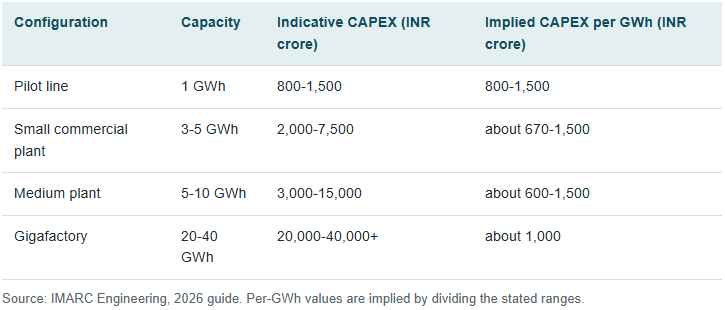
Setting up a battery cell manufacturing gigafactory in India costs roughly INR 800-1,500 crore for a 1 GWh pilot line and INR 20,000-40,000+ crore for a 20-40 GWh plant, which works out to about INR 1,000 crore per GWh at scale. The final figure depends on chemistry, cell format, automation level, dry room design and utilities.
Policy and import dependence shape the investment case. India imports over 90% of its lithium-ion cells, and the PLI Advanced Chemistry Cell (ACC) scheme carries an outlay of INR 18,100 crore for 50 GWh of domestic capacity. As of March 2026, the Ministry of Heavy Industries reported 40 GWh awarded, land acquired for all of it, and only 1 GWh commissioned, so capital discipline matters more than headline announcements.
Understanding battery cell manufacturing plant setup cost means looking beyond machinery. Dry rooms, utilities, fire protection and ramp-up losses can move a budget by thousands of crores. This guide breaks down CAPEX by configuration, shows where the money goes, and explains the operating cost and incentive factors investors should model.
How Much Does a Battery Cell Gigafactory Cost in India?
Indicative CAPEX rises with GWh capacity, but not in a straight line. Smaller plants can carry a higher cost per GWh because dry rooms, utilities and engineering do not shrink in proportion to output.
What Drives Battery Gigafactory Cost Up or Down?
Six variables explain most of the variation between projects:
- Chemistry: LFP is generally cheaper than NMC because of simpler cathode manufacturing. BloombergNEF’s 2025 survey put average LFP pack prices at USD 81/kWh against USD 128/kWh for NMC, about 37% lower.
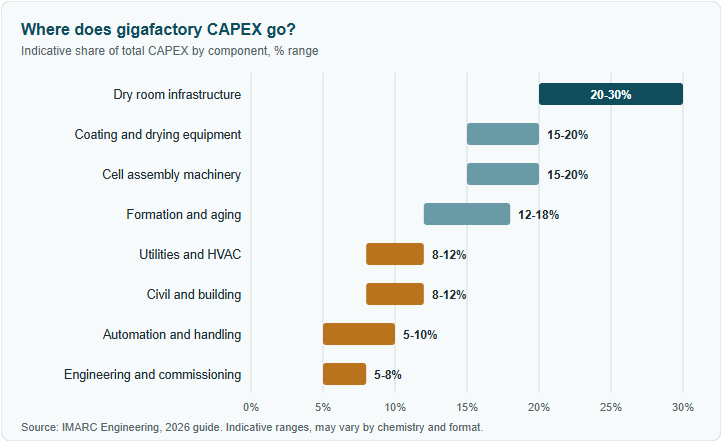
- Dry room: Moisture control at a dew point of -40 to -60°C can consume 20-30% of total CAPEX.
- Power: Medium and large plants need 50-200 MW of connected load and a dedicated substation.
- Land: A greenfield gigafactory typically needs 30-100 hectares including utilities and expansion space.
- Automation: Modern plants run at 80-95% automation, which raises CAPEX but supports yield and traceability.
- Yield: Raw materials dominate operating cost, so each percentage point of yield loss carries a real economic penalty.
How Does Capacity Planning Change the Budget?
GWh targets convert directly into line counts and CAPEX. A 5 GWh LFP plant making 100 Ah prismatic cells at 3.2 V (320 Wh per cell) needs about 15.6 million cells a year, or roughly 2,000 cells an hour at 90% yield over 8,000 operating hours. Several parallel lines aggregate to reach that target, so throughput, yield and line count should be fixed before equipment is priced.
Location also moves the budget. Gujarat, Karnataka, Maharashtra, Tamil Nadu, Andhra Pradesh and Telangana offer battery-specific support such as land, power and capital subsidies and stamp duty exemptions. Early engagement on environmental clearance and SPCB classification avoids approval delays that push commissioning, and cost, further out.
Which Approvals Must Be Budgeted Before Construction?
Approval costs and timelines are easy to underestimate. Typical requirements include:
- SPCB Consent to Establish before construction and Consent to Operate before production.
- Hazardous waste authorization for spent solvents, sludge and defective cells.
- Environmental Clearance under the EIA Notification 2006, where thresholds apply.
- PESO approvals for regulated flammable materials such as electrolyte solvents.
- Fire NOC under NBC 2016 and a factory license under the OSH Code.
Where Does the Money Go in a Gigafactory Budget?
Process equipment and dry room infrastructure take most of the spend. Dry room infrastructure is the largest single line, followed by coating and drying equipment, assembly machinery, and formation and aging systems.
What Are the Operating Costs of a Battery Cell Plant?
Raw materials dominate operating cost, so supply strategy matters as much as plant design. The indicative OPEX split is:
- Raw materials: 60-75%, covering cathode and anode active materials, electrolyte, separator and foils.
- Electricity: 8-15%, highest in NMP recovery, dry room dehumidification and formation.
- Labour: 4-10%, depending on automation.
- Consumables: 3-6%, and other costs 3-5%.
Global price pressure adds to the challenge. BloombergNEF’s 2025 survey recorded the average lithium-ion pack price at a record USD 108/kWh, down 8% year on year. China averaged USD 84/kWh, and BEV cells at USD 79/kWh made up about 80% of the pack price. Indian cell makers must plan against this benchmark.
How Does the PLI ACC Scheme Affect Investment?
The scheme lowers the operating cost gap against imports, but incentives follow production. Key facts for investors:
- Scheme size: INR 18,100 crore outlay for 50 GWh, with a minimum investment of INR 1,100 crore per beneficiary and 5 GWh minimum committed capacity.
- Incentive level: Performance-linked support of up to approximately INR 2,000 per kWh, or roughly INR 200 crore per GWh.
- Awards: 40 GWh allocated, with Ola Electric at 20 GWh, Reliance New Energy at 15 GWh and Rajesh Exports at 5 GWh.
- Status: Only 1 GWh commissioned as of March 2026, and no incentive disbursed as of October 2025 against a INR 2,900 crore target.
- Private pipeline: More than 10 non-PLI manufacturers have announced about 178 GWh of additional capacity.
Investors should treat incentives as upside, not as a substitute for a fully funded CAPEX plan. With support tied to commissioning and sales, delays in dry room completion, equipment qualification or yield stabilisation also delay incentive inflows, which raises the funding that sponsors must carry through the ramp-up years.
Which Hidden Costs and Delays Inflate Gigafactory Budgets?
- Undersized dry rooms: Moisture ingress degrades capacity and cycle life, and limits throughput.
- Fire protection: Lithium and flammable electrolyte call for early detection, suppression, compartmentalisation and a Fire NOC under NBC 2016.
- Solvent recovery: NMP recovery should target above 95%, since poor recovery damages electrode economics and air compliance.
- Formation and aging: 3-6 weeks of in-process time ties up working capital and floor space.
- Slow ramp-up: Utilisation typically runs at 30-50% in year 1, 60-80% in year 2 and 85-95% from year 3.
- Compliance and timelines: BIS standards IS 16046 and IS 16893, EPR under the Battery Waste Management Rules 2022 and a factory license under the OSH Code (in force since 21 November 2025) sit within a staged 30-48 month commissioning plan.
How IMARC Engineering’s Expertise Can Help in Battery Cell Gigafactory Planning
IMARC Engineering supports investors and project sponsors across the planning cycle:
- Feasibility studies and CAPEX and OPEX models by chemistry, format and GWh capacity.
- Site selection covering power, water, land and state battery incentives.
- Plant layout, dry room and utility planning aligned to the process flow.
- Equipment specification for coating, assembly and formation lines.
- Fire safety, environmental and regulatory planning, including PLI ACC structuring.
Get in Touch With Our Team: https://www.imarcengineering.com/contact-us
Conclusion
A battery cell gigafactory in India is a multi-thousand-crore commitment where small planning errors compound quickly. Dry rooms, yield, utilities and ramp-up speed shape returns as much as headline GWh. With PLI commissioning still limited and global pack prices at record lows, investors should build conservative, staged CAPEX plans, test every assumption against current pack prices and incentive status, and commit capital only when site, technology partner and approvals are aligned.
Frequently Asked Questions
What is the cost of a 1 GWh battery cell plant in India?
A 1 GWh pilot line typically needs an indicative INR 800-1,500 crore, depending on chemistry, format and automation.
How much does a 20-40 GWh gigafactory cost?
A full gigafactory typically requires INR 20,000-40,000+ crore, or about INR 1,000 crore per GWh.
Which part of a gigafactory takes the largest share of CAPEX?
Dry room infrastructure, at 20-30% of total investment.
Is LFP cheaper to manufacture than NMC?
Generally yes. LFP has simpler cathode manufacturing, and 2025 average pack prices were USD 81/kWh for LFP against USD 128/kWh for NMC.
How long does it take to set up a battery gigafactory in India?
Timelines vary by capacity and site readiness, but a staged commissioning approach of 30-48 months is typical.
Contact Us:
IMARC Engineering
Phone: +91-120-433-0800
Email: sales@imarcengineering.com
India: C-130, Sector 2, Noida, Uttar Pradesh 201301
LinkedIn: https://www.linkedin.com/showcase/imarc-engineering/
About the Author