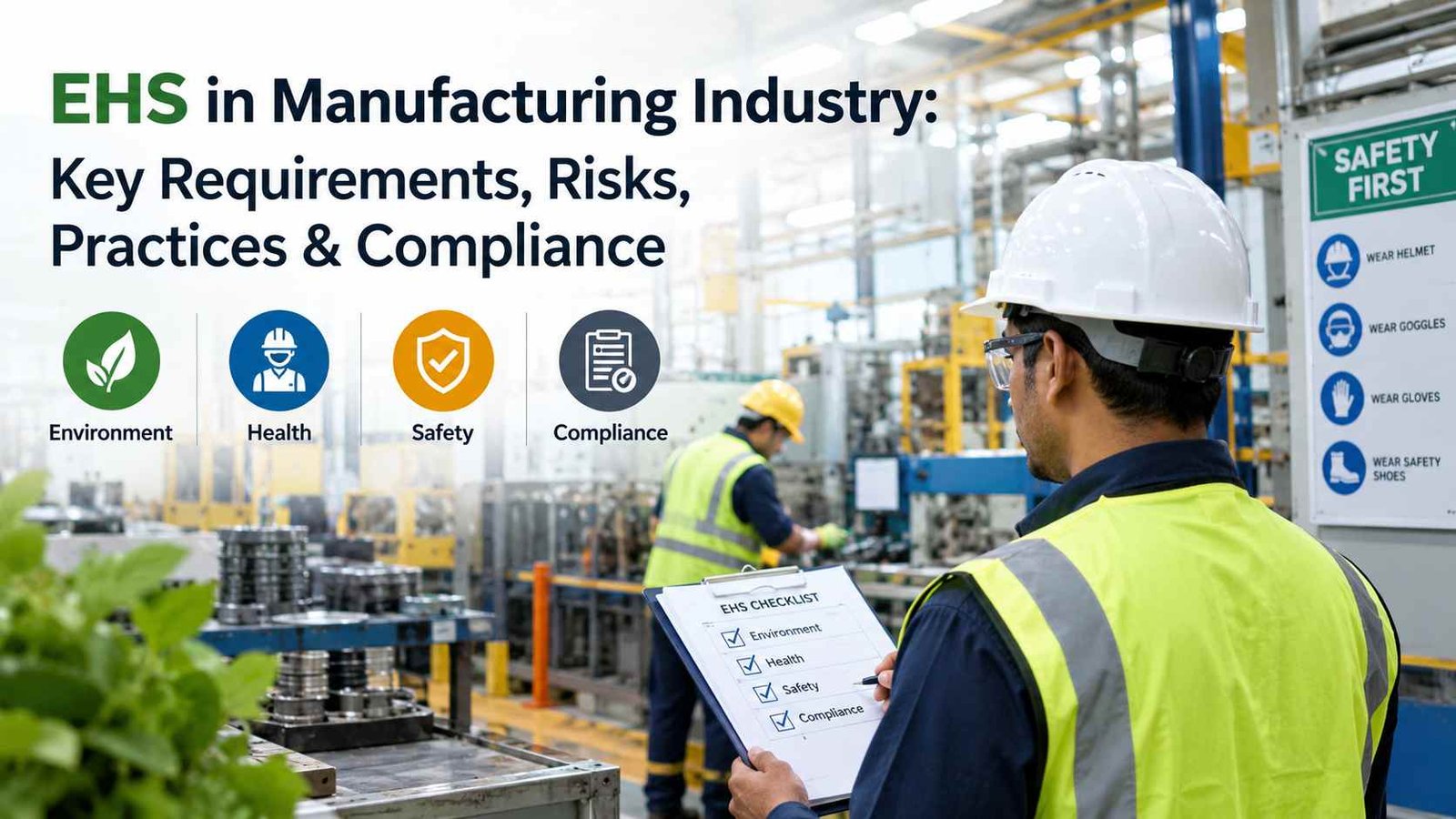
Environment, Health, and Safety in Indian manufacturing is no longer a paperwork function sitting alongside production. It has become a direct driver of whether a plant can legally operate, retain its workforce, and avoid the kind of incident that ends up in a fatality report. The regulatory architecture governing it has also just changed in a fundamental way, with new compliance obligations that most manufacturing units are still catching up with.
Getting EHS right is not optional risk management anymore, it is baseline operating discipline. A structured EHS in Manufacturing programme is what turns scattered safety documentation into a system that actually prevents incidents and satisfies the new compliance regime at the same time.
The Scale of the Risk: What Recent Data Shows
The numbers behind India’s factory safety record are sobering, and they show a pattern that manufacturers need to understand clearly.
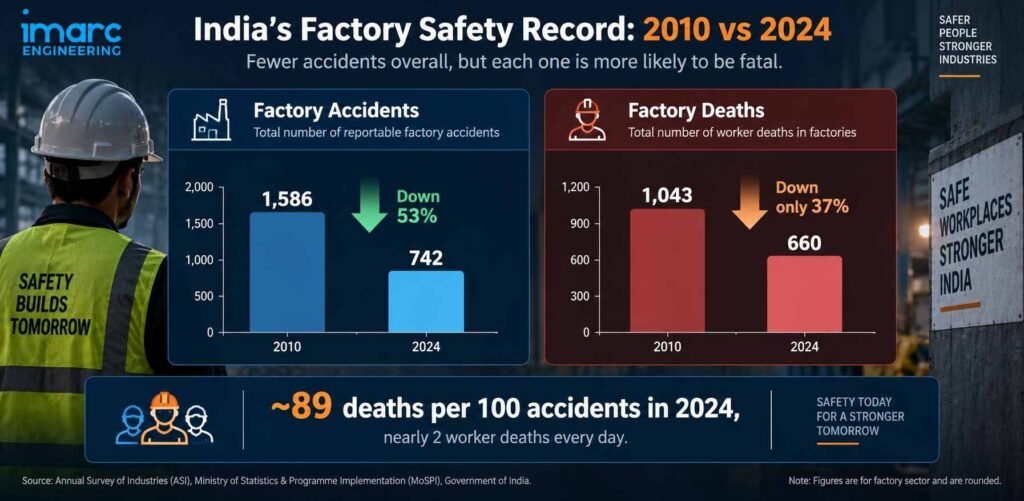
- India recorded 742 factory and machine accidents in 2024, down more than 53% from 1,586 in 2010, according to National Crime Records Bureau data
- Deaths, however, fell far more slowly over the same period, from 1,043 in 2010 to 660 in 2024, a decline of only around 37%
- That gap means accidents are becoming more lethal, with close to 89 deaths recorded for every 100 factory accidents in 2024, up sharply from the ratio seen a decade earlier
- 660 deaths in 2024 works out to nearly two worker fatalities every day in India’s registered factories alone
- DGFASLI data shows India records one serious industrial accident roughly every two days in registered factories
- Between 2018 and 2020, 3,331 deaths were recorded in registered factories, yet only 14 people were convicted under the Factories Act, 1948 during that period
- High-profile 2026 incidents, including an explosion at the Visakhapatnam Steel Plant in June and a blast at a Chhattisgarh power plant in April that killed 24 workers, underline that these are not statistical abstractions confined to informal-sector units
What Has Changed With India’s New Labour Codes
Manufacturers now operate under a fundamentally restructured compliance framework, and the transition is still actively underway.
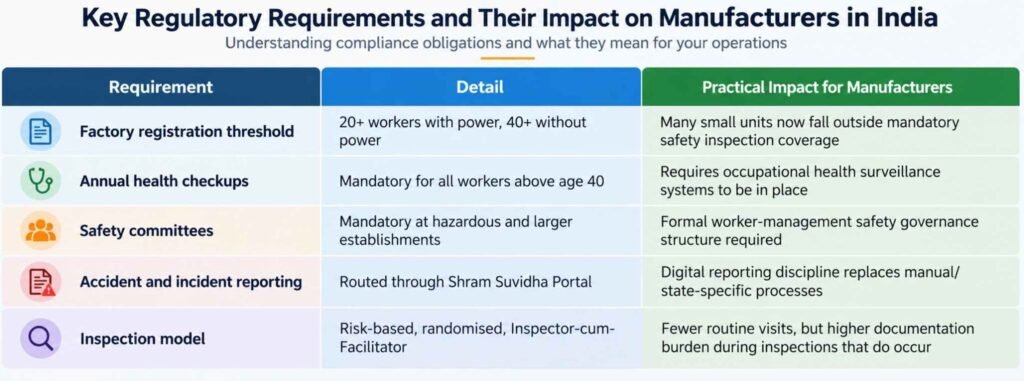
- Four Labour Codes, including the Occupational Safety, Health and Working Conditions (OSH) Code, 2020, came into effect on 21 November 2025, consolidating 29 central labour laws, 13 of them specific to occupational safety, into a single framework
- Central Rules under the OSH Code were notified on 9 May 2026, more than five months after the Code itself took legal effect
- As of April 2026, every state except West Bengal had notified its own OSHWC rules, meaning enforcement detail still varies materially by location
- The Code replaces the old complaint-based inspectorate with an Inspector-cum-Facilitator model, mandating risk-based, randomised, and largely web-based inspections rather than routine physical visits
- Accident reporting and registration now route through the Shram Suvidha Portal, with certificates auto-generated within seven days if left unprocessed
- Annual health examinations are now mandatory for all workers above the age of 40, alongside a requirement for gender-inclusive facilities and formal safety committees at covered establishments
Key EHS Compliance Requirements Under the OSH Code, 2020
Where EHS Risk Actually Concentrates on the Factory Floor
Most serious manufacturing incidents trace back to a narrow set of recurring risk categories rather than novel or unpredictable hazards:
- Machine guarding failures and unguarded moving parts, still one of the most common causes of factory injuries and amputations
- Confined space entry without proper permit-to-work procedures, particularly in chemical, metals, and process industries
- Hazardous chemical storage and handling gaps, including inadequate ventilation, labelling, or segregation of incompatible substances
- Electrical safety lapses, from improper lockout-tagout practices to overloaded or poorly maintained distribution systems
- Fire and explosion risk in facilities handling flammable materials, dust, or pressurised process equipment, as recent 2026 incidents have repeatedly demonstrated
- Inadequate personal protective equipment provision or enforcement, often driven by cost-cutting on contract and migrant labour rather than permanent staff
Factory Accidents in India: Falling in Number, Rising in Severity
EHS Practices That Actually Reduce Risk
- Build a permit-to-work system for every high-risk task, confined space entry, hot work, and electrical isolation, rather than relying on informal supervisor judgement
- Run machine guarding audits on a fixed schedule, not only after an incident or inspection notice, since guarding failures are among the most common and most preventable injury causes
- Establish structured occupational health surveillance, particularly given the new annual health checkup requirement for workers above 40, rather than treating it as a compliance box to tick
- Extend EHS training and PPE enforcement equally to contract and migrant labour, who make up a disproportionate share of India’s factory workforce and its accident statistics
- Digitise incident and near-miss reporting so patterns are visible before they escalate, aligning naturally with the new Shram Suvidha Portal reporting requirement
- Conduct internal EHS audits against the OSH Code’s specific thresholds and obligations now, rather than waiting for a state government’s rules to be finalised or an inspection to expose a gap
How IMARC Engineering’s Expertise Can Help in EHS for Manufacturing
- Assesses current EHS practices against the specific obligations introduced under the OSH Code, 2020, including thresholds that may newly apply to a facility
- Designs and delivers EHS training programmes covering machine safety, confined space entry, chemical handling, and permit-to-work systems for both permanent and contract workforce
- Builds occupational health surveillance systems aligned with the new mandatory annual checkup requirement for workers above 40
- Establishes digital incident and near-miss reporting processes compatible with Shram Suvidha Portal requirements
- Conducts machine guarding, electrical safety, and fire risk audits to identify the highest-probability incident sources before they materialise
- Supports safety committee formation and governance structures required under the new compliance regime
Consult With Our Team for Expert EHS Training: https://www.imarcengineering.com/contact?service=ehs-training
Conclusion
India’s factory safety data tells a genuinely mixed story: fewer accidents overall, but a rising share of those accidents proving fatal, against a backdrop of newly restructured labour codes that most manufacturers are still adapting to. Treating EHS as a system, machine guarding, permit-to-work discipline, occupational health surveillance, and digital reporting working together, is what actually moves a facility out of the statistics rather than into them.
Frequently Asked Questions
How many factory deaths occur in India each year?
India recorded 660 deaths from factory and machine accidents in 2024, close to two worker deaths every day, according to National Crime Records Bureau data, even as the total number of reported accidents has fallen sharply since 2010.
What changed in India’s EHS regulatory framework in 2025 and 2026?
Four Labour Codes, including the OSH Code, 2020, came into effect on 21 November 2025, consolidating 29 central labour laws into a single framework. Central Rules under the OSH Code were notified on 9 May 2026, introducing a risk-based, randomised inspection model in place of the earlier complaint-driven system.
What is the factory registration threshold under the new OSH Code?
The OSH Code sets the threshold at 20 or more workers for establishments using power, and 40 or more workers for those without power, which means many smaller units now fall outside mandatory safety inspection coverage.
What are the most common causes of manufacturing safety incidents in India?
Machine guarding failures, confined space entry without proper permits, hazardous chemical storage gaps, electrical safety lapses, and fire or explosion risk in facilities handling flammable materials account for most recurring incidents.
Is annual health screening mandatory for factory workers in India?
Yes, under the OSH Code, 2020, annual health examinations are now mandatory for all workers above the age of 40, requiring manufacturers to establish structured occupational health surveillance systems.
Contact Us:
IMARC Engineering
Phone: +91-120-433-0800
Email: sales@imarcengineering.com
India: C-130, Sector 2, Noida, Uttar Pradesh 201301
LinkedIn: https://www.linkedin.com/showcase/imarc-engineering/
About the Author