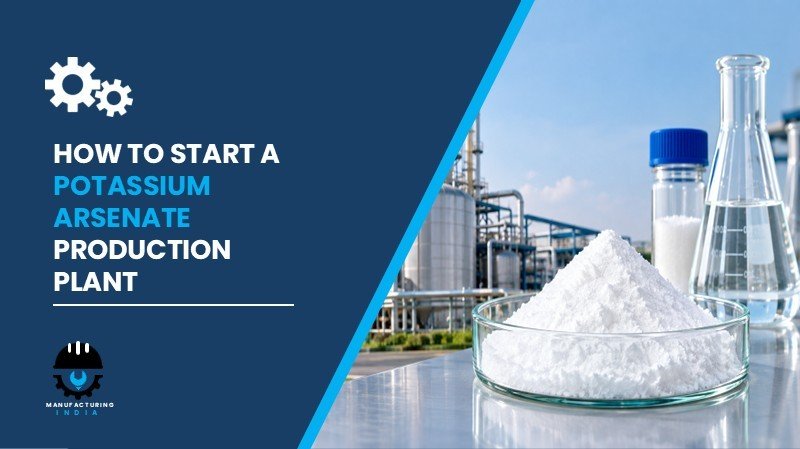
A potassium arsenate production plant setup in India presents a compelling investment case for investors targeting specialty and inorganic chemical segments. Demand for the compound is anchored in agriculture, chemical manufacturing, wood preservation, glass manufacturing, and pharmaceuticals, where it is valued as a herbicide, a reagent for chemical synthesis, and an input for regulated industrial processes. As India’s broader chemicals sector continues to expand, specialty compounds such as potassium arsenate remain relevant to laboratories, universities, and scientific institutions that rely on them as reference materials and research inputs, giving the segment a steady, if specialized, demand base.
India’s manufacturing ecosystem offers distinct advantages for this type of facility, including growing industrial infrastructure, an expanding chemicals market, and policy support through initiatives such as Make in India that encourage domestic production of specialty and industrial chemicals. Access to established chemical clusters, reliable logistics, and a large base of downstream industries – from agriculture to glass and pharmaceuticals – makes India a strategically sound base for this production.
This is a specialized, research and industrial-grade opportunity supported by consistent demand from agriculture, chemical synthesis, and specialty applications. With gross margins of 25-35% and net margins of 10-18%, cost-competitive domestic production, and a supportive regulatory framework, a well-planned facility of this kind offers a credible path to sustainable profitability and break-even viability.
What is Potassium Arsenate?
Potassium arsenate is a chemical compound composed of potassium, arsenic, and oxygen, characterized by its crystalline solid form and high solubility in water. It is primarily used in agricultural settings as a pesticide and herbicide to control weed and pest growth. It also functions effectively as a reagent in various chemical processes, though its toxic nature requires stringent safety measures throughout handling and production. Given its limited-volume, specialized use, understanding its role across agriculture and chemical processing is essential for any investor evaluating this potassium arsenate production plant opportunity.
The compound is produced through neutralization and crystallization, in which arsenic acid is reacted with potassium hydroxide under controlled conditions, followed by concentration, crystallization, drying, and packaging. Potassium arsenate serves a range of end-use industries, including agriculture, chemical manufacturing, wood preservation, glass manufacturing, pharmaceuticals, and specialty industrial chemicals.
Cost of Setting Up a Potassium Arsenate Production Plant in India
Setting up this facility in India involves costs that depend on capacity, technology, location, automation level, and regulatory compliance requirements.
1. Capital Expenditure (CapEx)
Land and site development form a significant part of the initial investment, and investors can evaluate options such as SEZs or established chemical industrial estates to benefit from ready infrastructure and streamlined approvals. Civil works and construction cover the reaction shed, quality control laboratory, raw material and finished goods storage, and the administrative block, all designed to support safe handling of arsenic-based inputs. Machinery represents a major share of capital cost given the corrosion-resistant, precision equipment this production plant requires. Key machinery required includes:
- Corrosion-resistant reaction vessels
- Dosing and mixing systems
- pH control units
- Evaporators/concentrators
- Crystallizers
- Centrifuges or filter presses
- Drying systems
- Milling/sieving units
- Packaging machines
Other capital costs cover effluent treatment plant installation, pre-operative expenses, commissioning, and applicable import duties on specialized machinery.
Request a Sample Report for In-Depth Market Insights: https://www.imarcgroup.com/potassium-arsenate-manufacturing-plant-project-report/requestsample
2. Operational Expenditure (OpEx)
Raw material cost is the largest component of operating expenses for a potassium arsenate production plant, with arsenic acid and potassium hydroxide together accounting for approximately 45-55% of total OpEx. Given the sensitivity of these inputs, investors should pursue long-term supplier contracts to secure consistent quality and stabilize pricing. Utility costs, covering electricity, water, and steam, account for approximately 10-15% of OpEx. Other operating costs include transportation, packaging, salaries and wages, repairs and maintenance, depreciation, and taxes. Over a five-year horizon, total operational costs for the plant are expected to increase substantially due to inflation, market fluctuations, potential rises in key material costs, supply chain disruptions, and shifts in the global economy.
3. Plant Capacity
The proposed potassium arsenate production plant is designed for an annual capacity ranging between 500-1,500 MT, allowing for economies of scale while maintaining operational flexibility. Capacity can be customized to individual investor requirements, and profitability generally improves as capacity utilisation increases.
4. Profit Margins and Financial Projections
Financial projections for this production plant are built on realistic assumptions covering capital investment, operating costs, capacity utilisation, pricing trends, and demand outlook, and include return on investment (ROI), net present value (NPV), internal rate of return (IRR), and payback period. Under normal operating conditions, the project demonstrates healthy profitability, with gross profit margins typically ranging between 25-35% and net profit margins between 10-18%, supported by stable demand and value-added applications.
Why Set Up a Potassium Arsenate Plant in India?
Versatile Industrial Applications: Potassium arsenate serves diverse industries, including agriculture, chemical manufacturing, wood preservation, glass manufacturing, and pharmaceuticals. This breadth of application gives manufacturers flexibility and high utility across multiple downstream sectors.
Consistent Market Demand: Ongoing demand for agricultural chemicals, alongside steady requirements from laboratories, universities, and scientific institutions for arsenate reference materials and research applications, ensures stable market growth and continuous opportunities for this production plant.
Chemical Stability: The compound’s stable chemical nature under varied conditions makes it suitable for integration into multiple industrial processes, supporting reliable production outcomes.
Supportive Regulatory Framework: Regulations guide the agricultural application of potassium arsenate, ensuring safety, quality, and an organized market structure for producers operating this type of plant in India.
Growing Chemicals Market: India’s domestic chemicals market was valued at USD 220 Billion in 2023 and is projected to grow to around USD 400-450 Billion by 2030, according to NITI Aayog, providing a favorable macro backdrop for specialty chemical investments such as this one.
Regional Demand Concentration: Asia Pacific accounts for approximately 40% of the global potassium arsenate market, positioning India-based production within the region driving the majority of worldwide demand.
Production Process – Step by Step
The potassium arsenate production process uses neutralization and crystallization as the primary production method.
- Reaction: Arsenic acid is reacted with potassium hydroxide under controlled conditions to form potassium arsenate.
- Concentration: The resulting solution is concentrated to prepare it for crystal formation.
- Crystallization: The concentrated solution undergoes crystallization to yield solid potassium arsenate.
- Drying: The crystallized product is dried to achieve the required moisture specification.
- Packaging: The finished potassium arsenate is packaged for dispatch to end-use industries, including agriculture, chemical manufacturing, wood preservation, glass manufacturing, and pharmaceuticals.
Key Applications
Potassium arsenate serves a range of industries that depend on its chemical reactivity and reagent properties.
- Agricultural Use: Utilized as a herbicide and pesticide to help manage weeds and pests and protect crops.
- Chemical Synthesis: Serves as a reagent in various chemical synthesis processes, providing reliable chemical reactivity.
- Pharmaceutical Applications: Used in specific, regulated pharmaceutical processes to synthesize particular compounds under controlled conditions.
- Textile Dyeing: Applied in dyeing processes for certain types of fabric treatments in the textile industry.
Leading Manufacturers
The global potassium arsenate industry includes established players with manufacturing capacities serving diverse application portfolios. A key player named in the source report is:
- Otto Chemie Pvt. Ltd.
These producers serve end-use sectors such as agriculture, chemical manufacturing, wood preservation, glass manufacturing, pharmaceuticals, and specialty industrial chemicals – the same downstream markets any new potassium arsenate production plant would target.
Timeline to Start the Plant
- Feasibility study and project report preparation
- Land acquisition and site development
- Regulatory approvals and environmental clearances
- Factory licence and fire safety compliance
- Machinery procurement and installation
- Raw material supplier agreements and supply chain setup
- Trial production and quality testing
- Commercial production launch
Licences and Regulatory Requirements
Starting a potassium arsenate production unit in India requires several approvals:
- Business registration (Proprietorship, LLP, or Pvt Ltd)
- Factory Licence under the Factories Act
- Environmental Clearance from State Pollution Control Board
- GST Registration
- Fire Safety NOC
- Hazardous/Chemical compliance, given the toxic nature of arsenic-based inputs
- Effluent Treatment Plant (ETP) operational clearance
- Occupational Health and Safety compliance
Key Challenges to Consider
High Capital Requirements: Corrosion-resistant reaction vessels, evaporators, crystallizers, and other specialized machinery require substantial upfront investment for this potassium arsenate production plant.
Raw Material Price Volatility: Arsenic acid and potassium hydroxide together represent 45-55% of OpEx, making the plant sensitive to price fluctuations in these core inputs.
Regulatory Compliance: The toxic nature of potassium arsenate requires stringent safety measures, environmental clearances, and ongoing compliance monitoring throughout production.
Technology and Process Precision: The potassium arsenate production process spans neutralization, concentration, crystallization, and drying, and achieving consistent quality requires tight control at each stage.
Competition: Established global producers, including Otto Chemie Pvt. Ltd., compete for market share across the same end-use sectors.
Skilled Manpower: Safe handling of arsenic-based raw materials and precision process equipment requires trained personnel and ongoing safety training.
Frequently Asked Questions
1. How much does it cost to set up a potassium arsenate production plant in India?
Cost depends on plant capacity, technology, automation level, and location, covering land, civil works, machinery, and other capital costs.
2. Is potassium arsenate production profitable in India in 2026?
Yes, the project demonstrates healthy profitability potential, with gross margins of 25-35% and net margins of 10-18% under normal operating conditions.
3. What machinery is required for a potassium arsenate plant in India?
Key machinery includes corrosion-resistant reaction vessels, dosing and mixing systems, pH control units, evaporators/concentrators, crystallizers, centrifuges or filter presses, drying systems, milling/sieving units, and packaging machines.
4. What licences and approvals are required to start a potassium arsenate plant in India?
Requirements include business registration, a Factory Licence, Environmental Clearance, GST Registration, Fire Safety NOC, hazardous chemical compliance, ETP clearance, and occupational health and safety compliance.
5. What raw materials are needed for potassium arsenate production?
The primary raw materials are arsenic acid and potassium hydroxide.
6. What are the environmental compliance requirements for a potassium arsenate plant in India?
Plants require Environmental Clearance from the State Pollution Control Board, an operational Effluent Treatment Plant, and hazardous/chemical compliance given the toxicity of the inputs and product.
7. What is the best location to set up a potassium arsenate plant in India?
The ideal site offers easy access to arsenic acid and potassium hydroxide suppliers, proximity to target markets, robust transportation and utility infrastructure, and compliance with local zoning and environmental regulations.
8. What is the break-even period for this type of plant in India?
Break-even depends on capacity utilisation, pricing, and cost structure; the report’s financial analysis section provides payback period, NPV, and IRR estimates.
9. What government incentives are available for manufacturers in India?
The regulatory framework guiding agricultural and industrial chemical applications supports an organized market structure, and initiatives such as Make in India encourage domestic production of specialty chemicals.
Key Takeaways for Investors
This production plant in India taps into consistent demand from agriculture, chemical synthesis, pharmaceuticals, and specialty industrial applications, alongside steady requirements from laboratories and research institutions. Financial viability holds across the 500-1,500 MT capacity range, with gross margins of 25-35% and net margins of 10-18% supported by stable demand and value-added applications. With India’s domestic chemicals market projected to grow from USD 220 Billion in 2023 to USD 400-450 Billion by 2030, and Asia Pacific already commanding roughly 40% of global potassium arsenate demand, this production plant is positioned within a market with durable, if specialized, long-term demand sustainability.
About the Author