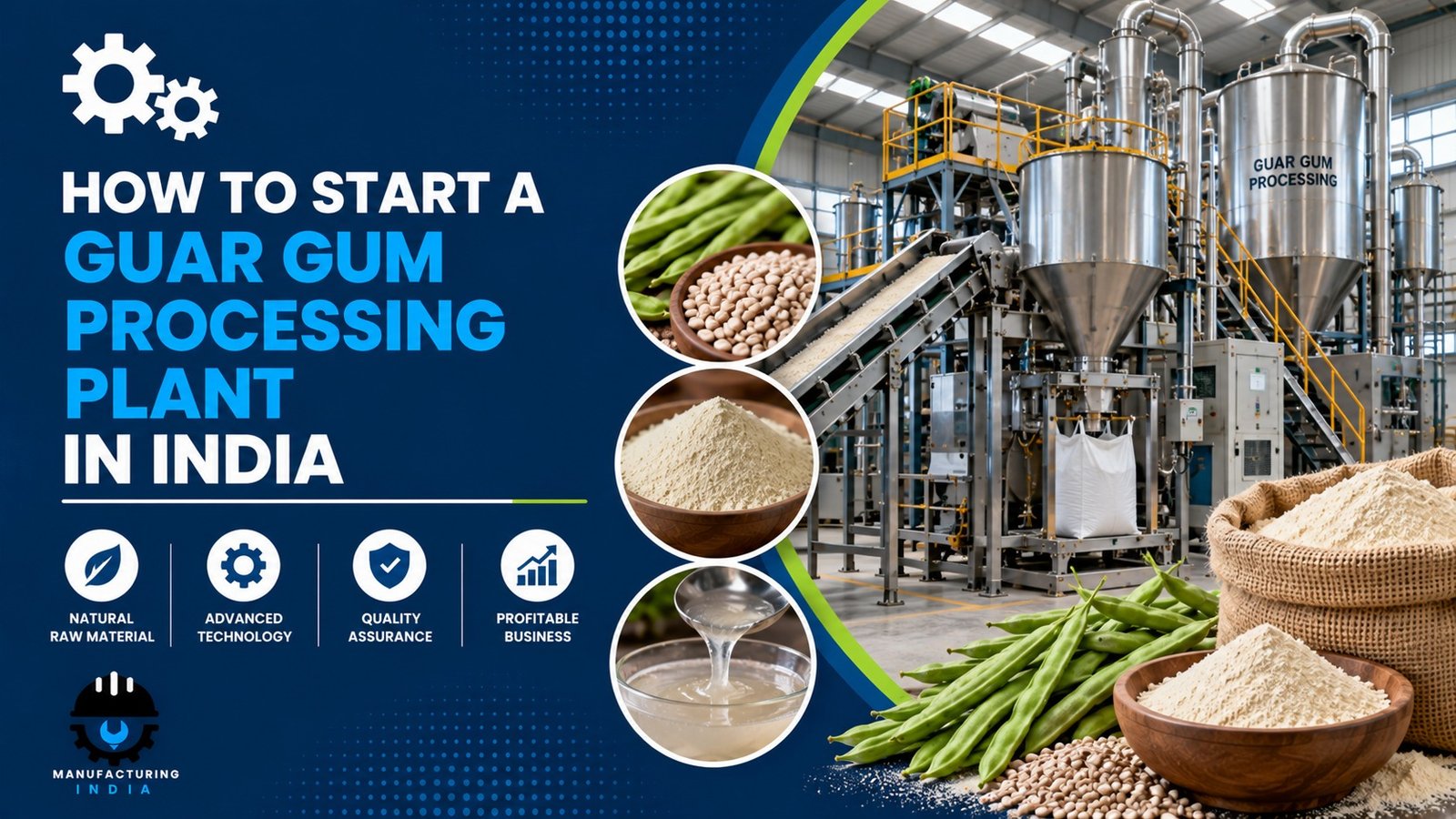
Setting up a guar gum processing plant in India presents a compelling investment case for entrepreneurs entering the natural hydrocolloids space. Demand is driven by the oil and gas industry, which uses guar gum in drilling and hydraulic-fracturing fluids, alongside food and beverages, pharmaceuticals, cosmetics, textile, paper, mining, water treatment, chemicals, and explosives manufacturers. These industries rely on guar gum’s strong thickening, water-binding, stabilizing, film-forming, and viscosity-control properties, making it a critical input across India’s industrial and export economy.
India is uniquely positioned to host a guar gum processing plant, accounting for about 80% of global guar production, with cultivation concentrated in Rajasthan’s arid and semi-arid regions. This locally sourced raw material base, paired with export orientation, gives domestic processors a structural cost advantage, making India a strategically sound base for this type of production.
Guar gum processing combines abundant domestic raw material availability with strong export demand and healthy profitability, with gross margins of 22–32% and net margins of 8–14%, supported by diversified end-use industries from oil and gas to pharmaceuticals, and a scalable capacity range that supports viable break-even economics across plant sizes.
What is Guar Gum?
Guar gum is a versatile polysaccharide derived from guar beans, valued for its thickening, stabilizing, and emulsifying properties. It enhances texture and shelf life in foods like ice cream, sauces, and gluten-free baked goods, with high viscosity and water-binding capability useful for controlling moisture and preventing syneresis. Beyond food, it serves as a disintegrant and conditioning agent in pharmaceuticals and cosmetics, a sizing agent in textiles, and a fracturing agent in oil and gas.
The guar gum processing process uses seed cleaning, conditioning, dehusking, degerming, separation of endosperm splits, hydration, flaking, drying, grinding, sieving, blending, quality testing, and packaging as its core operations. The finished product serves oil and gas, food and beverages, pharmaceuticals, cosmetics, textile, paper, mining, water treatment, chemicals, and explosives industries.
Cost of Setting Up a Guar Gum Processing Plant in India
Cost depends on capacity, technology, location, automation, and regulatory compliance.
1. Capital Expenditure (CapEx)
CapEx begins with land and site development – acquisition, registration, and site preparation, with industrial estates easing approvals. Civil works cover the processing shed, quality-control lab, storage, and administrative block. Machinery is the largest share of capital expenditure. Key machinery required includes:
- Raw-material receiving and storage systems
- Seed cleaners
- Magnetic separators
- Destoners
- Graders
- Seed conditioning units
- Roasters or heating systems
- Dehusking machines
- Degermination mills
- Hull separators
- Vibrating screens
- Pneumatic classifiers
- Gravity separators
- Guar-split separators
- Washing systems
- Hydration tanks or hydration conveyors
- Flakers
- Duct dryers
- Flash dryers
- Hammer mills
- Pin mills or ultrafine grinders
- Cyclone separators
- Air classifiers
- Rotary or vibrating sifters
- Blending machines
- Dust-collection systems
- Weighing and packing machines
- Sealing machines
- Finished-product storage systems
Other capital costs include effluent treatment plant installation, pre-operative expenses, commissioning, and import duties on any imported machinery.
Request a Sample Report for In-Depth Market Insights: https://www.imarcgroup.com/guar-gum-processing-plant-project-report/requestsample
2. Operational Expenditure (OpEx)
Raw material cost – guar seeds and water – dominates OpEx at approximately 55–65% of the total, so investors should pursue long-term supplier contracts to stabilize pricing. Utility cost, covering electricity, water, and steam, is around 10–14% of OpEx. Other operating costs include transportation, packaging, salaries, maintenance, depreciation, and taxes, with total operational cost expected to rise by year five due to inflation and market fluctuations.
3. Plant Capacity
The proposed plant is designed for annual capacity between 10,000 and 40,000 MT, enabling economies of scale while maintaining flexibility. Capacity can be customized to investor requirements, and profitability generally improves with higher capacity utilisation.
4. Profit Margins and Financial Projections
Financial projections cover capital investment, operating costs, capacity utilization, and pricing trends, feeding into ROI, net present value (NPV), internal rate of return (IRR), and payback period calculations. Gross margins typically range between 22–32%, and net margins between 8–14%, supported by stable demand.
Why Set Up a Guar Gum Plant in India?
Strong Export Potential. India is a major global supplier of guar gum. APEDA recorded 474,519.44 tonnes of exports worth USD 550.12 million in FY2024-25, underscoring established international demand.
Abundant Raw Material. Guar cultivation is concentrated in Rajasthan’s arid and semi-arid regions, supporting reliable local sourcing for any new plant.
Oil and Gas Demand. Guar gum’s viscosity-building and fluid-loss-control properties keep oil and gas a major industrial consumer.
Food Industry Growth. Natural hydrocolloids are widely used for thickening, stabilization, and water retention in processed foods, sustaining steady offtake.
Pharmaceutical Applications. Guar gum’s biocompatibility, biodegradability, and gel-forming properties support growing use in drug-delivery systems and controlled-release formulations.
Value Addition. Processing seeds into refined splits, powder, and modified derivatives generates more value than trading raw seeds, while a single plant can serve food, oil and gas, pharmaceutical, and textile customers, spreading demand risk.
Guar Gum Processing Process – Step by Step
The guar gum processing process uses seed cleaning, conditioning, dehusking, and degerming as its primary production method, followed by:
- Seed Cleaning: Guar seeds are cleaned using seed cleaners, magnetic separators, and destoners to remove impurities.
- Grading and Conditioning: Cleaned seeds are graded and passed through seed conditioning units and roasters or heating systems.
- Dehusking: Dehusking machines remove the outer husk from conditioned seeds.
- Degermination: Degermination mills separate the germ from the endosperm splits.
- Separation: Hull separators, vibrating screens, pneumatic classifiers, and gravity separators isolate splits using guar-split separators.
- Washing and Hydration: Washing systems clean the splits before hydration tanks or hydration conveyors.
- Flaking and Drying: Flakers convert hydrated splits into flakes, dried using duct dryers and flash dryers.
- Grinding: Hammer mills and pin mills or ultrafine grinders reduce flakes to required particle size.
- Classification and Sieving: Cyclone separators, air classifiers, and rotary or vibrating sifters refine particle size, with dust-collection systems removing dust.
- Blending, Testing, and Packaging: Blending machines standardize grades before quality testing, and weighing, packing, and sealing machines prepare product for finished-product storage and dispatch to end-use industries.
Key Applications
Guar gum’s versatility allows it to serve a wide range of industries.
- Oil and Gas: Manages viscosity, suspends particles, and lowers fluid loss in hydraulic fracturing and drilling fluids.
- Food and Beverages: Used in ice cream, dressings, dairy products, beverages, sauces, baked goods, canned goods, and pet food as a thickener and stabilizer.
- Pharmaceuticals: Used in drug delivery systems, hydrogels, tablets, and controlled-release formulations.
- Textile: Used in printing, sizing, and dye formulations for viscosity and film formation.
- Paper: Improves paper strength, retention, pulp hydration, and folding properties.
- Mining: Used as a flocculating and settling agent and filtration aid.
- Water Treatment: Used as a coagulant aid and viscosity-control material.
- Advanced Materials: Modified guar gum is investigated for packaging films, hydrogels, nanomaterials, and biomedical applications.
Leading Processors
Several leading companies dominate the guar gum processing industry, serving food and beverages, pharmaceuticals, cosmetics, textiles, and oil and gas end markets. Key players include:
- Hindustan Gum & Chemicals
- Jai Bharat Gum & Chemicals
- Vikas WSP, Ltd.
- India Glycols, Ltd.
- Shree Ram Industries
Timeline to Start the Plant
- Feasibility study and project report preparation
- Land acquisition and site development
- Regulatory approvals and environmental clearances
- Factory licence and fire safety compliance
- Machinery procurement and installation
- Raw material supplier agreements and supply chain setup
- Trial production and quality testing
- Commercial production launch
Licences and Regulatory Requirements
Starting a guar gum processing unit in India requires several approvals:
- Business registration (Proprietorship, LLP, or Pvt Ltd)
- Factory Licence under the Factories Act
- Environmental Clearance from State Pollution Control Board
- GST Registration
- Fire Safety NOC
- Effluent Treatment Plant (ETP) operational clearance
- Occupational Health and Safety compliance
Key Challenges to Consider
High Capital Requirements. Machinery, spanning seed cleaners through finished-product storage systems, accounts for the largest share of capital expenditure for this type of plant.
Raw Material Price Volatility. Guar seeds and water make up 55–65% of OpEx, so price swings can materially affect profitability.
Regulatory Compliance. Meeting environmental, factory licensing, and ETP requirements demands ongoing coordination with authorities.
Competition. Established players such as Hindustan Gum & Chemicals, Jai Bharat Gum & Chemicals, Vikas WSP, Ltd., India Glycols, Ltd., and Shree Ram Industries hold strong positions across end markets.
Skilled Manpower. The multi-stage process requires trained staff familiar with corrosion-resistant processing equipment.
Sustaining Export Quality. Meeting purity standards for export markets, which absorbed 474,519.44 tonnes of guar gum in FY2024-25, requires disciplined quality assurance.
Frequently Asked Questions
1. How much does it cost to set up a guar gum processing plant in India?
Cost depends on capacity, technology, location, and automation, with CapEx covering land, civil works, and machinery.
2. Is guar gum processing profitable in India in 2026?
Yes – gross margins of 22–32% and net margins of 8–14% are typical.
3. What machinery is required for a guar gum plant in India?
Core machinery includes seed cleaners, destoners, dehusking machines, degermination mills, flakers, dryers, grinders, and packing machines.
4. What licences and approvals are required to start a guar gum plant in India?
Requirements include business registration, a Factory Licence, Environmental Clearance, GST Registration, Fire Safety NOC, and ETP clearance.
5. What raw materials are needed for guar gum processing?
The primary raw materials are guar seeds and water.
6. What are the environmental compliance requirements for a guar gum plant in India?
Plants need Environmental Clearance from the State Pollution Control Board and an operational Effluent Treatment Plant.
7. What is the best location to set up a guar gum plant in India?
Locations near guar cultivation regions, particularly Rajasthan, offer the strongest raw material access and lowest sourcing costs.
8. What is the break-even period for this type of plant in India?
Break-even depends on capacity utilization, pricing, and cost structure, assessed through payback period and NPV analysis.
9. What government incentives are available for processors in India?
Applicable compliance and financial assistance considerations are outlined in the report’s regulatory and financial analysis sections.
Key Takeaways for Investors
This investment opportunity is backed by consistent demand from oil and gas, food and beverages, pharmaceuticals, textile, paper, mining, and water treatment industries. Financial projections indicate viable gross margins of 22–32% and net margins of 8–14% across the proposed 10,000–40,000 MT capacity range, supporting financial viability across plant sizes. With India accounting for about 80% of global guar production and the global guar gum market valued at USD 1.34 Billion in 2025, projected to reach USD 2.05 Billion by 2034 at a CAGR of 4.70%, the underlying demand base is well established and positioned for sustained long-term growth.
About the Author