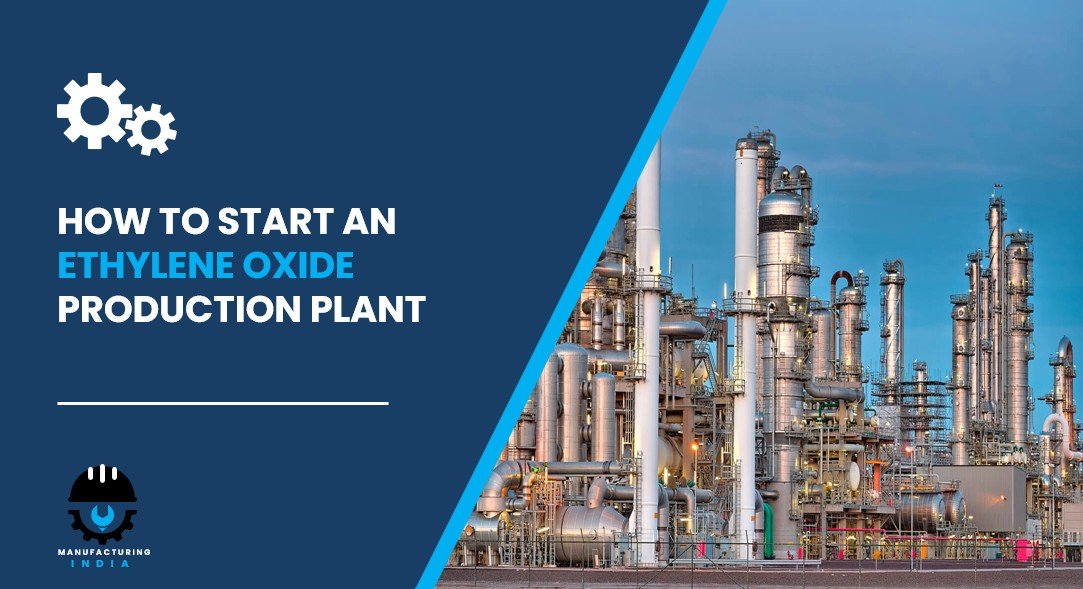
Setting up an ethylene oxide production plant in India represents a highly attractive investment proposition underpinned by robust and structurally growing demand from the surfactants and detergents industry, the ethylene glycol (antifreeze and PET/polyester value chain) segment, and the sterilization-grade healthcare sector. As global packaging, textile, and automotive industries expand, and as hygiene and sterilization standards in healthcare tighten worldwide, ethylene oxide (EO) available as a chemical intermediate and sterilant gas occupies an increasingly critical position across petrochemical, consumer goods, and medical device value chains. This growth trajectory, combined with steady feedstock availability from integrated ethylene crackers and strong downstream integration potential, creates a highly favourable manufacturing environment for new entrants with efficient oxidation, absorption, and purification systems.
What is Ethylene Oxide?
Ethylene oxide is a highly reactive, colourless organic chemical produced as a key intermediate for a wide range of industrial and consumer products. It is valued for its epoxide functional group, which enables efficient conversion into downstream derivatives such as ethylene glycols, ethoxylates, and ethanolamines. EO is handled as a pressurised liquid or gas under tightly controlled conditions owing to its flammability and toxicity, requiring strict process safety, containment, and vapour-control systems across production, storage, and transportation. Commercial EO is supplied in defined purity grades depending on downstream requirements, spanning chemical intermediate use and sterilisation-grade demand.
Beyond its role as a feedstock, ethylene oxide gas is used directly as a low-temperature sterilant for medical devices, pharmaceuticals, and other heat- or moisture-sensitive products, making purity control and residual-gas management central to plant design. Downstream, EO is converted into mono-, di-, and tri-ethylene glycol for the polyester and antifreeze value chains, and into ethoxylates that form the backbone of the global surfactant and detergent industry.
The global ethylene oxide market was valued at approximately USD 55.58 Billion in 2025 and is expected to reach USD 78.36 Billion by 2034, exhibiting a CAGR of 3.89% from 2026 to 2034, supported by sustained demand from the ethylene glycol, ethoxylate, and healthcare sterilisation segments.
Cost of Setting Up an Ethylene Oxide Production Plant
The total capital investment required to establish an ethylene oxide production plant is shaped by several key parameters: annual production capacity (typically ranging from 50,000 to 200,000 MT per annum), the oxidation technology and catalyst system adopted, the level of automation across the oxidation, absorption, and purification sections, facility specification, feedstock sourcing and integration strategy, and applicable process-safety and regulatory compliance requirements. Below is a structured breakdown of the major cost components.
1. Capital Expenditure (CapEx)
Total capital investment in an ethylene oxide production plant covers the following major heads:
Land and Site Development
This encompasses land acquisition or lease, site preparation, boundary development, and utilities connectivity. Site selection should prioritise proximity to integrated ethylene crackers or reliable pipeline access to ethylene and oxygen feedstock, as transportation of these hazardous gases over long distances is both costly and safety-intensive. Access to reliable power, steam, and cooling water infrastructure for the oxidation, absorption, and purification processes, strong road, rail, and pipeline logistics for feedstock and finished product, and a trained workforce experienced in hazardous chemical handling are critical site selection criteria. Compliance with industrial zoning regulations, process safety management standards, fire and explosion safety norms applicable to flammable gas operations, and effluent and emission compliance frameworks must be assessed from project initiation.
Civil Works and Construction
Building costs cover the main processing facility including the oxidation reactor section, EO absorption and stripping area, purification and distillation block, refrigerated storage tank farm, loading and dispatch infrastructure, quality control laboratory, administrative block, and utility infrastructure including boiler house, power backup, cooling water systems, flare and vent-gas recovery systems, and effluent treatment plant. Construction must comply with applicable factory act requirements, process safety management standards, explosion-proofing norms for flammable gas handling areas, and hazardous chemical storage guidelines.
Machinery and Equipment
Machinery represents the single largest CapEx component. Key equipment required for an ethylene oxide production plant includes:
- Feedstock Purification Systems: Gas purification and drying units for incoming ethylene and oxygen streams to remove moisture and trace impurities that can poison the oxidation catalyst
- Catalytic Oxidation Reactors: Tubular fixed-bed reactors packed with silver-based catalyst, operating under controlled temperature and pressure to convert ethylene and oxygen into ethylene oxide with high selectivity
- EO Absorption Systems: Absorption columns using chilled water to capture ethylene oxide vapour from the reactor off-gas, forming a dilute aqueous EO solution for downstream processing
- CO2 Removal Units: Carbon dioxide scrubbing and recovery systems to remove combustion by-products from the recycle gas loop and maintain reactor efficiency
- Stripping and Concentration Columns: Stripping towers that recover and concentrate ethylene oxide from the absorbent water, producing a high-purity EO vapour stream for purification
- Purification and Distillation Systems: Multi-stage distillation columns that remove light ends, water, and trace impurities to achieve commercial-grade and sterilisation-grade EO purity specifications
- Refrigerated Storage Tanks: Pressurised, temperature-controlled storage vessels designed to hold liquid ethylene oxide safely given its low boiling point, flammability, and reactivity
- Safety and Vent Systems: Flame arrestors, flare systems, inert-gas blanketing, pressure-relief systems, and continuous gas-leak detection instrumentation designed to applicable explosion-safety standards
- Boiler and Steam Generation: Steam boilers and heat-recovery systems to supply process steam and recover reaction heat for the oxidation, stripping, and distillation operations
- Loading and Dispatch Facilities: Specialised pressurised loading arms and tanker-filling infrastructure for the safe dispatch of liquid ethylene oxide to downstream users
- Quality Control Laboratory Equipment: Gas chromatography and analytical instruments for purity, moisture, and impurity testing to verify compliance with commercial and sterilisation-grade specifications
- Material Handling and Instrumentation: Pipeworks, compressors, pumps, and distributed control systems (DCS) for continuous, closely monitored plant operation
Other Capital Costs
These include pre-operative expenses, commissioning charges, import duties on specialised oxidation and purification equipment, staff training and competency development in hazardous chemical handling, initial catalyst charge and consumable inventory for production commissioning, regulatory compliance setup including hazardous chemical storage licensing, process safety management system establishment, and ISO 9001 / ISO 45001 quality and occupational safety management system establishment costs.
Request a Sample Report for In-Depth Market Insights: https://www.imarcgroup.com/ethylene-oxide-manufacturing-plant-project-report/requestsample
2. Operational Expenditure (OpEx)
Raw materials principally ethylene, industrial oxygen, and silver-based catalyst constitute the dominant operating cost, typically representing 70-80% of total OpEx. Utility costs, driven primarily by steam generation, electricity consumption of the oxidation and refrigeration systems, and cooling water circulation, account for 10-15% of OpEx. Labour, maintenance, quality control, packaging, transportation, depreciation, taxes, and overhead costs constitute the remainder of the operating cost base.
3. Plant Capacity
The proposed ethylene oxide production facility is designed with an annual production capacity ranging between 50,000-200,000 MT, enabling economies of scale while maintaining operational flexibility. This capacity range supports supply to downstream ethylene glycol, ethoxylate, and sterilisation-grade EO customers, serving domestic petrochemical markets, food and healthcare packaging value chains, and export channels.
4. Profit Margins and Financial Projections
The project demonstrates healthy profitability potential under normal operating conditions. Financial projections encompass capital investment, operating costs, capacity utilisation ramp-up schedule, product mix between merchant EO sales and downstream-integrated derivatives, and forward demand outlook underpinned by sustained ethylene glycol and ethoxylate consumption. A comprehensive feasibility analysis includes sensitivity analysis, Net Present Value (NPV), Internal Rate of Return (IRR), and Payback Period calculations. Gross profit margins for ethylene oxide production typically range from 25-35%, supported by stable downstream demand and efficient feedstock utilisation. Net profit margins of 10-20% are achievable with disciplined cost management, optimal capacity utilisation, and effective catalyst and energy management.
Why Set Up an Ethylene Oxide Production Plant?
Strategic Building-Block Position in the Petrochemical Value Chain
Ethylene oxide sits at the centre of multiple high-volume chemical chains, feeding directly into ethylene glycol and ethoxylate production. This central position makes it a strong platform molecule for diversified revenue streams, allowing producers to serve the polyester and packaging industry, the detergent and surfactant industry, and specialty chemical markets from a single production base.
Integration Advantage with Downstream Derivatives
Projects integrated with downstream mono-, di-, and tri-ethylene glycol production or ethoxylation units can capture margin across the value chain rather than selling merchant EO alone, improving resilience against feedstock and commodity price cyclicality while unlocking higher blended realisations.
Demand Anchored to Everyday Consumption
Detergents, packaging, textiles, and automotive coolant demand create recurring, non-discretionary pull-through for EO derivatives, supporting steady capacity utilisation even through broader economic cycles. This demand resilience distinguishes EO derivatives from more discretionary chemical end-uses.
Rising Healthcare Sterilisation Demand
Growing global healthcare infrastructure and rising output of single-use medical devices, surgical kits, and pharmaceutical packaging are driving sustained demand for sterilisation-grade ethylene oxide, a low-temperature sterilant of choice for heat- and moisture-sensitive medical products where alternative sterilisation methods are unsuitable.
Expanding Polyester and PET Packaging Value Chain
Ethylene oxide is a critical precursor to monoethylene glycol (MEG), the key feedstock for polyester fibres and PET resins used in packaging, textiles, and bottling applications. Regulatory shifts favouring recycled and virgin PET quality standards, including recent guidelines mandating minimum recycled-content thresholds in food-grade PET packaging in several markets, continue to support long-term MEG and, by extension, EO demand.
High Safety and Compliance as a Competitive Moat
Stringent process safety management, containment, and environmental control requirements for handling a flammable and toxic gas raise execution requirements for new entrants, favouring well-capitalised, quality-focused operators and creating a natural barrier to fragmented, undercapitalised competition.
Import Substitution and Regional Supply Security
In markets with EO or EO-derivative supply gaps, local production can reduce dependence on imports, shorten lead times for downstream formulators, and improve regional supply reliability, particularly given the safety and cost challenges associated with transporting ethylene oxide over long distances.
Manufacturing Process Overview
The ethylene oxide production process converts ethylene and oxygen feedstock into purified ethylene oxide through a sequence of catalytic oxidation, absorption, stripping, and purification operations. The key process stages are:
- Feedstock Purification: Incoming ethylene and industrial oxygen streams are purified and dried to remove moisture, sulphur compounds, and trace impurities that can poison or deactivate the silver-based oxidation catalyst.
- Catalytic Oxidation: Purified ethylene and oxygen, blended with recycle gas and a small moderating agent stream, are fed into tubular fixed-bed reactors packed with silver catalyst operating at controlled temperature and pressure, where ethylene is selectively oxidised to ethylene oxide while a portion combusts fully to carbon dioxide and water as an unavoidable side reaction.
- Heat Recovery: The strongly exothermic oxidation reaction generates significant process heat, which is recovered through the reactor cooling system to raise steam for use elsewhere in the plant, materially improving overall energy efficiency.
- EO Absorption: Reactor off-gas containing dilute ethylene oxide vapour is contacted with chilled water in absorption columns, capturing the EO into a dilute aqueous solution while unreacted ethylene and oxygen are recycled back to the oxidation reactors.
- CO2 Removal: A slipstream of the recycle gas passes through carbon dioxide scrubbing units to remove the CO2 generated by the combustion side-reaction, preventing its build-up in the closed-loop recycle system and preserving catalyst performance.
- Stripping and Concentration: The dilute aqueous EO solution is fed to stripping columns, where ethylene oxide is vaporised and concentrated, producing a high-purity EO vapour stream while the stripped water is recycled to the absorption section.
- Purification and Distillation: Concentrated ethylene oxide vapour undergoes multi-stage distillation to remove water, light ends such as carbon dioxide and residual ethylene, and trace impurities, yielding commercial-grade or sterilisation-grade liquid ethylene oxide meeting downstream purity specifications.
- Refrigerated Storage: Purified liquid ethylene oxide is transferred to pressurised, temperature-controlled storage tanks designed to safely contain the product given its low boiling point, high flammability, and reactivity, with continuous inert-gas blanketing and leak-detection monitoring.
- Quality Control: Purified ethylene oxide is tested using gas chromatography and other analytical methods for purity, moisture content, and impurity levels to verify compliance with commercial and sterilisation-grade quality standards before release.
- Loading and Dispatch: Liquid ethylene oxide is dispatched via specialised pressurised tank cars, ISO tank containers, or dedicated pipelines to downstream ethylene glycol, ethoxylation, and sterilisation customers, following stringent hazardous-material handling and transport protocols.
Key Applications of Ethylene Oxide
The ethylene oxide market serves several major end-use segments across the petrochemical, consumer goods, and healthcare sectors:
- Ethylene Glycol Production: The largest application of ethylene oxide, used to manufacture mono-, di-, and tri-ethylene glycol for the polyester fibre and PET resin value chain, as well as antifreeze and coolant formulations for the automotive and industrial sectors.
- Surfactants, Detergents, and Emulsifiers: Ethylene oxide is reacted with fatty alcohols and other substrates through ethoxylation to produce non-ionic surfactants used extensively in household and industrial detergents, personal care formulations, and emulsifiers.
- Ethanolamines and Glycol Ethers: EO-derived ethanolamines are used in gas treatment, personal care, and agrochemical formulations, while glycol ethers serve as solvents in paints, coatings, and cleaning products.
- Healthcare Sterilisation: Ethylene oxide gas is widely used to sterilise medical devices, surgical instruments, and disposable healthcare products that cannot withstand heat or moisture-based sterilisation methods, making it indispensable to modern medical device manufacturing.
- Solvents and Cellulose Ethers: EO derivatives serve as industrial solvents and as feedstock for cellulose ether production used in construction materials, pharmaceuticals, and food formulations.
Global Ethylene Oxide Market Outlook
The global ethylene oxide market was valued at approximately USD 55.58 Billion in 2025. According to IMARC Group estimates, the market is expected to reach USD 78.36 Billion by 2034, exhibiting a CAGR of 3.89% from 2026 to 2034. The ethylene oxide market benefits from multiple structural demand drivers:
- Sustained demand for ethylene glycol from the global polyester fibre, PET resin, and packaging industries, supported by continued growth in textiles and food and beverage packaging
- Rising consumption of ethoxylate-based surfactants and detergents across household, institutional, and industrial cleaning applications globally
- Expanding healthcare infrastructure and single-use medical device manufacturing, driving sustained demand for sterilisation-grade ethylene oxide
- Regulatory developments favouring recycled and higher-quality PET packaging, such as mandated minimum recycled-content thresholds for food-grade packaging in several jurisdictions, supporting the broader polyester value chain
- Continued capacity investment by major petrochemical producers integrating ethylene oxide production with downstream glycol and ethoxylate units to capture value-chain margins
- Growing capacity additions in Asia-Pacific and the Middle East, reflecting strong regional demand growth for EO derivatives and continued investment in petrochemical integration
- Ongoing focus on energy-efficient catalytic oxidation technologies and improved catalyst selectivity, supporting margin resilience amid feedstock cost volatility
Major players in the global ethylene oxide industry include Dow, Shell, SABIC, LyondellBasell, and BASF, serving end-use sectors including detergents and surfactants, the polyester and packaging value chain via monoethylene glycol, and healthcare sterilisation.
Latest Industry Developments
- November 2024: Sinopec announced the successful start-up of a new ethylene complex in northern China, with the facility designed around a 1.2 million tonnes per annum ethylene plant intended to supply feedstock for approximately 4 million tonnes annually of downstream high-end chemical products and fine chemical intermediates, including ethylene oxide derivatives.
- 2024-2025: Asia-Pacific capacity additions continued at pace, with Shandong Yulong Petrochemical commencing operations at a 0.73 million tonnes per annum ethylene oxide plant in Longkou, China, in 2024, while BASF has been advancing a major integrated complex in Zhanjiang, China, that includes a 0.66 million tonnes per annum ethylene oxide unit, reflecting sustained investor confidence in regional EO and derivatives capacity growth.
Licenses and Regulatory Requirements
Establishing an ethylene oxide production unit requires a range of approvals and certifications, which may vary by country and jurisdiction, including:
- Business registration and company incorporation under applicable company law
- Factory License under applicable state Factories Act provisions for manufacturing operations
- Hazardous and Process Chemicals (Manufacturing, Storage and Import) Rules compliance for ethylene oxide and other flammable, toxic feedstock handling
- Explosive and pressurised-gas storage licenses from the applicable Petroleum and Explosives Safety Organisation or equivalent national authority
- Process Safety Management (PSM) certification and hazard and operability (HAZOP) study documentation for the oxidation and storage sections
- Pollution Control Board Clearances – Consent to Establish (CTE) and Consent to Operate (CTO) – for manufacturing operations involving flammable gas processing and effluent generation
- ISO 9001:2015 Quality Management System Certification for quality management infrastructure compliance
- ISO 45001 Occupational Health and Safety Management System Certification, particularly critical given the toxicity and flammability of ethylene oxide
- ISO 14001 Environmental Management System Certification for emission and effluent compliance
- Weights and Measures (Legal Metrology) registration for product labelling and net quantity declaration
- Export-Import Code (IEC) for international market access
- Transport permits and hazardous goods certification for pressurised tank car, ISO tank container, or pipeline dispatch of liquid ethylene oxide
Key Challenges to Consider
Feedstock Price Volatility
Ethylene, which accounts for 70-80% of total operating costs, is a commodity petrochemical subject to crude oil and naphtha price cycles, cracker utilisation rates, and regional feedstock availability. Price volatility in ethylene and industrial oxygen can materially affect margins, making feedstock supply contracts and, where feasible, backward integration into ethylene production important risk mitigation strategies.
Process Safety and Hazardous Material Handling
Ethylene oxide is highly flammable, toxic, and can form explosive mixtures with air across a wide concentration range, introducing significant fire, explosion, and occupational health hazards. These must be managed through explosion-proof equipment, continuous gas-leak detection, inert-gas blanketing, and rigorous process safety management protocols compliant with hazardous chemical handling regulations. Any lapse in containment increases regulatory and safety exposure and can result in operational shutdowns.
Catalyst Performance and Replacement Costs
The silver-based catalyst used in the oxidation reactor gradually loses selectivity and activity over its operating life, requiring periodic replacement at significant cost. Catalyst performance directly affects EO yield, energy consumption, and by-product formation, making catalyst management and supplier relationships a critical operational and cost-control priority.
Downstream Demand Concentration
A substantial share of EO demand is concentrated in the ethylene glycol and ethoxylate segments, both of which are themselves exposed to cyclical demand from the polyester, packaging, and detergent industries. Producers without downstream integration or diversified offtake arrangements face greater exposure to demand and pricing fluctuations in these end markets.
Capital Intensity and Long Payback Periods
Ethylene oxide production, particularly integrated facilities combining oxidation with downstream glycol or ethoxylation units, represents a capital-intensive undertaking with long project gestation and payback periods. New entrants must carefully evaluate capacity scale, integration strategy, and financing structure against target markets and long-term strategic positioning.
Environmental and Emissions Compliance
Ethylene oxide production generates carbon dioxide as an unavoidable by-product of the oxidation reaction, and fugitive emissions of EO itself are subject to increasingly stringent environmental and occupational exposure limits in many jurisdictions. Maintaining compliance requires ongoing investment in vent-gas recovery, emission monitoring, and abatement systems.
Frequently Asked Questions (FAQs)
1. How much does it cost to set up an ethylene oxide production plant?
The total investment depends on plant capacity (50,000-200,000 MT per annum), the oxidation technology and catalyst system adopted, automation level, facility specification, location, and target market certifications. Costs cover land, civil construction (oxidation section, absorption and stripping area, purification and distillation block, refrigerated storage tank farm, quality laboratory, utilities), machinery (oxidation reactors, absorption columns, stripping and distillation systems, refrigerated storage, safety systems), quality certifications, working capital, and regulatory compliance. A comprehensive feasibility study from IMARC Group provides detailed, capacity-specific cost estimates covering all CapEx and OpEx components.
2. Is ethylene oxide production a profitable business in 2026?
Yes. Sustained demand from the ethylene glycol, surfactant, and healthcare sterilisation segments, combined with gross margins of 25-35% and net profit margins of 10-20%, make ethylene oxide production financially attractive. Integration with downstream glycol or ethoxylation units offers meaningful margin enhancement opportunities above what merchant EO sales alone would generate.
3. What machinery and equipment are required for an ethylene oxide production plant?
Key equipment includes feedstock purification and drying systems, catalytic oxidation reactors with silver-based catalyst, EO absorption columns, CO2 removal units, stripping and concentration columns, multi-stage purification and distillation systems, refrigerated pressurised storage tanks, safety and vent-gas recovery systems, steam boilers, quality control laboratory equipment, and specialised pressurised loading facilities for dispatch.
4. What licenses and approvals are required?
Required approvals include company registration, Factory License, hazardous chemical storage and handling licenses, Process Safety Management certification, Pollution Control Board clearances, ISO 45001 occupational health and safety certification, and ISO 14001 environmental management certification. Given the toxicity and flammability of ethylene oxide, process safety management and hazardous material handling licenses are mandatory legal prerequisites for manufacturing operations.
5. How long does it take to commission an ethylene oxide production plant?
Typically, 18-30 months from project initiation to commercial production launch, depending on project scale, facility construction timeline, equipment procurement lead times for oxidation and purification systems, regulatory approvals, and process safety certification timelines, which should be initiated early in the project to avoid delays to commercial launch.
6. What are the key raw materials for ethylene oxide production?
The primary raw materials are ethylene and industrial oxygen, together with a silver-based catalyst used in the oxidation reactor. Other key inputs include moderating agents for reaction control, chilled water for the absorption process, and specialised pressurised packaging and transport equipment for the finished liquid product.
7. What is the break-even period for an ethylene oxide production plant?
The break-even period generally depends on capacity utilisation ramp-up trajectory, the product mix between merchant EO sales and downstream-integrated derivatives, feedstock supply consistency, and offtake arrangements with glycol and ethoxylate customers. Securing long-term ethylene supply agreements and stable offtake arrangements for EO or its derivatives significantly improves revenue predictability and supports faster break-even achievement.
8. What are the main grades of ethylene oxide and their applications?
The two principal grades are commercial-grade ethylene oxide, used as a chemical intermediate for ethylene glycol, ethoxylates, and ethanolamines, and sterilisation-grade ethylene oxide, produced to higher purity specifications for use as a low-temperature sterilant for medical devices, pharmaceuticals, and other heat-sensitive healthcare products.
9. What government incentives are available for ethylene oxide producers?
Processors may benefit from petrochemical sector investment incentives, state-level industrial investment incentives and capital subsidies for chemical manufacturing units, infrastructure support under petrochemical and chemical industrial park schemes, and export promotion benefits for EO derivatives. Evolving downstream regulations, such as recycled-content mandates for PET packaging, also indirectly support demand for ethylene glycol and its EO feedstock.
10. How does ethylene oxide production compare to other petrochemical processing in terms of setup?
Compared to other olefin-derivative processing, ethylene oxide production requires significantly higher investment in process safety, containment, and vapour-control infrastructure given the flammability and toxicity of the intermediate. The catalytic oxidation, absorption, and purification technology employed is well-established, allowing processors with experience in petrochemical operations to adapt existing technical capabilities to ethylene oxide with targeted investment in safety and refrigerated storage infrastructure.
Key Takeaways for Investors
The ethylene oxide production industry represents a structurally resilient and financially attractive investment opportunity positioned at the intersection of the global polyester and packaging value chain, the detergent and surfactant industry, and the healthcare sterilisation sector. Stable demand from ethylene glycol, ethoxylate, and sterilisation channels provides resilience against single-segment demand volatility, while integration with downstream glycol or ethoxylation units offers meaningful margin enhancement beyond merchant EO sales alone. The central, platform-molecule position of ethylene oxide within the petrochemical value chain provides diversified revenue exposure, while continued capacity investment by established petrochemical players in Asia-Pacific and the Middle East reflects strong confidence in the long-term growth and profitability of the category. The high safety and process compliance requirements inherent to EO production create a natural barrier to fragmented competition, allowing well-capitalised investors to build a durable, quality-focused market position.
About the Author