Setting up a food processing plant in India presents a compelling investment case driven by the rising demand for packaged and ready-to-eat foods, rapid urbanisation, and the expanding consumption of processed products across retail and foodservice channels. The food processing sector serves structurally stable end-use industries including retail food, hospitality, institutional catering, and foodservice – all of which are experiencing sustained volume growth as Indian households shift toward convenience-oriented consumption. The production of processed fruits and vegetables, ready-to-eat meals, packaged snacks, dairy products, and sauces and condiments is increasingly critical to India’s food security infrastructure, making this processing segment both economically significant and commercially resilient.
India offers a unique combination of advantages that make it an ideal destination for establishing a food processing plant. The country’s rapid urbanisation, the rise of nuclear families, an expanding working population, and the proliferation of modern retail formats and quick-service restaurants are collectively accelerating demand for standardised and shelf-stable food products. Government initiatives supporting food parks, cold-chain logistics, agro-processing clusters, and export incentives are strengthening the broader food processing ecosystem. Processing states with strong agricultural supply chains and logistics connectivity provide ideal locations for this type of plant, ensuring proximity to raw material sources and target markets alike.
Establishing a food processing plant in India combines strong policy tailwinds under government schemes with a cost-competitive processing environment. The facility is projected to deliver gross margins of 30-40% and net profit margins of 12-18%, serving robust demand from retail, hospitality, institutional catering, and foodservice sectors. With a realistic capacity of 10,000-20,000 MT per year, the break-even trajectory and long-term demand sustainability make this an investment case worth serious consideration.
What is Food Processing?
Food refers to any nutritious matter that comes from plants, animals, or fungi and is consumed by human beings and other living organisms for the purpose of gaining energy. Food consists of important nutrients such as carbohydrates, which provide energy; proteins, which are used to repair and build tissues; and fats, vitamins, and minerals, which are used by the body for various functions. Food plays important roles in human life, not only as a source of energy but also as a means of satisfying social and emotional needs.
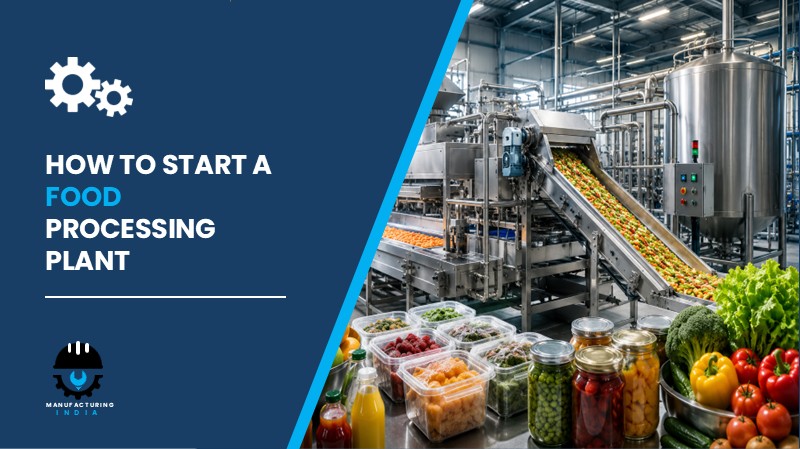
A food processing plant converts raw agricultural inputs into value-added, shelf-stable, or ready-to-consume products. The primary production method involves a multi-stage process of cleaning, grading, milling or cooking, dehydration or freezing, blending, and packaging – transforming raw fruits, vegetables, and other agricultural inputs into standardised, commercially viable products. Key product categories produced in such a facility include ready-to-eat meals, packaged snacks, processed fruits and vegetables, dairy products, and sauces and condiments. The end-use industries served include retail food, hospitality, institutional catering, and foodservice, all of which represent high-volume, recurring demand channels within India’s evolving consumption landscape.
Cost of Setting Up a Food Processing Plant in India
The total cost of establishing a food processing plant in India depends on several variables including plant capacity, technology selection, geographic location, level of automation, and compliance with food safety and environmental regulations. Both capital expenditure and operational expenditure must be planned carefully to build a viable, long-term investment.
1. Capital Expenditure (CapEx)
The capital investment for a food processing plant covers several major heads:
Land and Site Development – constitutes a substantial portion of the total CapEx, including land registration charges, boundary development, and associated infrastructure. Investors may consider locating within a designated food park, Special Economic Zone (SEZ), or industrial estate to benefit from concessional land rates and shared infrastructure.
Civil Works and Construction cost – include the main production shed, quality control laboratory, cold storage, raw material and finished goods warehouses, and administrative block – all of which must comply with food safety design standards.
The machinery and equipment investment represents the largest single component of CapEx. Key machinery required includes:
- Industrial washers
- Slicers and dicers
- Mixers and blenders
- Cooking and pasteurization systems
- Freezing or dehydrating tunnels
- Portioning machines
- Primary and secondary packaging lines
Other Capital Costs – include effluent treatment plant (ETP) installation, pre-operative expenses, commissioning costs, and import duties on specialised processing equipment where applicable.
Request a Sample Report for In-Depth Market Insights: https://www.imarcgroup.com/food-processing-plant-project-report/requestsample
2. Operational Expenditure (OpEx)
The operating cost structure of a food processing plant is primarily driven by raw material consumption.
Raw Material Cost – covering various fruits and vegetables, packaging materials, and preservatives – accounts for approximately 60-70% of total operating expenses. Investors are advised to establish long-term procurement contracts with reliable suppliers to mitigate price volatility and ensure production continuity.
Utility Cost – covering electricity, water, and steam consumed during processing, cleaning, and cold storage, accounts for 15-20% of total OpEx.
Other Operating Costs – include transportation, packaging, salaries and wages, depreciation, taxes, and repairs and maintenance – each of which must be planned as a recurring line item. By the fifth year of operations, total operational cost is expected to increase substantially due to inflation, market fluctuations, and potential rises in the cost of key raw materials, along with supply chain disruptions and rising consumer demand.
3. Plant Capacity
The proposed food processing facility is designed with an annual production capacity ranging between 10,000 and 20,000 MT, enabling economies of scale while maintaining operational flexibility. Capacity can be customized per investor requirements based on available capital, target markets, and product portfolio. Profitability of the food processing plant improves significantly with higher capacity utilisation, as fixed costs – land, civil works, machinery – are spread across a larger volume of production.
4. Profit Margins and Financial Projections
The food processing plant project demonstrates strong profitability potential under normal operating conditions. Gross profit margins typically range between 30-40%, supported by stable demand and value-added applications across retail and institutional channels. Net profit margins are projected at 12-18% on an average basis across the five-year financial projection horizon. Key financial metrics including Net Present Value (NPV), Internal Rate of Return (IRR), payback period, and sensitivity analysis are covered in detail within the full project report, providing investors with a comprehensive view of viability, ROI, and long-term sustainability.
Why Set Up a Food Processing Plant in India?
Essential Consumer Sector Demand: Food processing is a backbone industry that ensures food availability, safety, and convenience across urban and rural markets, making it a structurally stable and recession-resilient sector. India’s large and growing population ensures sustained, non-cyclical demand that underpins long-term revenue visibility for investors in this segment.
Megatrend Alignment Driving Volume Growth: Rapid urbanisation, an increasing working population, the rise of nuclear families, and the expansion of modern retail formats are fuelling demand for processed and convenience foods across India. Consumers are increasingly opting for ready-to-eat, ready-to-cook, and packaged food products, which provide convenience without compromising taste and nutritional value.
Policy and Infrastructure Push: Government initiatives supporting food parks, cold-chain logistics, agro-processing clusters, and export incentives are indirectly strengthening the food processing ecosystem across India. These policy tailwinds reduce infrastructure investment risk and create a more favourable operating environment for new entrants in this processing category.
Cost-Competitive Processing Environment: India offers competitive land acquisition costs, a large and trainable labour force, and well-developed agricultural supply chains that reduce input procurement costs. Locating a food processing manufacturing plant near agricultural production zones ensures freshness, reduces logistics costs, and improves overall operational efficiency.
Active Industry Investment Confirming Confidence: In September 2025, Reliance Consumer Products Ltd (RCPL) signed a ₹40,000-crore agreement with the Food Processing Industries Ministry to establish integrated food processing facilities across the country, signalling institutional confidence in the sector’s long-term growth trajectory. In the same month, three Coca-Cola bottlers in India – SLMG Beverages, Hindustan Coca-Cola Beverages (HCCB), and Kandhari Group – committed ₹25,760 crore (USD 2.96 Billion) to expand food processing infrastructure, signing memoranda of understanding with the Ministry of Food Processing Industries for greenfield and brownfield projects.
Local Supply Chain Preference: Foodservice operators and retailers prefer regional suppliers to ensure freshness, reduce logistics costs, and build supply chain reliability – providing a strong commercial opportunity for locally established food processors. This preference for regional sourcing creates a durable competitive moat for new plants established in proximity to their end-use customers.
Processing Process – Step by Step
The food processing process uses cleaning, grading, milling or cooking, dehydration or freezing, blending, and packaging as the primary production method. The process flow is a multi-step operation involving several unit operations, material handling, and quality checks at each stage.
- Cleaning: Raw inputs including various fruits and vegetables are thoroughly washed using industrial washers to remove contaminants, pesticide residues, and foreign matter before processing begins.
- Grading and Sorting: Raw materials are graded by size, ripeness, and quality to ensure consistent product output and minimize downstream wastage.
- Milling or Cooking: Depending on the end product, raw materials pass through cooking and pasteurization systems or milling equipment to convert inputs into their processed intermediate form.
- Dehydration or Freezing: Processed intermediates are passed through freezing or dehydrating tunnels to extend shelf life and preserve nutritional value, depending on the product category.
- Blending: Mixers and blenders combine processed ingredients with preservatives and other components to achieve standardised product formulations meeting quality assurance criteria.
- Slicing and Dicing: Slicers and dicers portion raw or processed materials to required specifications, ensuring product consistency across batches.
- Portioning: Portioning machines allocate the correct product volumes for packaging, maintaining weight accuracy and reducing giveaway.
- Primary and Secondary Packaging: Finished products are sealed, labelled, and packed into primary consumer units and secondary shipping cartons using automated packaging lines before dispatch to retail food, hospitality, institutional catering, and foodservice end-use industries.
Key Applications
The food processing plant serves a broad range of industries and end-use channels, each representing a distinct and significant demand segment.
- Retail Food: Production of ready-to-eat meals, packaged snacks, processed fruits and vegetables, and sauces and condiments for sale through modern retail and online grocery channels.
- Hospitality: Supply of standardised, shelf-stable processed food products to hotels, restaurants, and catering operations requiring consistent quality at scale.
- Institutional Catering: Processed food products supplied to schools, hospitals, corporate cafeterias, and large-scale institutional kitchen operators.
- Foodservice: Processed ingredients and finished products supplied to quick-service restaurants, food delivery operators, and cloud kitchens requiring high-volume, reliable supply.
- Food Processing Equipment Applications: Power and control for mixers, ovens, conveyors, and processing machinery within integrated food processing environments.
- Quality Control and Instrumentation: Wiring and connections for sensors, inspection systems, temperature probes, and monitoring devices that support food safety compliance.
Leading Manufacturers
The global food processing industry is served by several multinational companies with extensive production capacities and diverse application portfolios across all major end-use sectors. Key players in the global food processing industry include:
- Nestlé
- PepsiCo
- Unilever
- Tyson Foods
- Kraft Heinz
Timeline to Start the Plant
Establishing a food processing plant in India involves a structured sequence of planning, regulatory, procurement, and commissioning activities. A realistic project timeline covers the following phases:
- Feasibility study and project report preparation
- Land acquisition and site development
- Regulatory approvals and environmental clearances
- Factory licence and fire safety compliance
- Machinery procurement and installation
- Raw material supplier agreements and supply chain setup
- Trial production and quality testing
- Commercial production launch
Licences and Regulatory Requirements
Starting a food processing unit in India requires several approvals across central, state, and sector-specific regulatory bodies:
- Business registration (Proprietorship, LLP, or Pvt Ltd)
- Factory Licence under the Factories Act
- Environmental Clearance from State Pollution Control Board
- GST Registration
- Fire Safety NOC
- FSSAI (Food Safety and Standards Authority of India) licence for food production and handling compliance
- Effluent Treatment Plant (ETP) operational clearance
- Occupational Health and Safety compliance
Key Challenges to Consider
High Capital Requirements: The food processing plant involves significant upfront investment in machinery – including industrial washers, pasteurization systems, and packaging lines – along with civil works and ETP infrastructure, which can be a barrier for smaller investors without access to structured debt financing.
Raw Material Price Volatility: The primary inputs – various fruits and vegetables, packaging materials, and preservatives – are subject to seasonal availability fluctuations and commodity price cycles, creating margin pressure during periods of supply disruption or crop failure.
Regulatory Compliance: Food safety and quality regulations in India are enforced at multiple levels including FSSAI licensing, environmental clearance, and factory safety compliance. Ongoing adherence requires dedicated quality control systems and documentation infrastructure.
Technology and Innovation Pressure: The global food processing sector is experiencing steady growth driven by evolving consumer lifestyles and increasing awareness of food safety and quality. Investors must ensure their technology selection remains aligned with current processing standards to maintain product competitiveness.
Competition from Established Players: The market includes large multinational players such as Nestlé, PepsiCo, Unilever, Tyson Foods, and Kraft Heinz, which possess significant scale and brand advantages. New entrants must differentiate on localisation, responsiveness, and cost efficiency to compete effectively.
Skilled Manpower: Operating a food processing plant with automated packaging lines, quality control instrumentation, and pasteurization systems requires a trained workforce capable of maintaining food safety standards and equipment performance across shifts.
Frequently Asked Questions
1. How much does it cost to set up a food processing plant in India?
The total cost depends on capacity, technology, location, and automation level. Key cost components include land and site development, civil works, machinery (including industrial washers, slicers and dicers, mixers and blenders, cooking and pasteurization systems, freezing or dehydrating tunnels, portioning machines, and packaging lines), ETP, and pre-operative expenses.
2. Is food processing profitable in India in 2026?
Yes. The food processing plant project demonstrates gross profit margins of 30-40% and net profit margins of 12-18%, supported by stable demand from retail, hospitality, institutional catering, and foodservice channels. With the India food processing market valued at INR 33,053.73 Billion in 2025 and projected to reach INR 68,196.62 Billion by 2034, the sector offers strong long-term profitability.
3. What machinery is required for a food processing plant in India?
Essential equipment includes industrial washers, slicers and dicers, mixers and blenders, cooking and pasteurization systems, freezing or dehydrating tunnels, portioning machines, and primary and secondary packaging lines.
4. What licences and approvals are required to start a food processing plant in India?
Required approvals include business registration, Factory Licence under the Factories Act, Environmental Clearance from the State Pollution Control Board, FSSAI licence, GST Registration, Fire Safety NOC, ETP operational clearance, and Occupational Health and Safety compliance.
5. What raw materials are needed for food processing?
The primary raw materials are various fruits and vegetables, packaging materials, and preservatives – with raw material costs accounting for 60-70% of total operating expenditure.
6. What are the environmental compliance requirements for a food processing plant in India?
An Effluent Treatment Plant (ETP) is required for managing process wastewater, along with Environmental Clearance from the State Pollution Control Board. Advanced monitoring systems must be installed to detect deviations in the process, and all emission standards must be met throughout operations.
7. What is the best location to set up a food processing plant in India?
The ideal location offers easy access to key raw materials such as various fruits and vegetables, proximity to target markets to minimise distribution costs, robust transportation and utility infrastructure, and compliance with local zoning and environmental regulations. Food parks and agro-processing clusters supported by government schemes are particularly advantageous.
8. What is the break-even period for this type of plant in India?
The break-even period depends on plant capacity utilisation, product pricing, and cost management efficiency.
9. What government incentives are available for manufacturers in India?
Government initiatives include support for food parks, cold-chain logistics, agro-processing clusters, and export incentives that strengthen the food processing ecosystem. The Ministry of Food Processing Industries has signed landmark investment agreements with major industry players, reflecting strong policy commitment to the sector’s expansion.
Key Takeaways for Investors
A food processing plant in India represents a compelling and well-supported investment opportunity, underpinned by sustained demand from retail food, hospitality, institutional catering, and foodservice sectors – all of which are growing alongside India’s urbanisation and changing consumption patterns. The facility demonstrates strong financial viability with gross margins of 30-40% and net margins of 12-18% achievable across a range of plant capacities from 10,000 to 20,000 MT per year. The India food processing market, valued at INR 33,053.73 Billion in 2025, is projected to reach INR 68,196.62 Billion by 2034 at a CAGR of 8.4% from 2026 to 2034 – providing a long-horizon demand runway that supports capital recovery and sustained profitability. With megatrend tailwinds including urbanisation, nuclear family growth, modern retail expansion, and active policy support from the Ministry of Food Processing Industries, the demand sustainability case for this investment is structurally sound well into the next decade.
About the Author