A high voltage cable manufacturing plant setup in India presents a compelling investment case, driven by electricity-grid expansion, renewable power integration, cross-border interconnections, and increasing electrification. Demand is growing for underground and subsea cables used in transmission networks, offshore wind projects, and interconnectors, while grid modernization is increasing requirements for high-capacity transmission infrastructure. The global market was valued at USD 46.40 Billion in 2025 and is projected to reach USD 70.40 Billion by 2034, growing at a CAGR of 4.6%, underlining the scale of opportunity for a new entrant.
India’s rapid urbanisation, expanding infrastructure investment, and push toward domestic manufacturing under initiatives like Make in India create a favourable backdrop for this facility. States with strong industrial ecosystems and power-sector demand, such as Gujarat and Maharashtra, offer locational advantages. Combined with cost-competitive land, labour, and utility inputs, India is strategically positioned for high voltage cable production.
A high voltage cable manufacturing plant is backed by expanding grid infrastructure, renewable-energy integration, and subsea interconnection demand in India, supported by policy-driven domestic manufacturing momentum. With reported gross margins of 14-22%, net margins of 5-10%, and capacities scalable from 10,000 to 30,000 MT per year, the segment offers a financially viable and cost-competitive entry point for investors.
What is High Voltage Cable?
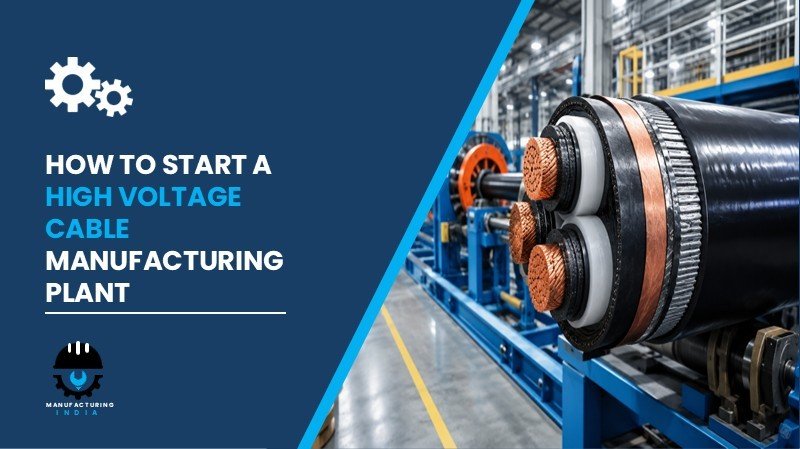
High voltage cable is an insulated electrical cable designed to transmit and distribute electricity at high voltage levels while maintaining electrical safety, mechanical strength, and reliable insulation performance. It generally consists of a conductive core, semiconductor screens, insulation, a metallic screen or sheath, protective layers, and an outer sheath, with the exact construction depending on voltage rating and installation environment. Conductors are commonly made from copper or aluminium, while insulation typically uses cross-linked polyethylene (XLPE). High voltage cable can be installed underground, overhead, or underwater as subsea cable, and design choices depend on voltage level, current-carrying capacity, installation conditions, thermal performance, mechanical stresses, and required service life.
The plant serves power transmission and distribution, renewable energy, offshore wind, industrial infrastructure, utilities, railways, and cross-border electricity interconnection – end-use industries the report identifies as core demand sources. The high voltage cable manufacturing process centers on conductor preparation followed by wire drawing, stranding, conductor screening, insulation extrusion, insulation screening, metallic screening, sheathing, armoring where required, testing, and cable winding or drum packaging.
Cost of Setting Up a High Voltage Cable Manufacturing Plant in India
Cost depends on capacity, technology, location, automation level, and regulatory compliance.
1. Capital Expenditure (CapEx)
Capital costs are organized around four heads: land and site development, civil works, machinery, and other capital costs. The cost of land and site development – including land registration and boundary development charges – forms a substantial part of overall investment, with options including industrial estates and SEZs offering infrastructure readiness and compliance support. Civil works cover the manufacturing shed, a quality-testing laboratory, raw material and finished-goods storage, and the administrative block.
Machinery costs account for the largest portion of total capital expenditure. Key machinery required includes:
- Wire drawing machines
- Annealing machines
- Bunching and stranding machines
- Conductor compacting machines
- Conductor preheaters
- Triple-layer extrusion lines
- XLPE insulation extrusion lines
- Semiconductor extrusion units
- Cross-linking and curing systems
- Cooling systems
- Metallic screening machines
- Lead or aluminium sheathing equipment
- Armoring machines
- Outer-sheath extrusion lines
- Spark testers
- Diameter and thickness gauges
- High voltage testing equipment
- Partial-discharge testing systems
- Cable winding machines
- Cable drum packaging equipment
Other capital costs include effluent treatment plant (ETP) installation, pre-operative expenses, commissioning costs, and any applicable import duties on specialized equipment.
Request a Sample Report for In-Depth Market Insights: https://www.imarcgroup.com/high-voltage-cable-manufacturing-plant-project-report/requestsample
2. Operational Expenditure (OpEx)
Raw material cost is the dominant OpEx component, accounting for an estimated 68-78% of total operating expenditure. Key raw materials for the plant include:
- Copper or aluminium conductor
- XLPE insulation compound
- Semi-conductive screens
- Lead or corrugated aluminium sheath
- HDPE/PP outer jacket
Given this concentration, investors are advised to pursue long-term supplier contracts to stabilize pricing and secure supply. Utility cost, covering electricity, water, and steam, accounts for an estimated 10-14% of OpEx. Other operating costs include transportation, packaging, salaries and wages, depreciation, taxes, and repairs and maintenance, with total operating cost expected to rise substantially by year five due to inflation and market fluctuations.
3. Plant Capacity
A high voltage cable manufacturing plant is typically designed with an annual capacity between 10,000 and 30,000 MT, enabling economies of scale with operational flexibility. Capacity can be customized to investor requirements, and profitability improves with higher capacity utilisation as fixed costs spread across greater output.
4. Profit Margins and Financial Projections
The financial analysis includes liquidity analysis, profitability analysis, payback period, net present value (NPV), and internal rate of return (IRR), along with a full profit and loss account developed from capital investment, operating costs, capacity utilisation, pricing trends, and demand outlook. Gross margin is estimated at 14-22%, while net margin is estimated at 5-10%, projected across a five-year income and expenditure horizon.
Why Set Up a High Voltage Cable Plant in India?
Expanding Grid Infrastructure: Increasing electricity consumption and the integration of new generation capacity are creating requirements for additional transmission infrastructure, directly supporting long-term utilisation for this facility.
Renewable-Energy Integration: Large solar and wind projects often require high-capacity transmission connections to move electricity from generation locations to demand centers, reinforcing demand from India’s expanding renewable pipeline.
Growth in Subsea Interconnections: Countries are increasingly developing cross-border and island interconnectors to improve energy security, electricity trading, and renewable-energy integration, opening export opportunities for Indian-manufactured cable.
Policy and Regulatory Tailwinds: India’s Make in India initiative and broader push toward domestic manufacturing support import substitution in capital-intensive segments such as this one, easing the path for new capacity.
High-Value, Cost-Competitive Manufacturing: High voltage cable requires specialized materials, manufacturing processes, testing, and quality control, creating opportunities for technically advanced manufacturers, while India’s competitive land, labour, and supply chain costs strengthen the investment case relative to other hubs.
Active Industry Development: In June 2026, Nexans completed cable manufacturing for the Malta-Sicily Second Interconnector, a major subsea electricity transmission project using 245 kV submarine cable intended to double Malta’s interconnection capacity with Sicily – signalling the scale of ongoing global investment in high voltage cable capacity that a new Indian entrant can position itself alongside.
Manufacturing Process – Step by Step
The high voltage cable manufacturing process uses conductor preparation followed by extrusion-based insulation and sheathing as the primary production method.
- Conductor Preparation: Copper or aluminium conductor is prepared as the base current-carrying element.
- Wire Drawing: Conductor material is drawn to the required gauge.
- Stranding: Drawn wires are bunched and stranded into the finished conductor form.
- Conductor Screening: A semi-conductive screen is applied over the conductor.
- Insulation Extrusion: XLPE insulation compound is extruded over the screened conductor.
- Insulation Screening: A further semi-conductive screen is applied over the insulation layer.
- Metallic Screening: A metallic screen or sheath, such as lead or corrugated aluminium, is applied.
- Sheathing: An HDPE/PP outer jacket is applied over the cable core.
- Armoring (Where Required): Additional armoring is applied for mechanical protection in demanding installation environments.
- Testing: Cable is validated through spark testing, diameter and thickness checks, high voltage testing, and partial-discharge testing.
- Winding and Packaging: Finished cable is wound and packaged on cable drums for dispatch to end-use industries.
Key Applications
High voltage cable manufactured at the plant serves power-critical infrastructure across the demand sectors identified in the report.
- Power Transmission Networks: Transports electricity over long distances between generating facilities, substations, and load centers.
- Underground Power Transmission: Installed underground where overhead lines are unsuitable due to land-use, environmental, or urban constraints.
- Subsea Interconnectors: Used beneath seas and coastal waters to connect electricity grids between islands, countries, and offshore generation facilities.
- Offshore Wind Farms: Transmits electricity generated by offshore wind turbines to offshore substations and onshore grids.
- Renewable Energy Projects: Connects solar, wind, hydro, and other large-scale renewable generation facilities with transmission networks.
- Industrial Facilities: Supplies high-capacity electricity within large industrial plants and energy-intensive facilities.
- Substations: Connects transformers, switchgear, busbars, and other major electrical equipment.
- Cross-Border Electricity Networks: Enables electricity exchange between neighboring power systems, improving grid reliability and energy security.
Leading Manufacturers
The global high voltage cable industry features established multinational players with extensive production capacities and diverse application portfolios. Key players include:
- Prysmian Group
- Nexans
- NKT A/S
- Southwire Company, LLC
- Sumitomo Electric Industries, Ltd.
- Finolex Cables
Timeline to Start the Plant
- Feasibility study and project report preparation
- Land acquisition and site development
- Regulatory approvals and environmental clearances
- Factory licence and fire safety compliance
- Machinery procurement and installation
- Raw material supplier agreements and supply chain setup
- Trial production and quality testing
- Commercial production launch
Licences and Regulatory Requirements
Starting this manufacturing unit in India requires several approvals:
- Business registration (Proprietorship, LLP, or Pvt Ltd)
- Factory Licence under the Factories Act
- Environmental Clearance from State Pollution Control Board
- GST Registration
- Fire Safety NOC
- Effluent Treatment Plant (ETP) operational clearance
- Occupational Health and Safety compliance
Key Challenges to Consider
High Capital Requirements: Machinery costs account for the largest portion of total capital expenditure, alongside land, site development, and civil works, requiring careful capital structuring before commissioning.
Raw Material Price Volatility: With copper or aluminium conductor, XLPE insulation compound, and other inputs accounting for 68-78% of operating expenditure, price fluctuations can materially affect margins, making long-term supplier contracts essential.
Regulatory Compliance: Environmental clearances, factory licensing, and ongoing compliance obligations require dedicated attention throughout setup and operations.
Competition from Established Players: Global players such as Prysmian Group, Nexans, NKT A/S, Southwire, Sumitomo Electric Industries, and Finolex Cables are well-established with extensive production capacities, raising the bar for new entrants.
Technology and Quality Pressure: High voltage cable requires specialized materials, processes, testing, and quality control, placing ongoing pressure on process control and equipment reliability.
Skilled Manpower: Operations require trained technical personnel across production, quality assurance, and testing, and securing this workforce is a recurring operational challenge.
Frequently Asked Questions
1. How much does it cost to set up a high voltage cable manufacturing plant in India?
Costs depend on land and site development, civil works, machinery, and other capital costs, with machinery representing the largest share of total capital expenditure.
2. Is high voltage cable manufacturing profitable in India in 2026?
The report estimates gross margins of 14-22% and net margins of 5-10%, supported by a global market projected to grow from USD 46.40 Billion in 2025 to USD 70.40 Billion by 2034.
3. What machinery is required for a high voltage cable plant in India?
Key machinery includes wire drawing machines, extrusion lines for XLPE insulation and outer sheathing, metallic screening and armoring machines, and high voltage and partial-discharge testing equipment.
4. What licences and approvals are required to start a high voltage cable plant in India?
Requirements include business registration, a factory licence, environmental clearance, GST registration, fire safety NOC, ETP clearance, and occupational health and safety compliance.
5. What raw materials are needed for high voltage cable manufacturing?
Key raw materials include copper or aluminium conductor, XLPE insulation compound, semi-conductive screens, lead or corrugated aluminium sheath, and HDPE/PP outer jacket.
6. What are the environmental compliance requirements for a high voltage cable plant in India?
Plants require Environmental Clearance from the State Pollution Control Board and an operational ETP, alongside broader safety and environmental compliance protocols throughout production.
7. What is the best location to set up a high voltage cable plant in India?
Industrial states with strong power-sector demand and infrastructure access, such as Gujarat and Maharashtra, offer locational advantages, alongside SEZ and industrial estate options.
8. What is the break-even period for this type of plant in India?
The report’s financial analysis covers payback period, net present value, and internal rate of return as part of its profitability analysis.
9. What government incentives are available for manufacturers in India?
India’s Make in India initiative and broader domestic manufacturing push support capacity investment in capital-intensive segments such as this one.
Key Takeaways for Investors
A high voltage cable manufacturing plant is positioned to benefit from sustained demand in India across power transmission, renewable energy integration, offshore wind, and cross-border interconnection – sectors the report identifies as core growth drivers. Financial viability holds up across scalable capacities of 10,000 to 30,000 MT per year, with reported gross margins of 14-22% and net margins of 5-10%. Underlying demand is reinforced by a global market projected to grow from USD 46.40 Billion in 2025 to USD 70.40 Billion by 2034 at a 4.6% CAGR, alongside active industry investment such as Nexans’ June 2026 completion of the Malta-Sicily interconnector. With grid expansion, electrification, and renewable integration all on a sustained growth path, long-term demand for high voltage cable manufacturing in India looks structurally well supported.
About the Author