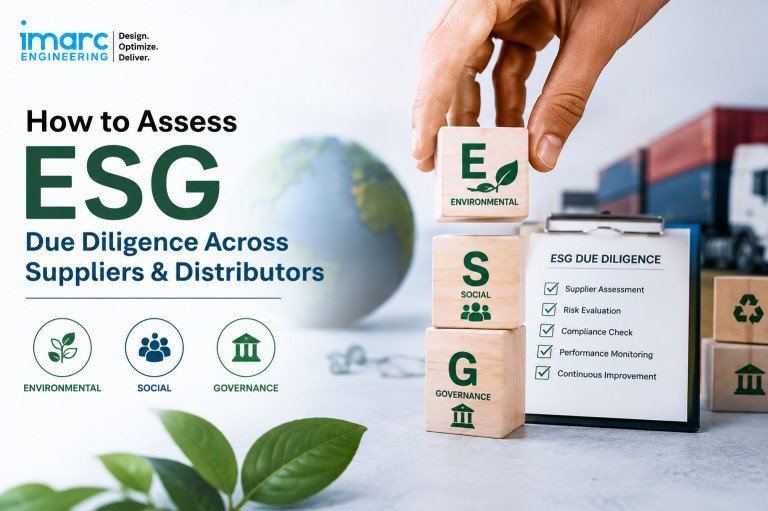
Most guides on ESG due diligence tend to repeat the same high-level talking points: ESG is important, regulations are evolving, and companies must act now. While true, these statements offer little practical value to a procurement head managing hundreds of active vendors across geographies, categories, and risk profiles. When you are responsible for 300+ suppliers and distributors, the real question is not whether to implement ESG due diligence, but where to start, how to prioritize, and what actions to take that actually reduce risk and protect business continuity. This is where most frameworks fall short, they lack operational clarity, measurable thresholds, and decision-making logic, turning ESG into a checkbox exercise rather than a strategic lever.
This guide addresses that gap by providing a structured segmentation framework to identify high-risk vendors, a scoring rubric to quantify ESG exposure, a regulatory comparison to align with Indian and global compliance expectations, and a red-flag checklist to detect early warning signals. The goal is to transform value chain ESG due diligence services from a compliance burden into a practical, decision-driven system embedded within procurement operations ,enabling teams to focus on the right vendors, take timely action, and build a resilient, risk-aware supply chain.
Why the Old Approach (Send Everyone a Questionnaire) Fails
Before the framework, it’s worth understanding why blanket supplier questionnaires don’t work. Scope 3 emissions, everything upstream and downstream of your own plant, make up 70 to 90% of a manufacturing company’s total carbon footprint, with purchased goods and services alone often accounting for 50% or more of that figure. Yet fewer than half of suppliers asked for environmental data actually provide it, per CDP. Sending 300 identical forms into that gap produces mostly silence. A working system has to be selective, evidence-based, and tiered from day one.
A Practical Step By Step Approach
Step 1: Segment Using SEBI’s Own Threshold Logic
Instead of inventing your own cutoffs, mirror the materiality threshold SEBI already applies to listed companies: value chain partners accounting for 2% or more of total purchases or sales, or those together covering 75% of aggregate purchase and sales value.
Worked example: A mid-sized auto-components manufacturer with 300 active vendors typically finds that no more than 25 to 40 suppliers individually clear the 2% procurement threshold, yet those same vendors collectively represent the bulk of spend needed to hit the 75% coverage mark. That shortlist, not the full 300, is your assessment universe for Year 1. Everyone else moves to a lighter-touch, self-certification track.
This single step is what separates a due diligence program that finishes from one that stalls under its own vendor count.
Step 2: Tier by Risk, Not Just Spend
Spending alone misses risk concentration. Cross-reference spend tier against exposure category:
| Tier | Criteria | Assessment Depth |
| Tier A | High spend + export-linked, commodity-linked (EUDR), or carbon-intensive (CBAM) | On-site audit, annual reassessment |
| Tier B | High spend, domestic-only, moderate risk category | Document verification, biennial reassessment |
| Tier C | Low spend, low criticality | Self-certification, spot-checked every 3 years |
| Tier D (Distributors) | Any distributor handling branded product or last-mile delivery | Labour practice and warehousing safety review, annual |
Note the separate distributor row. Most manufacturers build supplier frameworks and forget distributors entirely, despite the fact that downstream labour practices, warehousing safety, and counterfeit or grey-market leakage sit just as close to brand and regulatory risk as upstream sourcing does.
Step 3: Score on a Weighted Rubric, Not a Pass/Fail Checklist
A binary pass/fail wastes the nuance you need for remediation planning. A workable weighting for manufacturing vendors:
- Environmental (40%): emissions data availability, effluent/waste handling, hazardous material storage, energy source mix
- Social (35%): wage compliance documentation, safety incident history, working-hours records
- Governance (25%): anti-bribery policy existence, sub-contractor transparency, data protection practices
Weight environmental higher for chemicals, cement, and metals vendors; weight social higher for labour-intensive food processing and textiles-adjacent suppliers. A vendor scoring below 50% on any single pillar, regardless of composite score, should trigger mandatory remediation rather than being averaged away by strong performance elsewhere. This catches the specific failure mode where a supplier looks acceptable on paper but has one severe, hidden liability.
Step 4: Verify With Evidence, Prioritised by Tier A First
For Tier A vendors, replace self-declared answers with primary evidence: utility bills and metering data for emissions claims, third-party certifications, and factory audit reports. Cross-check declared emissions intensity against sector peer benchmarks; unexplained mismatches are consistently the strongest indicator of unreliable data.
Red flags that should stop a vendor’s onboarding or renewal:
- Declared emissions intensity significantly below sector peer average with no efficiency investment to explain it
- No documented safety incident log at all (absence of records, not absence of incidents, is the flag)
- Sub-contractors used for material production stages that were never disclosed
- Certifications that cannot be traced to an accredited issuing body
- Identical wording or data across multiple unrelated vendor questionnaires (a sign of templated, non-genuine responses)
Step 5: Match Your Regulatory Obligation to the Right Trigger
Manufacturers frequently over-invest in one framework while missing another that actually applies to them. Use this to check exposure:
| Framework | Who It Applies To | What It Requires From Suppliers | Penalty for Gaps |
| SEBI BRSR Core (Value Chain) | Top 1,000 listed Indian companies | ESG data from vendors covering 75% of purchase/sales value | INR 2,000/day under LODR, up to INR 1 crore SEBI enforcement |
| EU CS3D | Companies above 5,000 employees and €1.5 billion turnover (roughly 6,000 firms globally) | Tier 1 supplier due diligence, extending deeper only where risk is indicated | Civil liability, contract loss |
| EU CBAM | Exporters of steel, aluminium, cement, fertilisers to the EU | Verified, third-party audited embedded emissions per shipment | Default (higher) carbon values applied at customs |
| EU EUDR | Exporters/importers of palm oil, rubber, soy, timber and derivatives | Due diligence statement confirming deforestation-free, legally sourced production | Import rejection at EU border |
If you export steel or aluminium to the EU, CBAM is your binding constraint. If you’re a listed company with domestic vendors, BRSR Core is. Most manufacturers need to actively design for two of these simultaneously, not all four.
Step 6: Close the Loop, Don’t Leave It Open-Ended
A due diligence program that ends at scoring is incomplete. Build in:
- Contractual ESG clauses tied to the Step 3 rubric, not vague sustainability language
- Reassessment cadence matched to the tier table in Step 2
- A capacity-building track for MSME Tier A/B vendors who fail on data availability rather than actual practice, since most of India’s 63 million MSMEs still lack formal ESG disclosure systems and need support, not exclusion
- Board or leadership-level reporting on remediation status, so gaps surface before an external audit does
Sector-Specific Priorities
- Pharmaceuticals: fold ESG screening into existing CDSCO/GMP vendor qualification for API and excipient suppliers, where quality and ESG risk frequently share root causes
- Chemicals: weight environmental pillar highest; prioritise CBAM-exposed exporters for Tier A treatment
- Food Processing: weight social and traceability highest across smallholder and agri-input vendors
- Automotive & Electronics: map Tier 2/3 component sourcing early; this is where conflict-mineral and e-waste exposure concentrates, often invisibly, in multi-tier supply chains
How IMARC Engineering Can Help
IMARC Engineering designs and implements risk-based ESG due diligence systems for manufacturers, not templated questionnaires: threshold-based supplier and distributor segmentation, risk-weighted scoring rubrics, on-site verification, and MSME vendor capacity building, mapped against whichever combination of BRSR Core, CS3D, CBAM, or EUDR actually applies to your export and listing profile. We help procurement, compliance, and sustainability teams turn this framework into an audit-ready program, not a one-time report.
Speak with an ESG Due Diligence Expert: https://www.imarcengineering.com/contact?service=esg-compliance
Conclusion
Effective ESG due diligence is no longer about sending questionnaires to every supplier. Manufacturers need a structured, risk-based approach that prioritizes high-impact suppliers, validates ESG claims with evidence, and aligns due diligence with applicable regulatory requirements. By embedding ESG into procurement decisions, organizations can reduce supply chain risk, strengthen compliance, and improve long-term business resilience.
Contact Us:
IMARC Engineering
Phone: +91-120-433-0800
Email: sales@imarcengineering.com
India: C-130, Sector 2, Noida, Uttar Pradesh 201301
LinkedIn: https://www.linkedin.com/showcase/imarc-engineering/
About the Author