Evaluating Modular Construction for Manufacturing
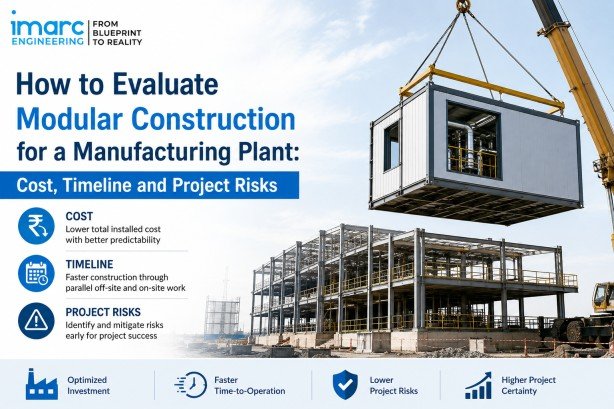
Most conversations about modular construction start with the wrong question: “Is modular faster and cheaper? The honest answer is: sometimes, for some parts of a project, under some conditions. The better question is whether building sections of your plant off-site, then transporting and installing them, actually lowers your total installed cost and shortens your real critical-path duration, once engineering, logistics, lifting, foundations, and commissioning are all accounted for.
What Modular Construction Means on an Industrial Project
Modular construction for manufacturing plants is a spectrum, and where your project sits on it changes the cost and risk picture
- structural prefabrication (pre-engineered buildings, steel frames, pipe racks, platforms), building prefabrication (wall panels, modular control rooms, cleanroom shells),
- MEP prefabrication (electrical skids, cable-tray assemblies, HVAC packages),
- process modularization (pump/compressor skids, dosing systems, CIP/SIP units), volumetric modules (finished 3D units that arrive largely complete),
- hybrid modularization, where select systems are built off-site while civil works stay conventional.
For many Indian industrial projects, hybrid tends to be more practical than fully volumetric, since process equipment, utilities, and site interfaces are usually project-specific rather than standardized.
The First Decision: What Should Be Modularized?
Most evaluations go wrong by treating modularization as one decision for the whole plant, when different systems have very different suitability. Utility and process skids are usually the strongest candidates; pipe racks and electrical rooms are often good where repeated; cleanroom modules are frequently modular in pharma and food processing; main civil structure and heavy foundations usually stay conventional or hybrid.
The useful output isn’t simply “modularize or don’t”; it’s a recommended level of modularization, system by system: conventional, hybrid, partial, or highly modular.
Compare Total Installed Cost, Not Module Price
Comparing a fabricator’s quotation against a conventional construction estimate isn’t fair. The number that matters is
- Total Installed Cost (TIC) — everything from the first engineering hour to commissioning sign-off.
- Modular TIC = Engineering + Fabrication + Factory QA/FAT + Transportation + Permits/Escorts + Crane/Lifting + Foundations + Site Installation + Tie-ins + Commissioning + Temporary Facilities + Contingency
- Conventional TIC = Engineering + Site Fabrication + Site Labor + Temporary Facilities + Supervision + Rework + Weather/Delay Costs + Installation + Commissioning
Build both estimates line by line rather than comparing a single quote to a single number — the gap between the two totals is what decides whether modularization is worth it.
How Modularization Actually Changes the Schedule
Modularization helps a schedule for one reason: parallel execution — not every hour saved in the factory shortens the overall project.
Conventional: Engineering → Civil works → Equipment arrival → Installation → Piping → Electrical → Commissioning Modular: Engineering → Fabrication (parallel with civil/site prep and procurement) → Assembly/FAT → Transport → Lift → Tie-in → Commissioning
The real question isn’t “how long does fabrication take?” It’s how much critical-path duration moving that work off-site actually removes. If civil works, procurement, approvals, or commissioning stay on the critical path regardless, the project may not get meaningfully shorter even though work happened in parallel.
Schedule benefit = Conventional critical-path duration − Modular critical-path duration. Map both sequences against your actual critical path before assuming a schedule win.
Is Your Project Ready for Modularization?
Design freeze isn’t optional in modular work the way it can be conventionally. A late design change on-site is a rework order; in modular work it can mean reopening a factory job and if the error is already built into several modules, rework multiplies.
Before releasing modules for fabrication, confirm: process design and equipment selection are frozen; vendor data is available; utility loads, module dimensions, and nozzle orientation are confirmed; piping, electrical, and instrumentation interfaces are frozen; foundation loads are confirmed; the transport route and lift study are complete; and FAT requirements are set. If several of these aren’t settled, delay fabrication release rather than abandoning modularization.
Transportation and Site Logistics
This is one of the most India-specific parts of the evaluation, well beyond permits. Assess module dimensions and weight against route restrictions, turning radius along the full route, overhead lines and railway crossings, bridge/culvert strengthening needs, gate and internal road dimensions, laydown and crane setup area, crane ground-bearing pressure, night-movement restrictions, state permit timelines, transport-window weather, and any port or rail interface required. A module that looks efficient in the fabrication estimate can become uneconomic once the actual route is mapped.
Foundations, Structure, and Interfaces
Modularization shifts fabrication off-site, but foundations don’t disappear — in some respects they need more precision. Account for module support-point loads, anchor bolt tolerance, seismic and wind loads on the erected module, differential settlement against adjoining structure, and transport-induced stresses carried into the design.
Every module also creates interfaces a fully site-built design wouldn’t have: module ↔ civil, ↔ process, ↔ electrical, ↔ instrumentation, ↔ utilities, and — on brownfield sites — ↔ existing plant. That’s the core trade-off: modularization reduces field labor but increases interface work, which is why “maximum modularization” isn’t the goal; the right level is.
When Modularization Tends to Pay Off and When It Doesn’t
Favors modularization: brownfield expansions where shutdown days have a measurable production cost; remote sites with high labor/accommodation costs; repetitive systems; weather-exposed sites with regular monsoon delays; schedule-critical projects where critical-path analysis shows a real reduction; and process-heavy facilities — pharma, chemical, food processing, water treatment.
Favors conventional construction: constrained site access (narrow roads, low bridges, tight gates); frequent design changes likely at this stage; oversized or irregular equipment; a dense site with limited crane/laydown space; cost rather than schedule as the actual constraint; or little scope for parallel execution.
A Modularization Suitability Scoring Framework
Score each system , not the whole plant , from 1 to 5 across four categories, weighted by what matters most on your project:
| Category | What to score |
| Commercial | Downtime cost, site labor cost, schedule value |
| Engineering | Design maturity, repetition, interface complexity |
| Logistics | Transport distance, module dimensions, site/crane access |
| Risk | Vendor capability, design-change likelihood, QC history |
A high score for a given system points toward a higher level of modularization for that system, not automatically the whole plant. A middling score usually points toward hybrid — modularize the utility and skid-based systems, keep civil works and the building envelope conventional.
Brownfield Expansion: When Shutdown Avoidance Changes the Economics
If your project expands a live plant, the calculation changes. As an illustrative example: if an existing line contributes ₹20 lakh a day in margin, and modularization cuts a planned shutdown from 17 days to 7, that’s roughly ₹2 crore in avoided production loss — against which even a ₹50–70 lakh modularization premium looks straightforward. Weigh avoided shutdown loss + earlier production + reduced site overhead against modularization premium + logistics/lifting + extra engineering + financing costs during fabrication.
Typically, teams fabricate and pre-test off-site while the plant keeps running, then use the shutdown window only to remove old equipment, lift the new module into place, connect utilities, test, and restart ,an installation event rather than a construction event, and often the real driver behind modularization on brownfield projects.
Key Risks by Category
- Engineering — late design changes, interface mismatch, incomplete vendor data, tolerance issues
- Manufacturing — fabrication quality gaps, capacity constraints, slippage, defect replication across identical modules
- Logistics — route restrictions, transport damage, permit delays, crane availability
- Construction — foundation mismatch, lifting constraints, site congestion, weather at install
- Commercial — unclear scope split, change orders, warranty and interface ownership
- Commissioning — incomplete FAT, failed site integration, utility mismatch, control-system integration
Set these up as an actual risk register: assign each risk to the specific module it applies to, name an owner, and define the trigger point at which it needs checking — for example, “lift study complete” as the gate before crane mobilization is booked.
Design for Manufacture and Assembly (DfMA) — engineering for how something will be fabricated, transported, lifted, and connected, not just how it functions — sits underneath most of these risk categories. Weak DfMA input early on is a common root cause behind interface mismatches and factory rework later.
How IMARC Engineering Can Help
Deciding whether to modularize — and to what level, system by system — isn’t a decision to make late in a project. IMARC Engineering supports manufacturers through this early, before design freeze, with:
- Modularization suitability assessments scoring individual plant systems and recommending a level backed by a full TIC comparison
- Critical-path schedule analysis comparing conventional and modular sequences against your actual project path
- Brownfield modularization studies quantifying avoided shutdown value against modularization premiums
- Transport and site logistics feasibility — route surveys, crane/lift planning, and foundation interface review for Indian conditions
- Vendor due diligence for module fabricators, plus interface and contracting strategy support so responsibility is clearly assigned before contracts are signed
Planning a new plant or a brownfield expansion? Assess modularization before design freeze with a project-specific feasibility study covering total installed cost, schedule, logistics, interfaces, and execution risk — reach out to IMARC Engineering to assess your modularization feasibility.
Speak With An Expert: https://www.imarcengineering.com/contact?service=turnkey-project-management
Conclusion
Modular construction isn’t a universal upgrade over conventional building methods, and it isn’t a shortcut either. Don’t ask whether modular construction is cheaper in general — determine whether modularization creates a measurable advantage in total installed cost, critical-path duration, shutdown avoidance, and execution risk for this specific plant, system by system. The manufacturers who get real value from modularization evaluate it early, at concept or FEED stage, using full TIC comparisons and critical-path analysis rather than factory quotations and general schedule claims. Get that assessment right early, and modularization can meaningfully shorten your project. Get it wrong, or decide too late, and it adds cost and interface risk without delivering the benefit you were counting on.
Contact Us:
IMARC Engineering
Phone: +91-120-433-0800
Email: sales@imarcengineering.com
India: C-130, Sector 2, Noida, Uttar Pradesh 201301
LinkedIn: https://www.linkedin.com/showcase/imarc-engineering/
About the Author