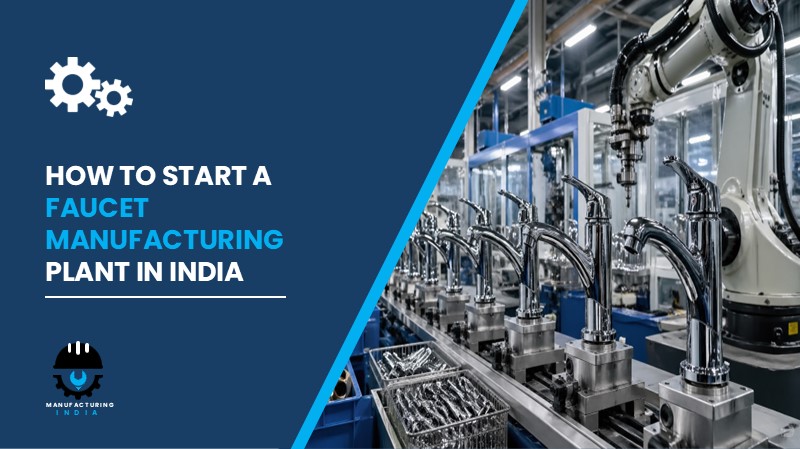
Setting up a faucet manufacturing plant in India presents a compelling investment case driven by the rapid expansion of residential and commercial infrastructure, surging demand for modern kitchen and bathroom fixtures, and a nationwide shift toward water-efficient plumbing solutions. Faucets — devices that manage water flow across residential, commercial, and industrial areas — are essential components in every constructed structure, making them a cornerstone product for India’s booming construction and renovation sectors. The hospitality industry, which requires both standard and stylish plumbing fixtures at scale, further amplifies this demand, creating a robust and sustained market for domestic producers.
India’s strategic advantages make it an especially sound location for this investment. Rapid urbanisation, sustained growth in residential and commercial construction, and the government’s Make in India initiative collectively create a favourable environment for establishing a domestic faucet production base. Industrial clusters in states such as Gujarat and Maharashtra offer access to metal supply chains — particularly brass and stainless steel — alongside reliable logistics infrastructure and cost-competitive labour. Proximity to raw material suppliers and end-use markets reduces distribution costs significantly, while the country’s large and growing middle class continues to drive renovation-led replacement demand.
Establishing a faucet manufacturing plant in India combines policy support through Make in India, access to cost-competitive land and labour, and strong demand from residential, commercial, and hospitality sectors. With gross profit margins ranging between 35–45% and net margins of 15–20%, the unit economics are robust across plant capacities, making this a financially viable and strategically sound investment with a clear path to break-even.
What is a Faucet?
Faucets are plumbing devices that manage water flow in residential, commercial, and industrial settings. The structure of a faucet typically includes a spout, one or more handles, a valve mechanism, and an air mixer — all working together to control the flow and temperature of the water. Common faucet materials include brass, stainless steel, and zinc alloys, with most units finished in chrome, nickel, or similar coatings that enhance durability and aesthetics.
There are several styles of faucets available, including single-handle, double-handle, pull-out, sensor-based, and wall-mounted variants. Modern faucets are designed for smooth operation, minimal maintenance, and water efficiency — attributes that are increasingly demanded across all market segments. The production process involves casting, machining, surface finishing (polishing or plating), assembling, quality control, and packaging — a well-defined multi-step workflow that scales efficiently with capacity.
Faucets serve a broad range of end-use industries, including residential plumbing, commercial buildings, the hospitality and HoReCa sector, and industrial facilities. Their applications span kitchens, bathrooms, utility areas, and industrial setups, delivering both functional and decorative advantages. The standardisation inherent in faucet manufacturing ensures consistent quality, durability, and ease of installation across large-scale projects.
Cost of Setting Up a Faucet Manufacturing Plant in India
The total cost of establishing a faucet manufacturing plant depends on several variables, including plant capacity, chosen technology, geographical location, level of automation, and regulatory compliance requirements.
1. Capital Expenditure (CapEx)
Land and site development represent a substantial component of total capital investment. Investors may consider locating the plant within a Special Economic Zone (SEZ) or a designated industrial estate to benefit from fiscal incentives and streamlined regulatory approvals. Site preparation costs include land registration charges, boundary development, and related infrastructure works.
Civil construction costs cover the manufacturing shed, laboratory, raw material and finished goods storage, and an administrative block — all of which must meet factory safety and environmental norms.
Machinery and equipment represent the largest single portion of CapEx for a faucet manufacturing plant. Key machinery required includes:
- Casting molds
- CNC machines
- Polishing units
- Plating tanks
- Assembly lines
- Testing equipment
Other capital costs include the effluent treatment plant (ETP), pre-operative expenses, commissioning charges, and, where applicable, import duties on specialised equipment procured from international suppliers.
Request a Sample Report for In-Depth Market Insights: https://www.imarcgroup.com/faucet-manufacturing-plant-project-report/requestsample
2. Operational Expenditure (OpEx)
Raw material cost is the dominant component of operating expenses, accounting for approximately 60–70% of total OpEx. The primary raw materials required for faucet production are brass/stainless steel, ceramic discs, rubber seals, and chrome plating. Investors are advised to negotiate long-term contracts with reliable domestic and regional suppliers to stabilise pricing and ensure supply continuity, particularly given the price sensitivity of brass and stainless steel.
Utility costs — covering electricity, water, and steam — account for a further 10–15% of operating expenditure, reflecting the energy requirements of casting, machining, and surface finishing operations. Additional operating costs include transportation, packaging, salaries and wages, maintenance, depreciation, and applicable taxes. By the fifth year of operations, total OpEx is expected to increase materially due to inflation, market fluctuations, rising input material costs, potential supply chain disruptions, and growing consumer demand.
3. Plant Capacity
The proposed manufacturing facility is designed with an annual production capacity ranging between 2 and 5 million units, enabling economies of scale while maintaining operational flexibility. This capacity range can be customised to match investor resources and market strategy. Profitability improves progressively with higher capacity utilisation, as fixed costs are absorbed across a larger output base, reducing the per-unit cost of production.
4. Profit Margins and Financial Projections
The faucet manufacturing plant demonstrates healthy profitability potential under normal operating conditions. Gross profit margins typically range between 35–45%, supported by stable demand and value-added product applications. Net profit margins average 15–20% over a five-year projection period. The financial model incorporates detailed analysis of net present value (NPV), internal rate of return (IRR), payback period, income projections, expenditure forecasts, and sensitivity analysis — all of which support informed investment decision-making and project financing.
Why Set Up a Faucet Plant in India?
Rising Construction and Renovation Activity. Increasing residential and commercial infrastructure development across India is the primary driver of faucet demand. New housing projects, office complexes, and public infrastructure works all require plumbing fixtures, creating a sustained and growing market for domestically manufactured faucets.
Durability and Water Efficiency Demand. Modern consumers and commercial buyers increasingly prioritise faucets that deliver long-lasting performance while meeting water-saving requirements. Anti-corrosion coatings, eco-friendly designs, and multifunctional capabilities are now standard expectations, driving continuous product innovation and premium pricing opportunities for manufacturers.
Expanding Hospitality Sector. Hotels, restaurants, and resorts require plumbing fixtures that are both standardised for easy maintenance and stylish for guest experience. The hospitality and HoReCa sector’s demand for high-durability, aesthetically appealing faucets represents a growing and stable revenue stream for Indian manufacturers.
Smart Water Management Tailwinds. The trend toward smart home and digitalised water management solutions is accelerating adoption of sensor-based and automated faucets. In June 2025, Chennai Metrowater planned to replace 100,000 analog meters with smart water meters, offering households precise real-time water usage data — a development that drives greater demand for advanced faucets that optimise flow and efficiency.
Active Industry Investment and Innovation. Leading manufacturers are actively investing in next-generation products. In September 2025, Chicago Faucets introduced the 8″ Gooseneck HyTronic Patient Care faucet for healthcare settings, and in February 2025, Moen introduced the Instant Hot SIP faucets designed for sustainability and kitchen convenience — both signals of strong innovation momentum and growing market sophistication that domestic Indian manufacturers can capitalise on.
Local Supply Chain Preference. Construction companies, hospitality groups, and industrial facility operators increasingly prefer local sourcing for plumbing fixtures to reduce lead times and logistical costs. A domestically located faucet manufacturing plant is well positioned to serve these buyers with faster turnaround and more competitive pricing than import-dependent supply chains.
Manufacturing Process – Step by Step
The faucet manufacturing process uses casting, machining, surface finishing, assembling, quality control, and packaging as the primary production method.
- Casting: Raw materials such as brass or stainless steel are melted and poured into casting molds to form the basic body of the faucet.
- Machining: CNC machines are used to precision-finish the cast bodies, cutting threads, drilling holes, and achieving dimensional accuracy.
- Surface Finishing: Polishing units smooth and prepare the faucet surface, followed by plating tanks applying chrome or nickel finishes to enhance aesthetics and corrosion resistance.
- Component Assembly: Ceramic discs, rubber seals, valve mechanisms, handles, and spouts are assembled on dedicated assembly lines.
- Quality Control and Testing: Each unit passes through testing equipment to verify water flow, pressure resistance, temperature regulation, and finish integrity.
- Packaging and Dispatch: Finished faucets are packaged and dispatched to residential plumbing, commercial, hospitality, and industrial end-use markets.
Key Applications
Faucets serve a wide range of industries requiring reliable and aesthetically consistent water flow management:
- Residential Plumbing: Guarantees safe, long-lasting, and aesthetic water dispensing options in homes — kitchens, bathrooms, and utility areas.
- Commercial Buildings and Offices: Standardised faucets enable easier maintenance and consistent performance in high-traffic areas.
- Hospitality and HoReCa Sector: Quick installation, high durability, and design variety are key advantages for hotels and restaurants.
- Industrial Facilities: In factories, laboratories, and utility areas, faucets support heavy-duty usage requirements.
Leading Manufacturers
The global faucet industry is served by several multinational companies with extensive production capacities and diverse application portfolios. Key players in the market include:
- Danze Faucets
- Delta Faucet Company
- House of Rohl
- Jaquar India
- Kohler Co.
Timeline to Start the Plant
- Feasibility study and project report preparation
- Land acquisition and site development
- Regulatory approvals and environmental clearances
- Factory licence and fire safety compliance
- Machinery procurement and installation
- Raw material supplier agreements and supply chain setup
- Trial production and quality testing
- Commercial production launch
Licences and Regulatory Requirements
Starting a faucet manufacturing unit in India requires several approvals:
- Business registration (Proprietorship, LLP, or Pvt Ltd)
- Factory Licence under the Factories Act
- Environmental Clearance from State Pollution Control Board
- GST Registration
- Fire Safety NOC
- Hazardous/Chemical compliance (applicable for plating chemicals and surface treatment agents used in the process)
- Effluent Treatment Plant (ETP) operational clearance
- Occupational Health and Safety compliance
Key Challenges to Consider
High Capital Requirements. Establishing a faucet plant demands significant upfront investment in casting molds, CNC machines, plating tanks, and assembly lines, along with land, civil works, and ETP infrastructure. Securing structured project financing is essential.
Raw Material Price Volatility. The primary inputs — brass/stainless steel, ceramic discs, rubber seals, and chrome plating — are subject to global commodity price fluctuations. Since raw materials account for 60–70% of OpEx, even moderate price swings can materially affect margins without long-term supplier contracts in place.
Regulatory Compliance. The use of plating chemicals and surface treatment agents requires careful adherence to environmental and hazardous material regulations. Maintaining ETP operations and pollution control clearances adds to ongoing compliance costs.
Technology and Innovation Pressure. The rapid adoption of sensor-based and automated faucets, driven by smart home trends and water management mandates, requires manufacturers to invest in innovation and upgrade product lines continuously to remain competitive.
Competition from Established Players. Competing against established manufacturers such as Kohler Co., Delta Faucet Company, Jaquar India, and others requires a clear differentiation strategy — whether through pricing, product customisation, or channel relationships.
Skilled Manpower. Operating CNC machines, plating tanks, and quality testing equipment requires technically trained personnel. Recruitment, retention, and ongoing skill development are important operational considerations.
Frequently Asked Questions
1. How much does it cost to set up a faucet manufacturing plant in India?
The total cost depends on plant capacity, technology choice, location, and automation level. CapEx covers land, civil works, machinery (casting molds, CNC machines, plating tanks, assembly lines), and an ETP. A detailed financial model is available in the full project report.
2. Is faucet manufacturing profitable in India in 2026?
Yes. The faucet manufacturing plant demonstrates gross profit margins of 35–45% and net margins of 15–20%, supported by strong and growing demand from residential, commercial, and hospitality sectors.
3. What machinery is required for a faucet plant in India?
Key equipment includes casting molds, CNC machines, polishing units, plating tanks, assembly lines, and testing equipment.
4. What licences and approvals are required to start a faucet plant in India?
Required approvals include business registration, a Factory Licence, Environmental Clearance, GST Registration, Fire Safety NOC, ETP clearance, hazardous/chemical compliance, and Occupational Health and Safety compliance.
5. What raw materials are needed for faucet manufacturing? The primary raw materials are brass/stainless steel, ceramic discs, rubber seals, and chrome plating.
6. What are the environmental compliance requirements for a faucet plant in India?
An Effluent Treatment Plant must be operational, and the unit must obtain clearance from the State Pollution Control Board. Compliance with chemical handling and emission norms applicable to plating operations is also mandatory.
7. What is the best location to set up a faucet plant in India?
Ideal locations offer proximity to brass and stainless steel supply chains, reliable utilities, strong transportation infrastructure, and access to industrial estates or SEZs. States such as Gujarat and Maharashtra are well suited given their established manufacturing ecosystems.
8. What is the break-even period for this type of plant in India?
The break-even period depends on capacity utilisation, pricing strategy, and operating cost management. The full project report provides payback period calculations based on detailed financial projections.
9. What government incentives are available for manufacturers in India?
The Make in India initiative, state-level industrial policies, SEZ benefits, and capital subsidy schemes for manufacturing units provide meaningful support to investors establishing production facilities in India.
Key Takeaways for Investors
A faucet manufacturing plant in India is a strong investment opportunity, with demand anchored by growth in residential plumbing, commercial construction, the hospitality sector, and emerging smart water management infrastructure. The unit economics are compelling across plant capacities, with gross margins of 35–45% and net margins of 15–20% making this a financially viable venture at both small and medium scales. The global faucet market was valued at USD 33.05 Billion in 2025 and is projected to reach USD 58.30 Billion by 2034 at a CAGR of 6.5%, reflecting sustained long-term demand growth that supports the investment case for domestic Indian production. With urbanisation accelerating, infrastructure spending rising, and consumer preferences shifting toward water-efficient and sensor-based products, demand sustainability for domestically manufactured faucets in India is firmly intact.
About the Author