Coco Peat Discs Manufacturing Plant
Setting up a coco peat discs manufacturing plant in India presents a compelling investment case rooted in the country’s world-class coconut production base, rapidly expanding greenhouse and hydroponic farming sector, growing demand for sustainable agricultural inputs, and an accelerating trend of home gardening and urban horticulture. Coco peat discs — compact, compressed growing media manufactured from coconut husk fibre — offer superior water retention, excellent aeration, and outstanding root support properties that make them an ideal growing medium for hydroponic systems, greenhouse cultivation, nursery operations, and home gardening. As a renewable and biodegradable product derived from coconut husks, coco peat discs align with the global shift toward eco-friendly, sustainable agriculture, giving Indian producers a dual advantage of feedstock abundance and growing international demand.
India’s position as one of the world’s largest coconut-producing nations — with major cultivation in Kerala, Tamil Nadu, Karnataka, and Andhra Pradesh — provides a cost-competitive and abundantly available raw material base in the form of coconut husks, which are the primary feedstock for coco peat disc production. Government support for sustainable farming through schemes such as the Paramparagat Krishi Vikas Yojana (PKVY), which had received ₹2,078.67 crore and covered 8.41 lakh hectares as of June 30, 2024, directly encourages farmers to adopt natural, eco-friendly cultivation methods — creating institutional and commercial demand for coco peat discs across India’s agricultural sector. The Make in India initiative and export potential for certified horticultural growing media to European, North American, and Southeast Asian markets further reinforce the investment rationale for establishing a coco peat discs manufacturing plant in India.
A coco peat discs manufacturing plant in India converts abundant, low-cost coconut husk byproduct into a high-demand, export-oriented horticultural growing medium. Backed by expanding greenhouse and hydroponic farming, government support for sustainable agriculture, rising home gardening trends, and strong international demand for certified coconut fibre growing media, this investment delivers attractive financial returns and multi-channel demand visibility for well-positioned Indian producers.
What is Coco Peat Discs?
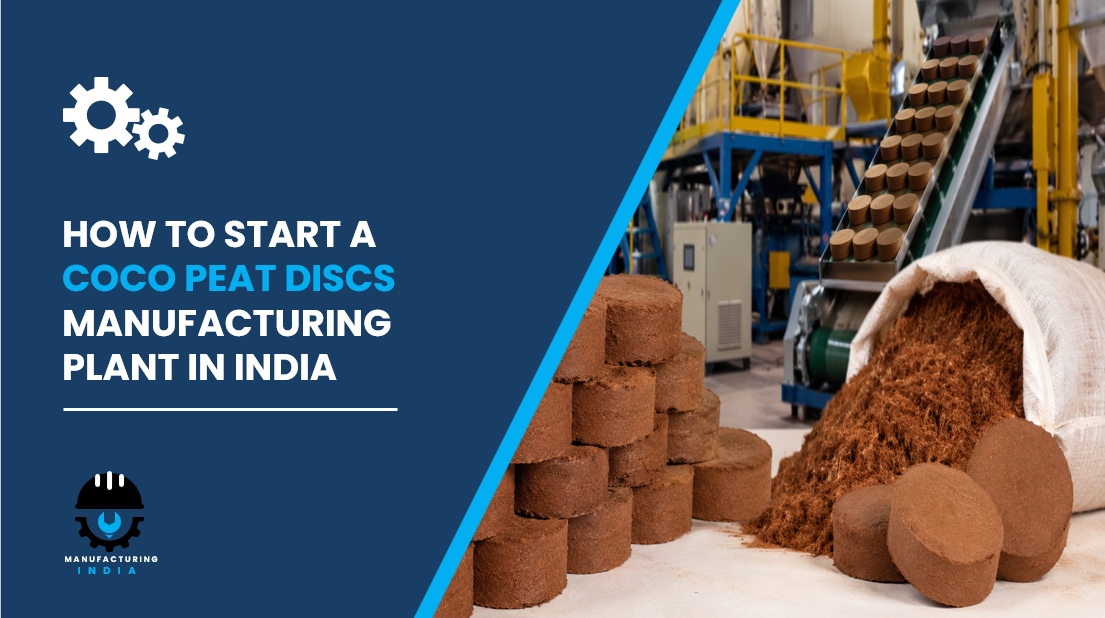
Coco peat discs are compressed, disc-shaped growing media manufactured from the fibrous pith extracted from coconut husks. Made from coconut husks, they offer a renewable and biodegradable alternative to traditional soil amendments. Their excellent water retention and aeration properties make them ideal for organic farming and sustainable horticulture. Coco peat discs are lightweight, biodegradable, and mess-free compared to traditional soil, making them popular among both commercial growers and home gardeners. When hydrated with water, the compressed discs expand into a nutrient-absorbing, root-supporting growing medium suitable for seedling propagation, transplanting, and container gardening.
Coco peat discs provide superior root support, moisture control, and disease resistance compared to traditional soil across their key application segments. In hydroponic systems, they provide an efficient alternative to soil, ensuring optimal root support and nutrient absorption. The product serves end-use markets including greenhouse farming operations, hydroponic cultivation systems, nursery and floriculture producers, organic farmers, and individual home gardeners seeking low-maintenance, sustainable growing solutions.
Cost of Setting Up a Coco Peat Discs Manufacturing Plant in India
The total cost of establishing a coco peat discs manufacturing plant in India depends on production capacity, compression and processing technology, plant location, degree of automation, and regulatory compliance requirements.
1. Capital Expenditure (CapEx)
The capital investment required to set up this facility covers several major cost heads. Land and site development — including land registration, boundary development, weatherproof storage for coconut husks, and related site infrastructure — forms a substantial portion of total CapEx. Investors should consider locating the unit within or adjacent to India’s primary coconut growing belts in Kerala, Tamil Nadu, Karnataka, and Andhra Pradesh to minimise husk transportation costs and ensure consistent feedstock availability. Coastal and semi-coastal agro-industrial estates in these states offer established coconut processing infrastructure and good logistics connectivity to port facilities for export markets.
Civil works and construction costs cover the husk receiving and sorting yard, coco peat extraction and drying area, mixing and blending zone, compression and disc forming hall, drying and curing area, quality control laboratory, finished goods warehouse and packaging area, and administrative block. Adequate covered storage for both raw husk and processed coco peat is essential given the moisture-sensitive nature of the material at various stages of production.
Machinery and equipment represent the largest component of total capital expenditure for this coco peat discs manufacturing plant. The production process requires equipment for coco peat extraction, processing, and disc compression, including machinery for raw husk processing, screening and grading, washing and buffering, drying, mixing, hydraulic or mechanical compression for disc forming, and automated packaging systems. All machinery must comply with industry standards for safety, efficiency, and reliability.
Other capital costs include effluent treatment plant (ETP) installation for process wastewater from husk washing and coco peat processing, pre-operative and commissioning expenses, and utility connection charges for electricity, water, and compressed air supply.
Request a Sample Report for In-Depth Market Insights: https://www.imarcgroup.com/coco-peat-discs-manufacturing-plant-project-report/requestsample
2. Operational Expenditure (OpEx)
The operating cost structure of a coco peat discs manufacturing plant is primarily driven by raw material procurement and processing. Raw material cost — covering coconut husks sourced from coconut processing operations and coir industry units in the producing states — represents the dominant share of total OpEx. Coconut husks, while available in large volumes as a byproduct of coconut oil and copra processing, require collection, transportation, and initial processing before they can be converted into coco peat. Investors should establish long-term supply agreements with coconut processing units, coir fibre manufacturers, and coconut aggregators to stabilise husk procurement costs and ensure production continuity across harvest seasons.
Utility costs, covering electricity for compression machinery, drying equipment, and packaging lines, along with water for husk washing and coco peat buffering operations, represent a meaningful share of OpEx given the energy and water demands of the drying and compression stages. Other operating costs include transportation and logistics for finished disc dispatch to greenhouse operators, hydroponic distributors, nurseries, e-commerce platforms, and export markets, packaging materials, salaries and wages, maintenance and repairs of compression and drying equipment, depreciation of fixed assets, and applicable taxes. By the fifth year of operations, total operational costs are projected to increase substantially due to inflation, husk procurement cost escalation, market fluctuations, and growing domestic and international demand dynamics.
3. Plant Capacity
Plant capacity for a coco peat discs manufacturing unit can be customised based on specific investor requirements, available coconut husk supply in the target sourcing region, target market mix between domestic and export channels, and available capital. Profitability and unit economics improve with higher capacity utilisation, and the scalable compression-based production process allows for incremental capacity additions with relatively modest equipment investment as market demand grows.
4. Profit Margins and Financial Projections
The coco peat discs manufacturing plant demonstrates healthy profitability potential under normal operating conditions. Financial projections for the proposed project are based on realistic assumptions related to capital investment, operating costs, production capacity utilisation, pricing trends, and demand outlook — providing a comprehensive view of the project’s financial viability, ROI, profitability, and long-term sustainability. Key financial indicators including NPV, IRR, payback period, liquidity analysis, and sensitivity analysis are covered comprehensively in the full project report, enabling investors to assess break-even timelines and long-term return profiles specific to their chosen capacity, market positioning, and export strategy.
Why Set Up a Coco Peat Discs Manufacturing Plant in India?
Growing Demand for Sustainable Agriculture. The growing demand for sustainable agriculture is significantly driving the expansion of the coco peat discs market. Farmers and cultivators are increasingly adopting eco-friendly solutions to reduce environmental degradation and promote sustainable farming. Coco peat discs, made from coconut husks, offer a renewable and biodegradable alternative to traditional soil amendments, and their water retention properties help reduce overall water consumption in agriculture. Government schemes such as India’s Paramparagat Krishi Vikas Yojana (PKVY) — which had received ₹2,078.67 crore and covered 8.41 lakh hectares as of June 30, 2024 — directly encourage farmers to shift toward natural and eco-friendly cultivation methods, creating institutional demand for coco peat discs.
Expanding Greenhouse and Hydroponic Farming. Farmers are increasingly adopting controlled-environment agriculture to enhance crop yields and reduce reliance on traditional soil. Coco peat discs serve as an excellent growing medium in hydroponic systems, providing an efficient alternative to soil by ensuring optimal root support and nutrient absorption. Urbanisation and limited arable land — particularly in developing countries — are accelerating the shift toward soilless farming methods. In December 2024, Tripura launched a commercial hydroponics initiative with a 560-square-metre unit, focusing on crops including lettuce, coriander, strawberries, and marigolds, supported by a ₹55 lakh government investment aimed at conserving water, optimising land use, and ensuring year-round crop production — a direct indicator of growing institutional adoption of hydroponic farming across India.
Rising Trend of Home Gardening. Urban dwellers are increasingly engaging in home gardening to grow vegetables, herbs, and ornamental plants. Limited space in cities encourages the use of compact, easy-to-use growing mediums like coco peat discs. Home gardeners prefer coco peat discs because they are lightweight, biodegradable, and mess-free compared to traditional soil, and e-commerce platforms are making them increasingly accessible, further fuelling their adoption among urban gardeners. Social media trends and online gardening communities are inspiring more individuals to engage in home gardening activities, and rising disposable incomes are encouraging investments in high-quality gardening supplies.
Increasing Demand for Flowers, Ornamentals, and Nursery Crops. The increasing demand for flowers, ornamental plants, and nursery crops is driving the adoption of coco peat discs, which offer superior root support, moisture control, and disease resistance compared to traditional soil. India’s floriculture and horticulture sectors are expanding rapidly, creating a growing institutional buyer base for reliable, high-performing growing media.
Active Global Investment in Coconut Byproduct Development. In January 2025, DTI Region 11 partnered with PUM Netherlands to develop high-value coconut husk products under the Coconut Farmers Industry Development Plan, with training sessions focused on substrates and growing media benefiting 25 enterprises in the Davao Region, aimed at boosting coconut by-product utilisation and enhancing exports. In December 2024, twenty-four young artisans completed training on coconut fibre products including coco peat, supported by the European Union, to enhance livelihoods and eco-friendly practices — confirming strong international institutional support for the coconut-based growing media industry that India-based producers can directly leverage for capacity building and export market access.
Export Potential Across Global Horticultural Markets. India is one of the world’s largest producers and exporters of coco peat products, supplying greenhouse operators, hydroponic producers, and horticulturalists across Europe, the Middle East, North America, and Southeast Asia. Coco peat discs represent a value-added, export-ready format that commands premium pricing relative to bulk coco peat, giving India-based manufacturers a strong opportunity to expand export revenue alongside their domestic sales.
Manufacturing Process — Step by Step
The coco peat discs manufacturing process involves a multi-step operation covering raw material processing, coco peat extraction, quality treatment, compression, and packaging. The process spans multiple unit operations with material handling stages and quality verification checkpoints throughout.
- Coconut Husk Receipt and Sorting: Coconut husks are received from coconut processing units and aggregators, inspected for freshness, contamination, and fibre quality, and sorted before entering the processing line.
- Husk Decortication and Coco Peat Extraction: Husks are processed to separate the long fibre (coir) from the coco peat — the spongy, fine pith material that forms the primary raw material for disc production.
- Washing and Buffering: Extracted coco peat is washed to remove excess salt content (naturally present in coconut husks) and buffered with calcium and magnesium to optimise the electrical conductivity and pH levels required for horticultural growing media applications.
- Screening and Grading: Washed coco peat is screened to remove oversized fibre particles and achieve uniform particle size distribution, ensuring consistent product performance across all disc batches.
- Drying: Screened and buffered coco peat is dried to the required moisture content specification using drying systems, producing a free-flowing, low-moisture coco peat material suitable for compression.
- Mixing and Blending: Dried coco peat is blended to achieve uniform consistency in moisture content, particle size distribution, and physical properties across the production batch before compression.
- Compression and Disc Forming: Blended coco peat is loaded into disc moulds and compressed using hydraulic or mechanical compression equipment to form the characteristic compact disc shape. Compression parameters — pressure, dwell time, and disc thickness — are controlled to achieve the specified expansion ratio when the finished disc is hydrated.
- Quality Inspection and Testing: Finished discs are inspected for dimensional accuracy, compression consistency, expansion performance, moisture content, electrical conductivity, and pH against applicable quality specifications for domestic and export markets.
- Packaging: Approved coco peat discs are counted, packed in protective retail or bulk packaging, labelled with product specifications, and prepared for dispatch to greenhouse operators, hydroponic suppliers, nurseries, e-commerce platforms, garden centres, and international export buyers.
Key Applications
The coco peat discs manufacturing plant serves multiple end-use markets with growing demand for reliable, sustainable, and high-performance growing media:
- Greenhouse Farming: Coco peat discs are used as a substrate in greenhouse cultivation operations to maintain moisture levels, improve plant health, and support year-round crop production across vegetable, fruit, and flower growing applications.
- Hydroponic Systems: Used in hydroponic growing setups as an efficient soil alternative that ensures optimal root support and nutrient absorption for crops including lettuce, coriander, strawberries, and herbs — as demonstrated by Tripura’s December 2024 commercial hydroponics initiative.
- Nursery and Floriculture: Used for seedling propagation, transplanting, and the cultivation of flowers and ornamental plants, offering superior root support, moisture control, and disease resistance compared to traditional soil.
- Organic Farming: Preferred by organic farmers as a natural, biodegradable soil amendment that helps maintain soil health and fertility while reducing water consumption through extended moisture retention.
- Home Gardening: Popular among urban home gardeners for growing vegetables, herbs, and ornamental plants in pots and containers, valued for their lightweight, biodegradable, and mess-free properties.
Leading Manufacturers
The coco peat discs industry is served by producers operating across major coconut-growing regions globally. India is a dominant supplier of coco peat products including discs to international horticultural markets. Key participants include producers operating in Kerala, Tamil Nadu, Karnataka, and Andhra Pradesh, as well as international players developing coconut husk product programmes — including the DTI Region 11 and PUM Netherlands partnership announced in January 2025 focusing on substrates and growing media for the Davao Region.
Timeline to Start the Plant
- Feasibility study and project report preparation
- Land acquisition and site development
- Regulatory approvals and environmental clearances
- Factory licence and fire safety compliance
- Machinery procurement and installation
- Raw material supplier agreements and supply chain setup
- Trial production and quality testing
- Commercial production launch
Licences and Regulatory Requirements
Starting a coco peat discs manufacturing unit in India requires several approvals:
- Business registration (Proprietorship, LLP, or Pvt Ltd)
- Factory Licence under the Factories Act
- Environmental Clearance from State Pollution Control Board
- GST Registration
- Fire Safety NOC
- FSSAI compliance (for coco peat discs positioned for use in food crop growing applications)
- Export-related certifications and phytosanitary compliance — required for international shipments including import permits and growing media quality certifications for European, North American, and Middle Eastern markets
- Effluent Treatment Plant (ETP) operational clearance for process wastewater from husk washing and buffering operations
- Occupational Health and Safety compliance
Key Challenges to Consider
Raw Material Availability and Seasonal Variability. Coconut husk supply is tied to coconut harvest cycles and the production schedules of coconut processing units. Supply fluctuations during off-seasons and competition for husks from the coir fibre industry can impact production continuity. Long-term agreements with multiple coconut processing suppliers across different growing regions are essential for year-round operational stability.
Quality Consistency for Export Markets. International buyers — particularly in Europe and North America — impose strict quality specifications on electrical conductivity, pH, expansion ratio, moisture content, and phytosanitary compliance. Maintaining consistent product quality across all export batches requires robust quality management systems, regular third-party testing, and certified export documentation, adding ongoing compliance costs to operations.
Regulatory Compliance. Meeting ETP discharge standards for coco peat process wastewater, State Pollution Control Board environmental requirements, and export phytosanitary certification obligations requires dedicated compliance infrastructure and ongoing monitoring investment.
Technology and Innovation Pressure. Growing market preference for specialised coco peat disc formats — including pre-inoculated discs, discs with specific EC and pH profiles for particular crops, and compostable packaging — requires producers to invest in product development and process innovation to remain competitive with established export suppliers and premium product lines.
Competition. India is a globally competitive coco peat producing country, with numerous manufacturers across Kerala, Tamil Nadu, and Karnataka already serving both domestic and international markets. New entrants must differentiate on product quality, certifications, customer service, and value-added formats — such as discs with pre-optimised buffering — to establish durable commercial relationships with major buyers.
Skilled Manpower. Operating coco peat buffering systems, compression equipment, and quality testing laboratories to international export specifications requires trained personnel familiar with horticultural growing media standards — a workforce category that can require targeted recruitment and training investment in locations outside established coir processing clusters.
Frequently Asked Questions
1. How much does it cost to set up a coco peat discs manufacturing plant in India? Total investment depends on production capacity, compression technology, location relative to coconut growing zones, degree of automation, and export certification requirements. Key cost components include land and site development, civil construction, machinery for husk processing, coco peat extraction, washing and buffering, drying, compression and disc forming, and packaging, along with ETP infrastructure and working capital. A detailed project report provides capacity-specific CapEx and OpEx estimates.
2. Is coco peat discs manufacturing profitable in India in 2026? Yes. The coco peat discs manufacturing plant demonstrates healthy profitability potential under normal operating conditions, supported by growing demand from greenhouse farming, hydroponic cultivation, nursery operations, and home gardening markets domestically and internationally. The low-cost coconut husk feedstock base and value-added disc format pricing support attractive margins. Financial projections including gross margin, net margin, NPV, and IRR are detailed in the full project report.
3. What machinery is required for a coco peat discs manufacturing plant in India? Key equipment covers the complete production chain from raw husk processing through to finished disc packaging, including husk decortication machines, coco peat extraction units, washing and buffering tanks, screening and grading equipment, drying systems, mixing and blending machines, hydraulic or mechanical compression presses for disc forming, and automated packaging systems.
4. What licences and approvals are required to start a coco peat discs manufacturing plant in India? Required approvals include business registration, Factory Licence under the Factories Act, Environmental Clearance from the State Pollution Control Board, GST registration, Fire Safety NOC, ETP operational clearance, and — for export — phytosanitary certification and compliance with importing country growing media quality standards. FSSAI compliance applies where discs are used for food crop cultivation.
5. What raw materials are needed for coco peat discs manufacturing? The primary raw material is coconut husks sourced from coconut processing units, coir fibre manufacturers, and coconut aggregators in India’s major coconut growing states — Kerala, Tamil Nadu, Karnataka, and Andhra Pradesh. Supporting process inputs include water for washing and buffering, and calcium and magnesium compounds for EC and pH optimisation of the coco peat.
6. What are the environmental compliance requirements for a coco peat discs manufacturing plant in India? Operators must obtain Environmental Clearance, maintain an operational Effluent Treatment Plant for process wastewater from husk washing and coco peat buffering operations, and comply with State Pollution Control Board guidelines on effluent quality before discharge. Solid waste from husk processing — including separated coir fibre — should be managed responsibly through sale to coir industry buyers or composting programmes.
7. What is the best location to set up a coco peat discs manufacturing plant in India? Ideal locations offer maximum proximity to coconut husk supply sources and established coir processing infrastructure. Kerala — India’s largest coconut-producing state — along with Tamil Nadu (particularly Pollachi, Coimbatore, and Tirunelveli), Karnataka, and Andhra Pradesh are the strongest location options, offering abundant husk availability, established coco peat processing know-how, skilled labour, and port access for export logistics.
8. What is the break-even period for this type of plant in India? Break-even depends on production scale, husk procurement costs, capacity utilisation, the revenue mix between domestic and export sales, and pricing achieved across different product grades. Export-oriented operations targeting premium markets in Europe and the Middle East typically achieve better margin profiles that can support shorter payback timelines. A detailed feasibility study provides project-specific break-even, NPV, and IRR projections.
9. What government incentives are available for manufacturers in India? Coco peat discs manufacturers in India can benefit from support under the Paramparagat Krishi Vikas Yojana for organic farming input producers, capital subsidies under state-level agro-processing and horticulture investment schemes in Kerala and Tamil Nadu, MSME development scheme funding, export incentives for horticultural growing media through APEDA (Agricultural and Processed Food Products Export Development Authority), and reduced duty structures for export-oriented agro-processing units. The Coconut Development Board may also provide development support for value-added coconut byproduct manufacturers.
Key Takeaways for Investors
The coco peat discs manufacturing plant opportunity in India is underpinned by a powerful alignment of India’s world-class coconut production base, rapidly expanding greenhouse and hydroponic farming adoption — driven by government-backed initiatives including Tripura’s December 2024 hydroponics launch — growing home gardening trends among urban consumers, and escalating international demand for certified, sustainable horticultural growing media. The investment benefits from low-cost coconut husk feedstock abundance in India’s southern and coastal states, the renewable and biodegradable nature of coco peat discs that positions the product directly in the path of global sustainable agriculture trends, and strong export market access to Europe, the Middle East, North America, and Southeast Asia. As India’s institutional support for sustainable farming deepens through schemes like PKVY — covering 8.41 lakh hectares as of June 2024 — and global investment in coconut byproduct development accelerates through partnerships like the January 2025 DTI-PUM Netherlands initiative, coco peat discs manufactured in India are positioned for durable, multi-decade demand growth across every channel from large greenhouse operators and hydroponic farms to individual urban home gardeners and international export buyers.
About the Author