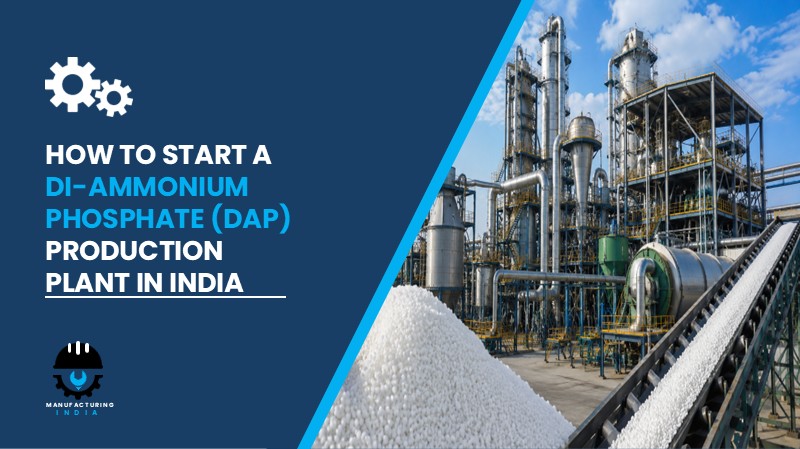
Setting up a di-ammonium phosphate (DAP) production plant in India presents a compelling investment case at a time when the country’s agricultural sector is under intense pressure to deliver higher crop yields, the government is actively managing fertiliser supply chains as a strategic food security priority, and global fertiliser markets are tightening in ways that make domestic production capacity a national imperative. Di-ammonium phosphate — the water-soluble, nitrogen and phosphorus-rich fertiliser chemically represented as (NH₄)₂HPO₄ and containing approximately 18% nitrogen and 46% phosphorus pentoxide — is the most widely used phosphorus-based fertiliser globally and the dominant source of phosphate nutrition for India’s vast cereal, oilseed, vegetable, and fruit growing sectors. Without reliable domestic DAP production, India remains exposed to global supply disruptions, export restrictions from major producing nations, and price volatility that directly threatens the affordability and availability of a fertiliser that over 140 million farm households depend on for every planting season.
India’s strategic need for domestic DAP production has never been more clearly articulated than in July 2025, when India signed a five-year agreement with Saudi Arabia’s Ma’aden to secure a steady supply of DAP and other key fertilisers — a landmark diplomatic and commercial commitment made specifically to ensure price stability and reliable availability for Indian farmers amid tightening global markets and export restrictions from China. This policy response to supply chain vulnerability is the most direct evidence possible that establishing domestic DAP production capacity in India is not merely a commercial investment decision; it is a contribution to food security infrastructure that the government actively supports through subsidy schemes, import partnerships, and production incentives. As per the report published by the Press Information Bureau (PIB) in August 2025, the Government of India extended a one-time special subsidy of ₹3,500 per tonne for DAP fertiliser from April 2024 to March 2025 to support farmers amid global market pressures — a government commitment to DAP affordability that directly stabilises demand and revenue for domestic producers.
Investing in a di-ammonium phosphate (DAP) production plant in India today aligns India’s food security imperative, government subsidy frameworks, and rising global food demand — with FAO projecting global cereal production of 10.1 million tonnes in 2025 with wheat output at 809.7 million tonnes — alongside domestic manufacturing ambitions exemplified by Hindustan Zinc’s Rs 1,700 Crore DAP facility launching by December 2026. With commercially sound profit margins and a break-even period ranging from 3 to 7 years across varying capacity and efficiency parameters, DAP production represents one of India’s most strategically significant and government-backed agricultural input manufacturing investments.
What is Di-Ammonium Phosphate (DAP)?
Di-ammonium phosphate (DAP) is a highly water-soluble fertiliser widely utilised in agriculture to supply essential nutrients to crops. Chemically represented as (NH₄)₂HPO₄, DAP is composed of two ammonium ions and one phosphate ion, typically containing about 18% nitrogen (N) and 46% phosphorus pentoxide (P₂O₅). Its crystalline structure allows for easy handling, storage, and transportation, making it one of the most popular phosphorus-based fertilisers globally.
DAP’s high solubility facilitates rapid nutrient availability, supporting vigorous root development and early crop growth across cereals, oilseeds, fruits, and vegetables. Key properties include low hygroscopicity, high purity, and stability under normal storage conditions, which ensure minimal nutrient loss during the extended supply chain journey from plant to farm. DAP promotes higher yields and enhances nutrient use efficiency across India’s diverse cropping systems — from Punjab’s wheat and Andhra Pradesh’s paddy to Maharashtra’s oilseeds and Rajasthan’s pulses — making it an indispensable input for both subsistence and commercial agriculture at every scale.
The primary production process covers neutralisation of concentrated phosphoric acid with gaseous ammonia, granulation, drying, cooling, screening, and coating. End-use industries served include agriculture, horticulture, floriculture, and turf management. Applications span fertilisation of cereals, oilseeds, vegetables, fruits, and pasture lands across India’s diverse agro-climatic zones.
Cost of Setting Up a DAP Production Plant in India
The cost of establishing a di-ammonium phosphate production plant in India depends on plant capacity, technology selection between rotary drum granulation and fluidised bed granulation, raw material sourcing strategy for phosphoric acid and ammonia, geographic location — particularly proximity to phosphoric acid supply and agricultural market distribution networks — degree of automation, and the safety and environmental compliance requirements applicable to ammonia handling and granulation operations.
1. Capital Expenditure (CapEx)
Land and Site Development forms a foundational component of total capital investment, covering land acquisition charges, site registration, boundary development, drainage and containment infrastructure, and site utilities. The location must offer easy access to key raw materials such as phosphoric acid, ammonia, and water for slurry formation. Proximity to target agricultural markets minimises distribution costs across seasonal procurement cycles. The site must have robust infrastructure including reliable transportation, utilities, and waste management systems, with compliance with local zoning laws and environmental regulations ensured from the earliest planning stage. Investors may explore fertiliser industrial zones in Rajasthan, Gujarat, Andhra Pradesh, and Uttar Pradesh — states with both raw material supply chain access and large agricultural customer bases.
Plant Layout Optimisation is a critical civil and construction investment that goes beyond standard chemical plant design. The layout must be optimised to enhance workflow efficiency, safety, and minimise material handling distances. Separate areas for raw material storage, production, quality control, and finished goods storage must be designated, with space for future expansion incorporated to accommodate business growth — a particularly important consideration given India’s fertiliser sector growth trajectory.
Machinery and Equipment represent the largest single component of total CapEx for a di-ammonium phosphate production plant. Essential equipment includes:
- Neutralisation reactors
- Granulators (rotary drum or fluidised bed)
- Dryers
- Coolers
- Screening machines
- Coating units
- Ammonia storage and injection systems
- Dust collection and scrubbing systems
Other Capital Costs include an effluent treatment plant (ETP) to minimise environmental impact and ensure compliance with emission standards, advanced monitoring systems to detect leaks or deviations in the process, pre-operative expenses, environmental clearance costs, commissioning charges, and any import duties on specialised granulation technology or automated packing line components not available domestically.
Request a Sample Report for In-Depth Market Insights: https://www.imarcgroup.com/di-ammonium-phosphate-manufacturing-plant-project-report/requestsample
2. Operational Expenditure (OpEx)
Raw Material Cost is the dominant operational expense, accounting for the largest share of total OpEx. The primary raw materials are phosphoric acid (H₃PO₄), ammonia (NH₃), water for slurry formation, and optional anti-caking agents to ensure granule stability and prevent clumping during storage and handling. Phosphoric acid — as the phosphorus source and the highest-value reagent — drives the majority of raw material cost and is sourced from phosphate rock processing operations. Ammonia, as the nitrogen source, is available from domestic fertiliser producers and petrochemical ammonia plants. Long-term contracts with reliable suppliers must be negotiated to stabilise pricing and ensure a steady supply, with sustainability and supply chain risks assessed from the outset of the sourcing strategy. Nearby suppliers should be selected wherever possible to minimise transportation costs on the highest-volume inputs.
Utility Cost is the second-largest OpEx component, covering electricity, water, and steam requirements across neutralisation reactor operations, granulation, drying, cooling, and screening. Energy-efficient granulation units and heat recovery from the exothermic neutralisation reaction are increasingly incorporated by manufacturers to reduce utility consumption and environmental impact — investments in process efficiency that directly improve the long-term profitability of the facility.
Other Operating Costs include transportation and distribution to agricultural wholesale networks, district-level fertiliser dealers, farmer cooperatives, and government distribution channels, packaging materials for bagged DAP in 50 kg standard format and bulk packaging for large-scale buyers, salaries and wages for chemical process engineers and quality control staff, routine machinery maintenance, depreciation on production equipment, and applicable taxes. By the fifth year of operations, total operational costs are projected to increase substantially due to factors such as inflation, market fluctuations, and potential rises in the cost of key materials. Supply chain disruptions, rising consumer demand, and shifts in the global economy are expected to contribute to this increase.
3. Plant Capacity
Plant capacity for a DAP production facility can be customised per investor requirements, from smaller regional units to large integrated complexes targeting both domestic market supply and export. The facility should incorporate automated ammonia injection systems, precise temperature and pH monitoring units, and dust control mechanisms to ensure operational safety and environmental compliance. In August 2025, Hindustan Zinc — a Vedanta Group company — announced its Rs 1,700 Crore fertiliser plant scheduled to launch by December 2026, with the first phase delivering a phosphoric acid plant operational by March–April 2026 followed by full DAP production. This landmark domestic investment sets the benchmark for the scale and timeline of serious DAP manufacturing investment in India in the current period. Transformer manufacturing processes can be scaled with controlled capital investment, with capacity expansion built into site layout planning to accommodate future business growth.
4. Profit Margins and Financial Projections
The financial projections for a di-ammonium phosphate production plant demonstrate commercially viable profitability potential supported by government subsidy frameworks and recurring agricultural procurement demand. Profitability depends on several factors including market demand, production efficiency, pricing strategy, raw material cost management, and operational scale, with profit margins usually improving with capacity expansion and increased capacity utilisation rates. A comprehensive financial analysis covering NPV (net present value), IRR (internal rate of return), payback period, and break-even analysis is essential before committing capital. Break-even in a DAP production business typically ranges from 3 to 7 years, depending on production capacity, market demand, operating efficiency, and capital investment — with cost control and consistent sales being critical to achieving profitability within this timeframe.
Why Set Up a DAP Production Plant in India?
Rising Global Food Demand Sustaining Fertiliser Consumption. The increase in global population, projected to exceed 9 billion by 2035, necessitates higher agricultural output to ensure food security. Staple crops such as rice, wheat, and maize require phosphorus and nitrogen for optimal development, and DAP’s nutrient composition directly supports enhanced root growth, tillering, and grain formation. According to the Food and Agriculture Organisation (FAO), its global cereal production forecast for 2025 predicts 10.1 million tonnes, with wheat output projected at 809.7 million tonnes — up 1.3% from 2024 — indicating further growth in the primary crops that drive consistent DAP demand for both subsistence and commercial farming across India and globally.
Government Subsidies and Policy Support Creating Demand Security. Government policies and subsidy programmes significantly influence DAP market growth by ensuring affordability for India’s farming population. As per the report published by the Press Information Bureau (PIB) in August 2025, the Government of India extended a one-time special subsidy of ₹3,500 per tonne for DAP fertiliser from April 2024 to March 2025 to support farmers amid global market pressures. This move ensures affordable access to DAP while helping maintain crop productivity, and aligns with broader efforts to strengthen India’s fertiliser sector and promote sustainable agriculture. These initiatives stimulate demand by encouraging adoption of mechanised and precision fertiliser application.
India’s Strategic Partnership with Ma’aden Signalling Supply Security Priority. In July 2025, India signed a five-year agreement with Saudi Arabia’s Ma’aden to secure a steady supply of DAP and other key fertilisers, amid tightening global markets and export restrictions from China. The deal ensures price stability and reliable availability for Indian farmers and reinforces India’s commitment to ensuring stable fertiliser supplies. This landmark diplomatic agreement directly validates the strategic importance of domestic DAP production capacity — making investment in Indian DAP manufacturing a complement to, and ultimately a replacement for, import-dependent supply security strategies.
Active Domestic Investment Confirming Market Confidence. In August 2025, Hindustan Zinc — a Vedanta Group company — announced its Rs 1,700 Crore fertiliser plant scheduled to launch by December 2026, designed to produce DAP fertiliser to reduce reliance on imports and support farmers. The first phase will see a phosphoric acid plant operational by March–April 2026, followed by full DAP production — a phased investment model that demonstrates the viability of domestic integrated DAP manufacturing at commercial scale and provides a blueprint for investors evaluating comparable capacity establishment.
Asia-Pacific Market Leadership and India’s Strategic Position. Regional growth in Asia-Pacific, particularly India, China, and Southeast Asia, is propelled by government subsidy programmes, crop diversification, and adoption of precision farming practices. India sits at the centre of this regional growth trajectory — as both the world’s largest agricultural market after China and as a country whose food security policy actively mandates fertiliser availability at affordable prices. This dual role as a large domestic consumer and a policy-prioritised production target makes India one of the most commercially and strategically sound locations globally for new DAP production capacity.
Manufacturers Investing in Energy-Efficient and Automated Production. Manufacturers are increasingly investing in energy-efficient granulation units, dust control systems, and automated packing lines to reduce production costs and environmental impact. Advanced plants include automated ammonia injection systems, precise temperature and pH monitoring units, and dust control mechanisms — technology investments that improve operational safety, product consistency, and environmental compliance simultaneously. New investors who establish facilities with current state-of-the-art technology benefit from these efficiency improvements from commissioning, creating a cost position advantage over older legacy installations.
Manufacturing Process — Step by Step
The di-ammonium phosphate production process uses neutralisation and granulation as the primary production method, covering sourcing and preparing raw materials, reaction of phosphoric acid with ammonia to form slurry, granulation, drying and cooling, screening and coating, storage and packaging, and quality control and testing. Each stage requires precisely controlled pH, temperature, and moisture parameters to produce uniform, specification-grade DAP granules meeting the nutrient content, granule hardness, and moisture specifications required by agricultural distribution and application equipment.
- Raw Material Receipt and Preparation: Phosphoric acid, ammonia, water for slurry formation, and anti-caking agents are received from certified suppliers, quality-checked for purity and concentration, and prepared in metered quantities for controlled feed into the neutralisation reactor system.
- Neutralisation Reaction: Concentrated phosphoric acid is reacted with gaseous ammonia in neutralisation reactors under carefully controlled conditions to maintain optimal pH and temperature throughout the exothermic reaction. The pH is controlled between 6.0 and 7.5 to favour di-ammonium phosphate formation over monoammonium phosphate, producing a DAP slurry of specified consistency and nutrient composition.
- Granulation: The resulting DAP slurry is fed into rotary drum granulators or fluidised bed granulators, where controlled tumbling and agglomeration action forms uniform DAP granules of the target size distribution — typically 2–4 mm diameter for standard agricultural application. Recycle fines from the screening stage are returned to the granulator to improve yield and granule uniformity.
- Drying: Wet DAP granules are processed through dryers at controlled temperature and airflow to reduce moisture content to specification levels — typically below 1.5% — ensuring granule strength, storage stability, and resistance to caking during the distribution chain to farm.
- Cooling: Dried DAP granules pass through coolers where controlled ambient air reduces granule temperature to near-ambient levels, preventing caking during storage and ensuring safe packaging into bags without heat damage to packaging materials.
- Screening: Cooled granules are processed through screening machines to separate on-specification product (2–4 mm) from oversize and undersize fractions. Oversize granules are crushed and recycled, and undersize fines are returned to the granulator, ensuring consistent product size distribution and maximising yield from each production cycle.
- Coating: On-specification DAP granules are treated in coating units with optional anti-caking agents to ensure granule stability and prevent clumping during storage and handling — a particularly important quality step for DAP destined for humid regional markets or extended supply chain transit times.
- Quality Control and Testing: Finished DAP granules undergo comprehensive quality testing covering nitrogen content, P₂O₅ content, moisture level, granule hardness, particle size distribution, and colour against FCO (Fertiliser Control Order) specification requirements before release for packaging.
- Packaging and Dispatch: Specification-compliant DAP granules are filled into 50 kg bags and sealed using bagging and packaging machines, labelled with nutrient declaration, lot number, and manufacturing details compliant with FCO marking requirements, then dispatched to agricultural wholesale networks, government distribution channels, farmer cooperatives, and horticulture and turf management customers across India’s agricultural states.
Key Applications
Di-ammonium phosphate produced in India serves a broad and structurally essential range of agricultural and horticultural applications across India’s diverse cropping systems:
- Cereal and Grain Farming: DAP supports vigorous root development, tillering, and grain formation in wheat, rice, and maize — India’s most critical food security crops — through its balanced 18:46 nitrogen-phosphorus nutrient delivery.
- Oilseed Production: Applied as a starter fertiliser and soil enrichment product across soybean, groundnut, mustard, and sunflower cultivation, supporting strong early growth and improved oil content in high-value oilseed crops.
- Horticulture and Plantation Crops: Used in vegetable, fruit, tea, coffee, and other plantation crop cultivation for high-value horticulture applications where precise nutrient management is critical for yield and quality.
- Floriculture and Turf Management: Applied in flower production and turf grass management for professional landscaping, sports field maintenance, and ornamental horticulture where DAP’s rapid solubility supports responsive nutrient availability.
Leading Manufacturers
The global di-ammonium phosphate industry is served by a group of large-scale manufacturers with vertically integrated production and distribution networks across the major phosphate-producing and consuming regions. Key players in the global market include:
- Mosaic
- Vigyan Chemicals
- Sichuan Blue Sword Chemical Co. Ltd
- Pacific Chemicals Ltd
- Mississippi Potashcorp
- OCP Group
- Phosphates Corporation
- Liuguo Chemical
- Wengfu Group
- Shandong Lubei Chemical
Timeline to Start the Plant
Establishing a di-ammonium phosphate production plant in India involves a structured multi-phase development sequence. The timeline can range from 12 to 36 months depending on plant capacity, land acquisition, environmental approvals, and equipment procurement, with project design, construction, and commissioning stages requiring careful planning to avoid delays. Investors should plan for the following phases:
- Feasibility study and project report preparation
- Land acquisition and site development
- Regulatory approvals and environmental clearances
- Factory licence and fire safety compliance
- Machinery procurement and installation
- Raw material supplier agreements and supply chain setup
- Trial production and quality testing
- Commercial production launch
Licences and Regulatory Requirements
Starting a di-ammonium phosphate production unit in India requires several approvals spanning business registration, fertiliser regulation, ammonia safety, environmental, and agricultural compliance domains:
- Business registration (Proprietorship, LLP, or Pvt Ltd)
- Factory Licence under the Factories Act
- Environmental Clearance from the State Pollution Control Board
- GST Registration
- Fire Safety NOC
- Fertiliser Control Order (FCO) registration under the Essential Commodities Act for commercial manufacture and sale of DAP as a controlled fertiliser in India
- PESO approval and compliance under the Petroleum and Explosives Safety Organisation rules for ammonia storage and handling as a compressed toxic gas
- Hazardous/Chemical compliance under the Manufacture, Storage and Import of Hazardous Chemical (MSIHC) Rules applicable to ammonia and phosphoric acid handling
- Effluent Treatment Plant (ETP) operational clearance
- Occupational Health and Safety compliance including On-Site Emergency Plan mandatory for ammonia-handling major hazard installations
Key Challenges to Consider
High Capital Requirements and Long Construction Timelines. Establishing a DAP production plant involves significant capital investment in land, civil works, neutralisation reactors, granulation equipment, drying and cooling systems, ammonia storage infrastructure, and dust control systems. Equipment procurement lead times for specialised granulation technology and the complexity of ammonia-handling infrastructure extend construction-to-commissioning timelines to 12–36 months, requiring careful financial planning and pre-commitment of working capital.
Phosphoric Acid and Ammonia Feedstock Availability and Price Volatility. Phosphoric acid — derived from phosphate rock — and ammonia — a natural gas derivative — are the two primary raw material inputs whose pricing is subject to global commodity cycles. India’s domestic phosphate rock resources are limited, creating import dependence for phosphoric acid feedstock that must be managed through long-term supply contracts and port-accessible import logistics. Ammonia availability from domestic fertiliser producers must be secured through formal supply agreements given competing demand from urea and other fertiliser manufacturers.
Ammonia Safety and Regulatory Compliance. Ammonia — used as gaseous feed for the neutralisation reaction and stored in pressurised vessels — is a toxic, flammable gas that requires the most stringent safety management across the production facility. PESO approval, ammonia leak detection systems, emergency response infrastructure, and worker safety training are mandatory regulatory requirements that add both capital cost and ongoing operational management obligations unique to ammonia-handling chemical facilities.
FCO Compliance and Government Price Regulation. DAP sold in India as an agricultural fertiliser is subject to the Fertiliser Control Order — specifying minimum nutrient content, labelling requirements, and quality standards — and its pricing is influenced by government subsidy mechanisms. Navigating the FCO registration and ongoing compliance surveillance, while managing the pricing dynamics of a subsidised, regulated product, requires dedicated regulatory expertise and government relations management.
Competition from Established Domestic and International Producers. The competitive landscape includes large multinational producers including Mosaic, OCP Group, and Wengfu Group with scale and vertical integration advantages, alongside domestic investments including Hindustan Zinc’s announced Rs 1,700 Crore facility. New entrants must secure agricultural distribution network access, qualify as FCO-registered producers, and establish supply relationships with state fertiliser corporations and cooperative distribution systems to compete effectively.
Skilled Manpower for Ammonia-Handling Chemical Operations. Maintaining safe and consistent operation of neutralisation reactors, ammonia injection systems, and granulation equipment requires trained chemical process engineers and safety-certified ammonia plant operators — a specialised technical workforce requiring ongoing investment in recruitment, safety training, and certification maintenance under regulatory requirements.
Frequently Asked Questions
1. How much does it cost to set up a di-ammonium phosphate production plant in India?
Capital requirements generally include land acquisition, construction, equipment procurement, installation, pre-operative expenses, and initial working capital. Equipment costs — including neutralisation reactors, granulators, dryers, coolers, screening machines, coating units, ammonia storage and injection systems, and dust collection and scrubbing systems — represent a significant portion of capital expenditure. The total amount varies with capacity, technology, and location. A detailed project report with full CapEx and OpEx breakdowns is available on request.
2. Is di-ammonium phosphate production profitable in India in 2026?
Yes. Profitability is supported by India’s government subsidy framework — including the ₹3,500 per tonne special DAP subsidy extended through March 2025 — stable agricultural demand across all cropping seasons, and FAO’s projected 2025 global cereal production growth that sustains fertiliser consumption. Profit margins usually improve with capacity expansion and increased capacity utilisation rates, with break-even ranging from 3 to 7 years depending on plant efficiency and market conditions.
3. What machinery is required for a di-ammonium phosphate production plant in India?
Key machinery includes neutralisation reactors, granulators, dryers, coolers, screening machines, coating units, ammonia storage and injection systems, and dust collection and scrubbing systems. Auxiliary systems including conveyors, pumps, and control units are also essential. High-quality, corrosion-resistant machinery tailored for DAP production must be selected, with all machinery complying with industry standards for safety, efficiency, and reliability.
4. What licences and approvals are required to start a di-ammonium phosphate production plant in India? Required approvals include business registration, a Factory Licence under the Factories Act, Environmental Clearance from the State Pollution Control Board, GST registration, a Fire Safety NOC, FCO registration for agricultural fertiliser manufacture and sale, PESO approval for ammonia storage and handling, MSIHC Rules compliance for phosphoric acid and ammonia, ETP operational clearance, and Occupational Health and Safety compliance including On-Site Emergency Plan.
5. What raw materials are needed for di-ammonium phosphate production?
The primary raw materials are ammonia (NH₃), phosphoric acid (H₃PO₄), and water for slurry formation. Anti-caking agents to ensure granule stability and prevent clumping during storage and handling are also required. These core ingredients react in a controlled environment to form DAP granules, with high-purity chemical grades used to ensure fertiliser quality and FCO nutrient specification compliance.
6. What are the environmental compliance requirements for a di-ammonium phosphate production plant in India?
The unit must obtain Environmental Clearance from the State Pollution Control Board, operate a certified ETP to minimise environmental impact and ensure compliance with emission standards, install advanced monitoring systems to detect leaks or deviations in the process, implement ammonia emission scrubbing for neutralisation reactor off-gas, and maintain dust collection systems for granulation and screening operations.
7. What is the best location to set up a di-ammonium phosphate production plant in India?
The location must offer easy access to key raw materials including phosphoric acid, ammonia, and water for slurry formation. Proximity to target agricultural markets minimises distribution costs across India’s seasonal fertiliser procurement cycles. The site must have robust infrastructure including reliable transportation, utilities, and waste management systems. Fertiliser industrial zones in Rajasthan, Gujarat, Andhra Pradesh, and Uttar Pradesh offer relevant combinations of raw material access and agricultural market proximity.
8. What is the break-even period for this type of plant in India?
Break-even in a di-ammonium phosphate production business typically ranges from 3 to 7 years, depending on production capacity, market demand, operating efficiency, and capital investment. Cost control and consistent sales are critical to achieving profitability within this timeframe. A detailed financial analysis including payback period, NPV, and IRR projections is available via the sample request link.
9. What government incentives are available for manufacturers in India?
Governments may offer incentives such as capital subsidies, tax exemptions, reduced utility tariffs, export benefits, or interest subsidies to promote manufacturing under various national or regional industrial policies. The Indian government’s fertiliser sector support — including the ₹3,500 per tonne special DAP subsidy — state-level agricultural input manufacturing incentives, and the landmark July 2025 Ma’aden supply agreement that signals India’s strategic commitment to DAP supply security collectively strengthen the investment environment for domestic DAP production.
Key Takeaways for Investors
A di-ammonium phosphate production plant in India represents one of the most strategically significant agri-input manufacturing investments available in the country — positioned at the intersection of India’s food security imperative, the government’s active fertiliser subsidy and supply security programmes, and the global agricultural productivity challenge driven by a population projected to exceed 9 billion by 2035. The project demonstrates commercial viability across a range of plant capacities supported by India’s government subsidy framework — including the ₹3,500 per tonne special DAP subsidy extended through March 2025 — stable, seasonally predictable agricultural procurement demand, and the July 2025 five-year Ma’aden supply agreement that explicitly validates the urgency of building domestic DAP production capacity to replace import dependence. With Hindustan Zinc’s Rs 1,700 Crore DAP facility scheduled for full production by December 2026 setting the benchmark for serious domestic investment commitment, FAO projecting continued global cereal production growth sustaining fertiliser demand, and the Asia-Pacific region’s government-driven fertiliser consumption expansion placing India at the centre of the world’s most dynamic agricultural input market, demand sustainability for India-based DAP production is structurally robust, policy-anchored, and nationally essential across the full investment horizon.
About the Author