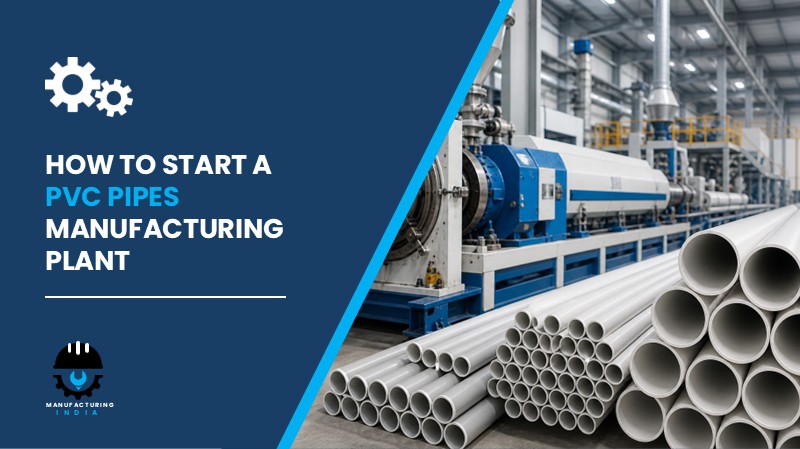
Setting up a PVC pipes manufacturing plant in India presents a compelling investment case driven by surging demand across construction and real estate, water supply and sanitation infrastructure, agriculture and irrigation, industrial processing units, and the electrical and telecom sectors. As India accelerates its urban expansion and infrastructure build-out, PVC pipes have become indispensable to the country’s fluid transportation and drainage systems. The product’s combination of strength, durability, corrosion resistance, and cost-effectiveness makes it one of the most strategically important materials in India’s infrastructure pipeline.
India’s ongoing urbanisation, Make in India initiative, and expanding rural irrigation programmes create an ideal operating environment for a new PVC pipes manufacturing facility. Key manufacturing states such as Gujarat and Maharashtra offer industrial estates, reliable utility supply, and established chemical input supply chains that significantly reduce CapEx friction. With a globally proven extrusion technology base and a vast domestic demand pool, the business case for setting up this type of plant in India is both timely and financially sound.
Investors entering the PVC pipes segment in India benefit from policy tailwinds, cost-competitive land and labour, and a diverse demand base spanning construction, agriculture, and municipal infrastructure. With gross profit margins ranging between 20-30% and a scalable extrusion-based production model, this investment offers healthy returns and a credible break-even trajectory for entrepreneurs and institutional investors alike.
What are PVC Pipes?
PVC (Polyvinyl Chloride) pipes are widely used plastic piping systems produced from polymerized vinyl chloride resin blended with stabilizers, lubricants, and performance-enhancing additives. These materials collectively provide strength, durability, and flexibility while maintaining a lightweight structure that simplifies transportation and installation. The smooth interior of the pipes reduces friction, enhancing flow efficiency and lowering energy usage. PVC pipes also offer excellent resistance to corrosion, chemical reactions, and biological growth, making them suitable for harsh operating environments.
The production method is a multi-step operation encompassing PVC resin blending, material feeding, extrusion, sizing and calibration, cooling, cutting, socketing, quality inspection, and packaging. The facility serves end-use industries including construction and real estate, water supply and sanitation infrastructure, agriculture and irrigation, industrial processing units, and the electrical and telecom sector. Applications range from drinking water pipelines and sewerage systems to agricultural irrigation networks, borewell casing, cable conduits, and industrial fluid transport systems.
Cost of Setting Up a PVC Pipes Manufacturing Plant in India
The cost of establishing a PVC pipes manufacturing plant in India depends on several factors, including production capacity, technology level, plant location, degree of automation, and regulatory compliance requirements. Investors must account for both upfront capital expenditure and recurring operational costs when preparing a detailed project report.
1. Capital Expenditure (CapEx)
Land and Site Development: forms a substantial portion of the total CapEx. Costs cover land registration charges, boundary development, and site preparation. Investors may choose between Special Economic Zones (SEZs), MIDC or GIDC industrial estates, or private plots depending on state-specific incentives and proximity to raw material suppliers and markets.
Civil Works and Construction: include factory sheds, quality control laboratories, raw material storage areas, finished goods warehouses, and administrative blocks. Proper layout planning is critical to ensure workflow efficiency, safety compliance, and room for future capacity expansion.
Machinery and Equipment: represent the largest single component of capital expenditure. Key machinery required includes:
- High-output extruders
- Vacuum calibration tanks
- Haul-off units
- Cutters
- Socketing machines
- Packaging systems
Other Capital Cost: include effluent treatment plant (ETP) installation, pre-operative expenses such as feasibility studies and DPR preparation, import duties on specialized equipment where applicable, and commissioning charges.
Access the Detailed Feasibility Analysis, Request Sample: https://www.imarcgroup.com/pvc-pipes-manufacturing-plant-project-report/requestsample
2. Operational Expenditure (OpEx)
Raw Material Cost: is the dominant driver of OpEx for this type of plant. The primary raw materials required for PVC pipes manufacturing are PVC resin and performance-enhancing additives including stabilizers and lubricants. Raw material costs account for approximately 70-80% of total operating expenses. Investors are advised to negotiate long-term contracts with reliable domestic or import suppliers to mitigate price volatility and ensure supply continuity.
Utility Cost: covers electricity, water, and steam consumption across the extrusion and calibration lines. Utility and energy costs represent 10-15% of total OpEx and are a key variable in site selection, favouring states with competitive industrial power tariffs.
Other Operating Cost: include transportation and logistics for inbound raw materials and outbound finished goods, packaging materials for bundled pipe dispatch, salaries and wages for plant operators, technical staff, and administrative personnel, plus routine maintenance, depreciation on machinery, and applicable taxes. By the fifth year of operations, the total operational cost is expected to increase substantially due to inflation, market fluctuations, rising costs of key materials, supply chain disruptions, and shifts in global economic conditions.
3. Plant Capacity
The proposed manufacturing facility as detailed in IMARC Group’s project report is designed with an annual production capacity ranging between 30,000 and 60,000 MT, enabling economies of scale while maintaining operational flexibility. Capacity can be customised based on investor requirements and target market size. As a general principle, profitability improves with higher capacity utilisation, making the scale selection a critical strategic decision.
4. Profit Margins and Financial Projections
The project demonstrates healthy profitability under normal operating conditions. Gross profit margins for this type of plant typically range between 20-30%, while net profit margins average 8-12%. A detailed financial analysis covering NPV (Net Present Value), IRR (Internal Rate of Return), payback period, income projections, and expenditure forecasts over a five-year horizon is essential for investor confidence and lender presentations. The project’s financial projections are developed based on assumptions related to capital investment, operating costs, production capacity utilisation, pricing trends, and demand outlook.
Why Set Up a PVC Pipes Plant in India?
Strong Infrastructure Growth and Urbanisation: Continuous investment in housing, sanitation, and water supply projects ensures sustained demand for PVC pipes across Indian cities and towns. Urbanisation is accelerating the requirement for reliable water conveyance and drainage systems in both residential and commercial developments.
Agricultural Sector Modernisation: The agriculture sector’s modernisation, particularly the installation of efficient irrigation and water distribution systems, is significantly increasing the use of PVC pipes in rural India. Drip irrigation, sprinkler systems, and water conveyance pipelines all depend on PVC piping solutions, creating a large and growing demand base beyond urban markets.
Policy and Regulatory Tailwinds: Government policies focused on easy access to clean drinking water, expanding wastewater treatment facilities, and enhancing irrigation infrastructure are accelerating market demand across India. These policy mandates directly translate into procurement requirements for PVC pipes at the municipal and state level.
Cost-Competitive Manufacturing: India offers cost advantages across land acquisition, construction labour, and domestic chemical supply chains. Locating the facility in an established industrial estate in states such as Gujarat or Maharashtra further lowers input costs and simplifies regulatory approvals.
Active Industry Investment: In March 2025, Supreme Industries agreed to acquire Wavin India’s piping business for USD 30 Million, including PVC pipes and fittings, boosting its piping capacity by 73,000 tonnes annually. In February 2025, Malpani Pipes & Fittings introduced new PVC pipes with an annual production capacity of 1,800 tons, backed by an investment of INR 3.8 Crore in advanced machinery. These developments confirm that the Indian PVC pipes sector continues to attract capital and capacity expansion.
Local Supply Chain Preference: Construction companies, real estate developers, municipal bodies, and agricultural equipment suppliers are increasingly preferring locally sourced PVC piping solutions to reduce lead times and transportation costs, creating a captive market opportunity for new domestic manufacturers.
Manufacturing Process – Step by Step
The PVC pipes manufacturing process uses PVC resin blending, material feeding, extrusion, sizing and calibration, cooling, cutting, socketing, quality inspection, and packaging as the primary production method. Each stage involves defined unit operations with specific equipment requirements:
- PVC Resin Blending: PVC resin is combined with stabilizers, lubricants, and performance additives in precise proportions to achieve the required mechanical and chemical properties.
- Material Feeding: The blended compound is loaded into the extruder feed hopper using automated or manual feeding systems.
- Extrusion: The compound is processed through high-output extruders where heat and pressure transform the blend into a continuous pipe profile.
- Sizing and Calibration: The extruded pipe passes through vacuum calibration tanks to achieve precise dimensional tolerances in diameter and wall thickness.
- Cooling: The pipe is cooled progressively using water baths to solidify the profile and stabilise dimensions.
- Cutting: Haul-off units pull the pipe forward at a controlled speed while cutters trim it to specified lengths.
- Socketing: Socketing machines form the socket end of the pipe to enable jointing during installation.
- Quality Inspection: Pipes are tested for dimensional accuracy, pressure resistance, and material performance against quality assurance criteria.
- Packaging and Dispatch: Finished pipes are bundled, labelled, and packaged for dispatch to construction sites, agricultural distributors, industrial buyers, and electrical/telecom contractors.
Key Applications
PVC pipes serve a broad range of industries spanning municipal infrastructure, agriculture, construction, and industrial processing. Key applications include:
- Water Supply and Sanitation Infrastructure: Used in municipal water distribution and sewerage networks for reliable conveyance of potable water and wastewater.
- Agriculture and Irrigation: Employed in drip irrigation, sprinkler systems, and water conveyance pipelines across farmlands and rural zones.
- Construction Industry: Used for internal plumbing, drainage, and rainwater harvesting systems within residential and commercial buildings.
- Industrial Applications: Suitable for chemical transport and industrial fluid handling across processing units.
- Electrical and Telecom Sector: Used as conduits for cable protection and routing in electrical installations and telecom infrastructure.
- Borewell Casing: Applied in borewell construction for groundwater extraction across agricultural and municipal uses.
- Drinking Water Pipelines and Drainage Systems: Core infrastructure components in urban and rural water supply schemes.
Leading Manufacturers
The global PVC pipes industry is served by several multinational companies with extensive production capacities and diverse application portfolios. Key players as identified in IMARC Group’s market analysis include:
- Mexichem
- Radius Systems Ltd.
- National Pipes & Plastics
- Georg Fischer Ltd.
- Astral Pipes
- Yonggao Co., Ltd.
- Vinidex Pty Ltd
- COEMAC
- Adequa Water Solutions, S.A.
Timeline to Start the Plant
Investors should plan for a structured project execution timeline covering the following phases:
- Feasibility study and project report preparation
- Land acquisition and site development
- Regulatory approvals and environmental clearances
- Factory licence and fire safety compliance
- Machinery procurement and installation
- Raw material supplier agreements and supply chain setup
- Trial production and quality testing
- Commercial production launch
Licences and Regulatory Requirements
Starting a PVC pipes manufacturing unit in India requires several approvals:
- Business registration (Proprietorship, LLP, or Pvt Ltd) under the Ministry of Corporate Affairs
- Factory Licence under the Factories Act from the State Labour Department
- Environmental Clearance from the State Pollution Control Board
- GST Registration with the relevant tax authority
- Fire Safety NOC from the State Fire Department
- Hazardous/Chemical compliance for handling PVC resin and chemical additives
- Effluent Treatment Plant (ETP) operational clearance to manage process wastewater
- Occupational Health and Safety compliance under applicable state and central regulations
Key Challenges to Consider
High Capital Requirements: Establishing a PVC pipes manufacturing plant involves significant investment in land, civil construction, and machinery including high-output extruders, vacuum calibration tanks, haul-off units, cutters, socketing machines, and packaging systems. Proper financial planning and phased investment are essential to manage cash flow.
Raw Material Price Volatility: PVC resin and performance additives, which account for 70-80% of total OpEx, are subject to global price fluctuations driven by petrochemical feedstock costs, supply chain disruptions, and currency movements. Long-term supplier contracts and hedging strategies are advisable.
Regulatory Compliance: Environmental clearances, ETP requirements, factory licensing, and chemical handling regulations add time and cost to the project timeline. Early engagement with state pollution control boards and local authorities is strongly recommended.
Technology and Innovation Pressure: Ongoing technological advancements in extrusion processes and material formulations continue to raise quality and performance expectations. Investors must select machinery that meets current industry standards and can be upgraded as the market evolves.
Competition from Established Players: The presence of large players such as Astral Pipes and global manufacturers like Georg Fischer Ltd. and Mexichem creates pricing pressure in the market. Differentiation through product quality, local service, and application-specific offerings is key.
Skilled Manpower: Operating high-output extruders and calibration systems requires trained technical personnel. Workforce development and retention programmes are important for maintaining production quality and efficiency.
Frequently Asked Questions
1. How much does it cost to set up a PVC pipes manufacturing plant in India?
The total cost depends on capacity, location, technology, and automation level. Key cost heads include land and site development, civil construction, machinery such as extruders and calibration tanks, and working capital for raw materials including PVC resin and additives. A detailed CapEx and OpEx breakdown is available in IMARC Group’s project report.
2. Is PVC pipes manufacturing profitable in India in 2026?
Yes. The project demonstrates gross profit margins of 20-30% and net profit margins of 8-12% under normal operating conditions, supported by strong and diversified demand across construction, agriculture, and municipal sectors.
3. What machinery is required for a PVC pipes plant in India?
Key machinery includes high-output extruders, vacuum calibration tanks, haul-off units, cutters, socketing machines, and packaging systems.
4. What licences and approvals are required to start a PVC pipes plant in India?
Required approvals include business registration, Factory Licence, Environmental Clearance, GST Registration, Fire Safety NOC, chemical compliance certificates, ETP clearance, and Occupational Health and Safety compliance.
5. What raw materials are needed for PVC pipes manufacturing?
The primary raw materials are PVC resin and performance-enhancing additives including stabilizers and lubricants. Raw material costs account for 70-80% of total operational expenditure.
6. What are the environmental compliance requirements for a PVC pipes plant in India?
Manufacturers must obtain Environmental Clearance from the State Pollution Control Board, operate a certified Effluent Treatment Plant, and comply with emission standards and chemical handling regulations applicable to PVC processing.
7. What is the best location to set up a PVC pipes plant in India?
Locations near raw material suppliers, with access to reliable utilities and transportation infrastructure, are preferred. Industrial estates in Gujarat and Maharashtra offer established supply chains, competitive utility costs, and favourable regulatory environments.
8. What is the break-even period for this type of plant in India?
Break-even timelines depend on plant capacity, utilisation rates, and prevailing market pricing. Detailed payback period calculations using NPV and IRR analysis are provided in the IMARC Group feasibility report.
9. What government incentives are available for manufacturers in India?
Manufacturers can explore incentives under the Make in India initiative, state industrial promotion schemes, MSME credit guarantee schemes, capital subsidy programmes, and SEZ benefits. Specific incentives vary by state and product category.
Key Takeaways for Investors
A PVC pipes manufacturing plant in India represents a financially viable and strategically well-timed investment opportunity, with end-use demand driven by construction and real estate, municipal water and sanitation infrastructure, agriculture and irrigation, and the electrical and telecom sectors. The project demonstrates sound financial performance across a range of plant capacities, with gross profit margins of 20-30% and net profit margins of 8-12% making this investment competitive across multiple capital deployment scenarios. The global PVC pipes market reached 26.88 Million Tons in 2025 and is projected to reach 37.61 Million Tons by 2034, growing at a CAGR of 3.8% from 2026 to 2034, reflecting robust and sustained long-term demand. With urbanisation, agricultural modernisation, and government infrastructure programmes continuing to accelerate across India, demand sustainability for this type of plant remains well-founded over the medium and long term.
About the Author