Introduction
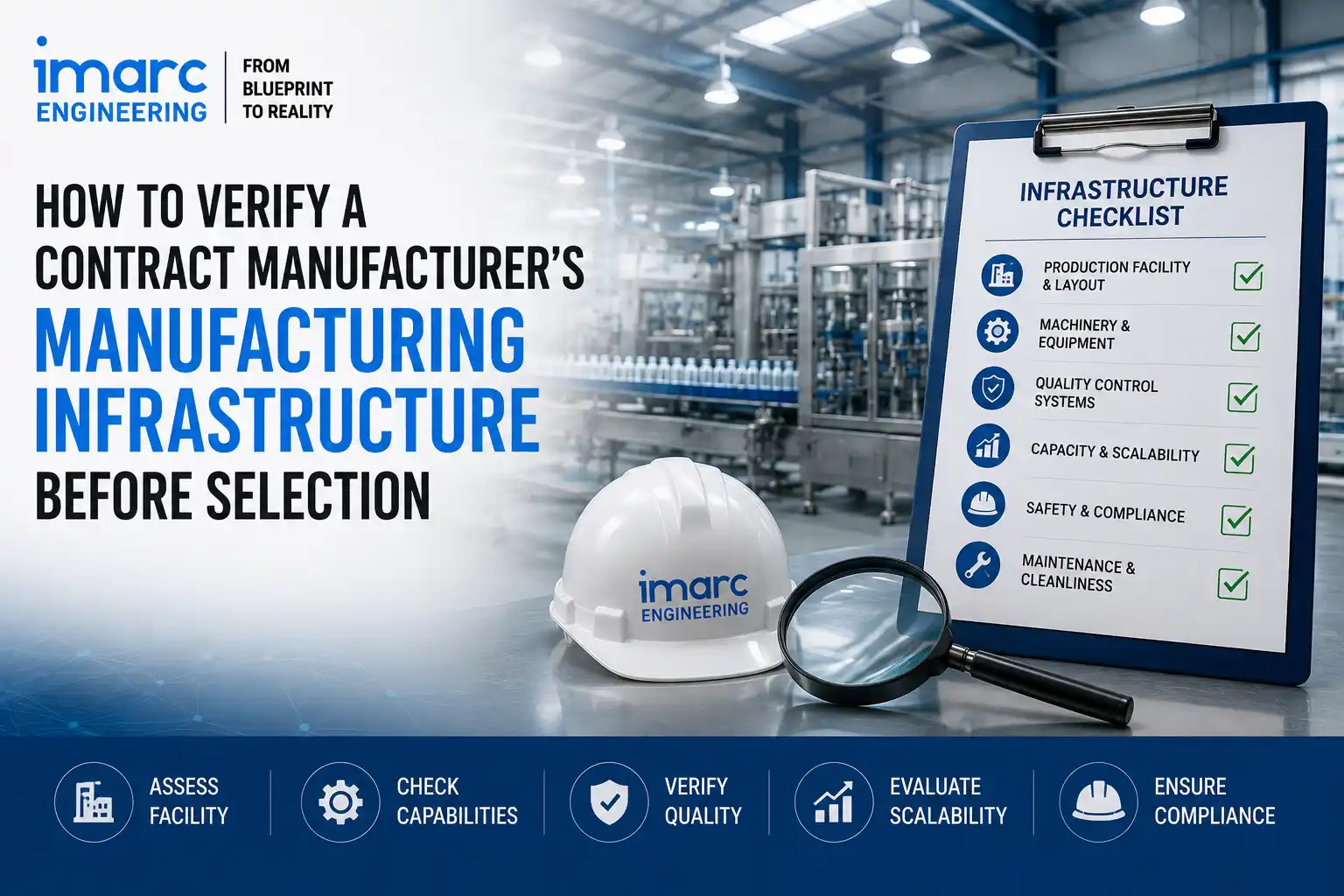
Verifying a contract manufacturer’s manufacturing infrastructure is one of the most important steps before selection — and one of the most often reduced to a short plant tour.
Once orders are placed or a long-term agreement is signed, the hidden gaps surface: utilities already near limit, layout that cannot support your volume, equipment condition that drives downtime, storage that creates quality risk, and expansion claims that do not survive contact with real load. These issues are rarely obvious in a quotation or a capability brochure. They become clear only when infrastructure is checked against process, capacity, utility headroom and operating evidence before the partnership is locked.
A structured infrastructure assessment can help buyers distinguish between a manufacturer that looks capable on paper and one that can reliably support the required production. This article explains how to verify contract manufacturing infrastructure before selection, which checks matter most, and how structured verification can protect supply continuity and cost.
Why Infrastructure Verification Matters in India’s Manufacturing Market
India’s manufacturing sector continues to attract sourcing and partnership interest under policy support and rising capacity.
- Manufacturing growth is estimated at around 7% at constant prices in FY 2025-26 (MoSPI First Advance Estimates).
- FDI into manufacturing rose 18% in FY 2024-25 to US$19.04 billion (Ministry of Commerce & Industry / DPIIT).
- PLI cumulative investment has exceeded ₹2.16 lakh crore, with cumulative production and sales surpassing ₹20.41 lakh crore as of December 2025 (PIB).
- Logistics costs have improved to an estimated 7.97% of GDP (DPIIT-NCAER study).
As more buyers source from Indian contract manufacturers, infrastructure verification becomes the filter between a competitive quote and a plant that can actually deliver. Price matters. Utility readiness, layout fitness, asset condition and capacity headroom matter more over the life of the relationship.
What “Manufacturing Infrastructure” Includes
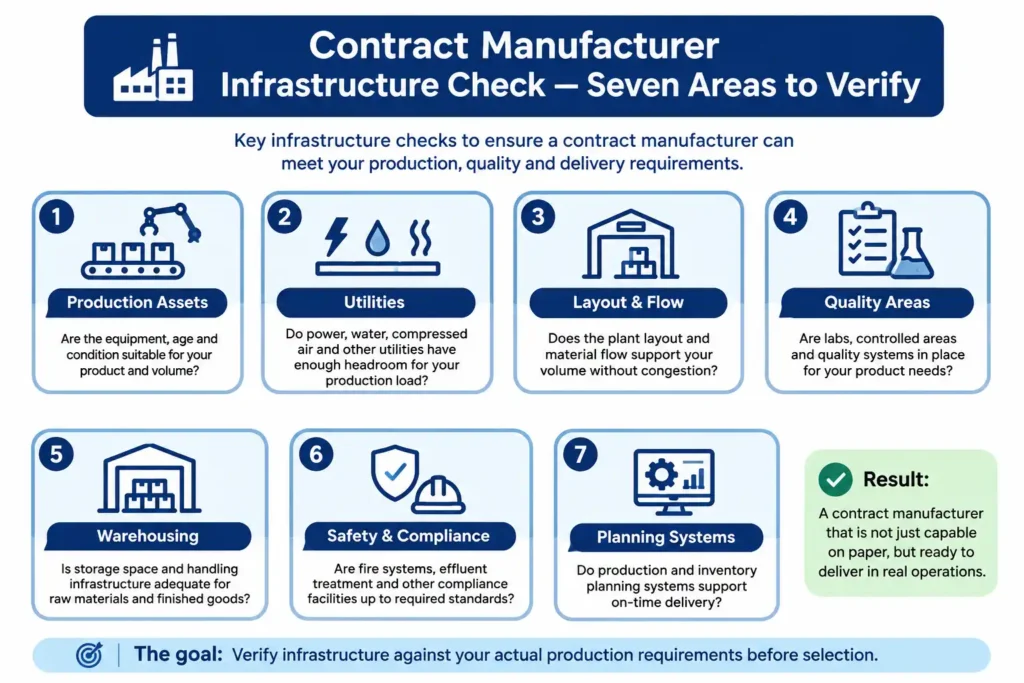
Manufacturing infrastructure is more than buildings and machines. A practical verification should assess the physical assets, supporting systems and operating infrastructure required to deliver your product consistently:
- Production assets — core equipment, age, condition, maintenance discipline and critical spares
- Utilities — power, water, steam, compressed air, HVAC and effluent capacity versus required load
- Layout and material flow — aisles, staging, storage, access and whether volume creates congestion
- Quality and controlled areas — labs, segregation, environmental controls where the product needs them
- Warehousing and handling — inbound, in-process and finished goods space, condition and traceability support
- Safety and compliance infrastructure — fire systems, effluent treatment, access control and licence-linked facilities
- Digital and planning support — basic production, inventory and quality data systems that affect delivery reliability
A partner can look strong on one dimension and still fail if utilities, layout or asset condition cannot support your product and volume.
Step-by-Step: How to Verify Manufacturing Infrastructure
1. Define your load before you visit
Define your production requirements before visiting the plant. Specify volume range, product mix, utility intensity, storage needs and compliance expectations.Without a clear requirement, almost every plant can appear “adequate.””
2. Validate capacity against demonstrated output
Validate claimed capacity against demonstrated output. Compare recent production evidence, utilisation levels and bottleneck constraints with your expected order volume. Nameplate capacity is not the same as sustainable capacity for your orders.
3. Check utility headroom
Check utility headroom against your expected production load. Confirm that power, water, effluent and other services can support your process without immediate major upgrades. Also ask how the system performs at peak load.
4. Walk the layout with your process in mind
Walk the layout against your actual production flow. Assess whether material movement, staging, storage and access will work at your expected volume. Congestion and cross-traffic can become early indicators of delivery, quality and safety risk.
5. Inspect critical equipment condition
Inspect the condition of critical production equipment. Review equipment age, maintenance records, breakdown history and critical-spares strategy for assets that directly affect product quality and uptime.
6. Review storage and handling infrastructure
Inadequate or poorly controlled storage creates damage, mix-ups and traceability gaps — especially for regulated or quality-sensitive products.
7. Confirm compliance-linked facilities
Effluent treatment, fire systems, controlled environments and documentation areas must match the standards your market requires.
8. Test whether expansion claims are real
If growth is part of the partnership case, verify space, utility capacity and layout headroom — not only verbal assurance.
9. Score infrastructure on a common scorecard
Use the same criteria across shortlisted manufacturers so decisions are comparable and evidence-based.
What Should You Check During a Contract Manufacturer Site Assessment?
A contract manufacturer site assessment should verify whether the plant can support your product, production volume and quality requirements under actual operating conditions. Key checks include:
- Production equipment condition and maintenance
- Demonstrated production capacity and utilisation
- Power, water, compressed air and effluent headroom
- Plant layout and material movement
- Raw material and finished goods storage
- Quality testing and controlled areas
- Fire, safety and environmental infrastructure
- Production and inventory planning systems
- Workforce and maintenance capability
- Space and utilities available for future expansion
The objective is not simply to confirm that the infrastructure exists. It is to determine whether it is fit for your specific production requirements.
7 Red Flags to Watch During a Contract Manufacturer Site Assessment
- Large gap between claimed capacity and recent actual output
- Utilities already operating near limit with growth assumed
- Layout that cannot absorb your volume without chronic congestion
- Critical equipment near end of life without a funded replacement plan
- Weak segregation between raw, in-process and finished goods
- Compliance infrastructure that exists on paper more than in daily use
- Reluctance to share maintenance, downtime or utility data
Any one red flag deserves deeper diligence. Several together usually mean higher lifecycle supply risk than the quotation suggests.
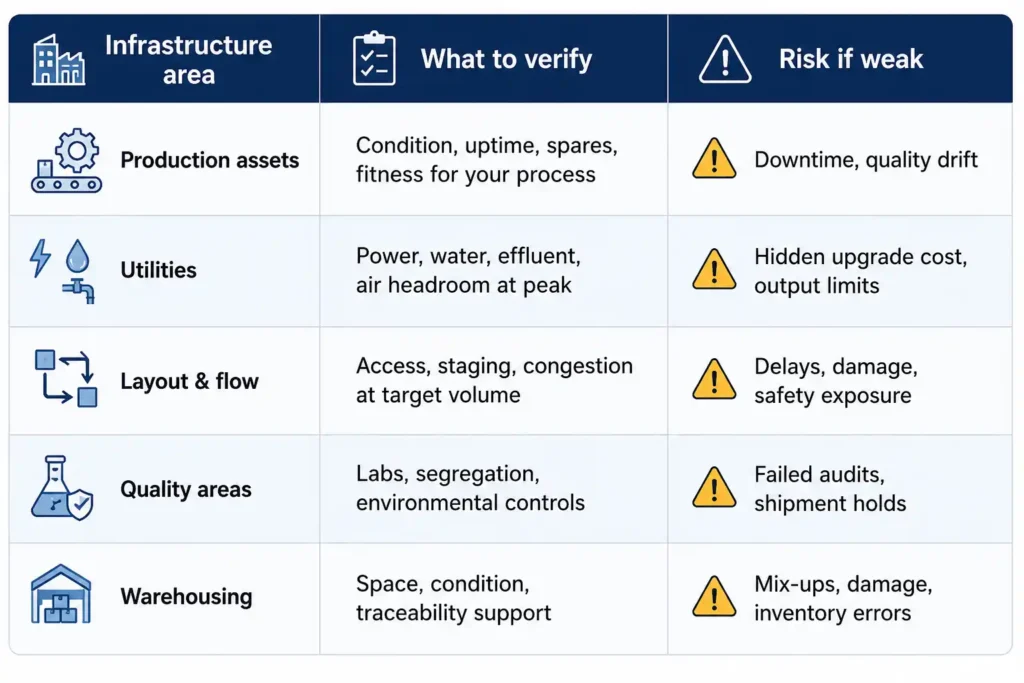
Infrastructure Verification Focus Areas at a Glance
How Strong Infrastructure Verification Improves Partner Selection
A structured infrastructure verification can help buyers make better partner-selection decisions by providing:
- Clearer view of true capacity and utility limits
- Lower risk of post-award surprises on upgrades or downtime
- Stronger negotiation position based on evidence
- Better match between product requirements and plant reality
- Fewer partner changes after launch
- More reliable planning for volume ramp-up
The cost and effort involved in pre-selection verification can be significantly lower than dealing with infrastructure gaps after production orders are already live.
How IMARC Engineering Supports Infrastructure Verification
IMARC Engineering supports industrial buyers and project sponsors with contract manufacturer infrastructure and manufacturing capability assessments across India. Its assessment approach can include:
● Process and capacity verification
● Utility readiness checks
● Layout and asset-condition review
● Operational risk identification
● Infrastructure suitability assessment before partner selection
● Support for companies evaluating manufacturing partners in India
The approach can be applied across pharmaceuticals, food and beverage, chemicals, auto components, electronics, FMCG and discrete manufacturing.
For contract manufacturer infrastructure and capability assessment support, explore IMARC Engineering’s services: https://www.imarcengineering.com/contact?service=contract-manufacturer-identification
Common Mistakes When Checking Contract Manufacturer Infrastructure
- Relying on a short plant tour without requirement-based checks
- Accepting nameplate capacity without production evidence
- Ignoring utility headroom until after orders are placed
- Treating certificates as proof of daily infrastructure control
- Skipping storage, handling and maintenance checks
- Believing expansion claims without verifying available space and utility capacity
Conclusion
Verifying a contract manufacturer’s infrastructure before selection helps buyers determine whether a plant can support their actual product, volume and quality requirements. The assessment should cover production assets, utilities, layout, storage, quality facilities, safety systems and future expansion capacity rather than relying on a plant tour or capability brochure alone.
Buyers that validate these capabilities against operating evidence are better positioned to select manufacturing partners that can support reliable production and future volume growth. Through capacity, utility and operational-readiness assessments, IMARC Engineering helps companies identify infrastructure constraints before commitment rather than after orders are already live.
Contact Us:
IMARC Engineering
Phone: +91-120-433-0800
Email: sales@imarcengineering.com
India: C-130, Sector 2, Noida, Uttar Pradesh 201301
LinkedIn: https://www.linkedin.com/showcase/imarc-engineering/
About the Author