Key takeaways
- Medium- and high-technology industries now account for close to 46.3% of India’s manufacturing value added, according to the latest central government expenditure data, a sign that Indian manufacturers are increasingly competing on process sophistication rather than cost alone.
- India’s manufacturing sector recorded gross value added growth of 7.72% in Q1 and 9.13% in Q2 of FY26, growth that is increasingly concentrated in technology-intensive segments such as electronics, automobiles, and pharmaceuticals rather than traditional low-technology output.
- Central incentive schemes increasingly tie disbursement to demonstrated technology absorption rather than investment alone. Under one such production-linked scheme, 96 companies had been approved with a combined investment commitment of ₹316.87 billion by March 2026, tracked against measurable production and localisation milestones.
- A technology that performs well at its country of origin can still fail on an Indian shop floor if feedstock variability, utility quality, ambient conditions, or workforce skill profile were not evaluated against the original process design before transfer began.
- Most technology transfer failures do not surface during commissioning, they surface months earlier, when licensing terms, process boundary conditions, or regulatory fit were assumed rather than verified against the receiving plant’s actual environment.
- Evaluation, adaptation, and transfer are frequently run as three separate, sequential projects handled by different teams, when the technologies that scale up successfully in India are the ones planned as one continuous process from technology selection through to validated production.
Introduction
Bringing a new manufacturing technology into an Indian plant, whether licensed from a foreign partner, transferred between group facilities, or scaled up from a pilot line, tends to fail for reasons that have little to do with the technology itself. It fails because the technology was evaluated in isolation, adapted without accounting for local feedstock and utility conditions, or handed over without documentation the receiving plant could actually work from.
Experienced technology transfer consultants in India treat evaluation, adaptation, and transfer as one continuous process rather than separate handoffs. The objective is to verify whether the technology fits the receiving plant, adapt it to local operating conditions, and transfer the process knowledge, documentation, and training required for reliable production.
This guide explains how to evaluate a new manufacturing technology before committing to it, what adaptation to Indian production conditions involves, and where technology transfers most often break down on the path to full-scale production.
Evaluating a Technology Before You Commit to It
A sound technology evaluation checks the technology against the receiving plant’s actual conditions, not against how it performed at its source. That means verifying claimed yield, throughput and quality figures against the feedstock grade, utility profile and ambient conditions the Indian plant will actually operate under, rather than assuming the source plant’s inputs will simply carry over. It also means reviewing the licensing and IP terms in detail: what is actually being transferred, process know-how, equipment design, or patent rights, and where the boundaries sit, since ambiguity at this stage routinely turns into a dispute once the transfer is underway.
Regulatory fit deserves the same scrutiny early, not after equipment has already been ordered. A technology that clears every technical benchmark can still stall for months if applicable BIS requirements, sector-specific approvals, or emission and effluent norms were not assessed before commitment. With medium- and high-technology industries now contributing close to 46.3% of India’s manufacturing value added, more of this evaluation work is happening for processes that are technically demanding enough that a wrong assumption at this stage is expensive to unwind later.
Where Adaptation Gets Skipped
Process parameters validated at a source plant are calibrated to that plant’s feedstock, water quality, voltage stability and climate, conditions that frequently do not hold at an Indian site. Skipping a dedicated adaptation step, and assuming the process will simply behave the same way once installed, is one of the most common reasons a technology that worked reliably elsewhere underperforms after it is commissioned in India.
The fix is a pilot-scale adaptation trial run against the receiving plant’s actual inputs before full-scale equipment is finalised, not after. Catching a feedstock or utility mismatch at pilot scale costs a trial run. Catching the same mismatch once the full line is installed costs a shutdown, a redesign, and a delayed production start.
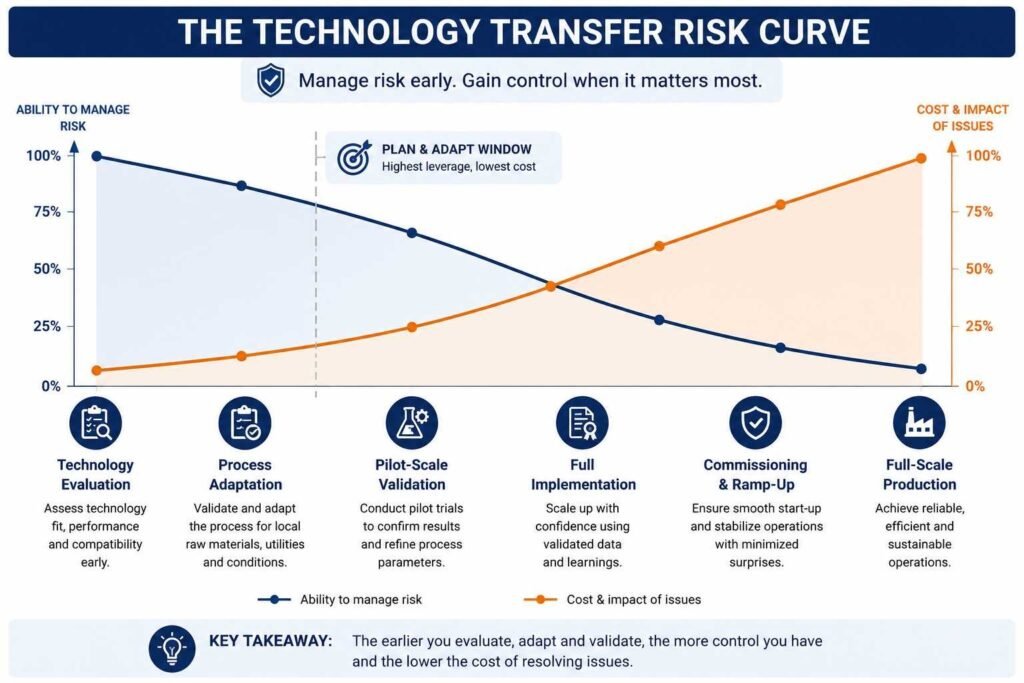
How a Skipped Evaluation Step Becomes a Line Stoppage
A licensing agreement that leaves process boundary conditions loosely defined is a useful example of how this compounds. If the exact feedstock specification and utility tolerances are not written into the agreement, equipment may be specified around source-plant assumptions. That mismatch is usually invisible until commissioning, when the process fails to hit its targets under the receiving plant’s actual conditions.
At that point, the fix is no longer a documentation clarification, it is equipment rework, a renegotiation with the technology partner, and potential delays to production start-up. One ambiguous clause in an evaluation document, left unresolved, generates cost across equipment, schedule, and the partner relationship itself.
Consult IMARC Engineering for Expert Technology Transfer Support: https://www.imarcengineering.com/contact?service=technology-transfer
Where Technology Transfer Risk Concentrates
The table below outlines where technology transfer projects most commonly lose ground, and the downstream consequence each gap typically produces.
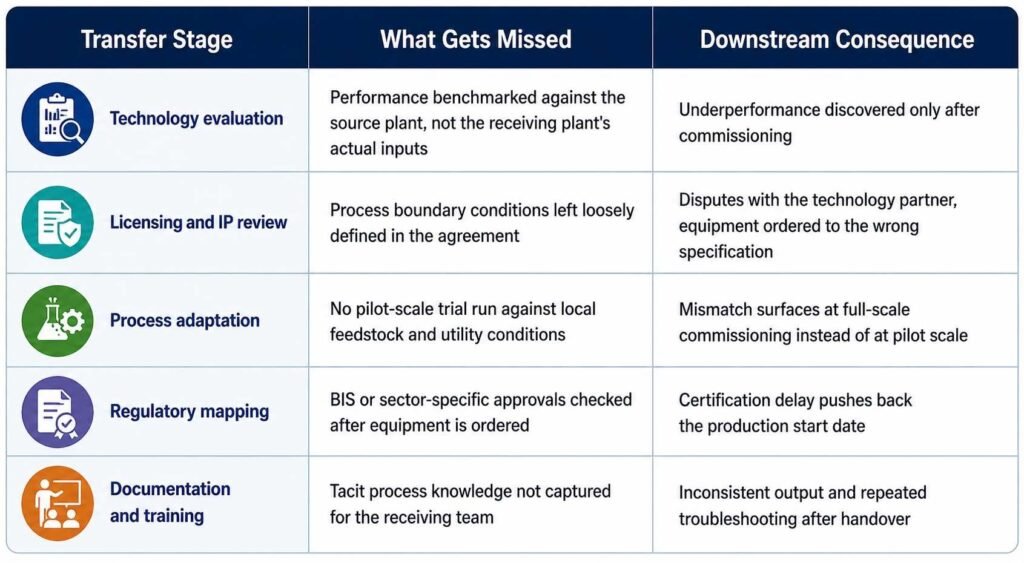
Structuring a Transfer That Actually Scales
A technology transfer that scales reliably runs licensing review, readiness assessment, pilot-scale adaptation, and documentation as a single coordinated sequence under one project owner, rather than as separate workstreams that only talk to each other once something has already gone wrong. Licensing terms get clarified before equipment specification begins. Adaptation gets validated at pilot scale before full transfer. Documentation and training get built for the team that will actually run the process day to day, not just the team that developed it. Sequenced this way, the technologies that reach full-scale Indian production do so with far fewer surprises left for commissioning to uncover.
How IMARC Engineering De-Risks Technology Transfer From Evaluation to Full-Scale Production
- Technology readiness assessed against the receiving plant: Claimed performance is verified against the Indian site’s actual feedstock, utility and quality profile, not the source plant’s operating conditions.
- Technology-transfer scope clarified before equipment is ordered: Process requirements, technical boundaries and responsibilities are defined early so equipment specifications align with the agreed transfer scope.
- Process parameters adapted and validated at pilot scale: Local feedstock and utility conditions are trialled before full-scale equipment is finalised, catching mismatches while they are still inexpensive to fix.
- Regulatory and compliance fit mapped early: BIS certification and sector-specific approvals are checked against the technology before commitment, not after equipment is on order.
- Documentation and training built for the receiving team: Process knowledge is captured and transferred in a form the plant’s own operators and engineers can work from, supporting consistent output after handover.
Bringing a new technology into an Indian plant also means planning the evaluation and adaptation sequence correctly from the start. For a detailed walkthrough, see IMARC Engineering’s Technology Transfer for Manufacturing in India: https://www.imarcengineering.com/blog/technology-transfer-for-manufacturing-in-india
Final thoughts
Technology-transfer problems often begin well before a production line fails to meet its targets. Unresolved licensing boundaries, feedstock assumptions, utility requirements, process parameters, or regulatory requirements can carry forward into commissioning and full-scale production. Manufacturers that evaluate, adapt, and transfer technology as one coordinated process are better positioned to reduce these risks and achieve stable production.
Contact Us:
IMARC Engineering
Phone: +91-120-433-0800
Email: sales@imarcengineering.com
India: C-130, Sector 2, Noida, Uttar Pradesh 201301
LinkedIn: https://www.linkedin.com/showcase/imarc-engineering/
About the Author