Key takeaways
- NCRB data recorded 5,888 fire-accident deaths across India in 2024, and while that figure has declined nearly 35% over five years, industrial facilities continue to account for a disproportionate share of high-casualty incidents relative to their number.
- A June 2025 dust explosion at a chemical factory in Telangana killed 46 workers, one of the deadliest industrial fire incidents in recent Indian history, underscoring how process-specific hazards like combustible dust need fire protection design that goes beyond generic building fire safety.
- A April 2025 warehouse explosion in Gujarat that killed 21 people was traced to a facility operating with an expired safety license, a documented pattern across multiple 2025 incidents where compliance lapses, not the absence of fire safety knowledge, were the direct cause.
- Six major industrial disasters between January and April 2026 alone caused at least 71 deaths and 80 injuries across power, steel, mining, and chemical facilities, spanning multiple states and pointing to systemic gaps in maintenance and regulatory oversight rather than isolated failures.
- Industry review of 2025 fire incidents found a consistent pattern: facilities either lacked a valid Fire NOC, had not installed required fire safety equipment, or had systems installed but non-functional at the time of the incident, three distinct failure modes that a properly engineered and maintained system addresses differently.
- Fire protection for a manufacturing plant is not a single generic system. Hazard classification, applicable IS codes, and suppression technology all vary by occupancy type and process risk, which is why fire safety design needs to be engineered around the specific facility, not applied from a standard template.
Introduction
India’s industrial fire safety record has improved on paper, NCRB data shows fire-related deaths declining nearly 35% over the past five years, yet 2025 and early 2026 have still seen some of the deadliest single industrial incidents in recent memory. The pattern across these incidents is consistent: the underlying risk was known, but the systems designed to manage it were either absent, expired, or non-functional when they were needed most. This is the gap an Industrial Fire Protection Consultant in India is meant to close, engineering fire safety around a facility’s specific process hazards rather than treating compliance as a checkbox exercise.
This guide covers what current incident data reveals about India’s industrial fire risk, what a properly engineered fire protection scope actually includes, and where the recurring gaps between design and real-world compliance tend to originate.
What the Data Shows About Industrial Fire Risk
NCRB’s most recent Accidental Deaths and Suicides report recorded 5,888 fire-accident deaths in 2024, down 15.4% from the prior year and part of a broader five-year decline from 9,110 deaths in 2020. That downward trend, however, has not prevented a series of severe, high-casualty industrial incidents through 2025 and into 2026.
A June 2025 dust explosion at a chemical factory in Pashamylaram, Telangana, killed 46 workers and injured 33 others, one of the deadliest single industrial incidents in recent Indian history, caused by a combustible dust explosion, a hazard category that generic fire safety measures frequently fail to address. Separately, an April 2025 explosion at a warehouse in Deesa, Gujarat, killed 21 people at a facility later found to have been operating with an expired safety license. Between January and April 2026 alone, six major industrial disasters across power, steel, mining, and chemical facilities caused at least 71 deaths and 80 injuries, spanning multiple states.
Why Generic Fire Safety Measures Aren’t Enough
A recurring finding across reviews of India’s 2025 fire incidents is that the underlying failure was rarely a lack of fire safety awareness. It was a compliance and engineering gap: facilities without a valid Fire NOC, facilities that had not installed the fire safety equipment their occupancy classification required, or facilities where equipment was installed but not functional at the time of the incident.
Industrial facilities carry hazard profiles that vary significantly by process, combustible dust in chemical and pharmaceutical manufacturing, flammable solvent storage, high electrical load density, or large open storage areas, each of which calls for a different suppression, detection, and egress strategy. A fire protection system designed around a generic commercial building template will not adequately address hazards specific to a given manufacturing process.
Consult IMARC Engineering for Expert Fire Safety Solutions: https://www.imarcengineering.com/contact?service=fire-safety-and-security-system-design
What Industrial Fire Protection Consulting Actually Covers
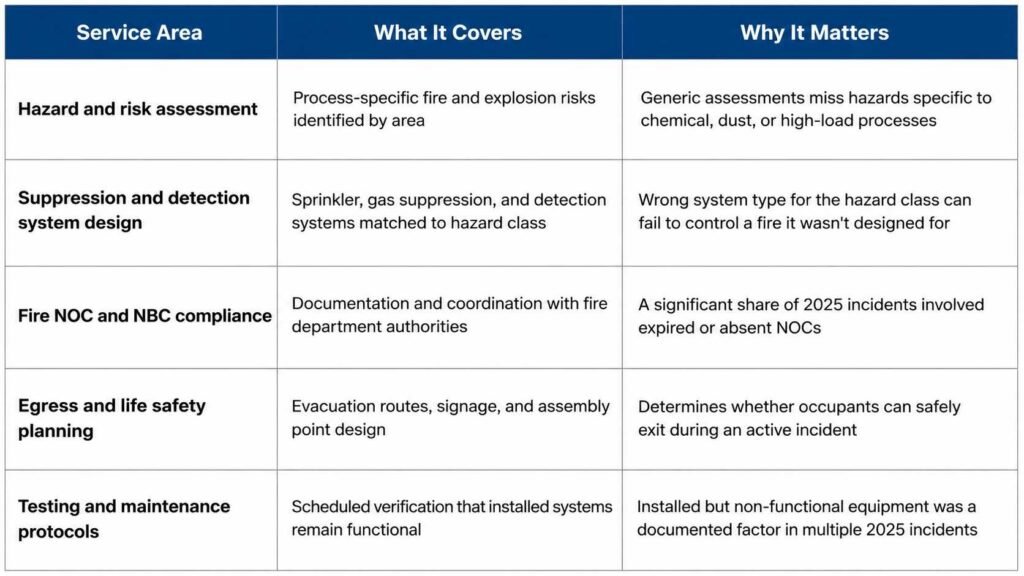
From identifying fire hazards to ensuring systems remain operational, industrial fire protection consulting covers several critical areas:
How a Fire Protection System Is Actually Engineered
A properly engineered fire protection scope follows a defined sequence, and skipping ahead to equipment selection before hazard assessment is complete is one of the more common reasons a system underperforms when it is actually needed.
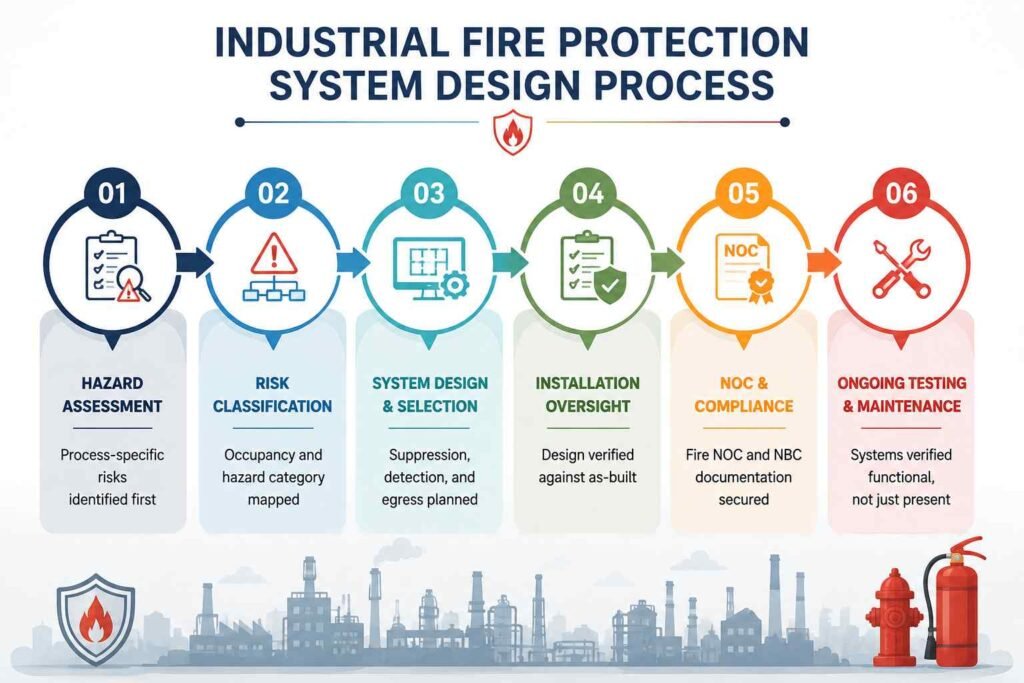
- Hazard assessment: Process-specific risks, combustible dust, flammable solvents, high electrical load, are identified by area before any system is specified.
- Risk classification: Occupancy type and hazard category are mapped against applicable National Building Code and IS code requirements, since classification directly determines what the system must be able to do.
- System design and selection: Suppression, detection, and egress systems are selected and engineered to match the specific risk classification, not selected from a generic default specification.
- Installation oversight: The design is verified against as-built installation, catching gaps between what was specified and what was actually installed before commissioning.
- NOC and compliance: Fire NOC documentation and coordination with local fire department authorities are managed as a structured process, not an afterthought handled once construction is complete.
- Ongoing testing and maintenance: Systems are verified functional on a recurring schedule, directly addressing the installed-but-non-functional failure pattern documented across multiple 2025 incidents.
Engineering Safety Into Every Layer: How IMARC Engineering Supports Your Fire Protection Strategy
- Process-specific hazard assessment: Fire and explosion risk is assessed against the facility’s actual process, chemical, dust, electrical, or storage-related, rather than a generic commercial building checklist.
- Code-compliant system design: Suppression, detection, and egress systems are engineered against applicable National Building Code and IS code requirements specific to the facility’s risk classification.
- End-to-end NOC and compliance management: Fire NOC documentation and fire department coordination are handled as a structured, sequenced part of the project, not a downstream administrative task.
- Installation verification: As-built installation is checked against the approved design before commissioning, closing the gap between specification and what actually gets installed on site.
- Ongoing testing and functional verification: Maintenance and testing schedules are built in to confirm installed systems remain functional over time, directly targeting the failure mode behind several recent industrial incidents.
For a detailed look at designing fire safety and security systems specifically for manufacturing plants, see IMARC Engineering’s guide on Designing Fire Safety and Security Systems for Manufacturing Plants in India: https://www.imarcengineering.com/blog/design-fire-safety-security-systems-manufacturing-plants-india
Final Thoughts
India’s declining national fire death statistics mask a persistent pattern in the industrial sector specifically: severe, preventable incidents where the fire safety system that should have prevented or contained the disaster was either never properly engineered for the facility’s actual hazards, or had lapsed into non-compliance without anyone catching it in time. Manufacturers who treat fire protection as an engineered, continuously verified system, rather than a one-time compliance requirement, are the ones positioned to avoid becoming the next entry in that pattern.
Contact Us:
IMARC Engineering
Phone: +91-120-433-0800
Email: sales@imarcengineering.com
India: C-130, Sector 2, Noida, Uttar Pradesh 201301
LinkedIn: https://www.linkedin.com/showcase/imarc-engineering/
About the Author