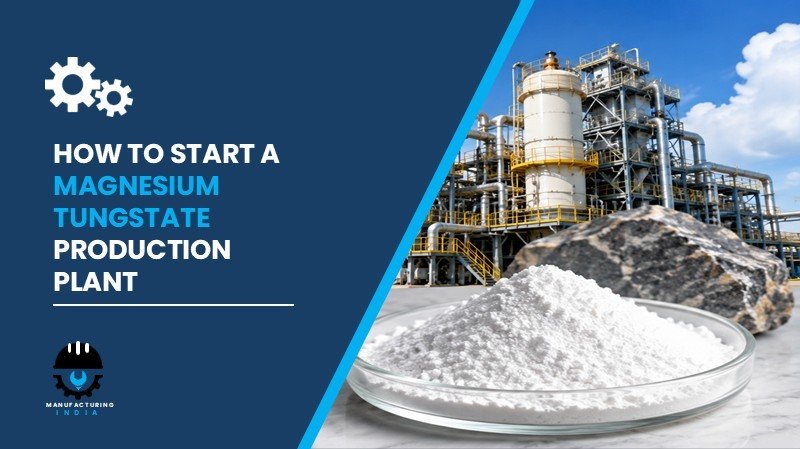
A magnesium tungstate production plant setup in India presents a compelling investment case for entrepreneurs eyeing the specialized inorganic materials space. Magnesium tungstate is used in luminescent products, functional ceramics, catalysts, coatings, and optical applications, and its optical and electrical properties support use in niche, high-value segments where material purity and controlled morphology matter. Applications span phosphors, catalysts, functional ceramics, and coating-filler modification, positioning the material as a critical input for India’s growing advanced-materials, electronics, and optical-equipment industries.
India’s expanding manufacturing base, supported by the Make in India initiative and growing industrial clusters, makes this an opportune time to enter tungstate-based specialty chemical production. States with strong chemical and materials-processing ecosystems, such as Gujarat and Maharashtra, offer access to industrial infrastructure, skilled manpower, and logistics networks suited to this line of production. Given the material’s role in high-value downstream sectors, India’s cost-competitive manufacturing environment strengthens the strategic case for domestic production rather than import dependence.
This investment combines policy support under Make in India with cost-competitive manufacturing economics, gross margins of 28-38%, and demand from phosphor, ceramics, optical, and radiation-detection sectors – creating a financially viable, break-even-capable opportunity for entrepreneurs entering the specialty materials segment.
What is Magnesium Tungstate?
Magnesium tungstate is an inorganic compound with the chemical formula MgWO₄, consisting of magnesium, tungsten, and oxygen. It is generally obtained as a white or light-colored powder with high density and low water solubility. Magnesium tungstate belongs to the family of metal tungstates and exhibits useful luminescent, optical, dielectric, catalytic, and electronic characteristics. It can be manufactured in different forms, including conventional powders, nanoparticles, and crystalline materials, with the properties of the final product depending on the synthesis route, particle size, crystallinity, morphology, purity, and heat-treatment conditions.
The production process uses raw-material preparation, solution preparation or solid-state mixing, reaction, precipitation, filtration, drying, grinding, calcination, classification, quality testing, and packaging as its core unit operations. The finished material serves end-use industries including advanced materials, electronics, ceramics, optical equipment, chemical processing, coatings, and radiation-detection technologies.
Cost of Setting Up a Magnesium Tungstate Production Plant in India
Cost depends on capacity, technology, location, automation level, and regulatory compliance requirements.
1. Capital Expenditure (CapEx)
Land and site development form a substantial part of the overall investment, covering land registration, boundary development, and related site-preparation expenses. Investors can evaluate options within industrial estates or SEZs to benefit from established infrastructure and streamlined regulatory processing. Civil works and construction costs cover the production shed, quality-control laboratory, raw-material and finished-goods storage areas, and the administrative block, with the layout designed to separate these functional zones for workflow efficiency and safety.
Machinery represents the largest portion of total capital expenditure for the facility. Key machinery required includes:
- Raw-material storage systems
- Precision weighing units
- Solution-preparation tanks
- Reactors
- High-speed mixers
- Precipitation vessels
- Filtration units
- Centrifuges
- Washing systems
- Dryers
- Ball mills
- Pulverizers
- Calcination furnaces
- Sintering furnaces
- Classifiers
- Packaging machines
Other capital costs include effluent treatment plant (ETP) installation, pre-operative expenses, commissioning costs, and applicable import duties on specialized equipment.
Request a Sample Report for In-Depth Market Insights: https://www.imarcgroup.com/magnesium-tungstate-manufacturing-plant-project-report/requestsample
2. Operational Expenditure (OpEx)
Raw material cost is the largest component of operating expenditure, accounting for approximately 50-60% of total OpEx. The primary raw materials are magnesium sulfate (MgSO₄) and ammonium tungstate ((NH₄)₂WO₄), with an alternative patent-confirmed route using magnesium hydroxide (Mg(OH)₂) and tungsten trioxide (WO₃). Given the concentration of global tungsten supply, producers should pursue long-term supplier contracts to stabilize pricing and secure a consistent feedstock supply.
Utility costs, covering electricity, water, and steam for reaction, filtration, drying, and calcination, account for approximately 16-22% of OpEx. Other operating costs include transportation, packaging, salaries and wages, depreciation, taxes, and repairs and maintenance. By the fifth year of operations, total operational costs are expected to increase substantially due to inflation, market fluctuations, and potential rises in the cost of key raw materials, along with supply chain disruptions and shifts in the global economy.
3. Plant Capacity
The proposed magnesium tungstate production plant is designed with an annual capacity ranging between 100-500 MT, enabling economies of scale while maintaining operational flexibility. Capacity can be customized based on investor requirements, target markets, and available capital, with profitability generally improving as capacity utilisation increases.
4. Profit Margins and Financial Projections
The project demonstrates healthy profitability potential under normal operating conditions. Gross profit margins typically range between 28-38%, supported by stable demand and value-added applications, while net profit margins range between 10-18%. Financial projections for the magnesium tungstate production plant are developed based on capital investment, operating costs, production capacity utilization, pricing trends, and demand outlook, covering return on investment (ROI), net present value (NPV), internal rate of return (IRR), payback period, and profit and loss analysis.
Why Set Up a Magnesium Tungstate Plant in India?
Specialized Functional Material Demand: Magnesium tungstate combines optical, luminescent, dielectric, and catalytic properties that support applications across phosphors, ceramics, catalysts, coatings, and optical and radiation-detection sectors. This multi-application profile broadens the addressable market for the facility beyond any single downstream industry.
Growing Asia-Pacific Market Share: According to industry reports, Asia-Pacific holds the largest share of the global magnesium tungstate market, accounting for about 48.0% of the total share. This regional concentration of demand supports the case for localized production capacity within Asia-Pacific economies, including India.
Policy and Regulatory Tailwinds: India’s Make in India initiative encourages domestic manufacturing of specialty chemicals and advanced materials, supporting entrepreneurs setting up a magnesium tungstate production plant with a policy environment oriented toward local value addition.
Cost-Competitive Manufacturing: India’s relatively lower land, labour, and infrastructure costs compared to several other manufacturing economies improve the overall cost competitiveness of the unit, supporting stronger margins on high-purity, value-added output.
Tungsten Feedstock Considerations: The latest U.S. Geological Survey (USGS) Mineral Commodity Summaries 2026 estimates world tungsten mine production at 85,000 metric tons in 2025, up from 82,000 metric tons in 2024, with China accounting for approximately 67,000 metric tons, or about 79% of global mine production. This concentrated global supply base makes raw-material sourcing an important planning consideration for the plant.
Product Customization Opportunity: Manufacturers can develop different grades according to particle size, morphology, dopant content, crystallinity, and intended application, allowing an Indian facility to serve multiple high-value niches from a single site.
Production Process – Step by Step
The magnesium tungstate production process uses a precipitation-based synthesis route as the primary production method, moving from raw-material handling through to a finished, packaged product.
- Raw-Material Preparation: Magnesium sulfate (MgSO₄) and ammonium tungstate ((NH₄)₂WO₄), or alternatively magnesium hydroxide (Mg(OH)₂) and tungsten trioxide (WO₃), are received, stored, and weighed using precision weighing units.
- Solution Preparation or Solid-State Mixing: Raw materials are combined in solution-preparation tanks or processed through solid-state mixing, depending on the selected synthesis route.
- Reaction: The prepared materials undergo a controlled reaction inside reactors and high-speed mixers.
- Precipitation: The reacted material is transferred to precipitation vessels, where magnesium tungstate is precipitated out of solution.
- Filtration: Filtration units and centrifuges separate the precipitated solid from the remaining liquid.
- Washing and Drying: Washing systems remove residual impurities before the material passes through dryers.
- Grinding: Ball mills and pulverizers reduce the dried material to the required particle size.
- Calcination: Calcination furnaces and sintering furnaces treat the material at controlled temperatures for the desired crystallinity and purity.
- Classification: Classifiers separate the processed material by particle size to meet application-specific specifications.
- Quality Testing: As part of the magnesium tungstate production process, the material undergoes technical testing to confirm purity, particle size, morphology, and crystal structure.
- Packaging and Dispatch: Packaging machines prepare the finished product for dispatch to end-use industries including advanced materials, electronics, ceramics, optical equipment, chemical processing, coatings, and radiation-detection technologies.
Key Applications
Magnesium tungstate produced at the facility serves a range of specialized, high-value industries.
- Phosphors: Used as a luminescent material and as a host material for developing phosphors with controlled optical characteristics.
- Functional Ceramics: Its thermal, dielectric, and structural characteristics make it relevant to specialized ceramic formulations.
- Catalysts: Applied in selected catalytic and photocatalytic systems.
- Coating Additives: Incorporated into selected coating formulations as a functional filler or modifier.
- Optical Materials: Its luminescent characteristics provide opportunities in optical and light-emitting material systems.
- Scintillation Materials: High-purity MgWO₄ crystals have been investigated for detecting ionizing radiation and rare-event applications.
Leading Manufacturers
Leading producers in the global magnesium tungstate industry include several multinational companies with extensive production capacities and diverse application portfolios. Key players include:
- Thermo Fisher Scientific Inc.
- American Elements
- Stanford Advanced Materials
- Materion Corporation
- ProChem Inc.
Timeline to Start the Plant
- Feasibility study and project report preparation
- Land acquisition and site development
- Regulatory approvals and environmental clearances
- Factory licence and fire safety compliance
- Machinery procurement and installation
- Raw material supplier agreements and supply chain setup
- Trial production and quality testing
- Commercial production launch
Licences and Regulatory Requirements
Starting a magnesium tungstate production unit in India requires several approvals:
- Business registration (Proprietorship, LLP, or Pvt Ltd)
- Factory Licence under the Factories Act
- Environmental Clearance from State Pollution Control Board
- GST Registration
- Fire Safety NOC
- Hazardous/Chemical compliance for tungstate and precursor material handling
- Effluent Treatment Plant (ETP) operational clearance
- Occupational Health and Safety compliance
Key Challenges to Consider
High Capital Requirements: Machinery, including reactors, precipitation vessels, calcination furnaces, and sintering furnaces, represents a significant share of total capital outlay, requiring careful project financing.
Raw Material Price Volatility: Magnesium sulfate, ammonium tungstate, and the alternative magnesium hydroxide and tungsten trioxide route are subject to price fluctuations tied to global tungsten supply dynamics.
Regulatory Compliance: Environmental clearances, effluent treatment obligations, and chemical-handling regulations require ongoing monitoring throughout operations.
Process Control: Achieving consistent particle size, morphology, crystallinity, and purity across batches requires precise control over precipitation, calcination, and classification stages.
Competition Among Established Players: Companies such as Thermo Fisher Scientific Inc., American Elements, Stanford Advanced Materials, Materion Corporation, and ProChem Inc. represent established global competition, requiring new entrants to differentiate on quality or application-specific grades.
Skilled Manpower: Operating precision equipment such as classifiers, calcination furnaces, and quality-testing systems requires trained technical personnel.
Frequently Asked Questions
1. How much does it cost to set up a magnesium tungstate production plant in India?
Total cost depends on capacity, technology, automation level, and location, covering land, civil works, machinery, and other capital costs, with machinery accounting for the largest share.
2. Is magnesium tungstate production profitable in India in 2026?
The project demonstrates healthy profitability potential, with gross profit margins of 28-38% and net profit margins of 10-18% under normal operating conditions.
3. What machinery is required for a magnesium tungstate plant in India?
Key machinery includes raw-material storage systems, precision weighing units, solution-preparation tanks, reactors, high-speed mixers, precipitation vessels, filtration units, centrifuges, washing systems, dryers, ball mills, pulverizers, calcination furnaces, sintering furnaces, classifiers, and packaging machines.
4. What licences and approvals are required to start a magnesium tungstate plant in India?
Requirements include business registration, a Factory Licence, Environmental Clearance from the State Pollution Control Board, GST Registration, Fire Safety NOC, hazardous/chemical compliance, ETP operational clearance, and Occupational Health and Safety compliance.
5. What raw materials are needed for magnesium tungstate production?
The primary raw materials are magnesium sulfate (MgSO₄) and ammonium tungstate ((NH₄)₂WO₄), with an alternative patent-confirmed route using magnesium hydroxide (Mg(OH)₂) and tungsten trioxide (WO₃).
6. What are the environmental compliance requirements for a magnesium tungstate plant in India?
Plants require Environmental Clearance from the State Pollution Control Board, an operational Effluent Treatment Plant (ETP), and adherence to emission and waste-management standards.
7. What is the best location to set up a magnesium tungstate plant in India?
Site selection should prioritize easy access to key raw materials, proximity to target markets, robust infrastructure including transportation and utilities, and compliance with local zoning and environmental regulations.
8. What is the break-even period for this type of plant in India?
Financial analysis covers payback period, net present value (NPV), and internal rate of return (IRR) as part of the broader profitability and viability assessment.
9. What government incentives are available for manufacturers in India?
India’s Make in India initiative supports domestic manufacturing of specialty materials, alongside standard state-level industrial policy incentives applicable to chemical processing units.
Key Takeaways for Investors
This opportunity is tied to demand from phosphor, functional ceramics, catalyst, coating, optical, and radiation-detection sectors, with Asia-Pacific already accounting for about 48.0% of the global market. Financial projections indicate gross margins of 28-38% and net margins of 10-18% are achievable across a proposed capacity range of 100-500 MT annually, with profitability strengthening as capacity utilisation improves. Tungsten feedstock supply remains concentrated, with USGS data showing global mine production rising to 85,000 metric tons in 2025, underscoring the importance of secure raw-material sourcing for any new plant. As demand for high-purity, application-specific functional materials continues to expand across electronics, optical, and advanced-materials industries, a well-planned magnesium tungstate production plant is positioned for sustained long-term relevance in India’s specialty chemicals landscape.
About the Author