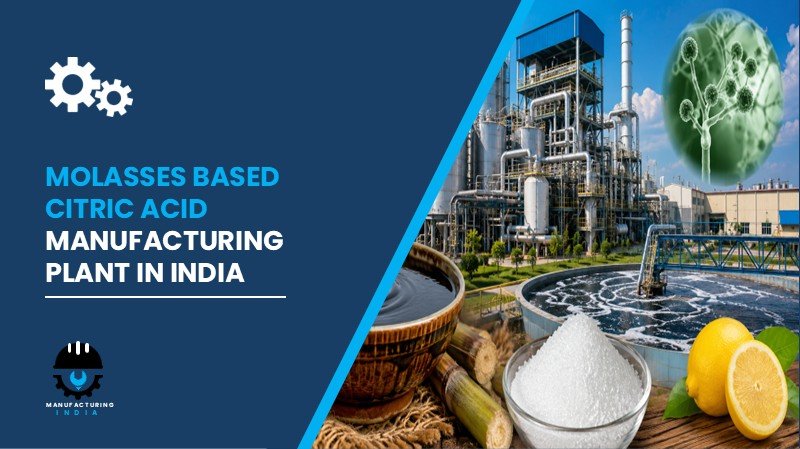
Molasses Based Citric Acid Manufacturing Plant
Setting up a molasses-based citric acid manufacturing plant in India offers investors a strong opportunity in the food, pharmaceutical, and specialty chemicals sectors, as citric acid is widely used as an acidulant, preservative, and flavoring agent in food and beverages, pharmaceuticals, personal care products, and household cleaners; produced through the fermentation of sugar-rich molasses using Aspergillus niger, the process provides an efficient way to convert a readily available sugar-industry by-product into a valuable commercial ingredient while supporting circular economy principles; with expanding food processing, pharmaceutical manufacturing, and consumer product industries in India, molasses-based citric acid production presents a scalable, cost-effective, and sustainable investment opportunity.
India’s structural advantages for molasses-based citric acid manufacturing are exceptional and uniquely aligned with this production route’s core economics. India is one of the world’s largest sugarcane producers — with major producing states in Uttar Pradesh, Maharashtra, and Karnataka — generating enormous volumes of blackstrap molasses as an unavoidable by-product of sugar refining operations. This molasses, rich in fermentable sugars at very low cost, is the primary feedstock for citric acid fermentation, providing Indian producers with a decisive raw material cost advantage over citric acid producers in countries without equivalent domestic molasses availability. The India food processing sector is set to more than double from USD 307 Billion in 2023 to USD 700 Billion by 2030, driving systematic expansion of the institutional citric acid customer base across food manufacturers, beverage producers, and packaged food companies — while India’s pharmaceutical market growing 7–9% in FY26 creates a parallel institutional demand stream for pharmaceutical-grade citric acid as an excipient and effervescent formulation component.
Investing in a molasses-based citric acid manufacturing plant in India today aligns India’s abundant domestic molasses supply, food processing sector doubling to USD 700 Billion by 2030, pharmaceutical growth of 7–9% in FY26, and APAC’s dominant 48.9% global market share with a bio-based fermentation production route that converts sugar industry by-products into a globally essential acidulant. With gross profit margins of 22–30% and net profit margins of 8–14% at annual production capacities of 10,000–40,000 MT, the unit economics are commercially sound, and the investment’s circular economy and import substitution positioning creates long-term strategic value.
What is Molasses-Based Citric Acid?
Molasses-based citric acid is a natural preservative and sour flavouring produced by fermenting sugar-rich molasses with a specific mould called Aspergillus niger. Molasses — the thick syrup left over from refining sugarcane or sugar beets — serves as an affordable and energy-packed carbon source for the mould. During the fermentation process, the mould consumes the sugars in the molasses and converts them into citric acid. Afterward, the mixture is carefully filtered and purified into a fine white powder or colourless crystalline product. This sustainable production method is highly popular in the food industry, providing a cost-effective way to add a tangy acidity to sodas, candies, and snacks while keeping products fresh for longer periods.
Citric acid’s extraordinary versatility — functioning simultaneously as an acidulant, preservative, chelating agent, pH regulator, flavour enhancer, emulsifier, and buffering agent — makes it one of the most consumed food additives globally. The molasses-based fermentation route offers a cost and sustainability advantage over sucrose-based fermentation by utilising a lower-cost carbon source from the sugar industry’s by-product stream, while advancements in fermentation technologies, microbial strain optimisation, and process efficiency are continuously improving production yields and cost competitiveness of this production pathway. A study published in Waste and Biomass Valorization in August 2025 specifically focused on strain improvement and fermentation optimisation for enhanced citric acid production by Aspergillus niger using waste molasses as a substrate — confirming that the research community continues to advance the productivity and economics of this well-established industrial fermentation process.
The primary production process covers molasses preparation, sterilisation, Aspergillus niger fermentation, filtration, acidification, calcium citrate precipitation, citric acid recovery, purification, and crystallisation. End-use industries served include food and beverages, pharmaceuticals, cosmetics and personal care, chemicals, agriculture, and industrial processing. Applications span acidity regulator and preservative in beverages and processed foods, excipient and buffering agent in pharmaceuticals, chelating and pH-adjusting agent in cosmetics, and cleaning and descaling agent in industrial applications.
Cost of Setting Up a Molasses-Based Citric Acid Manufacturing Plant in India
The cost of establishing a molasses-based citric acid manufacturing plant in India depends on plant capacity, fermentation technology and reactor configuration, molasses sourcing strategy and quality, product grade mix across food-grade, pharmaceutical-grade, and industrial-grade citric acid, geographic location — particularly proximity to sugar mills for molasses supply — degree of automation, and the FSSAI food safety and pharmaceutical GMP compliance requirements applicable to citric acid supplied across regulated food, pharmaceutical, and industrial market segments.
1. Capital Expenditure (CapEx)
Land and Site Development forms a foundational component of total capital investment, covering land acquisition charges, site registration, boundary development, drainage infrastructure, and site utilities. The location must offer easy access to key raw materials such as blackstrap molasses, Aspergillus niger, sulfuric acid, and calcium hydroxide. Proximity to target markets will help minimise distribution costs. The site must have robust infrastructure, including reliable transportation, utilities, and waste management systems. Compliance with local zoning laws and environmental regulations must also be ensured. Locating the plant adjacent to or near sugar mills in Uttar Pradesh, Maharashtra, or Karnataka provides the most cost-competitive molasses supply logistics — where blackstrap molasses can be piped or transported by tanker from the adjacent sugar mill at minimal cost and with assured quality and supply continuity.
Plant Layout Optimisation is critical for a molasses-based citric acid manufacturing facility integrating fermentation vessels, sterilisation systems, filtration operations, precipitation tanks, and downstream purification and crystallisation. The layout should be optimised to enhance workflow efficiency, safety, and minimise material handling. Separate areas for molasses storage and preparation, sterilisation, inoculum preparation, fermentation halls, filtration and precipitation, sulfuric acid treatment reactors, centrifuges or filter presses, evaporators, crystallisers, drying areas, quality control laboratory, and finished goods storage must be designated. Space for future expansion should be incorporated to accommodate business growth.
Machinery and Equipment represent the largest single component of total CapEx for a molasses-based citric acid manufacturing plant. Essential equipment includes:
- Molasses storage and preparation tanks
- Sterilisation units
- Fermentation vessels
- Aspergillus niger inoculum tanks
- Aeration and agitation systems
- Filtration units
- Calcium citrate precipitation tanks
- Sulfuric acid treatment reactors
- Centrifuges or filter presses
- Evaporators
- Crystallisers
- Dryers
- Packaging machines
Other Capital Costs include effluent treatment systems to minimise environmental impact and ensure compliance with emission standards for fermentation effluent and citric acid process water management, advanced monitoring systems to detect leaks or deviations in the process, pre-operative expenses, FSSAI and pharmaceutical GMP certification costs, commissioning charges, and import duties on specialised fermentation vessel internals or automated crystallisation equipment not available domestically.
Request a Sample Report for In-Depth Market Insights: https://www.imarcgroup.com/molasses-based-citric-acid-manufacturing-plant-project-report/requestsample
2. Operational Expenditure (OpEx)
Raw Material Cost is the dominant operational expense, accounting for approximately 45–55% of total OpEx. The primary raw materials are blackstrap molasses, Aspergillus niger starter culture, sulfuric acid, and calcium hydroxide. Blackstrap molasses — as the primary carbon source fermentation feedstock consumed in the largest volumes — drives the majority of raw material cost and is available from domestic sugar mills at competitive, seasonally influenced prices. Its availability as a sugar industry by-product positions it at significantly lower cost than refined sucrose, conferring the primary cost advantage of the molasses-based production route. Aspergillus niger inoculum is maintained through continuous culture management and periodic master culture renewal. Sulfuric acid and calcium hydroxide are consumed in the citrate precipitation and citric acid liberation stages. Long-term contracts with reliable suppliers will help mitigate price volatility and ensure a consistent supply, with nearby sugar mill suppliers selected wherever possible to minimise molasses transportation costs.
Utility Cost is the second-largest OpEx component, representing approximately 18–24% of total operating expenses — a relatively elevated utility proportion reflecting the energy intensity of fermentation vessel aeration, agitation, temperature control, evaporation, and drying operations that together constitute the most energy-demanding stages of citric acid production by submerged fermentation. Steam for sterilisation and evaporation, electricity for fermentation aeration compressors and agitators, and cooling water for fermentation temperature management constitute the primary utility inputs requiring careful site infrastructure planning.
Other Operating Costs include transportation and distribution to food and beverage manufacturers, pharmaceutical API producers, personal care ingredient formulators, detergent and cleaning product companies, water treatment chemical suppliers, and export buyers, specialised food-grade and pharmaceutical-grade packaging materials, salaries and wages for fermentation process engineers and quality control analysts, routine machinery maintenance including fermentation vessel cleaning cycles and filtration membrane replacement, FSSAI and GMP audit costs, depreciation on production equipment, and applicable taxes. By the fifth year, the total operational cost is expected to increase substantially due to factors such as inflation, market fluctuations, and potential rises in the cost of key materials. Additional factors, including supply chain disruptions, rising consumer demand, and shifts in the global economy, are expected to contribute to this increase.
3. Plant Capacity
The proposed manufacturing facility is designed with an annual manufacturing capacity ranging between 10,000 and 40,000 MT, enabling economies of scale while maintaining operational flexibility across food-grade citric acid anhydrous and monohydrate for beverage, confectionery, and processed food applications, pharmaceutical-grade citric acid for effervescent formulations, syrups, and tablet manufacturing, and industrial-grade citric acid for detergent, water treatment, and descaling applications. Plant capacity can be customised per investor requirements and phased in line with secured molasses supply agreements and customer off-take contracts across the food, pharmaceutical, and industrial chemical market segments.
4. Profit Margins and Financial Projections
The financial projections for a molasses-based citric acid manufacturing plant demonstrate commercially sound profitability potential under normal operating conditions. Gross profit margins typically range between 22–30%, supported by stable demand and value-added applications across food and beverages, pharmaceuticals, cosmetics and personal care, and industrial processing customer segments. Net profit margins are projected at 8–14% — commercially sound returns reflecting the fermentation bioprocess conversion of low-cost molasses feedstock into a globally essential acidulant that commands significant pricing premiums over its raw material inputs. A comprehensive financial analysis covering NPV, IRR, payback period, and five-year projections is essential before committing capital.
Why Set Up a Molasses-Based Citric Acid Manufacturing Plant in India?
Abundant and Cost-Effective Domestic Molasses Raw Material. Molasses, a sugar industry by-product, serves as an economical carbon source for citric acid fermentation, helping manufacturers reduce raw material costs while creating value from an agro-industrial residue. India’s position as one of the world’s largest sugarcane producers — generating enormous volumes of blackstrap molasses in Uttar Pradesh, Maharashtra, and Karnataka — provides domestic citric acid producers with a structural raw material cost advantage that import-competing producers cannot replicate, directly improving the economics and competitiveness of Indian citric acid production relative to both Chinese imports and sugar-based fermentation routes.
Megatrend Alignment with Growing Food Processing and Pharmaceutical Markets. The growing demand for citric acid across food and beverages, pharmaceuticals, personal care, detergents, and industrial applications is supporting consistent consumption. India’s food processing sector is set to more than double from USD 307 Billion in 2023 to USD 700 Billion by 2030, creating enormous institutional demand for food additives including citric acid as an acidulant, preservative, and flavour enhancer. India’s pharmaceutical market growing 7–9% in FY26 fuelled by robust domestic demand, new product innovation, and expansion into Europe — as IBEF indicates — creates a parallel institutional pharmaceutical-grade citric acid demand stream.
Circular Economy and Sustainability Push Rewarding Molasses-Based Production. Increasing emphasis on agro-industrial waste valorisation, bio-based manufacturing, and resource-efficient production is supporting the use of molasses as a fermentation feedstock, enabling manufacturers to convert sugar-industry by-products into higher-value citric acid. This circular economy positioning — transforming a waste stream into a globally traded food ingredient — aligns with the ESG preferences of major institutional food, pharmaceutical, and consumer goods buyers who increasingly specify sustainable sourcing and bio-based ingredient credentials in their supply chain requirements.
Research Confirming Ongoing Fermentation Technology Advancement. In August 2025, a study published in Waste and Biomass Valorization focused on strain improvement and fermentation optimisation for enhanced citric acid production by Aspergillus niger using waste molasses as a substrate. This active research confirms that the scientific and technology development community continues to advance the productivity, yield, and cost competitiveness of molasses-based citric acid fermentation — improvements that benefit new producers who establish facilities with current state-of-the-art fermentation technology from the first day of operation.
APAC’s Dominant 48.9% Global Market Share Confirming Regional Investment Rationale. APAC is the largest regional market for molasses-based citric acid, accounting for about 48.9% of global share — a dominance reflecting the concentration of food manufacturing, pharmaceutical production, and personal care ingredients consumption across the region. India’s rapidly growing position within this dominant regional market positions Indian citric acid producers to serve both the large domestic institutional customer base and growing export demand from regional markets seeking supply chain diversification away from dominant Chinese producers.
Supply Chain Localisation Creating Commercial Opportunity. Food, pharmaceutical, and industrial users are favouring local, dependable citric acid suppliers to shorten lead times, reduce import dependence, and ensure consistent product availability, opening opportunities for regional producers with efficient molasses sourcing, fermentation operations, and downstream processing. India currently imports a significant share of its citric acid requirements, primarily from China — creating a direct import substitution commercial opportunity for well-positioned domestic producers with competitive molasses feedstock access and FSSAI-certified quality management.
Manufacturing Process — Step by Step
The molasses-based citric acid manufacturing process uses molasses preparation, sterilisation, Aspergillus niger fermentation, filtration, acidification, calcium citrate precipitation, citric acid recovery, purification, and crystallisation as the primary production method. Each stage requires precisely controlled biological and chemical process parameters to produce citric acid of the target purity, crystal form, and quality required by food, pharmaceutical, and industrial customers.
- Molasses Receipt and Preparation: Blackstrap molasses is received from sugar mills, quality-checked for fermentable sugar content, Brix, pH, and absence of fermentation inhibitors, and diluted with process water in molasses storage and preparation tanks to the target sugar concentration — typically 14–20% sucrose equivalent — optimal for Aspergillus niger citric acid fermentation productivity.
- Nutrient Addition and pH Adjustment: The diluted molasses medium is supplemented with nitrogen sources, phosphate nutrients, and trace elements required for optimal Aspergillus niger growth and citric acid biosynthesis, with pH adjusted to the slightly acidic range optimal for fermentation productivity and contamination prevention.
- Sterilisation: The prepared molasses medium is sterilised in sterilisation units using heat treatment at controlled temperature and time conditions to eliminate competing microorganisms that would otherwise contaminate the Aspergillus niger fermentation and reduce citric acid yield.
- Inoculum Preparation: Aspergillus niger spore suspension is prepared and maintained in inoculum tanks at controlled conditions, with the inoculum culture quality — spore concentration, germination rate, and morphology — verified before introduction to the production fermenters.
- Submerged Fermentation: Sterilised molasses medium is inoculated with Aspergillus niger spore suspension in fermentation vessels operating under controlled aeration and agitation from aeration and agitation systems, temperature management, and pH control. The mould grows and metabolises the molasses sugars to produce citric acid over a fermentation cycle of typically 4–8 days, with pH falling progressively as citric acid accumulates in the fermentation broth.
- Fermentation Broth Filtration: After achieving the target citric acid titre in the fermentation broth, the fermentation cycle is ended and the broth is filtered through filtration units to separate the Aspergillus niger mycelium biomass from the citric acid-containing broth, with the mycelium biomass dewatered and processed as an agricultural by-product.
- Calcium Citrate Precipitation: Filtered citric acid broth is treated with calcium hydroxide in calcium citrate precipitation tanks under controlled pH and temperature conditions, causing the selective precipitation of calcium citrate — the insoluble calcium salt of citric acid — from the broth, leaving non-citric acid impurities in the aqueous phase for separation.
- Sulfuric Acid Treatment and Citric Acid Liberation: Filtered calcium citrate is reacted with sulfuric acid in sulfuric acid treatment reactors, converting the calcium citrate to citric acid and insoluble calcium sulfate (gypsum) which is separated by centrifuges or filter presses, producing a purified citric acid solution.
- Purification, Evaporation, and Crystallisation: The citric acid solution is purified through activated carbon treatment for decolourisation and ion exchange for trace mineral removal, then concentrated in evaporators and crystallised in crystallisers under controlled cooling to produce citric acid crystals — anhydrous or monohydrate form depending on process temperature — of the specified purity and crystal size.
- Drying and Quality Testing: Crystallised citric acid is dried in dryers to achieve the target moisture content, then subjected to comprehensive quality testing covering assay purity by titrimetric analysis, moisture content, heavy metal content, sulphate content, and colour, verifying FSSAI and pharmacopoeial specification compliance before packaging.
- Packaging and Dispatch: Specification-compliant citric acid is packaged in food-grade or pharmaceutical-grade bags or drums using packaging machines and dispatched to food and beverage manufacturers, pharmaceutical API producers, cosmetics and personal care ingredient formulators, detergent and cleaning product companies, and industrial customers.
Key Applications
Molasses-based citric acid manufactured in India serves a commercially diverse and structurally growing range of food, pharmaceutical, industrial, and agricultural applications:
- Food and Beverages: Functions as an acidulant, flavour enhancer, and preservative in carbonated beverages, juices, candies, jams, dairy products, and processed foods — the dominant application constituting the largest share of global citric acid consumption.
- Pharmaceuticals: Serves as an excipient and buffering agent in effervescent formulations, tablets, syrups, and active pharmaceutical ingredient processing, with pharmaceutical-grade citric acid commanding premium pricing over food-grade.
- Personal Care and Cosmetics: Applied as a pH-adjusting agent, chelating agent, and AHA component in skincare formulations, shampoos, conditioners, and cosmetic creams across India’s expanding personal care market.
- Cleaning and Industrial Products: Used as a descaling agent, chelating component, and acidulant in detergents, cleaning formulations, metal treatment, and water treatment applications where citric acid’s biodegradability and chelating performance provide advantages over mineral acid alternatives.
Leading Manufacturers
The global molasses-based citric acid industry is served by multinational food ingredient and fermentation chemistry companies with extensive manufacturing capacities. The market’s largest regional concentration — APAC at 48.9% — is served by established Chinese producers alongside growing regional manufacturers across India and Southeast Asia.
Timeline to Start the Plant
Establishing a molasses-based citric acid manufacturing plant in India involves a structured multi-phase development sequence. Investors should plan for the following phases:
- Feasibility study and project report preparation
- Land acquisition and site development
- Regulatory approvals and environmental clearances
- Factory licence and fire safety compliance
- Machinery procurement and installation
- Raw material supplier agreements and supply chain setup
- Trial production and quality testing
- Commercial production launch
Licences and Regulatory Requirements
Starting a molasses-based citric acid manufacturing unit in India requires several approvals spanning business registration, food safety, pharmaceutical compliance, environmental, and industrial safety domains:
- Business registration (Proprietorship, LLP, or Pvt Ltd)
- Factory Licence under the Factories Act
- Environmental Clearance from the State Pollution Control Board
- GST Registration
- Fire Safety NOC
- FSSAI (Food Safety and Standards Authority of India) Central licence mandatory for commercial manufacture of citric acid as a food additive for sale to food and beverage manufacturers
- Drug licence under the Drugs and Cosmetics Act and GMP certification under Schedule M for pharmaceutical-grade citric acid supply to drug manufacturers
- Effluent treatment systems operational clearance to minimise environmental impact and ensure compliance with emission standards for fermentation effluent management
- Occupational Health and Safety compliance including sulfuric acid vapour monitoring and fermentation biocontainment protocols
Key Challenges to Consider
Molasses Quality Variability and Seasonal Supply Management. Blackstrap molasses quality — fermentable sugar content, impurity profile, and fermentation inhibitor concentration — varies between sugar mills, sugarcane varieties, and crushing seasons, creating batch-to-batch fermentation yield variability that requires robust incoming material testing, supplier qualification, and molasses blending protocols. Seasonal molasses availability tied to sugarcane crushing seasons requires strategic storage infrastructure and pre-season procurement planning to maintain year-round production continuity.
High Utility Cost Proportion from Fermentation Energy Intensity. Utility costs representing 18–24% of total OpEx — one of the highest utility proportions across food-grade manufacturing categories — reflect the energy intensity of compressed air for fermentation aeration, steam for sterilisation and evaporation, and electricity for large fermentation vessel agitators. Optimising fermentation aeration efficiency, heat recovery from sterilisation, and evaporator steam economy are critical levers for managing the utility cost structure that defines citric acid fermentation economics.
Fermentation Process Control and Contamination Prevention. Aspergillus niger fermentation productivity is sensitive to contamination by competing microorganisms — yeasts, bacteria, and competing moulds — that can dramatically reduce citric acid yield if sterilisation or aseptic conditions are compromised. Maintaining rigorous sterilisation discipline, contamination monitoring, and rapid response to fermentation deviations requires experienced fermentation process engineers and validated clean-in-place protocols across all fermentation and upstream equipment.
Multi-Grade Quality Management for Food, Pharmaceutical, and Industrial Markets. Supplying citric acid simultaneously to food manufacturers requiring FSSAI compliance, pharmaceutical producers requiring GMP certification and pharmacopoeial specification, and industrial customers with different purity requirements demands robust quality management systems, batch traceability, grade segregation, and separate quality documentation pathways that add management complexity beyond single-market fermentation chemical production.
Competition from Established Chinese Import Supply. India’s citric acid market is currently heavily served by Chinese imports from large established fermentation producers with decades of fermentation technology optimisation, massive scale, and competitive pricing. New Indian producers must compete through domestic supply chain proximity advantages, import cost elimination, reliable delivery, FSSAI-certified local quality assurance, and the strategic supply security value that domestic production provides to buyers seeking to reduce import dependence.
Gypsum By-Product Management. The sulfuric acid treatment step that converts calcium citrate to citric acid generates large volumes of calcium sulfate gypsum as a co-product. Developing revenue pathways for this gypsum — through cement industry supply, wallboard manufacturing, or agricultural gypsum sales — or managing it as a compliant industrial solid waste disposal stream requires planning from the earliest stages of project development to avoid creating an ongoing waste management cost burden.
Frequently Asked Questions
1. How much does it cost to set up a molasses-based citric acid manufacturing plant in India?
The total capital investment depends on plant capacity, fermentation technology, and location. Equipment costs — for molasses storage and preparation tanks, sterilisation units, fermentation vessels, Aspergillus niger inoculum tanks, aeration and agitation systems, filtration units, calcium citrate precipitation tanks, sulfuric acid treatment reactors, centrifuges or filter presses, evaporators, crystallisers, dryers, and packaging machines — represent a significant portion of capital expenditure. A detailed project report with full CapEx and OpEx breakdowns is available on request.
2. Is molasses-based citric acid manufacturing profitable in India in 2026?
Yes. The project demonstrates gross profit margins of 22–30% and net profit margins of 8–14% under normal operating conditions, supported by India’s food processing sector doubling to USD 700 Billion by 2030, pharmaceutical market growing 7–9% in FY26, and APAC’s dominant 48.9% global market share. The abundant domestic molasses feedstock supply from India’s large sugar industry provides a structural raw material cost advantage that strengthens the investment’s competitive position.
3. What machinery is required for a molasses-based citric acid manufacturing plant in India?
Key machinery includes molasses storage and preparation tanks, sterilisation units, fermentation vessels, Aspergillus niger inoculum tanks, aeration and agitation systems, filtration units, calcium citrate precipitation tanks, sulfuric acid treatment reactors, centrifuges or filter presses, evaporators, crystallisers, dryers, and packaging machines. Fermentation vessels with integrated aeration and agitation systems are the most capital-intensive and production-critical equipment, determining citric acid fermentation productivity and overall plant throughput.
4. What licences and approvals are required to start a molasses-based citric acid manufacturing plant in India?
Required approvals include business registration, a Factory Licence under the Factories Act, Environmental Clearance from the State Pollution Control Board, GST registration, a Fire Safety NOC, FSSAI Central licence for food-grade citric acid manufacture, drug licence and GMP certification for pharmaceutical-grade supply, effluent treatment systems clearance, and Occupational Health and Safety compliance.
5. What raw materials are needed for molasses-based citric acid manufacturing?
The primary raw materials are blackstrap molasses, Aspergillus niger, sulfuric acid, and calcium hydroxide. Blackstrap molasses accounts for approximately 45–55% of total operating expenses as the dominant fermentation carbon source, making molasses procurement strategy, sugar mill supply agreements, quality management, and seasonal supply planning the most critical operational priorities for the investment.
6. What are the environmental compliance requirements for a molasses-based citric acid manufacturing plant in India?
The unit must obtain Environmental Clearance from the State Pollution Control Board, operate effluent treatment systems to minimise environmental impact and ensure compliance with emission standards for fermentation effluent management, implement monitoring systems for process deviations, and manage calcium sulfate gypsum by-product in compliance with applicable solid waste management regulations.
7. What is the best location to set up a molasses-based citric acid manufacturing plant in India?
Optimal locations offer proximity to sugar mills for cost-competitive molasses supply, reliable utilities including steam and compressed air for fermentation operations, access to food manufacturing and pharmaceutical customer clusters, and logistics connectivity for finished citric acid distribution. Sugar-belt states including Uttar Pradesh, Maharashtra, and Karnataka — co-located with or adjacent to large sugar mills — are among the most strategically relevant options, offering both the lowest molasses procurement cost and direct access to large institutional food processing customer bases.
8. What is the break-even period for this type of plant in India?
The break-even period depends on plant capacity, fermentation productivity, molasses quality and pricing, capacity utilisation rate, and demand conditions across food, pharmaceutical, and industrial customer segments. A detailed financial analysis including payback period, NPV, and IRR projections is included in the full project report, available via the sample request link.
9. What government incentives are available for manufacturers in India?
The Make in India initiative, PLI scheme for food processing and pharmaceuticals supporting downstream citric acid demand, Ministry of Food Processing Industries programmes, and state-level food processing zone incentives in Maharashtra and Uttar Pradesh provide financial and regulatory support for molasses-based citric acid manufacturing investments. Export promotion benefits under food ingredients categories and capital subsidy schemes under PMKSY and state investment promotion boards may be applicable.
Key Takeaways for Investors
A molasses-based citric acid manufacturing plant in India represents a commercially well-grounded and circular economy-aligned investment in the world’s most widely consumed organic acid — one produced through a proven, scalable fermentation bioprocess that converts India’s abundant domestic molasses by-product into a globally essential food, pharmaceutical, and industrial ingredient that the country currently imports in significant volumes. The project demonstrates financial viability across annual manufacturing capacities of 10,000 to 40,000 MT, with gross profit margins of 22–30% and net profit margins of 8–14% confirming commercially sound unit economics supported by India’s structural raw material advantage from domestic sugar industry molasses supply. India’s food processing sector doubling to USD 700 Billion by 2030, pharmaceutical market growing 7–9% in FY26, and APAC’s dominant 48.9% global market share collectively create a multi-sector, policy-backed domestic demand environment that positions a new Indian molasses-based citric acid producer as an import substitutor with decisive supply chain, lead time, and regulatory compliance advantages over Chinese import alternatives. With August 2025 research in Waste and Biomass Valorization confirming ongoing fermentation optimisation advances using waste molasses substrates, rising preference for local supplier relationships in food and pharmaceutical supply chains, and India’s circular economy and bio-based manufacturing policy momentum all aligned behind the molasses fermentation route, demand sustainability for India-based molasses-based citric acid manufacturing is structurally robust, feedstock-advantaged, and commercially compelling across the full investment horizon.
About the Author