Most industrial losses in India are not caused by rare, unforeseeable events. They come from hazards that were identifiable in advance, on a process line, a storage yard or a construction schedule, but were never assessed with enough rigour to act on before something went wrong. The gap between a hazard that exists and a hazard that is actually managed is exactly where risk management consulting earns its place in an industrial project.
For manufacturers, process plants and infrastructure developers across pharmaceuticals, chemicals, food processing and engineering, risk is rarely a single category. Cost overruns, safety incidents and project delays are usually connected, one triggers the next, and an unmanaged hazard on the shop floor can just as easily show up later as a stalled commissioning date or an unplanned insurance claim. Structured risk management consulting services exist to catch these connections early, using recognised methodologies rather than reactive fixes after an incident has already occurred.
The scale of industrial risk in India
The latest available data makes the case for structured risk management on its own. According to analysis of NCRB’s Accidental Deaths and Suicides in India (ADSI) data for 2024, India recorded 742 factory and machine accidents, resulting in 660 deaths. That ratio has stayed above 88% every year since 2018, which means that while the number of reported accidents has fallen over the past decade, the accidents that still occur are increasingly severe. Separately, DGFASLI-linked analysis puts India’s fatal injury rate in registered factories at 5.46 per lakh workers in 2023, only a modest decline from 6.32 per lakh a decade earlier.
The pattern extends into 2025 and 2026. A dust explosion at a Sangareddy, Telangana chemical facility in June 2025 killed 46 workers and injured 33. An explosion at a fireworks warehouse near Deesa, Gujarat in April 2025 killed 21. In Chhattisgarh alone, state government data placed industrial accident deaths at 122 for 2025 and a further 74 in the first five months of 2026. These are not isolated headlines, they are recurring outcomes of the same underlying gap: hazards that existed on paper, in a process design or a site layout, but were not converted into a tracked, funded mitigation plan before they became incidents.
Cost risk follows a related pattern. Government infrastructure data compiled separately shows cost overruns on large monitored projects running above 13% of original budgets, driven substantially by risks, design changes, regulatory delays, contractor disputes, that were foreseeable at the planning stage but were not formally assessed early enough to price into the project.
What risk management consulting actually covers
Effective industrial risk management does not treat cost, safety and project risk as separate disciplines run by separate teams. It works through one structured cycle, shown below.
- Hazard identification: drawing on process data, site conditions and historical incident records rather than assumption
- HIRA (Hazard Identification and Risk Assessment): applied to general workplace and process hazards across a facility
- HAZOP (Hazard and Operability Study): applied to process safety in chemical, pharmaceutical and process manufacturing environments
- FMEA (Failure Mode and Effects Analysis): applied where equipment or system reliability is the primary concern
- Mitigation planning: findings translated into engineering controls, procedural changes, training requirements and, where needed, budget contingencies built directly into the project cost plan
- Implementation through a hierarchy of controls: engineering safeguards first, then administrative procedures, then personal protective equipment, with every control tied to a monitoring and audit schedule
- Monitoring and review: incident data, near-miss reports and audit findings fed back into the next round of hazard identification, keeping the assessment current as a project or facility evolves
Regulatory and standards framework
Risk management consulting in India operates against a defined regulatory backbone:
- Factories Act 1948: the base statute for occupational safety in registered factories
- OSH Code 2020: the Occupational Safety, Health and Working Conditions Code, which consolidates and modernises several older labour safety laws
- MSIHC Rules: govern process industries handling hazardous chemicals
- PESO (Petroleum and Explosives Safety Organisation): regulates explosives and pressure equipment
- CPCB and State Pollution Control Boards: cover environmental risk
- Schedule M and CDSCO: benchmark pharmaceutical manufacturing risk assessments
- ISO 31000: the internationally recognised risk management framework many Indian industrial risk consultants align their methodology to, particularly for clients operating across multiple facilities or seeking a globally consistent risk register
Get Risk Assessment & Mitigation Support from IMARC Engineering: https://www.imarcengineering.com/contact?service=risk-assesssment-and-mitigation-planning
Why risk assessment changes project economics
The financial argument for structured risk management is often clearer than the safety argument, even though the two are connected. A hazard left unassessed does not disappear, it resurfaces later as one of three costs: an incident that halts production and triggers regulatory investigation, a design change forced mid-construction because a risk was missed at the planning stage, or an insurance premium loaded higher because the facility cannot demonstrate a documented risk management process. Each of these costs more, and arrives with less warning, than the same risk addressed through a HIRA or HAZOP study during design.
This is particularly relevant for project financing and insurance underwriting, both of which increasingly ask for a documented risk register before terms are finalised. Lenders and insurers price uncertainty, and a facility that can show formal hazard identification, quantified likelihood and severity scoring, and a costed mitigation plan is a materially easier facility to underwrite than one relying on informal safety practices. For promoters raising project debt or negotiating industrial all-risk insurance, a credible risk assessment report is increasingly treated as a financing input, not a compliance formality filed away after approval.
Industrial risk data at a glance
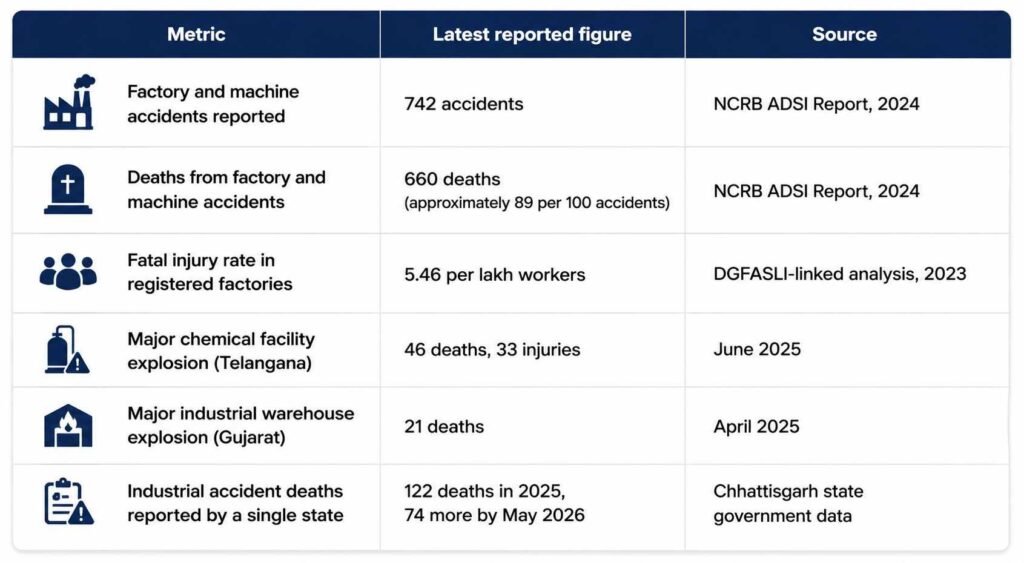
The consistency across these figures, a near-90% fatality-to-accident ratio, a fatal injury rate that has barely moved in a decade, and repeated large-scale incidents across different states and sectors, points to the same conclusion. Risk in Indian industrial operations is systemic rather than incidental, and it responds to structured assessment and mitigation planning, not to compliance treated as a formality.
How IMARC Engineering Approaches Risk Assessment and Mitigation Planning
IMARC Engineering builds risk management around the same cycle industrial clients need to run continuously, not just at project sanction. The team conducts HIRA and HAZOP studies calibrated to the specific process, whether it is a pharmaceutical clean-room line, a chemical reactor system or a food processing facility, and translates findings into mitigation plans that are costed and scheduled alongside the rest of the project, not appended afterward. Regulatory alignment with the Factories Act, OSH Code 2020, PESO and CPCB requirements is built into the assessment from the outset, and monitoring frameworks are handed over with the project so that risk registers stay current as operations scale.
Explore Our Detailed Guide to Effective Risk Assessment & Mitigation: https://www.imarcengineering.com/blog/how-risk-assessment-improves-project-execution-india
Conclusion
The data on Indian industrial accidents and cost overruns tells a consistent story: the hazards involved are rarely unknown, they are under-assessed. Structured risk management consulting, applied through hazard identification, HIRA and HAZOP assessment, costed mitigation planning and continuous monitoring, converts that gap into a managed, auditable process. As industrial capacity in India continues to expand through 2026, that discipline is becoming a baseline expectation for project financing and insurance, not an optional add-on.
Contact Us:
IMARC Engineering
Phone: +91-120-433-0800
Email: sales@imarcengineering.com
India: C-130, Sector 2, Noida, Uttar Pradesh 201301
LinkedIn: https://www.linkedin.com/showcase/imarc-engineering/
About the Author