
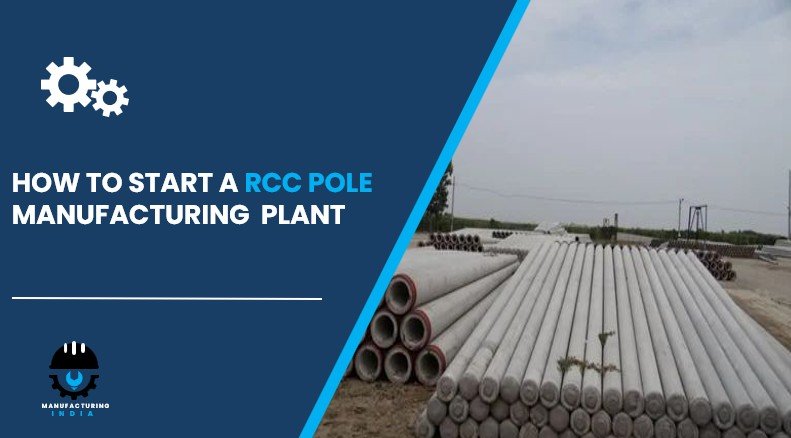
Setting up a RCC pole manufacturing plant in India represents a highly attractive investment proposition underpinned by robust and structurally growing demand from expanding power transmission and distribution networks, rural electrification programs, urban infrastructure development, and the continued expansion of telecommunication networks. As government-led grid modernisation programs advance, rural electrification coverage widens, and infrastructure spending accelerates, RCC (Reinforced Cement Concrete) poles used across electrical distribution lines, street lighting, telecom cable support, railway electrification, and fencing applications occupy an increasingly important position in India’s power and infrastructure ecosystem.
This growth trajectory, combined with strong institutional demand from government utilities and cost-competitive access to core raw materials such as cement, steel reinforcement, and aggregates, creates a highly favourable manufacturing environment for new entrants with efficient production and quality systems.
What is an RCC Pole?
An RCC pole is a structural utility pole manufactured using reinforced cement concrete, combining cement, aggregates, water, and steel reinforcement bars to deliver high strength, durability, and long service life. RCC poles are widely used to support electrical transmission and distribution lines, street lighting systems, telecommunication cables, railway electrification infrastructure, and agricultural or industrial fencing. Compared with wooden or steel poles, RCC poles offer a higher load-bearing capacity, strong resistance to corrosion, termites, and moisture, and minimal ongoing maintenance requirements, making them the preferred structural choice across diverse climatic conditions.
RCC poles are manufactured through a defined sequence of unit operations spanning raw material selection, preparation of the steel reinforcement cage, mould preparation, concrete mixing, pouring of concrete into moulds, vibration and compaction, curing, demoulding, and load testing. They are produced in a range of lengths and load-bearing capacities to suit different end-use applications, from low-tension rural distribution lines to higher-capacity transmission and railway electrification structures.
Asia Pacific is the largest regional market for RCC poles, accounting for approximately 37.8% of global revenue, reflecting the region’s large-scale rural electrification programs, expanding power distribution networks, and growing telecommunications infrastructure investment.
Cost of Setting Up an RCC Pole Manufacturing Plant
The total capital investment required to establish an RCC pole manufacturing plant is shaped by several key parameters: annual production capacity (typically ranging from 50,000 to 150,000 poles per annum), the level of automation across batching, moulding, and curing operations, facility specification, raw material sourcing strategy, and applicable regulatory and quality compliance requirements. Below is a structured breakdown of the major cost components.
1. Capital Expenditure (CapEx)
Total capital investment in an RCC pole manufacturing plant covers the following major heads:
Land and Site Development
This encompasses land acquisition or lease, land registration charges, site preparation, boundary development, and utilities connectivity. Site selection should prioritise proximity to key raw materials such as cement, steel reinforcement, and aggregates, as well as proximity to target markets and utility procurement offices, to minimise inbound and outbound transportation costs. Access to reliable power and water supply for concrete batching and curing operations, strong road logistics for dispatch of finished poles, and a trained local workforce are critical site selection criteria. Compliance with industrial zoning regulations, environmental clearances, and waste management requirements must be assessed from project initiation.
Civil Works and Construction
Building costs cover the main production facility including the raw material storage yard, reinforcement cage fabrication area, moulding and casting shed, curing yard or steam curing chambers, finished goods storage and load-testing area, quality control laboratory, administrative block, and utility infrastructure including power backup, water supply systems, and effluent and waste management arrangements. Construction must comply with applicable factory act requirements, environmental regulations, and local zoning and building norms.
Machinery and Equipment
Machinery represents a significant CapEx component. Key equipment required for an RCC pole manufacturing plant includes:
- Concrete Batching Plant: Automated or semi-automated systems for accurate proportioning and mixing of cement, aggregates, and water to produce consistent, high-strength concrete
- Reinforcement Cage Fabrication Machines: Equipment for cutting, bending, and welding high-tensile steel wires and bars into the reinforcement cages that form the structural core of each pole
- RCC Pole Moulds: Steel moulds of varying lengths and diameters corresponding to different pole specifications and load-bearing capacities
- Concrete Mixers: Pan or drum-type mixers for uniform blending of concrete prior to pouring into moulds
- Vibration and Compaction Equipment: Vibrating tables or spinning (centrifugal) casting systems to eliminate air voids and achieve dense, high-strength concrete compaction
- Curing Tanks and Curing Yards: Water curing tanks or steam curing chambers to achieve the required concrete strength development within production cycle times
- Demoulding and Handling Equipment: Cranes, hoists, and material handling systems for safe demoulding and transfer of cured poles
- Load Testing Equipment: Equipment for verifying the load-bearing capacity and structural integrity of finished poles prior to dispatch
- Quality Control Laboratory Equipment: Equipment for testing cement grade, aggregate quality, concrete compressive strength, and steel reinforcement quality to verify compliance with applicable standards
- Material Handling and Storage: Conveyors, storage racks, and yard equipment for raw material and finished goods handling with efficient stock management
Other Capital Costs
These include pre-operative expenses, commissioning charges, staff training and competency development, initial raw material and consumable inventory for production commissioning, and regulatory compliance setup including factory licensing, pollution control clearances, and applicable Bureau of Indian Standards (BIS) certification for RCC poles.
Request a Sample Report for In-Depth Market Insights: https://www.imarcgroup.com/rcc-pole-manufacturing-plant-project-report/requestsample
2. Operational Expenditure (OpEx)
Raw materials principally cement, steel reinforcement, and aggregates constitute the dominant operating cost, with cement alone typically accounting for approximately 60–70% of total OpEx. Utility costs, driven primarily by electricity consumption of batching, mixing, and vibration equipment along with water for curing operations, account for 15–20% of OpEx. Labour, maintenance, quality control, packaging, transportation, depreciation, taxes, and overhead costs constitute the remainder of the operating cost base.
3. Plant Capacity
The proposed RCC pole manufacturing facility is designed with an annual production capacity ranging between 50,000–150,000 poles, enabling economies of scale while maintaining operational flexibility. This capacity range supports a diversified product portfolio spanning various pole lengths and load-bearing capacities, serving power transmission and distribution companies, telecommunications providers, infrastructure developers, railway authorities, and municipal and rural electrification agencies.
4. Profit Margins and Financial Projections
The project demonstrates healthy profitability potential under normal operating conditions. Financial projections encompass capital investment, operating costs, capacity utilisation ramp-up schedule, product mix across pole lengths and specifications, and forward demand outlook underpinned by continued grid expansion and rural electrification programs. A comprehensive feasibility analysis includes sensitivity analysis, Net Present Value (NPV), Internal Rate of Return (IRR), and Payback Period calculations. Gross profit margins for RCC pole manufacturing typically range from 30–40%, supported by stable institutional demand and efficient raw material utilisation. Net profit margins of 15–22% are achievable with disciplined cost management, optimal capacity utilisation, and efficient production scheduling.
Why Set Up an RCC Pole Manufacturing Plant?
High and Stable Demand from Electrification Programs
Expanding rural and urban electrification programs, alongside government grid modernisation initiatives such as the Revamped Distribution Sector Scheme (RDSS) and rural electrification schemes, continue to generate strong and largely non-discretionary institutional demand for durable and cost-effective RCC poles from power distribution companies and government utilities.
Long Service Life and Lifecycle Cost Advantage
RCC poles offer an extended operational life of 50 or more years with minimal maintenance compared to wooden or steel alternatives, which are prone to rot, insect damage, and corrosion respectively. This lifecycle cost advantage supports the structural preference for RCC poles among utilities and infrastructure developers seeking reliable, low-maintenance pole infrastructure.
Expanding Power Transmission and Distribution Infrastructure
Substantial and rising electricity consumption across industrial, household, services, and agricultural sectors necessitates continued expansion and strengthening of transmission and distribution networks, directly driving demand for RCC poles as an essential infrastructure component of overhead power lines.
Growing Telecommunications and Rural Connectivity Demand
The expansion of broadband and mobile connectivity in semi-urban and rural areas, where underground cabling is limited, is generating additional demand for RCC poles to support overhead communication cables, providing processors with a diversified customer base beyond power utilities.
Cost-Competitive and Widely Available Raw Materials
Core raw materials cement, steel reinforcement, and aggregates are widely available across India through established supply chains, allowing processors to secure long-term supply arrangements and manage input cost volatility more effectively than industries dependent on imported or seasonally constrained feedstocks.
Scalable and Modular Operations
The RCC pole manufacturing process spanning reinforcement cage fabrication, batching, moulding, vibration or centrifugal casting, and curing allows processors to begin operations at a moderate scale and expand capacity by adding moulding lines and curing infrastructure as order volumes grow, supporting a phased and capital-efficient investment approach.
Urbanisation and Infrastructure Spending Growth
Approximately 45% of the world’s 8.2 billion people resided in urban areas in 2025, according to the United Nations World Urbanization Prospects 2025 report by UN DESA. Rising urbanisation, continued infrastructure spending, and ongoing upgrades to aging power distribution systems are expected to sustain steady demand for RCC poles across street lighting, municipal, and utility infrastructure projects.
Manufacturing Process Overview
The RCC pole manufacturing operation transforms raw materials cement, aggregates, water, and steel reinforcement into finished, load-tested poles through a sequence of fabrication, batching, casting, and curing operations. The key process stages are:
- Raw Material Selection and Storage: Cement, coarse and fine aggregates, and high-tensile steel wires and bars are received, inspected, and stored under controlled conditions to preserve quality prior to processing.
- Reinforcement Cage Preparation: Steel wires and bars are cut, bent, and welded or tied into reinforcement cages matching the design specification for the target pole length and load-bearing capacity.
- Mould Preparation: Steel moulds are cleaned, treated with release agents, and assembled to the required pole dimensions ahead of casting.
- Concrete Mixing: Cement, aggregates, and water are proportioned and mixed in the concrete batching plant to achieve the specified strength grade and workability.
- Pouring and Casting: The prepared concrete mix is poured into the assembled moulds around the positioned reinforcement cage, ensuring uniform distribution and coverage.
- Vibration and Compaction: Vibrating tables or centrifugal (spinning) casting systems are used to compact the concrete, eliminate air voids, and achieve dense, high-strength pole sections.
- Curing: Cast poles undergo water curing or accelerated steam curing to develop the required compressive strength within production cycle times.
- Demoulding: Cured poles are carefully removed from the moulds using cranes or hoists, minimising handling stress on the finished product.
- Finishing and Load Testing: Poles are inspected for surface finish and dimensional accuracy, and representative samples undergo load testing to verify structural performance against applicable standards.
- Quality Control: Finished poles are tested for compressive strength, dimensional tolerance, and load-bearing capacity to verify compliance with applicable Bureau of Indian Standards (BIS) and customer specifications before release.
- Storage and Dispatch: Load-tested poles are stored in a designated yard and dispatched by road transport to power distribution companies, telecom operators, infrastructure developers, and other institutional buyers.
Key Applications of RCC Poles
RCC poles serve several major end-use segments across power, telecommunications, infrastructure, and transport sectors:
- Power Transmission and Distribution: RCC poles support overhead power lines in rural and urban electrification projects, forming a core infrastructure component of distribution networks operated by government and private utilities.
- Telecommunications: RCC poles support overhead communication cables, particularly in semi-urban and rural areas where underground cabling is limited, aiding the expansion of broadband and mobile connectivity.
- Infrastructure and Municipal Services: RCC poles are used for street lighting systems, traffic signals, and public infrastructure installations, offering long-term operational reliability with minimal maintenance.
- Railways: RCC poles serve as structural supports for overhead electric lines on railway networks, particularly in cost-sensitive infrastructure segments.
- Fencing Applications: RCC poles are utilised in agricultural and industrial fencing due to their durability, weather resistance, and low maintenance requirements.
Global RCC Pole Market Outlook
The RCC pole market is primarily driven by the expansion of electricity transmission and distribution networks globally. Substantial electricity consumption across sectors including approximately 815 TWh in industry, 691 TWh in households, 703 TWh in services, 70 TWh in transport, and 46 TWh in agriculture and forestry in 2023 reflects strong and widespread power demand, necessitating continued expansion and strengthening of transmission and distribution networks. Asia Pacific leads the global market with a revenue share of approximately 37.8%, supported by large-scale rural electrification programs and expanding power infrastructure investment across the region.
The RCC pole market benefits from multiple structural demand drivers:
- Government infrastructure development programs and grid modernisation initiatives requiring reliable pole structures for overhead power lines
- Continued urbanisation, with approximately 45% of the world’s population residing in urban areas as of 2025, supporting sustained infrastructure and utility investment
- Growing telecommunications sector expansion, particularly broadband and mobile connectivity growth in rural and semi-urban areas
- Ongoing replacement of aging wooden and steel pole infrastructure with more durable, low-maintenance RCC alternatives
- Renewable energy integration projects requiring reliable pole structures to support new and upgraded transmission and distribution lines
- Rising infrastructure spending and government programs such as the Revamped Distribution Sector Scheme (RDSS) and rural electrification schemes in India
Leading manufacturers in the global RCC pole industry include several established players with extensive production capacities and diverse application portfolios, serving end-use sectors including power transmission and distribution, telecommunications, infrastructure and urban development, railways, and street lighting and municipal services.
Latest Industry Developments
- Continued rollout of India’s Revamped Distribution Sector Scheme (RDSS) is driving sustained procurement of RCC and PSCC poles by state power distribution utilities as part of grid strengthening and loss-reduction infrastructure upgrades.
- Established pole manufacturers are expanding production capacity across multiple states to meet rising institutional demand from rural electrification programs and replacement of aging wooden and steel pole infrastructure, reflecting continued investment confidence in the segment.
Licenses and Regulatory Requirements
Establishing an RCC pole manufacturing unit requires a range of approvals and certifications, which may vary by country and jurisdiction, including:
- Business registration and company incorporation under applicable company law
- Factory License under applicable state Factories Act provisions for manufacturing operations
- Bureau of Indian Standards (BIS) certification for RCC poles under applicable structural and quality standards
- Pollution Control Board Clearances Consent to Establish (CTE) and Consent to Operate (CTO) for manufacturing operations
- Trade License and Udyam (MSME) registration where applicable
- Goods and Services Tax (GST) registration
- ISO 9001:2015 Quality Management System Certification for quality management infrastructure compliance
- Weights and Measures (Legal Metrology) registration where applicable
- Export-Import Code (IEC) for international market access
- Trademark and Brand Registration for proprietary branded product launch
- Occupational Health and Safety management compliance (ISO 45001 / Factories Act provisions) for manufacturing worker safety
- Empanelment or vendor registration with relevant state power distribution utilities and government procurement agencies
Key Challenges to Consider
Raw Material Cost Volatility
Cement and steel, which together account for the majority of total operating costs, are subject to commodity price cycles driven by energy costs, freight rates, and domestic demand-supply conditions. Sustained increases in cement or steel prices can compress margins unless offset by pricing adjustments or long-term supply contracts with fixed or capped pricing terms.
Institutional Buyer Concentration and Payment Cycles
A significant share of demand originates from government power utilities and infrastructure agencies, which often involve tender-based procurement, extended payment cycles, and vendor empanelment requirements. Managing working capital and receivables against these institutional payment timelines is a critical operational priority for processors.
Quality Certification and Load Testing Compliance
Maintaining Bureau of Indian Standards (BIS) certification and consistently meeting load-bearing and dimensional specifications across production batches requires disciplined process control, incoming raw material quality management, and ongoing investment in testing infrastructure, as any compliance lapse can disrupt market access and utility empanelment status.
Transportation and Logistics of Heavy, Fragile Products
Finished RCC poles are heavy and can be prone to cracking or damage during handling and long-distance transportation. Processors must invest in appropriate handling equipment, packaging or protective measures, and logistics planning to minimise breakage and ensure poles reach customer sites intact.
Competition from Alternative Pole Materials
RCC poles compete with PSCC (pre-stressed cement concrete), steel tubular, and, in select applications, composite poles, which may offer advantages in specific load or aesthetic requirements. Processors must maintain cost competitiveness and product quality to retain market share against these alternative materials in tender-based procurement processes.
Frequently Asked Questions (FAQs)
1. How much does it cost to set up an RCC pole manufacturing plant?
The total investment depends on plant capacity (50,000–150,000 poles per annum), automation level, facility specification, location, and target market certifications. Costs cover land, civil construction (production shed, curing yard, storage and load-testing area, quality laboratory, utilities), machinery (concrete batching plant, reinforcement cage fabrication machines, moulds, mixers, vibration and curing systems), quality certifications, working capital, and regulatory compliance. A comprehensive feasibility study from IMARC Group provides detailed, capacity-specific cost estimates covering all CapEx and OpEx components.
2. Is RCC pole manufacturing a profitable business in 2026?
Yes. Sustained institutional demand from power distribution utilities, telecommunications providers, and infrastructure developers combined with gross margins of 30–40% and net profit margins of 15–22% make RCC pole manufacturing financially attractive. Stable, largely non-discretionary demand from government electrification and grid modernisation programs supports long-term revenue visibility.
3. What machinery and equipment are required for an RCC pole manufacturing plant?
Key equipment includes a concrete batching plant, reinforcement cage fabrication machines, RCC pole moulds, concrete mixers, vibration or centrifugal casting equipment, curing tanks or steam curing chambers, demoulding and handling equipment, load testing equipment, and quality control laboratory equipment.
4. What licenses and approvals are required?
Required approvals include company registration, Factory License, Bureau of Indian Standards (BIS) certification for RCC poles, Pollution Control Board clearances, GST registration, and ISO 9001:2015 quality management system certification. Vendor empanelment with relevant state power distribution utilities is also typically required to supply government tenders.
5. How long does it take to commission an RCC pole manufacturing plant?
Typically, 8–16 months from project initiation to commercial production launch, depending on project scale, facility construction timeline, equipment procurement lead times, and regulatory approvals, which should be initiated early in the project to avoid delays to commercial launch.
6. What are the key raw materials for RCC pole manufacturing?
The primary raw materials are cement, coarse and fine aggregates, water, and high-tensile steel wires and bars used for reinforcement cage fabrication. Cement typically accounts for the largest share of raw material cost.
7. What is the break-even period for an RCC pole manufacturing plant?
The break-even period generally depends on capacity utilisation ramp-up trajectory, product mix across pole lengths and specifications, raw material cost stability, and the pace of securing utility empanelment and tender contracts. Stable offtake arrangements with power distribution companies and infrastructure developers significantly improve revenue predictability and support faster break-even achievement.
8. What are the main types of poles produced and their applications?
RCC poles are manufactured in various lengths and load-bearing capacities for low-tension rural and urban distribution lines, higher-capacity transmission applications, street lighting, telecom cable support, railway electrification, and fencing. Pre-stressed cement concrete (PSCC) poles, a related product using pre-tensioned reinforcement, are used for higher load-bearing requirements.
9. What government incentives are available for RCC pole manufacturers?
Processors may benefit from state-level industrial investment incentives, MSME scheme benefits where applicable, and sustained institutional demand generated by government programs such as the Revamped Distribution Sector Scheme (RDSS) and rural electrification schemes, which indirectly support processor revenues through large-scale utility procurement.
10. How does RCC pole manufacturing compare to other construction material manufacturing in terms of setup?
Compared to other cement-based construction material manufacturing, RCC pole production requires specialised moulding, vibration or centrifugal casting, and load-testing infrastructure, along with reinforcement cage fabrication capability. Raw material sourcing and curing technology are broadly similar to other precast concrete product manufacturing, allowing processors with precast concrete experience to adapt existing capabilities to RCC pole production with targeted investment in moulds and testing equipment.
Key Takeaways for Investors
The RCC pole manufacturing industry represents a structurally resilient and financially attractive investment opportunity positioned at the intersection of expanding power transmission and distribution infrastructure, sustained rural electrification programs, and growing telecommunications network reach. Stable, largely institutional demand from government power utilities, telecom operators, infrastructure developers, and railway authorities provides resilience against single-segment demand volatility, while the long service life and low maintenance profile of RCC poles support their structural preference over wooden and steel alternatives. India’s cost-competitive access to cement, steel reinforcement, and aggregates, combined with continued government investment in grid modernisation programs such as RDSS and rural electrification schemes, improves the economics and demand visibility of new manufacturing capacity. The scalable and modular nature of the production process allows investors to phase capital deployment according to risk appetite and target market positioning, while continued capacity expansion by established players reflects strong confidence in the long-term growth and profitability of the category.
About the Author