Choosing the wrong machine is rarely a small mistake. It shows up months later as idle capacity, mismatched output rates, avoidable import duty, or a production line that can never quite hit its rated throughput. For manufacturers scaling capacity in India right now, getting equipment selection right the first time has become a genuine competitive question, not just a procurement task.
This is exactly the gap that structured Equipment Consulting Services are built to close. Rather than leaving machine selection to vendor brochures and internal guesswork, equipment consultants bring technical specification drafting, vendor benchmarking, and total-cost analysis into a single decision framework before capital is committed.
Why Equipment Decisions Carry More Weight Today
India’s equipment and capital goods landscape moved fast through FY26, and the numbers show why getting specifications right at the outset matters more than ever.
- IMTMA reported FY2025-26 machine-tool production of approximately ₹16,478 crore, up around 13% year on year. Domestic consumption crossed ₹35,000 crore, while imports exceeded ₹20,000 crore, underlining the continued importance of imported machinery in India’s machine-tool market.
- Machine tool consumption in India grew 15% year-on-year in FY26 to ₹36,419 crore, while imports climbed 16% to ₹21,628 crore, meaning close to 59% of national machine tool consumption is still met through imports.
- India now ranks 9th globally in machine tool production and 4th in consumption, per CECIMO’s World Machine Tool Industry Outlook for CY2024.
- Government capital expenditure was raised by roughly 9% to ₹12.2 lakh crore for FY2026-27, and Production Linked Incentive schemes had drawn over ₹2 lakh crore in realised investment as of September 2025, according to the Economic Survey 2025-26.
- The Union Budget 2026-27 also introduced the Scheme for Enhancement of Construction and Infrastructure Equipment (CIE) to boost domestic production of tunnel-boring machines, alongside CPSE-led high-tech tool rooms for precision component manufacturing.
- Capital goods sector output, which covers the broader plant, machinery, and equipment category beyond machine tools alone, had already climbed to ₹4,29,001 crore in the most recently reported full year, reflecting the scale of investment now flowing into new equipment across manufacturing.
Taken together, these figures point to a market where capacity is expanding quickly, import dependency remains high for precision equipment, and government incentives are actively reshaping which machines are worth localising versus importing. An equipment consultant’s job is to translate that shifting landscape into a specification and sourcing decision that fits a specific plant, not a generic one.
The stakes are highest at the specification stage, because that is where most avoidable cost gets locked in. A machine specified with the wrong duty cycle, an automation level the plant cannot maintain, or a certification gap that surfaces during a customs clearance check is expensive to fix after a purchase order is signed, and often impossible to fix without a costly retrofit. Independent technical review at the specification stage is where equipment consulting delivers its clearest return.
What Equipment Consulting Services Actually Cover
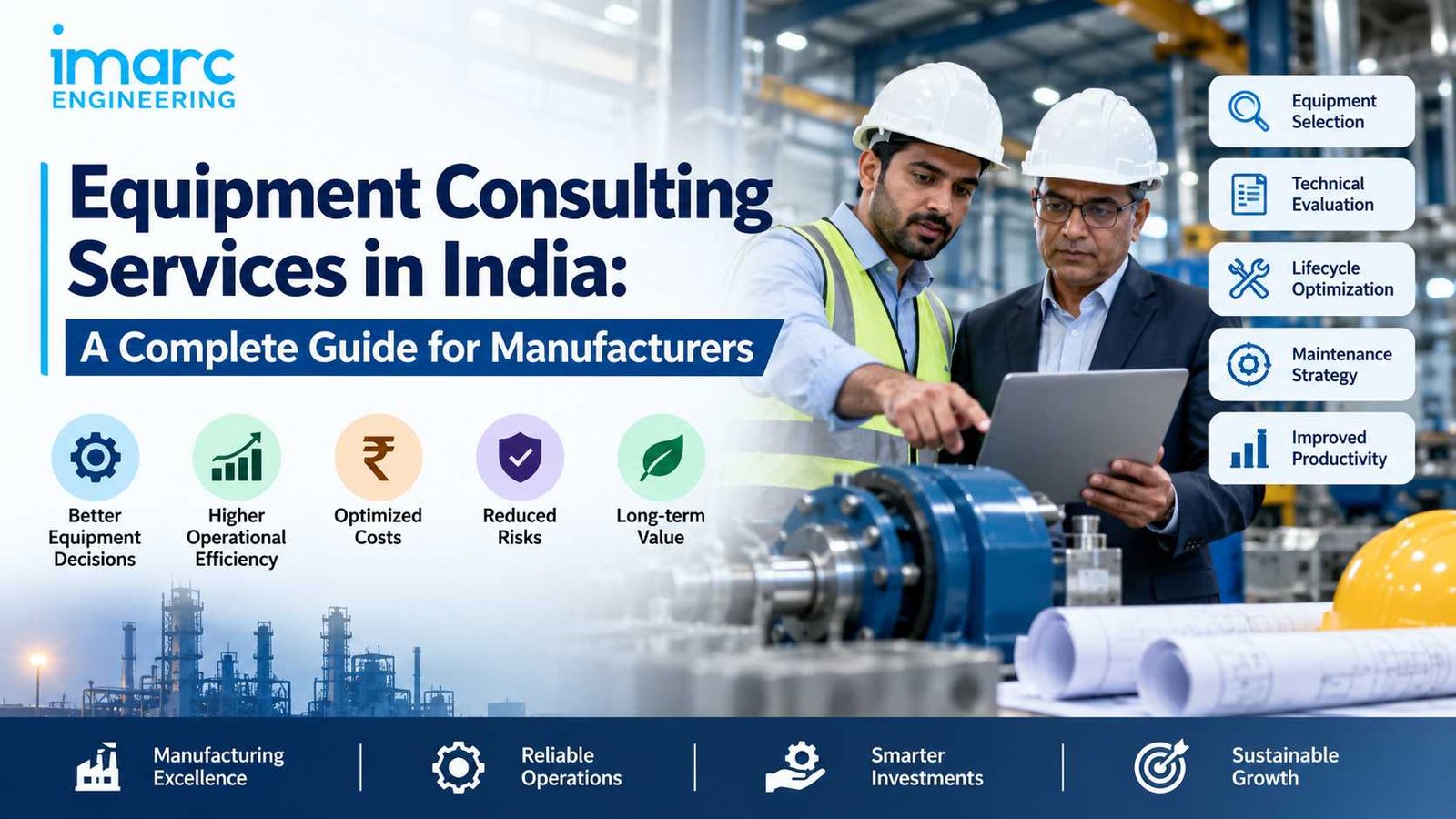
A complete equipment consulting engagement typically spans the full decision cycle, not just the final purchase order. Treating equipment selection as a single procurement event, rather than a sequence of technically validated decisions, is where most cost overruns and delayed commissioning schedules originate. Core components include:
- Technical specification drafting – translating process requirements into measurable, tender-ready specifications covering capacity, tolerances, utilities, and automation interfaces
- Vendor and OEM evaluation – benchmarking domestic and international suppliers on technical capability, after-sales support network, spares availability, and delivery track record
- Total cost of ownership analysis – comparing capital cost against energy consumption, maintenance load, spares cost, and expected operating life
- Compliance and certification mapping – aligning equipment specifications with BIS, PESO, CDSCO, or sector-specific certification requirements before procurement
- Capacity and scalability planning – sizing equipment against current demand while leaving a defined margin for planned expansion
- Technology benchmarking – comparing conventional, semi-automated, and fully automated equipment options against the plant’s actual skill and maintenance capability
The Equipment Selection Lifecycle
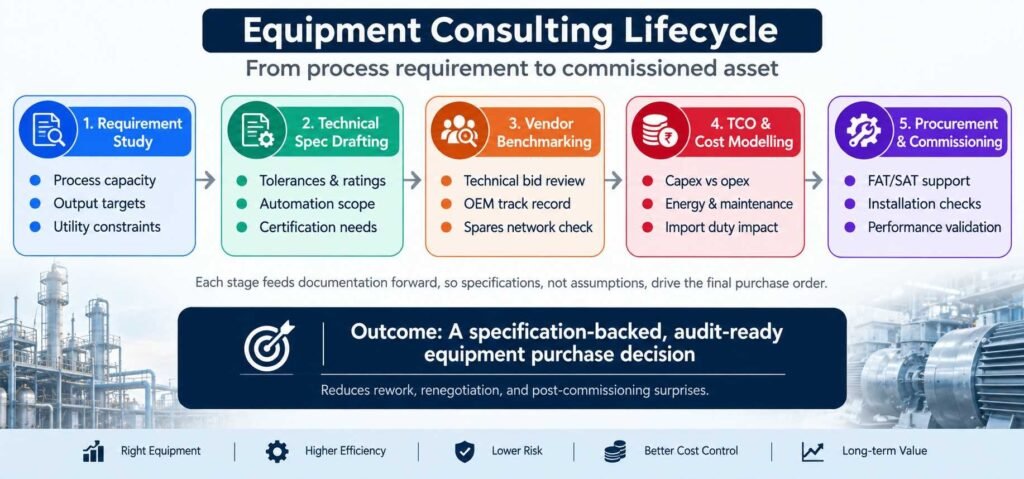
Manufacturers who treat equipment selection as a structured lifecycle, rather than a single procurement event, consistently avoid the rework and renegotiation that follow a rushed decision. Each stage below feeds documented output into the next, so the eventual purchase order reflects a validated specification rather than a vendor’s standard catalogue configuration.
Choosing the Right Equipment Consulting Engagement
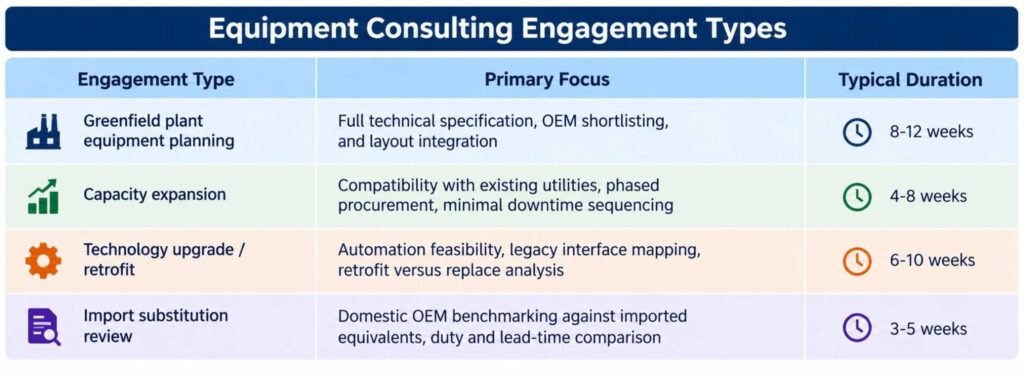
Not every project needs the same depth of consulting support. The right scope depends on whether the manufacturer is setting up a new line, expanding capacity, or upgrading legacy machinery, and the table below reflects how focus and duration shift across these four common engagement types.
Common Mistakes Manufacturers Make Without Expert Equipment Consulting
Most equipment-related losses trace back to a small, repeatable set of decisions made too quickly at the specification or vendor-selection stage. The most common ones include:
- Sizing equipment purely on current output needs, leaving no margin for approved expansion plans
- Relying on vendor-supplied specifications without independent technical validation
- Comparing capital cost alone while ignoring total cost of ownership over the equipment’s operating life
- Overlooking applicable BIS, PESO, or CDSCO certification requirements until installation is already underway
- Selecting automation levels that exceed the plant’s available skilled manpower and maintenance capability
- Finalising vendor selection without checking spares availability and regional service network coverage
Each of these gaps is preventable with a documented specification and a benchmarking step built into the procurement timeline, rather than treated as an optional add-on once budgets are already tight.
How IMARC Engineering’s Expertise Can Help in Equipment Consulting
Turning the lifecycle above into a repeatable, audit-ready process is where dedicated equipment consulting support makes the difference between a smooth commissioning schedule and a reworked one. This typically includes:
- Drafting tender-ready technical specifications aligned with process requirements, capacity targets, and applicable certification standards
- Running independent vendor and OEM benchmarking across technical capability, pricing, and after-sales support
- Building total cost of ownership models that weigh capital cost against energy, maintenance, and spares cost over the equipment’s life
- Mapping equipment specifications against BIS, PESO, and CDSCO requirements before procurement is finalised
- Supporting factory acceptance testing, installation checks, and post-commissioning performance validation
Consult With Our Team: https://www.imarcengineering.com/contact?service=equipment-selection-and-technical-specs-drafting
Conclusion
Equipment decisions made without independent technical validation tend to surface their true cost only after commissioning. With India’s machine tool production, consumption, and import volumes all moving sharply in FY26, manufacturers that pair capital expansion plans with structured equipment consulting are better positioned to size, source, and commission machinery that performs as specified from day one.
Frequently Asked Questions
What does an equipment consultant actually deliver?
A technical specification document, a shortlist of benchmarked vendors, a total cost of ownership comparison, and support through factory acceptance testing and commissioning.
Is equipment consulting only needed for new plants?
No. Capacity expansions, technology retrofits, and import-substitution decisions all benefit from the same specification and benchmarking discipline as a greenfield project.
How much of India’s machine tool demand is still import-dependent?
Close to 59% of India’s FY26 machine tool consumption was met through imports, based on IMTMA’s production and import data for the year, making sourcing strategy a genuine cost and lead-time variable.
How long does a typical equipment selection engagement take?
Depending on scope, engagements typically run from 3 weeks for a focused import-substitution review to 8-12 weeks for a full greenfield equipment planning exercise.
Contact Us:
IMARC Engineering
Phone: +91-120-433-0800
Email: sales@imarcengineering.com
India: C-130, Sector 2, Noida, Uttar Pradesh 201301
LinkedIn: https://www.linkedin.com/showcase/imarc-engineering/
About the Author