Key takeaways
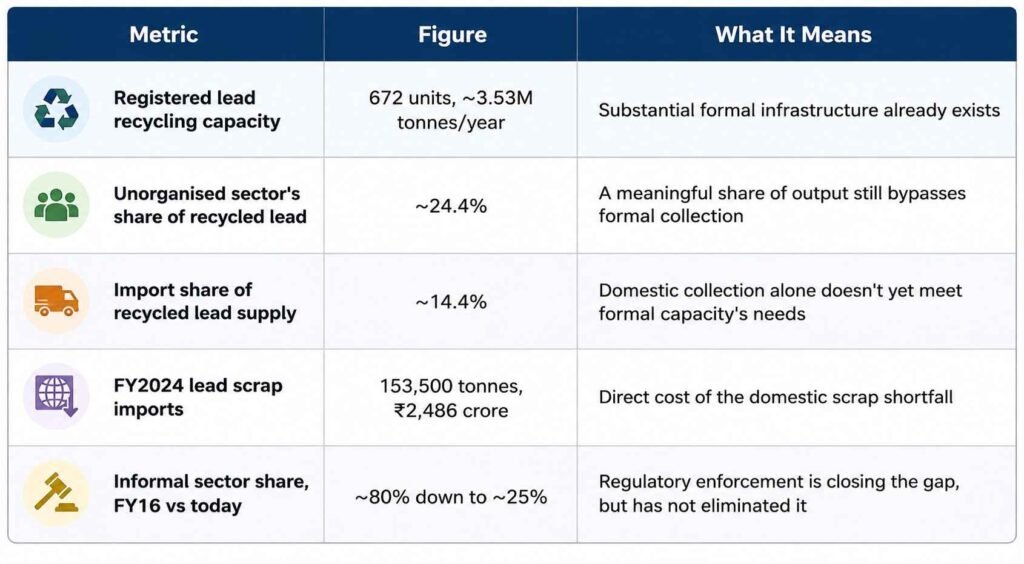
- India has around 672 registered lead recycling units with combined installed capacity of approximately 3.53 million tonnes per annum. However, the unorganised sector is estimated to account for 24.4% of recycled lead ingot supply, while imports contribute another 14.4%, highlighting the continuing gap between formal recycling capacity and reliable domestic scrap collection.
- The Battery Waste Management Rules, 2022 and subsequent amendments have strengthened Extended Producer Responsibility, collection, recycling and traceability requirements, supporting a gradual shift of waste batteries toward registered recyclers.
- India imported approximately 153,500 tonnes of lead scrap worth ₹2,486 crore in FY2024 alone, a direct measure of how much domestic scrap collection still falls short of what formal, licensed recycling capacity actually needs.
- Gravita India, one of the country’s largest secondary metal recyclers, grew its domestic battery scrap procurement by 35% year-on-year in Q2 FY26, shifting its domestic-to-import feedstock ratio from 36:64 to 52:48 in the space of a year, a concrete illustration of how directly addressable this supply gap actually is.
- India’s lead-acid battery market was valued at ₹42,150 crore in FY2025 and is projected to reach ₹59,671 crore by FY2030, a 7.2% CAGR, meaning demand for recycled lead is growing steadily even as the industry continues to compete for a limited, contested scrap supply.
- Lithium-ion battery recycling in India currently runs through a mixed formal and informal collection model, shaped partly by the fire safety risk associated with mishandled lithium-ion cells, a different scrap security dynamic than the lead-acid category faces.
Introduction
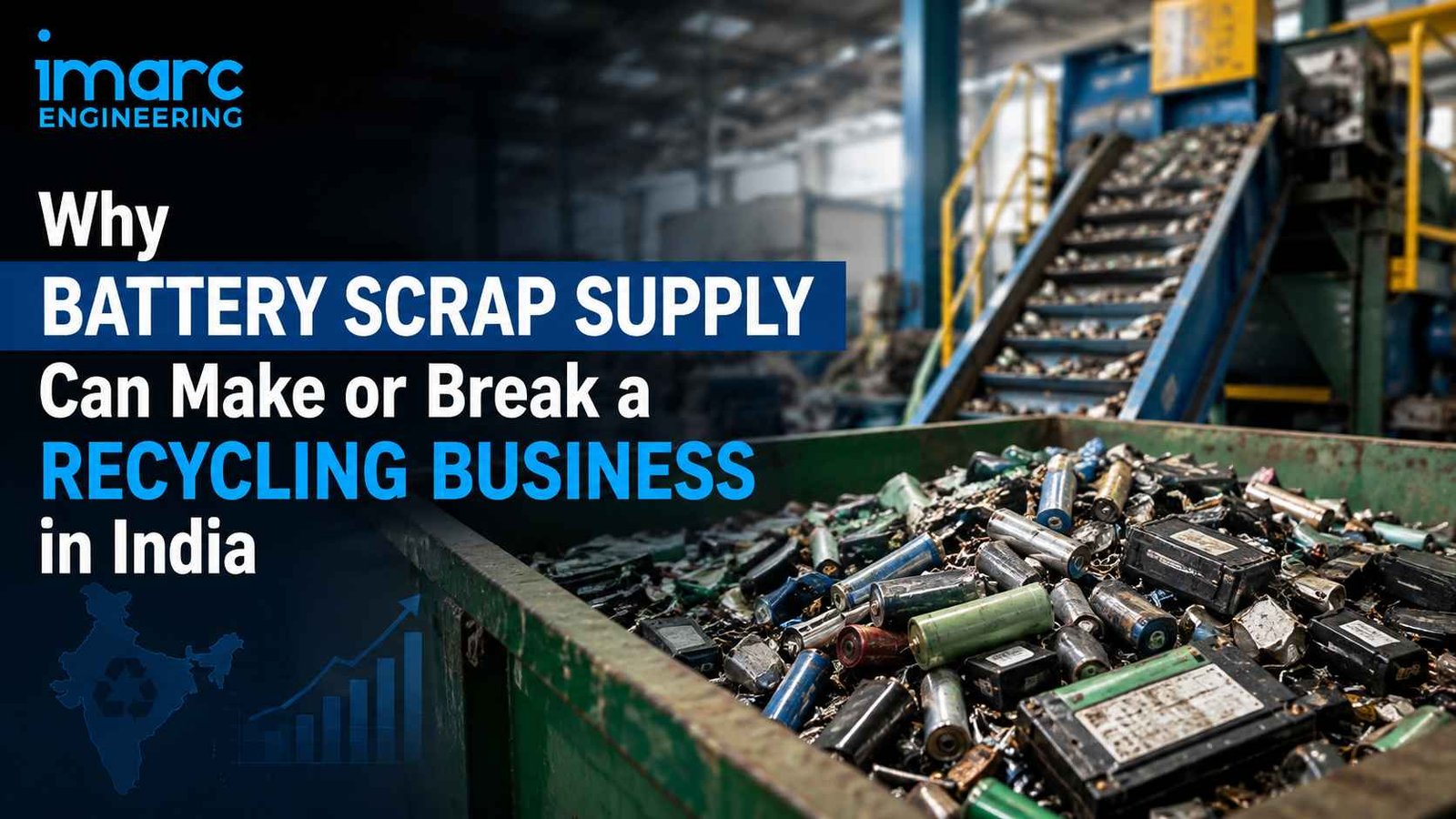
A battery recycling plant can be engineered, licensed and fully commissioned, yet still underperform its business case if it cannot secure enough scrap at the required quality, price and frequency. Feedstock availability is therefore a critical project variable, influencing plant utilisation, procurement costs, logistics and ultimately recycling economics.
This is particularly important in India, where formal recycling capacity is expanding while registered recyclers compete for domestic battery scrap and some operators continue to rely on imported feedstock. At the same time, the Battery Waste Management Rules, 2022 and Extended Producer Responsibility (EPR) framework are strengthening formal collection, recycling and traceability requirements.
This guide examines India’s battery scrap supply challenge, how formalisation is changing feedstock flows, and what project developers should evaluate when planning reliable feedstock supply. For a full walkthrough of facility planning, see IMARC Engineering’s guide on how to set up a battery waste management facility in India.
The scrap supply gap, in numbers
India’s formal lead recycling infrastructure looks substantial on paper: 672 registered recycling units spread across four regional clusters, with a combined installed capacity of approximately 3.53 million tonnes per annum. What that capacity figure doesn’t show is how much of it actually runs on secured, domestic scrap. The unorganised sector still supplies an estimated 24.4% of India’s recycled lead ingot output, and imports contribute another 14.4%, meaning nearly 40% of formal recyclers’ output still depends on scrap sources outside a reliable domestic collection system.
The scale of imports also illustrates the industry’s continuing reliance on overseas feedstock. India imported around 153,500 tonnes of lead scrap worth approximately ₹2,486 crore in FY2024, mainly from the United States, United Kingdom and Australia. While imports can form part of a deliberate sourcing strategy, continued dependence on overseas scrap also highlights the importance of strengthening domestic collection channels.
Why the informal sector still wins a meaningful share
The core reason formal recyclers struggle to secure scrap is straightforward economics: formal, licensed recycling carries compliance costs, environmental controls, and regulatory overhead that informal smelters simply don’t absorb. That cost gap lets informal buyers offer more attractive prices to the retailers, workshops, and scrap dealers who actually hold used batteries first, pulling volume away from the formal collection chain even when regulation technically requires it to flow to registered recyclers.
Poor collection frequency compounds the problem. When formal collection points are inconsistent or hard to access, batteries default to whichever buyer is most immediately available, which in practice is often an informal aggregator already embedded in the local scrap trade.
How EPR Is Changing Battery Scrap Flows
The Battery Waste Management Rules, 2022 have strengthened the formal framework for collecting and recycling waste batteries in India. Under the Extended Producer Responsibility (EPR) system, producers have defined obligations for ensuring that waste batteries are collected and recycled through registered entities, with applicable targets varying by battery category and compliance period. As implementation strengthens, the framework is expected to support greater traceability and movement of battery scrap toward the formal recycling sector.
Recent developments among organised recyclers also indicate improving domestic scrap procurement. Gravita India reported approximately 35% year-on-year growth in domestic battery scrap procurement in Q2 FY26. For its Indian operations, the battery scrap sourcing mix shifted from around 36% domestic and 64% overseas in the corresponding period a year earlier to approximately 52% domestic and 48% overseas. This illustrates how stronger domestic sourcing can reduce reliance on imported feedstock and improve access to scrap for formal recycling operations.
Scrap supply at a glance
Fueling Formal Recycling Capacity: How IMARC Engineering Supports Your Feedstock Strategy
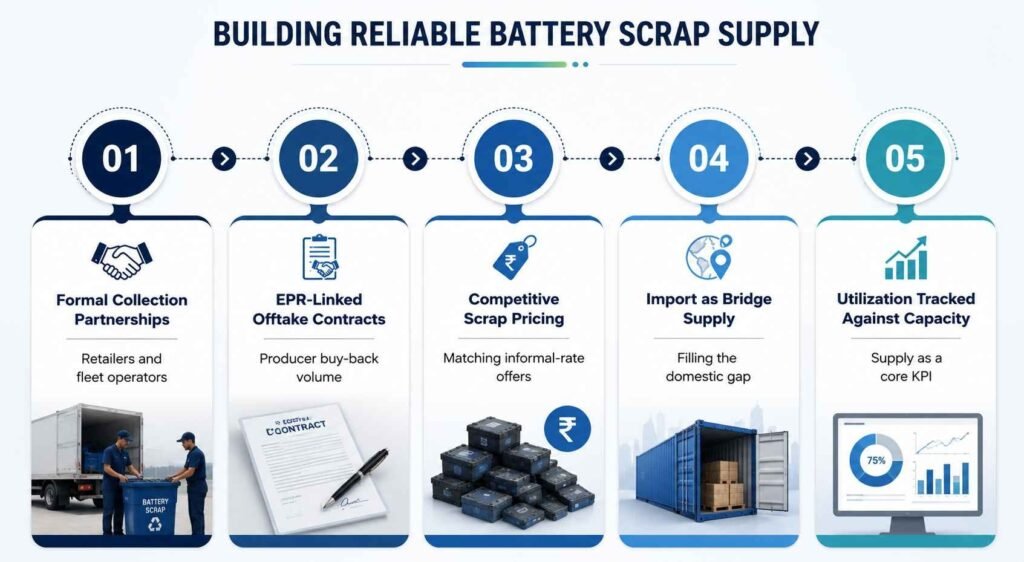
- Feedstock security assessed before capacity is finalized: Realistic scrap availability, not just installed capacity potential, is factored into project sizing from the earliest planning stage.
- Collection network and retailer partnership structuring: Support in building formal collection relationships with retailers, workshops, and fleet operators, the actual first point of contact for used batteries.
- EPR-linked offtake agreement support: Structuring collection and offtake arrangements tied to producer EPR obligations, converting a regulatory requirement into a secured, contracted feedstock stream.
- Import strategy as a deliberate bridge, not a default: Where domestic collection alone can’t yet meet capacity, import sourcing is planned as a managed, cost-aware bridge rather than an unplanned fallback.
- Utilization tracked as a core project metric: Feedstock security and actual capacity utilization are monitored on an ongoing basis, not assumed to hold steady once a facility is commissioned.
Consult IMARC Engineering for Battery Waste Management Facility Setup: https://www.imarcengineering.com/contact-us
Final thoughts
Installed recycling capacity alone does not make a battery recycling project viable. The plant also needs reliable access to sufficient feedstock at a workable delivered cost and quality.
As India’s battery-waste framework strengthens formal collection and recycling, more scrap may move toward registered facilities. However, project developers still need to assess local collection channels, competition for feedstock, logistics, pricing and realistic utilisation before finalising capacity.
Treating scrap availability as a core feasibility input—not a procurement problem to solve after commissioning—can help battery recycling projects reduce underutilisation risk and build more resilient project economics.
Contact Us:
IMARC Engineering
Phone: +91-120-433-0800
Email: sales@imarcengineering.com
India: C-130, Sector 2, Noida, Uttar Pradesh 201301
LinkedIn: https://www.linkedin.com/showcase/imarc-engineering/
About the Author