Bankable Feasibility Study for an Industrial Project
For most promoters, a feasibility study is written to answer one question: is this project worth building? For a lender, it must answer five: is it technically sound, is there real market demand, can it service debt, can the promoter execute it, and are the risks identifiable and manageable. A report that satisfies only the first question may not withstand lender due diligence or credit appraisal. This guide explains what makes a feasibility study bankable for an industrial project in India and how to structure it so that technical, market, financial and execution assumptions can withstand independent scrutiny.
What Does Bankable Actually Mean?
A bankable feasibility study provides lenders and investors with a sufficiently detailed, evidence-based and internally consistent assessment of whether an industrial project is technically feasible, commercially viable and financially sustainable.
For lenders, this means looking beyond projected returns. The study should demonstrate that assumptions around market demand, technology, capacity, site conditions, raw materials, utilities, project cost, operating expenses, working capital, implementation schedule and debt servicing are realistic and supported by appropriate evidence. Sensitivity analysis should also show how the project performs if key assumptions change.
The distinction is important. A general feasibility study may primarily help a promoter decide whether to proceed with an investment. A bankable study must go further by presenting the project in a form that can withstand independent technical, commercial and financial due diligence.
Why This Matters More in 2026
India continues to invest in infrastructure and industrial development that can support new manufacturing and logistics capacity. Union Budget 2026–27 provides ₹12.20 lakh crore for central government capital expenditure, while industrial infrastructure initiatives continue to support the development of investment-ready manufacturing locations.
DPIIT’s BHAVYA (Bharat Audyogik Vikas Yojna) scheme, with a proposed outlay of ₹33,660 crore through FY 2031–32, is aimed at developing 100 plug-and-play industrial parks, while the National Industrial Corridor Development Programme continues to expand industrial nodes supported by multimodal connectivity and enabling infrastructure.
As investment opportunities expand across manufacturing and industrial infrastructure, project promoters need feasibility studies that can support investment decisions, project definition, financing discussions and independent technical or financial due diligence.
Feasibility Study, DPR, and TEV Are Not the Same Document
These documents are related, but they serve different purposes and should not be treated as interchangeable:
- Feasibility study: Assesses whether a proposed project is technically, commercially and financially viable and supports the promoter’s or investor’s decision on whether to proceed.
- Detailed Project Report (DPR): Develops the selected project in greater technical, operational and financial detail, including capacity, process, equipment, utilities, project cost, implementation requirements and financial projections.
- Bankable feasibility study: Presents project viability with the level of evidence, traceability and financial analysis needed to support lender and investor appraisal.
- Techno-Economic Viability (TEV) study: Provides an independent assessment of the project’s technical and economic viability, typically examining areas such as technology, capacity, location, raw materials, utilities, market assumptions, project cost, implementation and financial performance.
Depending on the lender, project size, sector and financing structure, an independent TEV assessment may also be required during project appraisal. The objective of a bankable feasibility study is therefore not simply to present an attractive business case, but to ensure that its market, technical and financial assumptions are sufficiently supported and internally consistent to withstand independent review.
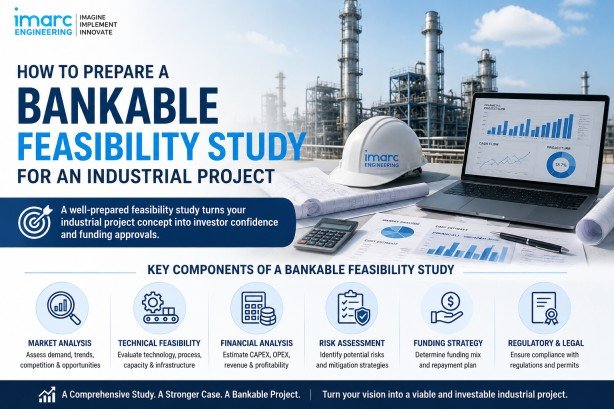
The Core Components of a Bankable Feasibility Study
Executive Summary
Written last but read first. It should let a credit officer grasp project cost, means of finance, capacity, IRR, DSCR, payback, and major risks within a few pages, without reading the full report.
Promoter and Management Assessment
Banks finance the project, the promoter, and the repayment capability together. This section should cover promoter net worth, existing borrowings, credit history, prior project execution experience, and the strength of the management team across technical, finance, and operations functions.
Market and Offtake Analysis
This is frequently the weakest section in unbankable studies. Demand, supply, and competitive benchmarking must be evidence-based, and pricing should be built as a chain: historical price to current market price to competitor price to customer willingness to pay, not assumed outright. Wherever possible, document letters of intent, offtake agreements, or existing customer relationships, and disclose customer concentration explicitly, since a project earning 65% of revenue from five customers carries a materially different risk profile than one earning 25% from the same number.
Technical Feasibility and Technology Selection
Installed capacity is not the same as achievable output. The chain of operating days, shifts, yield, and utilisation should be modelled explicitly rather than assumed at 90% from day one. Technology selection should weigh proven operating references, energy consumption, and maintenance requirements over lowest upfront CAPEX, since cheaper technology often carries higher operating cost, lower yield, and quality risk across the project’s operating life.
CAPEX Estimation Backed by Vendor Data
Cost estimates built on vendor and budgetary quotations, rather than historical benchmarks or round-number assumptions, carry significantly more credibility with lenders. This applies to plant and machinery, utilities, civil works, and contingency, which should be justified rather than inserted as an arbitrary percentage.
Financial Modelling, DSCR, and Sensitivity
The financial model should connect P&L, balance sheet, cash flow, and debt schedule into one structure, with Project IRR, Equity IRR, NPV, and break-even calculated explicitly. Working capital deserves the same rigour as CAPEX: raw material inventory, finished goods, receivables, and payables should each be built from realistic day-count assumptions rather than a flat percentage of revenue, since underestimated working capital is one of the more frequent gaps lenders flag during appraisal.
RBI defines DSCR broadly as cash accruals plus finance charges relative to current debt obligations plus finance charges, and while there is no universal threshold every lender applies, published project finance references commonly cite around 1.5x as an indicative benchmark, varying by lender and sector risk. Rather than asserting a fixed number a bank will accept, the model should demonstrate adequate debt-service headroom under both base-case and downside scenarios. Sensitivity analysis, testing selling price, input cost, capacity utilisation, CAPEX overrun, interest rate, and implementation delay against EBITDA, DSCR, and IRR, is what separates a bankable model from an optimistic one. RBI’s project finance framework explicitly recognises risk and sensitivity analysis as core to bankability assessment.
Regulatory, Environmental, and ESG Readiness
Environmental clearance, consent to establish and operate, and sector-specific approvals should be mapped against the project timeline rather than described as “to be obtained.” For projects under India’s EIA framework, PARIVESH categorises clearance requirements by project category, and timelines vary accordingly. ESG disclosure is also becoming more relevant to financing: SEBI’s BRSR Core framework extends its glide path to the top 1,000 listed entities by FY2026-27, and SEBI has since introduced more flexibility around assurance requirements, making ESG a financing and market-access consideration rather than a reporting formality alone.
Risk Assessment and Implementation Schedule
A dedicated risk register covering CAPEX escalation, construction delay, demand shortfall, and regulatory delay, each with likelihood and mitigation, should sit alongside a phased implementation schedule with long-lead items and commissioning milestones identified. A six-month delay in commissioning is rarely just a scheduling issue; it typically becomes a financing issue once interest during construction and working capital timing are affected.
Customer Concentration Deserves Its Own Line Item
Lenders increasingly ask this question directly during appraisal: what happens if your largest customer leaves. A project that names its top five customers and their share of projected revenue, rather than describing demand in aggregate, gives a credit committee a concrete basis to size that risk instead of guessing at it.
The Single Source of Truth Principle
The most common reason a feasibility study fails independent review is internal inconsistency: engineering assumes one production capacity while the financial model assumes another. Process design, equipment list, CAPEX, utilities, manpower, production capacity, operating cost, and revenue must trace back to one integrated technical-commercial-financial model. If that chain holds together end to end, the study becomes materially more defensible under lender or TEV scrutiny.
Common Mistakes That Make a Study Unbankable
- Revenue assumptions based on installed capacity rather than demonstrated demand
- Utilisation jumping from 0% to 90% with no ramp-up modelling
- Working capital underestimated, particularly receivables and inventory
- Government subsidy or grant treated as guaranteed rather than sanctioned
- Only a base case presented, with no downside scenario
- Equipment capacity, utility consumption, and financial model figures that don’t match each other
View Related Insight: https://www.imarcengineering.com/blog/why-feasibility-studies-matter
How IMARC Engineering Can Help
IMARC Engineering supports industrial promoters and EPCM teams in building feasibility studies that are structured to withstand lender and TEV-level review, not just present a favourable business case. This includes market and demand validation, technical and technology feasibility, CAPEX estimation backed by vendor quotations, integrated financial modelling with DSCR and sensitivity analysis, regulatory and ESG readiness mapping, and risk assessment aligned to implementation schedules. The work spans both greenfield and brownfield industrial projects across manufacturing, process, and infrastructure sectors, with the technical and financial components built on a single connected model so that engineering assumptions and lender-facing numbers remain consistent throughout due diligence.
Get a lender-ready feasibility study: https://www.imarcengineering.com/contact?service=feasibility-study-business-planning
Conclusion
A bankable feasibility study is more than a detailed project report or financial forecast. It is an evidence-based assessment in which market demand, technical design, capacity, CAPEX, operating costs, working capital, financing assumptions and project risks are connected through one internally consistent model.
For industrial projects, the strength of the study depends not only on the base-case returns but also on whether the underlying assumptions can withstand technical, commercial and financial scrutiny. Sensitivity analysis, realistic ramp-up assumptions, documented CAPEX inputs and clear regulatory and implementation planning help demonstrate how the project may perform when conditions differ from the original plan.
Building this level of traceability before financing discussions begin can help promoters identify weaknesses early, improve project definition and present lenders and investors with a more credible basis for evaluating the proposed investment.
Contact Us:
IMARC Engineering
Phone: +91-120-433-0800
Email: sales@imarcengineering.com
India: C-130, Sector 2, Noida, Uttar Pradesh 201301
LinkedIn: https://www.linkedin.com/showcase/imarc-engineering/
About the Author