Introduction
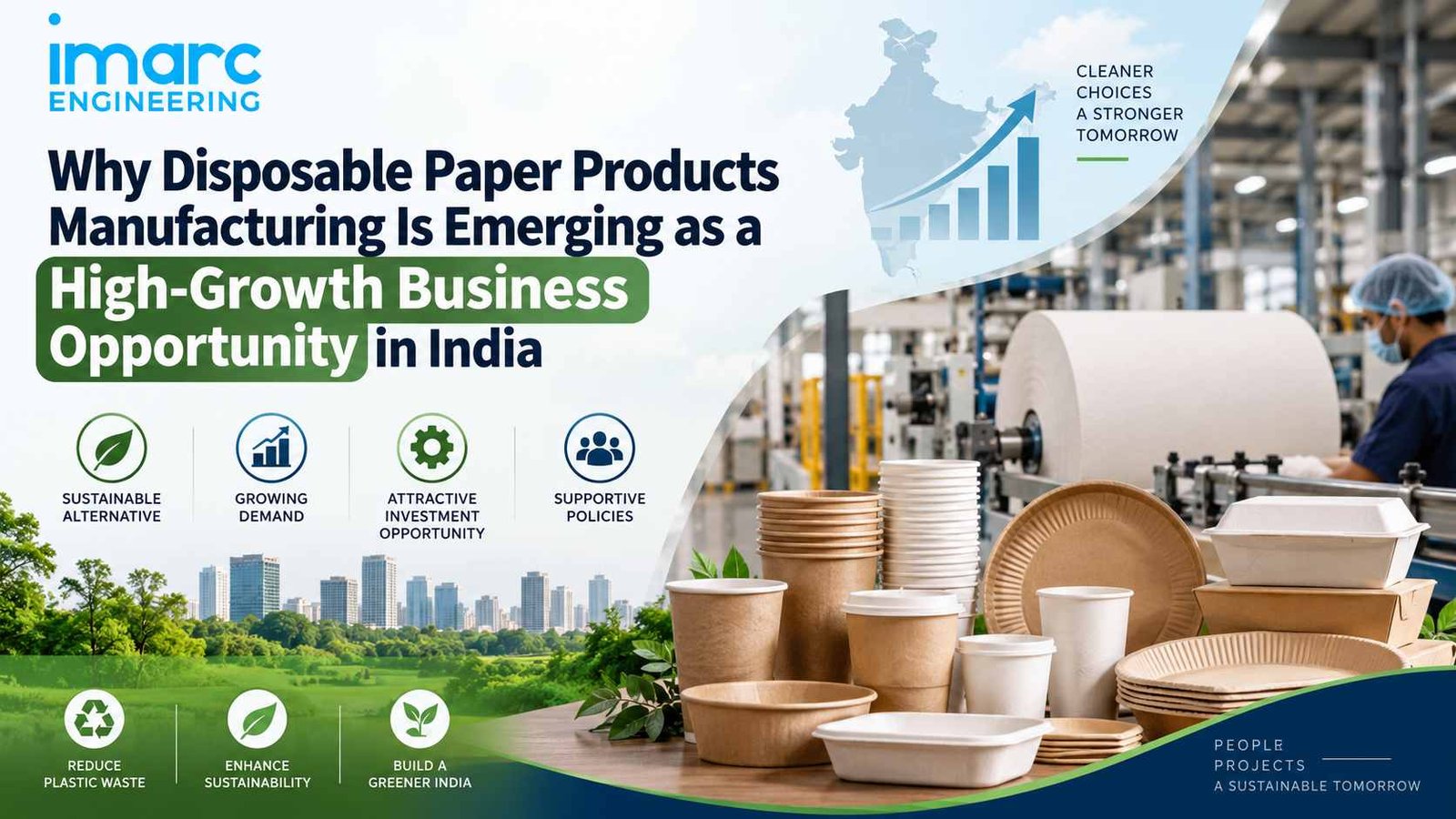
India’s disposable paper products industry is moving from a fragmented, unorganised activity to a structured manufacturing opportunity. Regulatory pressure on single-use plastics, rapid foodservice expansion, and rising hygiene consciousness are converging to push paper cups, plates, bowls, and trays into mainstream demand.
For investors evaluating where to deploy capital in 2026, the sector offers a rare combination: a policy-backed demand floor, low-to-moderate capital intensity compared with primary paper manufacturing, and a large, still-consolidating supplier base. This makes a Disposable Paper Products Manufacturing Plant Setup in India a genuinely attractive proposition for both new entrants and existing converters looking to diversify.
Why the Opportunity Is Growing Right Now
Several data points confirm that this is not a speculative trend but a measurable market shift.
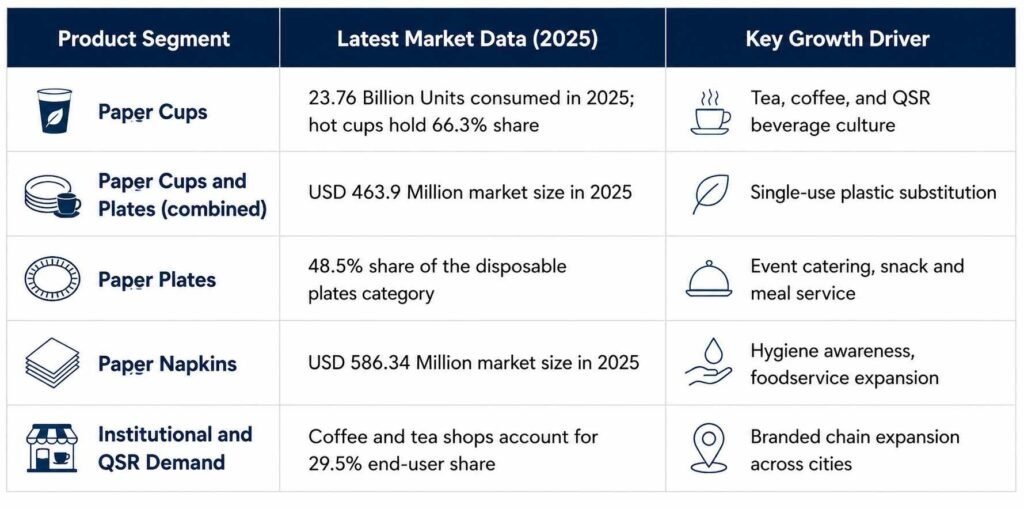
- The India paper cups and paper plates market size reached USD 463.9 Million in 2025. Looking forward, IMARC Group expects the market to reach USD 666.5 Million by 2034, exhibiting a growth rate (CAGR) of 3.99% during 2026-2034.
- India’s paper cups market alone stood at 23.76 Billion Units in 2025, expected to reach 29.66 Billion Units by 2034 at a CAGR of 2.28%.
- Hot paper cups accounted for 66.3% of the paper cups market in 2025, reflecting India’s deep-rooted tea and coffee consumption culture.
- Single-wall paper cups held a 51.5% share in 2025 owing to their cost efficiency, while the medium cup-size segment led with 45.8% share.
- Coffee and tea shops represented 29.5% of end-user demand in 2025, and Maharashtra alone accounted for 18.5% of national market share, the highest among all states.
- Paper-based plates are projected to dominate the broader disposable plates category, accounting for 48.5% of total consumption.
- The India paper napkin market was valued at USD 586.34 Million in 2025 and is forecast to reach USD 1,145.03 Million by 2034, at a CAGR of 7.7%, one of the fastest growth rates within the disposable paper products basket.
Taken together, these figures show a market that is broad-based across product categories (cups, plates, bowls, trays, napkins) rather than dependent on a single product line, which reduces concentration risk for new manufacturers.
Regulatory Push Is Creating a Durable Demand Floor
Unlike many consumer categories where demand is driven purely by discretionary spending, disposable paper products benefit from an active regulatory mandate.
- The single-use plastic ban under the Plastic Waste Management Rules 2016, as amended, took effect from 1 July 2022, prohibiting plastic plates, cups, glasses, cutlery, straws, stirrers, and trays used in food service.
- Enforcement has intensified across major metros including Delhi, Mumbai, Bengaluru, and Chennai, directly increasing institutional and retail dependence on paper alternatives.
- The FSS (Packaging) Regulations 2018, administered by FSSAI, govern food-contact paper materials, while the May 2022 Recycled Plastic Amendment restricts recycled material for direct food contact, effectively mandating virgin fibre paperboard for cups, plates, and bowls.
- Extended Producer Responsibility (EPR) requirements under the plastic waste framework apply to products with PE coatings or laminates, pushing manufacturers toward water-based or PLA barrier coatings that carry sustainability positioning advantages.
This regulatory architecture means demand is not contingent on consumer preference shifting on its own. It is being actively enforced, which is why quick-service restaurant chains, cloud kitchens, institutional caterers, and traditional retail are converting to paper-based formats at a structural rather than cyclical pace.
Why the Business Model Works for New Entrants
Beyond top-line demand, the underlying economics make disposable paper products manufacturing accessible to a wider pool of investors than integrated paper manufacturing.
- Disposable paper products manufacturing is largely a converting activity that uses purchased paperboard as feedstock, which substantially lowers capital intensity compared with primary pulp and paper production.
- Environmental clearance requirements are narrower because the process involves printing, cutting, forming, and finishing rather than pulping, bleaching, or chemical recovery.
- Product mix flexibility allows a single plant to manufacture cups, plates, bowls, and trays, reducing single-customer or single-segment concentration risk.
- Raw material cost typically represents 45% to 60% of variable manufacturing cost, giving operators a clear lever to manage margins through multi-source paperboard procurement.
- EBITDA margins in the 12% to 20% range are achievable depending on product mix, capacity utilisation, and the share of value-added, printed, or barrier-coated products in the portfolio.
Segment-Wise Snapshot of the Opportunity
Where the Demand Is Coming From
The end-use base for disposable paper products has diversified well beyond traditional retail.
- Quick-service restaurant chains, both domestic and international, are standardising on paper-based cups, bowls, and trays.
- Cloud kitchens and food delivery platforms require leak-resistant, branded paper packaging for takeaway orders.
- Institutional catering, including corporate cafeterias, hospitals, and educational institutions, is shifting bulk procurement to paper formats.
- Coffee shop and beverage chains continue to be the single largest end-user category by volume.
- Traditional retail and street food vendors are adopting paper following restrictions on using newspaper for food wrapping under the FSS (Packaging) Regulations 2018.
This spread across institutional, retail, and food-delivery channels means capacity utilisation is not dependent on any single demand source staying strong through economic cycles.
Practical Considerations Before Entering the Sector
Investors evaluating this opportunity should account for a few realities that determine whether a project performs as modelled.
- Machinery nameplate speed and achievable plant output differ meaningfully once changeover time, product dimensions, and operating efficiency are factored in.
- Food-contact compliance under FSSAI, applicable BIS standards for paperboard and printing inks, and EPR registration for coated products require planning from the design stage rather than after commissioning.
- Coating strategy (PE, water-based barrier, or PLA) affects both cost structure and the sustainability positioning that increasingly influences institutional and QSR procurement decisions.
- Capacity utilisation above 70% is generally required for machinery cost recovery, making demand aggregation and multi-product flexibility important at the planning stage.
How IMARC Engineering’s Expertise Can Help in Disposable Paper Products Manufacturing Plant Setup
Translating this market opportunity into a bankable plant requires disciplined planning across product mix, machinery, compliance, and capacity. IMARC Engineering supports investors and manufacturers across each of these decision points.
- Market feasibility and product-mix planning across cups, plates, bowls, and trays based on target customer segments and regional demand.
- Food-grade paperboard and coating selection, including PE, water-based barrier, and PLA options, balanced against cost and sustainability positioning.
- Machinery evaluation and vendor identification for cup forming, plate pressing, tray forming, printing, and die-cutting lines matched to targeted capacity.
- Plant layout and utility planning covering raw material storage, hygiene zones, and finished goods handling suited to food-contact manufacturing.
- CAPEX and OPEX modelling anchored to realistic capacity utilisation rather than machinery nameplate speed alone.
- Regulatory and licensing support spanning FSSAI compliance, applicable BIS standards, State Pollution Control Board consents, Factory Licence, Fire NOC, and EPR registration.
- Supplier evaluation and coordination for paperboard, printing inks, and adhesives to ensure consistent food-contact certification.
This end-to-end support helps sponsors move from market opportunity to a commissioned, compliant plant without gaps between planning stages.
Get in Touch With Our Team: https://www.imarcengineering.com/contact-us
Conclusion
India’s disposable paper products sector combines regulatory tailwinds, diversified demand, and moderate capital intensity into one of the more accessible manufacturing opportunities available to investors today. The data confirms sustained growth across cups, plates, and napkins, while the single-use plastic ban continues to convert latent demand into recurring institutional procurement. Disciplined planning around product mix, compliance, and capacity utilisation will determine which entrants convert this opportunity into a profitable, scalable operation.
Contact Us:
IMARC Engineering
Phone: +91-120-433-0800
Email: sales@imarcengineering.com
India: C-130, Sector 2, Noida, Uttar Pradesh 201301
LinkedIn: https://www.linkedin.com/showcase/imarc-engineering/
About the Author