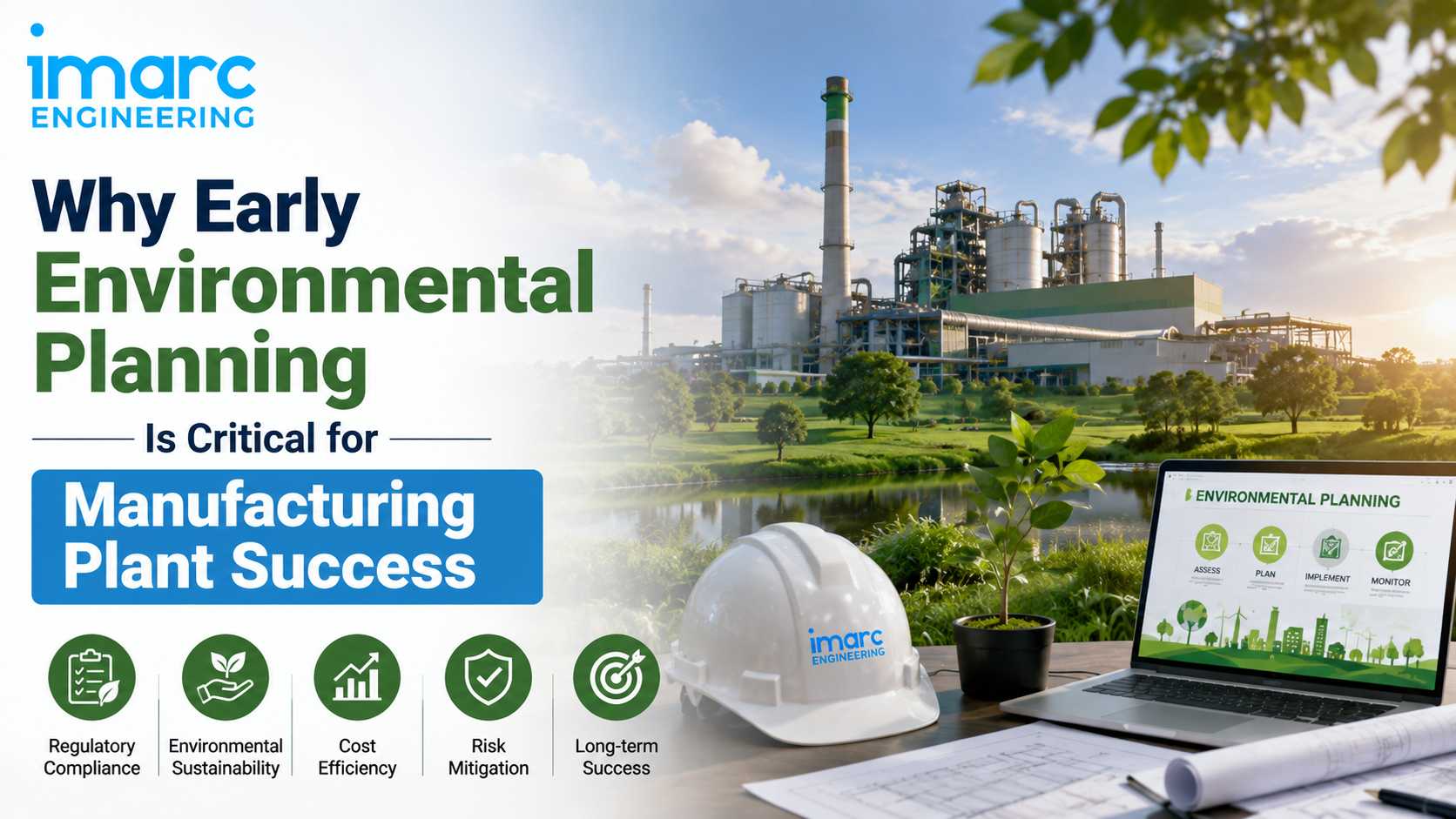
A manufacturing project that skips environmental planning until construction is already underway is not saving time. It is postponing a set of decisions that were always going to determine whether the plant gets built on schedule, whether it clears inspection after commissioning, and whether it stays open once it is running.
Environmental clearance, pollution control board consent, water sourcing, and waste disposal are not paperwork bolted on after the plant layout is finalised. They shape where the site can be located, how the process is designed, and what equipment can be specified. Manufacturers that bring environmental impact and sustainability studies into the earliest stage of project planning consistently avoid the redesign and re-approval cycles that catch late planners off guard.
The Cost of Treating Environmental Planning as an Afterthought
The financial exposure from poor upfront planning on Indian industrial and infrastructure projects is well documented. The Ministry of Statistics and Programme Implementation’s Flash Report for May 2026 tracked 1,987 central sector projects valued above Rs 150 crore each, and found their combined cost had risen from an original Rs 37.09 lakh crore to a revised Rs 42.50 lakh crore, an overrun of close to Rs 5.4 lakh crore. Land acquisition, statutory clearances, and design changes made after construction has begun are repeatedly cited among the leading causes of this gap, and environmental clearance sits squarely inside that category.
An Environmental Clearance obtained after site development has already started forces a manufacturer to choose between a costly redesign or accepting compliance conditions that were never built into the original process flow. Neither outcome is available to a manufacturer who commissions environmental studies before the plant layout is locked in.
Factors That Make Early Environmental Planning Essential
1. Project Categorisation Determines the Entire Approval Timeline
Every manufacturing project falls into a category under the EIA Notification 2006 that decides whether it needs a full Environmental Impact Assessment, a simplified process, or no clearance at all. Category A projects require Expert Appraisal Committee review at the central Ministry of Environment, Forest and Climate Change level, while Category B projects are appraised by the State Expert Appraisal Committee. Determining this categorisation before the site is finalised avoids the scenario where a manufacturer discovers, mid-construction, that its project actually needed a full EIA and public hearing.
2. The Regulatory Framework Keeps Shifting
Manufacturers who treat environmental compliance as a one-time checklist are working against a framework that is actively being rewritten. A manufacturer relying on a two-year-old understanding of which approvals apply can misjudge its entire compliance timeline:
- In January 2025, industrial sheds and educational buildings up to 1,50,000 square metres were exempted from Environmental Clearance requirements.
- In March 2025, linear projects such as roads, pipelines, and transmission lines were brought back under EIA regulation through a new Appendix XIV.
- Separately, 86 sectors have been notified under a White category, exempting them from Consent to Establish and Consent to Operate altogether.
3. Water Availability Has to Be Confirmed Before the Process Is Designed
For a manufacturer, India’s tightening water position translates into a very specific site-selection risk. Confirming water source, consumption limits, and discharge obligations before finalising the site avoids a scenario where the plant is built and then cannot secure the water allocation it needs to operate:
- India’s water demand is projected to be twice the available supply by 2030.
- The resulting gap could cost the economy up to 6% of GDP if left unaddressed.
- Closing it is estimated to require close to Rs 20 lakh crore in infrastructure investment nationally.
- A site chosen without a water balance study can turn out to sit in a region where groundwater extraction is restricted or Zero Liquid Discharge is mandatory.
4. Waste Streams Need a Disposal Pathway Before They Exist
Mapping expected waste streams and confirming disposal or treatment capacity during the planning stage, rather than after production has started, prevents a plant from generating waste it has no authorised way to dispose of:
- India’s e-waste generation reached 13.98 lakh tonnes in 2024-25, nearly double the 7.08 lakh tonnes recorded in 2017-18.
- Formal collection and processing capacity has struggled to keep pace, even though it has improved to around 70% of what is generated.
- Hazardous waste faces a similarly constrained disposal infrastructure under the Hazardous and Other Wastes Management Rules 2016.
- Authorisation from the State Pollution Control Board is required before a single tonne of scheduled hazardous waste can be generated, stored, or transported.
| Approval or Study | Purpose | Issuing Authority |
|---|---|---|
| Environmental Clearance (EC) | Mandatory approval for designated project categories before construction begins | MoEFCC (Category A) / SEIAA (Category B) |
| Consent to Establish (CTE) | Authorises construction of the manufacturing facility | State Pollution Control Board |
| Consent to Operate (CTO) | Authorises commencement of production after CTE conditions are verified | State Pollution Control Board |
| Hazardous Waste Authorisation | Required for facilities generating, storing, or transporting scheduled hazardous waste | State Pollution Control Board |
| Water Balance / ZLD Assessment | Confirms water source, consumption limits, and discharge feasibility | Central Ground Water Authority / SPCB |
| BRSR ESG Disclosure | Mandatory environmental, social, and governance reporting for top 1,000 listed companies | SEBI |
5. Carbon and ESG Readiness Now Shapes Market Access, Not Just Compliance
For manufacturers exporting to Europe or supplying multinational buyers, a Scope 1, 2, and 3 carbon footprint prepared early gives procurement teams a defensible baseline before a customer’s sustainability due diligence questionnaire or a carbon border adjustment requirement arrives unannounced:
- SEBI’s Business Responsibility and Sustainability Reporting framework requires India’s top 1,000 listed companies to disclose environmental performance data.
- BRSR Core indicators are now subject to reasonable assurance from FY 2024-25 onward.
- Retrofitting emissions data collection after a plant is already operating is far more difficult than designing metering and monitoring into the facility from the start.
Build a Strong Environmental Foundation for Manufacturing Success: https://www.imarcengineering.com/contact?service=environmental-impact-sustainability-studies
6. Air Quality Baselines Protect Against Future Restriction
Under the National Clean Air Programme, 103 cities recorded a reduction in PM10 levels between 2017-18 and 2024-25, and 22 cities have already met National Ambient Air Quality Standards, reflecting a policy direction that is only going to tighten emission limits further. A manufacturer that establishes its own site-specific ambient air quality baseline early has verifiable evidence of pre-project conditions, which becomes essential if airshed-level restrictions are introduced in the region after the plant is commissioned.
7. Site-Specific Baseline Data Cannot Be Reconstructed Later
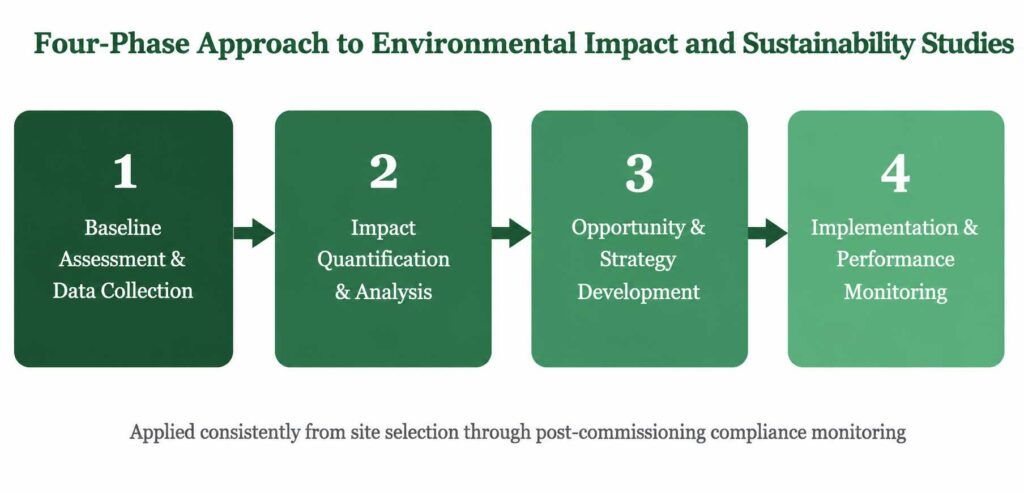
Ambient air quality, groundwater quality, soil characteristics, and ecological conditions all have to be measured at the actual site, across the seasons specified by regulatory guidance, before construction changes those conditions. A baseline study started after site clearing has begun no longer reflects the pre-project environment, which regulators and appraisal committees frequently flag as a data insufficiency issue, sending the application back for repeat studies and adding months to the approval timeline.
8. Public Hearings Reward Preparation, Not Improvisation
Category A and B1 projects require a public hearing in the project district as part of the Environmental Clearance process, and the quality of the Environmental Management Plan presented at that hearing directly affects how smoothly the appraisal proceeds. Manufacturers who have already modelled their air dispersion, water discharge, and noise impacts, and who can show a credible mitigation plan, face a materially different hearing than those presenting incomplete baseline data for the first time.
9. Non-Compliance After Commissioning Carries Real Financial and Legal Risk
Environmental planning does not end once the plant opens. A plant that has already built its environmental management plan and monitoring programme into its operating routine, rather than assembling one reactively after a show-cause notice, is in a fundamentally stronger position to respond to an inspection or a compliance query without production disruption:
- Operating without the applicable clearance, or in breach of consent conditions, exposes a manufacturer to closure orders from the State Pollution Control Board.
- Prohibition orders can be issued under the Environment Protection Act 1986.
- The National Green Tribunal can impose compensation orders calculated on a polluter-pays basis.
Environmental planning is most effective when aligned with the overall manufacturing plant setup strategy. Watch the video below to learn how early planning, approvals, and execution decisions contribute to successful industrial project delivery.
Watch here:
Conclusion
Environmental planning done early is not a compliance cost. It is the difference between a plant that clears appraisal, secures its water and waste pathways, and opens on schedule, and one that discovers its constraints only after the foundation is poured. As India’s environmental framework continues to evolve through 2026, manufacturers that build environmental studies into the earliest project stage will keep control of their timeline instead of surrendering it to redesign.
Contact Us:
IMARC Engineering
Phone: +91-120-433-0800
Email: sales@imarcengineering.com
India: C-130, Sector 2, Noida, Uttar Pradesh 201301
LinkedIn: https://www.linkedin.com/showcase/imarc-engineering/
About the Author