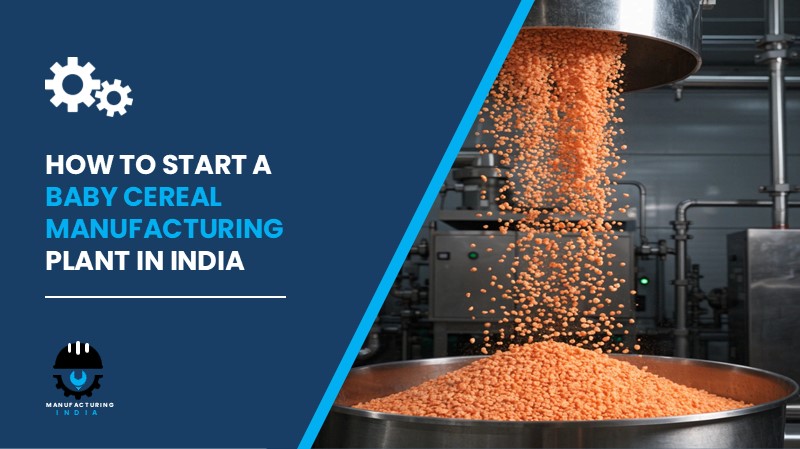
Setting up a baby cereal manufacturing plant in India presents a compelling investment case driven by rapidly expanding demand across the infant nutrition industry, the pediatric healthcare sector, the food and beverage industry, and government nutrition programs. Baby cereals — formulated from cereal grains such as rice, wheat, barley, oats, or corn and enriched with vital micronutrients — are increasingly recognised as a foundational product in early childhood development. India’s demographic profile, marked by one of the world’s largest birth cohorts and a growing base of health-conscious parents, creates a structurally robust and long-duration demand environment for this product category.
India’s urbanisation momentum, rising disposable incomes, and the expansion of organised retail are accelerating adoption of packaged infant nutrition products across Tier 1 and Tier 2 cities. States such as Gujarat, Maharashtra, Uttar Pradesh, and Tamil Nadu offer well-developed industrial infrastructure, reliable utility connectivity, and access to grain-producing agricultural belts, making them strategic locations for this type of facility. The Government of India’s Make in India initiative further reduces barriers for domestic manufacturers through streamlined approvals, production-linked incentives, and support for food processing investments, cementing India’s position as a globally competitive base for baby cereal production.
India is strategically well-positioned for baby cereal manufacturing, offering cost-competitive grain sourcing, strong policy support through Make in India, and sustained demand from an expanding urban parent population. With gross profit margins ranging between 35–45% and net margins of 15–20%, this investment delivers compelling financial viability and break-even sustainability across plant capacities.
What is Baby Cereal?
Baby cereal is an infant food product that is specially formulated to provide the appropriate nutrients needed by babies during the period of weaning and the early stages of their growth. The product is centred on cereal grains — rice, wheat, barley, oats, and corn — which are enriched with vitamins, minerals, and micronutrients including iron, calcium, zinc, and vitamins A, D, and the B complex. These nutritional credentials make baby cereals critical to brain development, immune system strengthening, and overall physical growth in infants and toddlers.
Baby cereals are available in a range of formulations, including single-grain, multi-grain, organic, gluten-free, and age-specific variants, allowing manufacturers to address diverse consumer preferences and institutional procurement specifications. Key attributes such as long shelf life, safety, and convenience of preparation make the product suitable across both home feeding and institutional nutrition environments. The production process involves raw material cleaning and grading, milling and roasting, blending and fortification, thermal processing, quality inspection, and packaging. End-use industries served by this facility include the infant nutrition industry, the pediatric healthcare sector, the food and beverage industry, and government nutrition programs.
Cost of Setting Up a Baby Cereal Manufacturing Plant in India
The total investment required for a baby cereal manufacturing plant in India depends on plant capacity, technology selection, site location, level of automation, and regulatory compliance requirements. Investors should approach financial planning with a clear understanding of both capital expenditure (CapEx) and ongoing operational expenditure (OpEx).
1. Capital Expenditure (CapEx)
Land and Site Development represents a significant component of the total CapEx. Investors may consider locating the unit within a Special Economic Zone (SEZ) or designated food processing industrial estate to benefit from land cost concessions, tax advantages, and shared infrastructure. Land registration charges, boundary development, and site levelling form part of this expense head.
Civil Works and Construction covers the construction of the main production shed, raw material storage warehouse, finished goods storage, quality control laboratory, effluent treatment plant (ETP) area, and an administrative block. Compliance with food-grade construction norms, including hygienic flooring, pest-proof structures, and clean-room preparation zones, adds to civil costs but is non-negotiable for regulatory clearances.
Machinery and Equipment accounts for the largest portion of total capital expenditure. Key machinery required includes:
- Grain cleaners
- Roasters
- Mills
- Blenders
- Extruders or drum dryers
- Packaging machines
- Laboratory testing instruments
Other Capital Costs include the effluent treatment plant, pre-operative expenses, commissioning costs, and applicable import duties on specialised processing equipment not manufactured domestically.
Request a Sample Report for In-Depth Market Insights: https://www.imarcgroup.com/baby-cereal-manufacturing-plant-project-report/requestsample
2. Operational Expenditure (OpEx)
Raw Material Cost is the dominant driver of ongoing operating expenses. Raw materials — primarily grains and milk powder — account for approximately 70–80% of total OpEx. To manage price volatility effectively, operators are advised to establish long-term supply contracts with reliable grain and milk powder suppliers, particularly those located in proximity to the plant site to reduce inbound logistics costs.
Utility Cost — covering electricity, water, and steam required for milling, roasting, thermal processing, and packaging — represents approximately 5–10% of total OpEx. Investments in energy-efficient boilers and variable-frequency drives can meaningfully reduce utility consumption over the production lifecycle.
Other Operating Costs include transportation and distribution, packaging materials, salaries and wages, routine maintenance, depreciation on machinery and civil assets, taxes, and quality assurance expenditures. By the fifth year of operations, the total operational cost is expected to increase substantially due to inflation, market fluctuations, potential rises in the cost of key input materials, supply chain disruptions, and shifts in the broader economy.
3. Plant Capacity
The proposed manufacturing facility is designed with an annual production capacity ranging between 5,000 and 10,000 MT, enabling economies of scale while maintaining operational flexibility. Capacity can be customised based on the investor’s market strategy, available capital, and target distribution geography. Profitability improves meaningfully with higher capacity utilisation, as fixed cost components — including depreciation, administrative salaries, and facility maintenance — are spread over a larger production volume.
4. Profit Margins and Financial Projections
The financial projections for this type of unit demonstrate healthy profitability potential under normal operating conditions. Gross profit margins typically range between 35–45%, supported by stable demand and value-added product positioning. Net profit margins average 15–20% over a five-year operating horizon. A comprehensive financial analysis covering net present value (NPV), internal rate of return (IRR), payback period, income and expenditure projections, fixed versus variable cost structures, and sensitivity analysis is essential to securing investor and lender confidence before committing capital.
Why Set Up a Baby Cereal Plant in India?
Rising Focus on Infant Nutrition: Parents in India are increasingly aware of the critical importance of nutrition during the first year of a baby’s life, making them the primary demand instigators for fortified baby cereals. Scientifically formulated products that guarantee safety, convenience, and nutritional adequacy are seeing accelerating uptake across urban and semi-urban markets.
Growing Urbanisation and Working Parents: Working parents with hectic time schedules are demonstrably choosing ready-to-use and wholesome baby food options over home-prepared alternatives. Urban migration and rising disposable incomes are expanding the addressable consumer base for packaged baby cereal products across Indian cities and towns.
Strong Government and Institutional Demand: Government nutrition programs and pediatric health guidelines actively favour the procurement of fortified infant foods. Large-volume institutional procurement supports social welfare activities, maternal and child nutrition initiatives, and public health campaigns, creating a stable, non-cyclical revenue stream for domestic producers.
Product Innovation Opportunities: The baby cereal category offers manufacturers significant scope to develop organic, allergen-free, probiotic-enriched, and age-specific cereal variants that command premium pricing. Clean-label ingredients and organic certifications are high-growth subsegments that Indian manufacturers can capture with relatively modest additional investment.
Active Industry Investment: In October 2025, Nestlé Ghana introduced a new CERELAC variant with no refined sugar, expanding its baby cereal lineup to support mothers and caregivers in selecting nutrition suited for young children. In March 2025, researchers published a study in the journal Children finding that fortified baby cereals contributed positively to nutrient intake during the complementary feeding period across infants in Brazil, the UAE, and the United States — reinforcing global evidence for the product’s nutritional value.
Asia Pacific Market Leadership: According to IMARC Group estimates, the Asia Pacific region accounted for the largest market share at over 48.9%, underscoring the region’s dominance in infant nutrition consumption. India’s position within this growth bloc, combined with its cost-competitive manufacturing base, makes the production opportunity structurally sound for both domestic supply and export.
Manufacturing Process Step by Step
The baby cereal manufacturing process uses raw material cleaning and grading, milling and roasting, blending and fortification, thermal processing, quality inspection, and packaging as the primary production method. The process is a multi-step operation involving several unit operations, material handling stages, and quality checks throughout.
- Raw Material Cleaning and Grading: Incoming grains and milk powder are received, inspected for quality, and cleaned using grain cleaners to remove foreign matter, dust, and sub-standard kernels before entering the production line.
- Milling: Cleaned grains are processed through mills to achieve the required particle size distribution, producing flour or flaked grain intermediates appropriate for infant digestibility.
- Roasting: Milled grain intermediates pass through roasters to achieve the desired flavour profile, moisture reduction, and microbial safety parameters critical for infant food products.
- Blending and Fortification: Roasted grain materials are combined with milk powder and a fortification premix — including iron, calcium, zinc, and vitamins A, D, and B complex — in blenders to produce a nutritionally complete intermediate.
- Thermal Processing: The blended product is subjected to controlled thermal treatment using extruders or drum dryers to ensure food safety, extend shelf life, and achieve the texture required for easy reconstitution by caregivers.
- Quality Inspection: Analytical laboratory instruments are used to verify product concentration, nutritional purity, microbiological safety, and physical stability against pre-determined quality assurance criteria.
- Packaging and Dispatch: Finished baby cereal is filled and sealed in retail-ready or institutional packaging using automated packaging machines, then dispatched to the infant nutrition industry, retail baby food segment, pediatric healthcare facilities, and government nutrition program procurement channels.
Key Applications
Baby cereal produced at this facility serves a broad range of end-use industries and institutional channels, reflecting the product’s cross-sectoral demand profile.
- Infant Nutrition Products: Baby cereal is the primary substance in complementary feeding and becomes the major source of cereal-based infant nutrition during the weaning period.
- Healthcare and Pediatric Nutrition: Hospitals and clinics incorporate nutrient-fortified cereals as part of the diet of infants and toddlers under medical supervision.
- Retail Baby Food Segment: Packaged baby cereals serve the demand of urban families seeking easy, safe, and nutritionally balanced feeding alternatives available through organised retail channels.
- Government and NGO Nutrition Programs: Large-volume procurement supports maternal and child nutrition initiatives, public health campaigns, and social welfare activities at state and national levels.
Leading Manufacturers
The global baby cereal industry is served by several multinational companies with extensive production capacities and diverse application portfolios spanning infant nutrition, healthcare, retail baby food, and institutional nutrition segments. Key players in the industry include:
- Nestlé S.A. (Switzerland)
- Meiji Holdings Co., Ltd. (Japan)
- Danone (France)
- Pfizer Inc. (U.S.)
- GlaxoSmithKline Consumer Healthcare Ltd. (U.K.)
Timeline to Start the Plant
Investors should anticipate the following sequential phases when planning a baby cereal manufacturing unit:
- Feasibility study and project report preparation
- Land acquisition and site development
- Regulatory approvals and environmental clearances
- Factory licence and fire safety compliance
- Machinery procurement and installation
- Raw material supplier agreements and supply chain setup
- Trial production and quality testing
- Commercial production launch
Licences and Regulatory Requirements
Starting a baby cereal manufacturing unit in India requires several approvals before commercial production can commence:
- Business registration (Proprietorship, LLP, or Pvt Ltd)
- Factory Licence under the Factories Act
- Environmental Clearance from State Pollution Control Board
- GST Registration
- Fire Safety NOC
- FSSAI (Food Safety and Standards Authority of India) licence — mandatory for all infant food manufacturers
- Effluent Treatment Plant (ETP) operational clearance
- Occupational Health and Safety compliance
Key Challenges to Consider
High Capital Requirements: Establishing a baby cereal manufacturing unit with food-grade infrastructure, advanced processing machinery, and compliant quality systems demands significant upfront investment, which can be a barrier for smaller investors without access to institutional lending.
Raw Material Price Volatility: The operating cost structure is heavily exposed to price fluctuations in grains and milk powder, which together account for 70–80% of total OpEx. Supply chain disruptions and global commodity cycles can compress margins in any given operating year.
Regulatory Compliance: Baby cereal is subject to stringent food safety standards for infant products, requiring continuous compliance with FSSAI regulations, microbiological testing, nutritional labelling norms, and ETP operational requirements.
Technology and Innovation Pressure: Manufacturers are increasingly required to invest in clean-label formulations, organic certifications, and allergen-free processing capabilities to remain competitive as consumer preferences evolve toward premium and specialised infant nutrition products.
Competition from Global Players: The presence of established multinationals — including Nestlé S.A., Danone, and GlaxoSmithKline Consumer Healthcare Ltd. — with strong brand equity and established distribution networks creates a competitive intensity that domestic entrants must plan for through differentiation and niche positioning.
Skilled Manpower: Operating food-grade processing machinery and maintaining rigorous quality assurance systems requires trained food technologists, production supervisors, and quality control laboratory personnel, which can present recruitment and retention challenges outside major industrial clusters.
Frequently Asked Questions
1. How much does it cost to set up a baby cereal manufacturing plant in India?
The total investment depends on plant capacity, technology, automation level, and location. Key cost heads include land and site development, civil construction, machinery (grain cleaners, roasters, mills, blenders, extruders or drum dryers, packaging machines, and laboratory instruments), pre-operative costs, and ETP installation. A detailed feasibility study is recommended to arrive at site-specific cost estimates.
2. Is baby cereal manufacturing profitable in India in 2026?
Yes. Gross profit margins typically range between 35–45% and net profit margins average 15–20%, supported by stable institutional and retail demand. Asia Pacific — the region that includes India — accounts for over 48.9% of the global market share, indicating strong structural demand.
3. What machinery is required for a baby cereal plant in India?
Essential machinery includes grain cleaners, roasters, mills, blenders, extruders or drum dryers, packaging machines, and laboratory testing instruments.
4. What licences and approvals are required to start a baby cereal plant in India?
Required approvals include business registration, Factory Licence, Environmental Clearance, GST Registration, Fire Safety NOC, FSSAI licence, ETP operational clearance, and Occupational Health and Safety compliance.
5. What raw materials are needed for baby cereal manufacturing?
The primary raw materials are cereal grains (rice, wheat, barley, oats, or corn) and milk powder, along with a fortification premix containing iron, calcium, zinc, and vitamins A, D, and B complex.
6. What are the environmental compliance requirements for a baby cereal plant in India?
An operational Effluent Treatment Plant (ETP) is required, along with Environmental Clearance from the State Pollution Control Board. Advanced monitoring systems should be installed to detect deviations in the process and ensure compliance with emission standards.
7. What is the best location to set up a baby cereal plant in India?
Optimal locations offer proximity to grain-producing agricultural belts, reliable utilities, robust transportation infrastructure, and access to a skilled workforce. States such as Gujarat, Maharashtra, Uttar Pradesh, and Tamil Nadu are strategically attractive. Proximity to raw material suppliers and target retail or institutional markets is essential to minimise distribution costs.
8. What is the break-even period for this type of plant in India?
The break-even period depends on plant capacity, utilisation rate, product pricing, and operating cost structure. A comprehensive financial analysis covering payback period, NPV, and IRR — as provided in a detailed project report — is necessary for an accurate investor-specific projection.
9. What government incentives are available for manufacturers in India?
The Make in India initiative, food processing sector PLI (Production Linked Incentive) schemes, and state-level industrial promotion policies offer eligible manufacturers subsidies on capital investment, concessional land in industrial estates, and tax benefits. Investors are advised to evaluate both central and state-level schemes applicable to their project location.
Key Takeaways for Investors
A baby cereal manufacturing plant in India represents a well-timed investment opportunity anchored in durable demand from the infant nutrition industry, the pediatric healthcare sector, the food and beverage industry, and government nutrition programs. The project demonstrates financial viability across a range of plant capacities, with gross margins of 35–45% and net margins of 15–20% providing a compelling risk-adjusted return profile for investors at both small and large scales of operation. Asia Pacific’s commanding market share of over 48.9% globally — the region in which India is a central growth driver — validates the long-run scale of the commercial opportunity. Sustained urbanisation, rising parental awareness of infant nutrition, and expanding government procurement programs collectively ensure that demand for fortified baby cereal products will remain robust well beyond the near-term investment horizon.
About the Author