Setting up an automotive axle manufacturing plant in India presents a compelling investment case anchored in the country’s rapidly expanding vehicle production base, the accelerating adoption of electric vehicles across passenger and commercial segments, the growing demand for reliable and technologically advanced drivetrain systems, and the expanding automotive aftermarket for replacement axle components across India’s large and aging vehicle fleet. Automotive axles essential drivetrain components that transmit power from the engine to the wheels while supporting the vehicle’s weight, ensuring stability, steering, and load distribution are indispensable safety-critical components in every passenger car, commercial truck, bus, off-road vehicle, and industrial transport platform manufactured or operated on Indian roads. The global automotive axle market was valued at USD 61.30 billion in 2025 and is projected to reach USD 70.96 billion by 2034 at a CAGR of 1.6%, driven by expanding passenger and commercial vehicle production, demand for durable and lightweight axles, and innovation in drivetrain technologies including the integration of electronic differentials and enhanced bearing systems.
India’s structural advantages make it an exceptionally strong location for establishing an automotive axle manufacturing plant at this point in the industry’s development cycle. The country’s automotive sector one of the world’s largest by volume is set to reach USD 300 billion in 2026 according to IBEF, directly sustaining large and growing procurement of axle components from domestic tier suppliers across every vehicle segment. In Phase II of the FAME India scheme, the Ministry of Heavy Industries approved a capital subsidy of INR 800 crore (USD 96.13 million) to establish 7,432 electric vehicle public charging stations directly stimulating EV production and in turn EV axle demand across the domestic supply chain. Established automotive manufacturing clusters in Pune, Chennai, Gurugram, Sanand, and Chakan provide investors with access to forged steel and alloy steel supply chains, automotive engineering talent, OEM tier supplier qualification pathways, and established distribution networks serving both vehicle manufacturers and aftermarket buyers across the country.
An automotive axle manufacturing plant in India is positioned within a global market valued at USD 61.30 billion in 2025 growing toward USD 70.96 billion by 2034 at a 1.6% CAGR, directly served by India’s USD 300 billion automotive sector, growing EV production demand, and an expanding aftermarket for replacement axle components. With gross margins of 25–35% and net margins of 12–18% at 500,000 to 2 million units annual production capacity, and validated by ZF’s multi-year India city bus axle supply agreement in February 2026, this investment delivers commercially sound, OEM-supply-anchored financial returns.
What is an Automotive Axle?
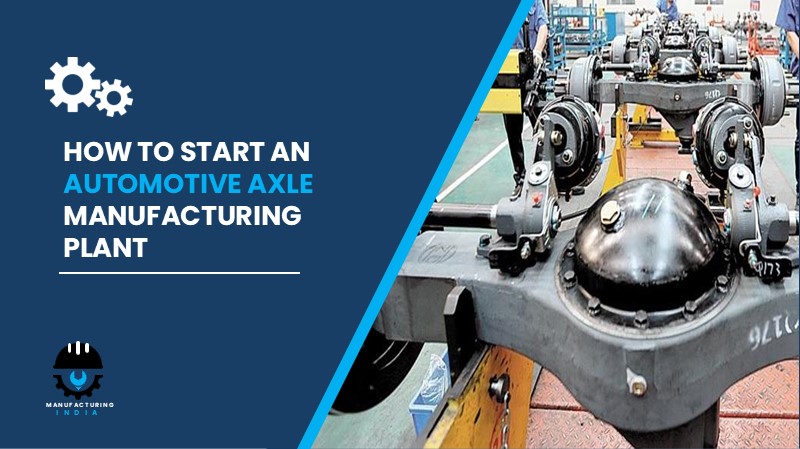
Automotive axles are essential drivetrain components that transmit power from the engine to the wheels while supporting the vehicle’s weight. They play a critical role in vehicle stability, steering, and load distribution across every vehicle type from passenger cars through to commercial trucks, buses, and off-road equipment. Axles are classified as front, rear, or drive axles depending on the vehicle configuration and drive system type and can be solid or independent in suspension architecture, with advanced variants incorporating lightweight alloy materials and optimised geometric designs for improved fuel efficiency and ride durability.
Modern automotive axles are manufactured to strict dimensional tolerance and quality standards under IATF 16949 automotive quality management requirements, capable of withstanding high mechanical stress across millions of operating cycles while ensuring occupant safety and smooth vehicle performance. Technological advancements include the integration of electronic differentials for traction control, enhanced bearing systems for extended service intervals, EV-specific electric portal axles for zero-emission drivetrains, and corrosion-resistant coatings that improve service life under harsh operating conditions. The primary production method involves raw material melting and forging, machining and turning, heat treatment, assembly, quality inspection, and packaging a multi-step precision manufacturing process integrating metallurgical processing, high-tolerance CNC machining, and rigorous quality verification at each stage. End-use industries served include passenger and commercial vehicles, off-road and speciality vehicles, the automotive aftermarket, and industrial machinery.
Cost of Setting Up an Automotive Axle Manufacturing Plant in India
The total investment required to establish an automotive axle manufacturing plant in India depends on plant capacity, axle type and vehicle segment focus, geographic location, level of automation, and compliance with automotive quality standards and environmental regulatory requirements. Investors must account comprehensively for both one-time capital expenditure and recurring operational costs when preparing a feasibility study or detailed project report (DPR).
1. Capital Expenditure (CapEx)
Land and Site Development constitutes a substantial foundational investment. Costs for land registration, boundary construction, internal road layout, drainage infrastructure, and site levelling vary based on whether the facility is within a government-notified automotive manufacturing zone, an existing automotive industrial cluster, or on privately acquired industrial land. Automotive component manufacturing parks in Pune, Chennai, Gurugram, and Sanand offer infrastructure-ready sites with proximity to vehicle OEM assembly plants, tier supplier networks, forged steel supply chains, and established automotive logistics and distribution infrastructure.
Civil Works and Construction encompasses the main forging and material preparation hall, CNC machining and turning production area, heat treatment furnace building with high-temperature industrial infrastructure, sub-assembly and final assembly lines, quality control and testing laboratory, finished goods warehouse, and administrative block. The heavy structural floor loads associated with forging presses and CNC machining centres, combined with high-bay construction requirements for material handling overhead cranes and large forge die storage, add to civil construction costs relative to lighter automotive assembly operations.
Machinery and Equipment represent the single largest component of capital expenditure. Key machinery required for an automotive axle manufacturing plant includes:
- Forging presses
- CNC machines
- Heat treatment furnaces
- Assembly lines
- Inspection tools
- Packaging systems
Other Capital Costs include the effluent treatment plant (ETP) for managing heat treatment quenching oil, surface treatment chemicals, and metalworking fluid waste streams, pre-operative expenses covering regulatory filings and IATF 16949 quality management system implementation, plant commissioning charges, utility connection fees, and import duties applicable to specialised CNC turning centres or automated assembly and inspection line equipment sourced internationally.
Request a Sample Report for In-Depth Market Insights: https://www.imarcgroup.com/automotive-axle-manufacturing-plant-project-report/requestsample
2. Operational Expenditure (OpEx)
Raw Material Cost is the dominant driver of operating expenditure, accounting for approximately 70–80% of total OpEx. The primary and most cost-significant inputs are forged steel and alloy steel billets. Forged steel the starting material for axle shaft, housing, and differential component production represents the largest single raw material cost line, with its price linked to domestic and international steel commodity markets subject to iron ore, coking coal, and energy cost dynamics. Alloy steel grades including case-hardening steels such as 20MnCr5 and EN36, and through-hardening grades for rear axle shaft applications are procured to precise chemical composition specifications that directly determine the fatigue life and mechanical performance of the finished axle component. Heat treatment chemicals including carburising gas, quench oils, and tempering bath media are additional significant consumable inputs. Investors are advised to negotiate long-term supply contracts with domestic forged billet manufacturers or established forge shops capable of delivering near-net-shape forgings to reduce machining stock and improve material utilisation, thereby reducing the per-unit raw material cost.
Utility Costs – covering electricity and natural gas for heat treatment furnaces, CNC machining centres, forging presses, and assembly line operations account for approximately 10–15% of total OpEx. Heat treatment including carburising, quenching, and tempering cycles that develop the surface hardness and core toughness required for fatigue-resistant axle components is the most energy-intensive process step in axle manufacturing. Investors in regions with competitive industrial electricity and gas tariffs, reliable utility supply, and access to renewable energy options are better positioned to manage this cost component over the plant’s operational life.
Other Operating Costs include outbound transportation to vehicle OEM assembly plants and tier supplier networks, aftermarket parts distributors, and export buyers; packaging for finished axle assemblies and axle shaft components; employee salaries and wages for CNC machine operators, heat treatment technicians, assembly and quality inspection personnel, and IATF 16949 quality engineers; equipment maintenance; quality assurance testing for dimensional conformance, hardness, fatigue life, and noise vibration harshness (NVH) compliance; depreciation on civil and machinery assets; and applicable taxes including GST. By the fifth year of operations, total operational costs are expected to increase substantially due to inflation, market fluctuations, potential rises in forged steel and alloy steel prices, supply chain disruptions, rising consumer demand, and shifts in the global economy.
3. Plant Capacity
The proposed automotive axle manufacturing facility is designed with an annual production capacity ranging between 500,000 and 2 million units, enabling significant economies of scale while maintaining operational flexibility across different axle types front axles, rear axles, drive axles, and electric portal axles and vehicle segments including passenger cars, commercial trucks, buses, and off-road equipment. This capacity range is well-aligned with the requirements of vehicle OEMs, tier-one automotive component assemblers, commercial vehicle manufacturers, and aftermarket distribution networks in India’s active domestic vehicle market and export supply chains. Capacity can be customised based on investor requirements, OEM supply contract volumes, and forged steel procurement network scale. Profitability improves consistently with higher capacity utilisation, and automotive axle manufacturing plants support phased capacity expansion through additional CNC machining centres and heat treatment furnace capacity with contained incremental CapEx.
4. Profit Margins and Financial Projections
The automotive axle manufacturing plant demonstrates healthy profitability potential under normal operating conditions. Gross profit margins typically range between 25–35%, supported by stable multi-segment OEM demand and the precision-engineered, safety-certified nature of automotive axle products that commands premium pricing relative to commodity forged steel inputs. Net profit margins range between 12–18%, reflecting the high raw material cost intensity and moderate utility requirements of the forging, machining, and heat treatment production model. A comprehensive financial analysis should include income projections, expenditure forecasts, gross and net margin tracking across Years 1 through 5, net present value (NPV), internal rate of return (IRR), payback period, and a full profit and loss account. Sensitivity analysis covering forged steel commodity price movements and OEM production volume variability is particularly important for investment-grade financial planning in this sector.
Why Set Up an Automotive Axle Manufacturing Plant in India?
India’s Expanding Vehicle Production Base Creating Structural OEM Demand. Rising automotive demand globally and in India specifically is increasing the requirement for high-quality axles across every vehicle segment. India’s automotive sector is set to reach USD 300 billion in 2026 according to IBEF directly sustaining large and growing procurement of axle components from domestic tier suppliers serving passenger car, commercial vehicle, bus, and off-road equipment OEM assembly plants. Vehicle OEMs increasingly prefer local tier supplier development for safety-critical drivetrain components to reduce supply chain risk, shorten lead times, and benefit from localisation compliance incentives.
EV Adoption Driving Demand for Advanced Electric Portal Axles. In Phase II of the FAME India scheme, the Ministry of Heavy Industries approved a capital subsidy of INR 800 crore (USD 96.13 million) to establish 7,432 electric vehicle public charging stations directly stimulating EV production and, by extension, demand for EV-specific electric portal axle units and integrated drivetrain components across India’s growing domestic EV manufacturing ecosystem. The shift toward EV drivetrains requires entirely new axle architectures including electric portal axles integrating motors, reduction gears, and inverters creating premium market segments for axle manufacturers who develop EV-specific engineering capability.
ZF’s Multi-Year India City Bus Axle Supply Agreement Validating Market Scale. In February 2026, ZF’s Commercial Vehicle Solutions division secured a significant multi-year India city bus supply agreement with an OEM for thousands of its next-generation AxTrax 2 LF electric portal units, slated for 2026 delivery and offering up to 20% improved efficiency over its predecessor. This agreement between a leading global axle technology company and an Indian bus OEM directly confirms the scale and commercial significance of India’s city bus and public transport axle procurement market — and signals the EV transition’s impact on axle technology requirements that domestic manufacturers must be prepared to address.
Bharat Forge’s Strategic Acquisition of AAM’s India Operations Confirming Domestic Market Value. In October 2024, American Axle & Manufacturing decided to sell its India commercial vehicle operations to Bharat Forge for approximately USD 65 million, covering Pune and Chennai facilities along with an engineering centre and supporting transition through the fourth quarter. The deal, centred on automotive axles for commercial vehicles, sharpened AAM’s global strategy while bolstering Bharat Forge’s component portfolio confirming the high commercial value that India’s own leading forging conglomerate places on domestic automotive axle manufacturing capacity, and directly validating the investment attractiveness of this product category within India’s automotive supply chain.
Growing Aftermarket Revenue Stream Providing Commercial Resilience. The aftermarket for replacement axles is growing due to vehicle aging, higher vehicle mileage, and the expanding registered vehicle fleet on Indian roads. Replacement axles for repairs, upgrades, and vehicle retrofits provide axle manufacturers with a recurring, price-stable revenue channel that runs independently of OEM production cycle variability improving overall commercial resilience and providing a stable revenue base during periods when OEM production volumes fluctuate.
Custom Engineering Opportunities Across EV Platforms and Speciality Vehicles. Manufacturers can develop custom axles for specialised vehicles including military platforms, agricultural equipment, mining machinery, and EV-specific drivetrain configurations offering differentiated, premium-margin product development opportunities alongside high-volume standard passenger and commercial vehicle axle production. The ability to serve both volume OEM supply and speciality engineering segments from the same manufacturing infrastructure improves overall capacity utilisation and margin contribution.
Manufacturing Process – Step by Step
The automotive axle manufacturing process uses raw material melting and forging, machining and turning, heat treatment, assembly, quality inspection, and packaging as the primary production method. Below are the main stages involved in the automotive axle manufacturing process flow:
- Raw Material Receipt and Quality Inspection: Forged steel and alloy steel billets are received, tested for chemical composition by spectrometric analysis, dimensional conformance, and mechanical properties, and cleared for production scheduling following metallurgical quality verification.
- Raw Material Melting and Forging: Forging presses heat steel billets to the forging temperature typically 1,100–1,250°C and then shape them into the near-net-shape geometry of axle shafts, differential housings, pinion gears, and side gears through closed-die forging operations. Forging improves grain flow, mechanical strength, and fatigue resistance relative to equivalent machined components from solid bar stock.
- Normalising and Controlled Cooling: Following forging, components undergo controlled air cooling or normalising heat treatment to refine grain structure, relieve forging stresses, and achieve the desired base hardness for subsequent machining operations.
- CNC Machining and Turning: CNC machines perform precision turning, milling, drilling, and grinding operations on forged blanks to achieve the dimensional tolerances, surface finishes, and geometric accuracy specifications required for each axle component including shaft journals, spline profiles, gear teeth, and bearing seats. Multi-axis CNC machining centres achieve complex component geometries in single setups, reducing handling time and dimensional variation.
- Gear Cutting and Shaping: Ring and pinion gears and differential side gears are cut using dedicated gear hobbing, shaping, or grinding machines to achieve the precise tooth form, pitch, and surface finish required for quiet, efficient differential operation over the vehicle service life.
- Heat Treatment: Heat treatment furnaces process machined axle components through carburising, case hardening, through hardening, or induction hardening cycles that develop the surface hardness and case depth required for fatigue and wear resistance, while maintaining sufficient core toughness to withstand impact and torsional loads throughout the vehicle’s operational life.
- Shot Blasting and Surface Treatment: Shot blasting removes heat treatment scale and develops compressive surface residual stresses that further improve fatigue resistance. Phosphating, painting, or corrosion-resistant coating applications are applied to housing components and shaft surfaces as specified for the target vehicle application and environment.
- Sub-Assembly: Assembly lines bring together machined and heat-treated components including differential pinion assemblies, ring and pinion gear sets, bearing assemblies, and axle shafts into differential sub-assemblies and axle shaft subassemblies according to OEM build specifications.
- Final Assembly and Adjustment: The complete axle assembly is assembled from all sub-assemblies, with bearing preloads, gear backlash, and differential side clearances set to specification using calibrated tools and gauges. Seals, gaskets, and fasteners are installed to specification torques, and lubrication is filled to the correct level.
- Quality Inspection and Testing: Inspection tools subject finished axle assemblies to comprehensive dimensional, functional, and NVH testing including rolling noise tests, backlash measurement, bearing preload verification, seal leakage tests, and dimensional conformance checks with all test results recorded for IATF 16949 traceability documentation and OEM quality record requirements.
- Packaging: Finished axle assemblies are packaged in protective materials appropriate to their size, weight, and OEM or aftermarket packaging specification, with component identification, specification markings, and batch traceability labels applied for supply chain identification.
- Dispatch to End-Use Industries: Finished automotive axles are dispatched to vehicle OEM assembly plants for passenger and commercial vehicle production, tier-one system assemblers for drivetrain module integration, aftermarket parts distributors for vehicle maintenance and repair, and export buyers in international automotive supply chains.
Key Applications
Automotive axles produced at this type of facility serve four primary end-use sectors with specific axle type, dimensional specification, and quality certification requirements for each:
- Passenger and Commercial Vehicles: Axles are key components in drivetrain systems for passenger cars, commercial trucks, and buses ensuring safe and reliable vehicle operation across every drive cycle condition including city driving, highway operation, and loaded commercial vehicle service.
- Off-Road and Speciality Vehicles: High-strength axles support heavy loads and challenging terrains for agricultural tractors, construction equipment, mining haul trucks, and military platforms requiring specialised metallurgical and geometric specifications beyond standard on-road vehicle axle designs.
- Automotive Aftermarket: Replacement axles for repairs, upgrades, and vehicle retrofits across India’s large registered vehicle fleet provide manufacturers with a recurring, contract-independent revenue stream through distributor and service centre networks.
- Industrial Machinery: Axles support mobile industrial equipment and transport vehicles including forklifts, automated guided vehicles, and heavy industrial transport platforms ensuring smooth and reliable operations in manufacturing and logistics environments.
Leading Automotive Axle Manufacturers
The global automotive axle industry is served by several large-scale multinational manufacturers with extensive production capacities and diversified vehicle segment application portfolios. Key players include:
- American Axle & Manufacturing, Inc.
- Dana Incorporated
- Daimler AG
- GNA Group
- Meritor Inc.
- ZF Friedrichshafen AG
Timeline to Start the Plant
Investors planning to establish an automotive axle manufacturing plant in India should anticipate the following project development phases:
- Feasibility study and project report preparation
- Land acquisition and site development
- Regulatory approvals and environmental clearances
- Factory licence and fire safety compliance
- Machinery procurement and installation
- Raw material supplier agreements and supply chain setup
- Trial production and quality testing
- Commercial production launch
Licences and Regulatory Requirements
Starting an automotive axle manufacturing unit in India requires several approvals:
- Business registration (Proprietorship, LLP, or Private Limited Company)
- Factory Licence under the Factories Act
- IATF 16949 Automotive Quality Management System certification — mandatory for supply to vehicle OEM assembly plants as a tier supplier
- Environmental Clearance from the State Pollution Control Board — including compliance with metalworking fluid, heat treatment oil, and surface treatment chemical waste management standards
- GST Registration
- Fire Safety NOC including heat treatment furnace and quench oil fire hazard compliance
- Effluent Treatment Plant (ETP) operational clearance for metalworking fluid, quench oil, and surface treatment chemical waste stream management
- Bureau of Indian Standards (BIS) certification for applicable automotive axle product standards where required for government procurement or aftermarket certification compliance
- Occupational Health and Safety compliance covering forging press operations, CNC machinery safety, heat treatment furnace procedures, and metalworking fluid exposure monitoring
- AIS (Automotive Industry Standard) type approval compliance where required for specific axle designs subject to CMVR safety regulations
Key Challenges to Consider
Forged Steel and Alloy Steel Price Volatility as the Dominant Cost Variable. Forged steel and alloy steel accounting for 70–80% of total OpEx are priced against domestic and international steel commodity markets subject to iron ore, coking coal, and energy cost dynamics. Any meaningful increase in steel prices directly and materially compresses gross margins. Long-term supply contracts with domestic forge shops and alloy steel producers, multi-supplier qualification, and strategic billet inventory management during price-advantageous procurement windows are essential risk mitigation disciplines.
OEM Customer Qualification Timelines and IATF 16949 Certification Requirements. Supplying automotive axles to vehicle OEMs requires IATF 16949 quality management certification, product-specific design and process FMEA documentation, control plan implementation, initial sample inspection reports (ISIR), and advanced product quality planning (APQP) completion processes that typically require 12 to 24 months from design freeze to volume production approval. Investors must plan for extended revenue ramp-up timelines, adequate working capital, and dedicated quality engineering resources throughout the OEM qualification process.
Precision Machining and Heat Treatment Process Control. Automotive axle manufacturing requires tight dimensional tolerances on shaft journals, spline profiles, gear tooth forms, and bearing fits maintained consistently across high-volume production runs. Heat treatment process control including carburising atmosphere management, quench severity, and tempering temperature uniformity directly determines fatigue life and warranty performance of finished axles. Any systematic deviation in machining accuracy or heat treatment process parameters can result in field failures, OEM warranty claims, and costly production quarantine activities.
EV Transition Requiring New Technology Investment. The shift toward electric vehicle drivetrains is creating demand for electric portal axle architectures that integrate motors, reduction gears, and inverters — fundamentally different from conventional mechanical axle designs. As confirmed by ZF’s February 2026 multi-year India city bus electric portal axle supply agreement, EV-specific axle technology is already entering production procurement at scale. Conventional axle manufacturers must invest in EV-specific design capability and manufacturing process development to maintain long-term OEM supply relevance as fleet electrification accelerates.
Competition from Established OEM-Qualified Tier Suppliers. India’s automotive axle market is served by established domestic and international tier suppliers including GNA Group, the India operations of Dana, and Bharat Forge’s recently acquired AAM commercial vehicle axle facilities all with established OEM qualification histories, production scale, and customer relationships. New entrants must differentiate through EV-specific design capability, cost competitiveness for target vehicle segments, or aftermarket channel focus to build sustainable commercial positioning against entrenched tier suppliers.
Skilled Workforce for Precision Automotive Manufacturing. Operating CNC multi-axis machining centres, gear cutting machines, heat treatment furnaces, and automated assembly and inspection lines requires mechanical and metallurgical engineers, CNC machine operators, and IATF 16949-trained quality assurance personnel with automotive sector experience. Sourcing and retaining this skilled workforce which is actively competed for by the broad automotive manufacturing sector in India’s industrial clusters is a persistent operational challenge that must be planned and resourced from the plant commissioning date.
Frequently Asked Questions
1. How much does it cost to set up an automotive axle manufacturing plant in India?
The total cost depends on plant capacity (500,000 to 2 million units per annum), axle type and vehicle segment focus, location, and automation level. CapEx covers land, automotive-grade industrial civil construction, and machinery including forging presses, CNC machines, heat treatment furnaces, assembly lines, inspection tools, and packaging systems, along with IATF 16949 quality system implementation and pre-operative regulatory costs.
2. Is automotive axle manufacturing profitable in India in 2026?
Yes. With gross margins of 25–35% and net margins of 12–18%, supported by India’s automotive sector targeting USD 300 billion in 2026, EV adoption driving demand for electric portal axle units, growing aftermarket revenue, and a global market of USD 61.30 billion growing toward USD 70.96 billion by 2034, the investment presents a commercially sound OEM-supply-anchored profitability case.
3. What machinery is required for an automotive axle manufacturing plant in India?
Key equipment includes forging presses, CNC machines (turning centres, machining centres, gear cutting machines), heat treatment furnaces, assembly lines, inspection tools, and packaging systems. Supporting systems include shot blasting equipment, surface treatment lines, NVH test benches, coordinate measuring machines (CMMs), and IATF 16949 compliant quality documentation systems.
4. What licences and approvals are required to start an automotive axle manufacturing plant in India?
Required approvals include business registration, IATF 16949 automotive quality management certification, Factory Licence, Environmental Clearance, GST Registration, Fire Safety NOC, ETP operational clearance, Occupational Health and Safety compliance, and AIS type approval where mandated for specific axle designs under CMVR regulations.
5. What raw materials are needed for automotive axle manufacturing?
The primary raw materials are forged steel and alloy steel billets or near-net-shape forgings. Additional inputs include heat treatment chemicals including carburising gas, quench oils, and tempering media, metalworking cutting fluids, gear hobbing tools, surface treatment chemicals including phosphating and corrosion protection coatings, and bearings, seals, and fasteners for assembly.
6. What are the environmental compliance requirements for an automotive axle manufacturing plant in India?
Environmental Clearance from the State Pollution Control Board is required, along with an ETP for managing metalworking fluid, heat treatment oil, and surface treatment chemical waste streams, compliance with CPCB standards for industrial effluent quality, spent quench oil and metalworking fluid waste management under Hazardous Waste Management Rules, and occupational health monitoring for cutting fluid and chemical exposure.
7. What is the best location to set up an automotive axle manufacturing plant in India?
Established automotive manufacturing clusters with proximity to vehicle OEM assembly plants, forged steel and alloy steel supply chains, and automotive engineering talent including Pune (Maharashtra), Chennai (Tamil Nadu), Gurugram and Manesar (Haryana), and Sanand (Gujarat) offer the best combination of OEM buyer proximity, tier supplier ecosystem access, skilled workforce availability, and logistics infrastructure for automotive axle manufacturing investment.
8. What is the break-even period for this type of plant in India?
The break-even period depends on plant capacity utilisation, OEM supply contract volumes, product mix between passenger and commercial vehicle axle segments, forged steel procurement cost management, and aftermarket revenue contribution. A full NPV and IRR analysis incorporating sensitivity testing for steel price movements and OEM production volume variability is recommended for investment-grade financial planning.
9. What government incentives are available for automotive axle manufacturers in India?
PLI scheme benefits for automotive components and advanced automotive technology, FAME scheme incentives indirectly expanding the domestic EV axle market, state-level automotive manufacturing investment incentive schemes in Maharashtra, Tamil Nadu, Gujarat, and Haryana, Make in India manufacturing support, and automotive localisation compliance requirements under OEM procurement policies all provide meaningful financial and market access support for qualifying automotive axle manufacturing investments.
Key Takeaways for Investors
An automotive axle manufacturing plant in India represents a commercially well-grounded investment in one of the automotive supply chain’s most safety-critical and technically demanding component categories backed by a global market valued at USD 61.30 billion in 2025 growing toward USD 70.96 billion by 2034, India’s automotive sector targeting USD 300 billion in 2026, and the structural EV transition driving demand for new electric portal axle architectures across passenger, commercial, and public transport vehicle segments. Financial viability is demonstrated across a production capacity range of 500,000 to 2 million units per annum, with gross margins of 25–35% and net margins of 12–18% achievable under competitive forged steel procurement and efficient CNC machining and heat treatment operations. Major recent industry developments including ZF’s February 2026 multi-year India city bus electric portal axle supply agreement delivering up to 20% efficiency improvement, and Bharat Forge’s October 2024 USD 65 million acquisition of AAM’s India commercial vehicle axle operations provide powerful validation of both the strategic commercial value of automotive axle manufacturing capacity in India and the EV-driven technology transformation that is creating new premium investment opportunities within this established product category. With India’s vehicle production expanding, EV adoption accelerating, aftermarket demand growing, and OEM localisation preferences favouring domestic tier suppliers for safety-critical drivetrain components, the long-term demand sustainability and commercial returns for automotive axle manufacturing investors in India are comprehensively and durably well-supported throughout the decade ahead.
About the Author