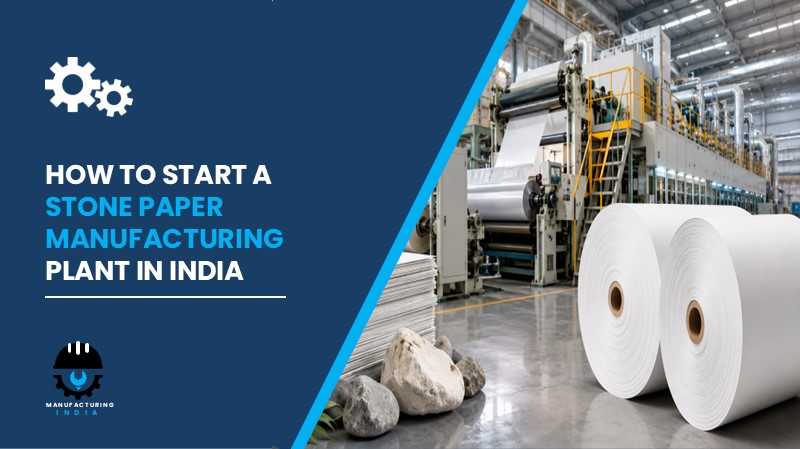
Setting up a stone paper manufacturing plant in India presents a compelling investment case driven by surging demand across food packaging, industrial packaging, and the rapidly expanding B2C e-commerce sector. Stone paper’s inherent water resistance, grease resistance, and exceptional durability make it a preferred alternative to conventional paper in applications ranging from food-grade packaging to high-strength industrial uses serving sectors including automotive, electronics, chemicals, and pharmaceuticals. As India’s packaging industry scales alongside its consumption economy, stone paper sits at the convergence of sustainability, performance, and supply security — a rare combination that makes this investment particularly timely.
India’s structural advantages further reinforce the case for stone paper manufacturing here. The country’s accelerating urbanisation, infrastructure push under the Make in India initiative, and competitive land and labour costs in industrial hubs such as Gujarat, Maharashtra, and Uttar Pradesh create a cost-efficient manufacturing environment. The domestic packaging industry is one of the fastest-growing in Asia, and Indian brands across food, fast-moving consumer goods, and logistics are actively seeking durable, moisture-resistant materials that can withstand the country’s highly variable climatic and transport conditions. Establishing a stone paper plant in India positions investors at the heart of this demand curve with strong local sourcing and distribution advantages.
India’s policy push for domestic manufacturing, combined with cost-competitive operations and accelerating demand from food packaging, industrial packaging, and e-commerce sectors, makes a stone paper manufacturing plant in India a financially viable, strategically sound, and growth-aligned investment. With the global industrial packaging market projected to reach US$83.4 Billion by 2032 and B2C e-commerce revenues forecast to hit US$5.5 trillion by 2027, investors entering stone paper production now are positioned for multi-year demand tailwinds and attractive break-even outcomes.
What is Stone Paper?
Stone paper is an innovative, mineral-based material produced primarily from calcium carbonate — the principal component of limestone — combined with a small proportion of non-toxic resin binders. Unlike conventional wood-pulp paper, this product requires no water, bleach, or acids in its manufacturing process, giving it a significantly different environmental and performance profile. Its key physical properties include exceptional water resistance, grease resistance, moisture resistance, and superior tear strength, all of which make it suitable for demanding packaging and printing applications where ordinary paper would fail. The smooth, uniform surface of stone paper also allows for high-quality printing and vivid customisation, which is increasingly important for brand differentiation in retail and food packaging contexts.
The manufacturing process involves converting calcium carbonate and resin into a film-like sheet through a series of mixing, extruding, calendering, and finishing operations. The end product can be produced in various grades and thicknesses, making it adaptable across applications. Stone paper serves a broad range of end-use industries, including food packaging, industrial packaging (covering automotive, electronics, chemicals, and pharmaceuticals), and e-commerce logistics packaging — all sectors where moisture resistance, durability, and print quality are non-negotiable requirements.
Cost of Setting Up a Stone Paper Manufacturing Plant in India
The total investment required depends on several interdependent factors including production capacity, level of automation, choice of technology, plant location, and applicable environmental and regulatory compliance costs. A structured understanding of both capital and operational expenditure is essential before finalising a project plan.
1. Capital Expenditure (CapEx)
Land and Site Development costs vary depending on whether the unit is established within a Special Economic Zone (SEZ), a government-notified industrial estate, or private industrial land. SEZs and MIDC or GIDC estates in Maharashtra and Gujarat typically offer better infrastructure connectivity and streamlined regulatory access, which can offset slightly higher acquisition costs. Site development expenditure includes boundary construction, internal roads, drainage, and utilities grid connections.
Civil Works and Construction include the main production shed, quality control laboratory, raw material storage warehouse, finished goods dispatch area, and an administrative and utility block. In India, pre-engineered building (PEB) structures are widely used for production sheds, offering faster construction timelines and lower civil costs compared to conventional RCC construction.
Machinery and Equipment represent the largest single component of CapEx in a stone paper plant. Key machinery required includes:
- Raw material mixing and blending systems
- Extrusion equipment for sheet/film formation
- Calendering and rolling machinery
- Cooling and conditioning units
- Slitting and cutting machines
- Surface treatment and coating equipment
- Quality inspection and testing instruments
- Material handling and conveying systems
- Packaging and dispatch equipment
Other Capital Costs include the Effluent Treatment Plant (ETP), pre-operative and preliminary expenses, commissioning and trial run costs, and applicable import duties on machinery procured from international suppliers where domestic equivalents are unavailable.
Request a Sample Report for In-Depth Market Insights: https://www.imarcgroup.com/stone-paper-manufacturing-plant-project-report/requestsample
2. Operational Expenditure (OpEx)
Raw Material Cost is typically the dominant component of monthly operating costs in a stone paper manufacturing plant. The primary raw materials — calcium carbonate (limestone-derived) and resin binders — must be sourced through reliable long-term supplier contracts to manage price volatility and ensure consistent production quality. Establishing quarterly or annual procurement agreements with domestic suppliers in mineral-rich states can substantially reduce per-unit input costs. Raw material sourcing strategy, transport logistics, and inventory management directly determine the plant’s cost competitiveness.
Utility Costs include electricity for extrusion and calendering equipment (which are energy-intensive), process water, and cooling systems. Plants located in states with lower industrial power tariffs — such as Gujarat or Madhya Pradesh — benefit from meaningfully lower utility bills, improving overall OpEx efficiency.
Other Operating Costs encompass outbound transportation and logistics, secondary packaging materials, salaries and wages across production, quality control, administration, and sales functions, routine machinery maintenance and spare parts provisioning, depreciation on fixed assets, and applicable taxes. A five-year OpEx projection should account for annual escalation in labour costs, utility tariffs, and raw material prices, which have historically increased in the range of 4–8% per annum in India’s manufacturing sector.
3. Plant Capacity
Stone paper plants can be configured across a wide range of production capacities, from smaller-scale units serving regional markets to large integrated facilities targeting national and export demand. The IMARC Group’s project report framework provides capacity modelling tools that allow investors to customise throughput parameters to their specific business plan. As with most material manufacturing units, profitability improves significantly with higher capacity utilisation — plants operating above 75–80% of installed capacity tend to achieve meaningfully better per-unit economics and faster break-even timelines.
4. Profit Margins and Financial Projections
A comprehensive financial model for a stone paper manufacturing plant should include Net Present Value (NPV) analysis, Internal Rate of Return (IRR), gross and net margin projections across a five-year horizon, and a clearly defined payback period assessment. The IMARC Group’s project report covers income projections, expenditure projections, taxation, depreciation modelling, liquidity analysis, and sensitivity analysis across demand and cost scenarios. Gross margins and net margins are tracked year-on-year across the profitability analysis framework, with Year 1 typically reflecting lower margins due to ramp-up costs, improving progressively as capacity utilisation rises and supplier contracts mature.
Why Set Up a Stone Paper Plant in India?
Booming Food Packaging Demand. The global food packaging market reached US$385.1 Billion in 2023, and India’s share of this market is growing rapidly alongside its food processing and organised retail sectors. Stone paper’s water resistance and grease resistance make it particularly effective for packaging dry goods, snacks, frozen foods, and beverages — all high-growth categories in India’s changing consumption landscape. Indian food brands are actively seeking packaging materials that maintain product freshness across the country’s challenging logistics network.
Expanding Industrial Packaging Sector. The global industrial packaging market is expected to reach US$83.4 Billion by 2032, driven by rising demand from automotive, electronics, chemicals, and pharmaceutical industries — all sectors where India has significant and growing manufacturing capacity. Stone paper’s tear resistance and inherent waterproof properties make it well-suited for protecting components and goods during transportation and storage, giving Indian manufacturers a strong incentive to source this material locally.
E-Commerce Packaging as a Structural Growth Driver. Global B2C e-commerce revenue is expected to grow to US$5.5 trillion by 2027 at a compound annual growth rate of 14.4%. India is one of the world’s fastest-growing e-commerce markets, and the explosion in direct-to-consumer shipments is creating enormous demand for durable, moisture-resistant, and environment-friendly packaging materials. Stone paper’s strength and moisture resistance make it an effective solution for e-commerce packaging innovation.
Cost-Competitive Manufacturing Environment. India offers significant cost advantages for manufacturing operations, including comparatively lower land acquisition costs, competitive industrial labour rates, and a well-developed domestic supply chain for limestone-derived raw materials. States like Gujarat, Maharashtra, and Rajasthan offer ready industrial infrastructure, port connectivity for potential exports, and established packaging industry clusters that facilitate faster market entry.
Policy and Regulatory Tailwinds. The Make in India initiative, Production Linked Incentive (PLI) schemes across manufacturing sectors, and state-level industrial promotion policies collectively create a supportive environment for new manufacturing investments. Packaging material producers may also benefit from state capital subsidy schemes, power tariff concessions, and stamp duty exemptions available in designated industrial zones.
Local Supply Chain Preference. With rising freight costs and global supply chain disruptions making imports less predictable, Indian packaging buyers across food, logistics, and industrial sectors are increasingly prioritising domestically manufactured materials. A locally established stone paper production facility gains immediate commercial relevance as a reliable, duty-free alternative to imported product.
Manufacturing Process – Step by Step
The stone paper manufacturing process uses a mineral-extrusion and calendering method as the primary production approach, converting calcium carbonate and resin into a durable, film-like sheet without the use of water, bleach, or acids. The process involves the following stages:
- Raw Material Preparation: Calcium carbonate is procured, quality-checked, and blended with resin binders in precise proportions using mixing and blending systems
- Compounding and Mixing: The mineral-resin compound is homogenised to achieve a uniform blend suitable for downstream extrusion
- Extrusion: The blended compound is fed into extrusion equipment where heat and pressure convert it into a continuous sheet or film
- Calendering and Rolling: The extruded sheet passes through calendering machinery to achieve the desired thickness, surface texture, and uniformity
- Cooling and Conditioning: The calendered sheet is cooled through conditioning units to stabilise its physical properties
- Surface Treatment and Coating: Surface treatment equipment applies any required coatings to enhance printability or functional performance
- Slitting and Cutting: Finished sheets are slit and cut to required dimensions using slitting and cutting machines
- Quality Inspection and Testing: Each batch undergoes quality inspection and technical testing against defined criteria before release
- Packaging and Dispatch: Finished stone paper is packaged and dispatched to end-use industries including food packaging, industrial packaging, and e-commerce logistics customers
Key Applications
Stone paper serves a diverse range of industries where moisture resistance, durability, and print quality are critical requirements.
- Food Packaging: Water-resistant and grease-resistant properties preserve the freshness and integrity of dry goods, snacks, frozen foods, and beverages during storage and transportation
- Industrial Packaging: Tear resistance and waterproof properties protect chemicals, electronics, automotive components, and pharmaceutical products during transit and warehousing
- E-Commerce and B2C Logistics Packaging: Durability and moisture resistance make stone paper effective for direct-to-consumer shipment packaging requiring consistent structural integrity
- Labels and Branding Materials: The smooth, printable surface enables high-resolution printing, supporting product differentiation and brand visibility on retail shelves and online platforms
- Automotive Sector Packaging: Protective packaging for automotive components and spare parts requiring moisture and tear protection during shipping
Leading Manufacturers
The global stone paper industry includes a range of specialised producers and emerging entrants across Asia, Europe, and the Americas. The IMARC Group’s project report provides a detailed competitive landscape covering the structure of the stone paper industry and its key participants. Specific manufacturer names and competitive benchmarking data are available in the full report from IMARC Group, which covers market segmentation, regional breakups, and the competitive landscape in detail.
Timeline to Start the Plant
Investors should plan for a structured multi-phase execution timeline:
- Feasibility study and project report preparation
- Land acquisition and site development
- Regulatory approvals and environmental clearances
- Factory licence and fire safety compliance
- Machinery procurement and installation
- Raw material supplier agreements and supply chain setup
- Trial production and quality testing
- Commercial production launch
Licences and Regulatory Requirements
Starting a stone paper manufacturing unit in India requires several approvals:
- Business registration (Proprietorship, LLP, or Pvt Ltd) under the Ministry of Corporate Affairs
- Factory Licence under the Factories Act, 1948
- Environmental Clearance from the State Pollution Control Board
- GST Registration under the Goods and Services Tax framework
- Fire Safety NOC from the local fire department
- Chemical and materials handling compliance under applicable hazardous substances regulations
- Effluent Treatment Plant (ETP) operational clearance from the pollution control authority
- Occupational Health and Safety compliance under the relevant state and central regulations
Key Challenges to Consider
High Capital Requirements. Establishing a stone paper manufacturing plant involves significant upfront investment in extrusion, calendering, and quality control infrastructure. Investors should plan funding structures carefully, incorporating a mix of equity and debt to manage early-stage cash flow.
Raw Material Price Volatility. Calcium carbonate and resin binders — the primary raw material inputs — are subject to global commodity price fluctuations. Long-term procurement contracts and multi-supplier strategies are essential to contain input cost variability and protect operating margins.
Regulatory Compliance. Environmental clearances, factory licences, ETP compliance, and chemical handling regulations in India involve multi-agency coordination and can extend project timelines if not planned proactively. Early legal and compliance advisory is recommended.
Technology and Innovation Pressure. The stone paper industry is a relatively newer segment of the packaging materials market, and continuous innovation in material grades, printability, and functional coatings is expected to intensify. Investors must plan for technology upgrades and R&D investment over the medium term.
Competition. As demand for stone paper grows globally, established packaging material producers and new entrants are likely to increase competitive intensity in the Indian market. A clear differentiation strategy around product quality, pricing, and supply reliability is essential.
Skilled Manpower. Operating extrusion and calendering equipment to consistent quality standards requires trained technical personnel. Workforce development and retention programmes should be built into the plant’s operational plan from the outset.
Frequently Asked Questions
1. How much does it cost to set up a stone paper manufacturing plant in India?
The total investment depends on plant capacity, location, automation level, and regulatory requirements. IMARC Group’s project report provides a detailed CapEx and OpEx breakdown customised to specific capacity and location parameters.
2. Is stone paper manufacturing profitable in India in 2026?
Yes, given the expanding food packaging, industrial packaging, and e-commerce sectors in India, stone paper manufacturing presents strong profitability potential. NPV, IRR, gross margin, and net margin projections across a five-year horizon are detailed in the IMARC Group feasibility report.
3. What machinery is required for a stone paper plant in India?
Key machinery includes mixing and blending systems, extrusion equipment, calendering machinery, cooling units, slitting and cutting machines, surface treatment equipment, and quality inspection instruments.
4. What licences and approvals are required to start a stone paper plant in India?
Required approvals include business registration, Factory Licence, Environmental Clearance from the State Pollution Control Board, GST Registration, Fire Safety NOC, ETP clearance, and Occupational Health and Safety compliance.
5. What raw materials are needed for stone paper manufacturing?
The primary raw materials are calcium carbonate (derived from limestone) and non-toxic resin binders, which together form the mineral-based compound processed into stone paper sheets.
6. What are the environmental compliance requirements for a stone paper plant in India?
Plants must obtain Environmental Clearance from the State Pollution Control Board, maintain an operational Effluent Treatment Plant, and comply with applicable hazardous materials and chemical handling regulations.
7. What is the best location to set up a stone paper plant in India?
States like Gujarat, Maharashtra, Rajasthan, and Uttar Pradesh offer a combination of industrial land availability, raw material access, logistics connectivity, and state-level investment incentives that make them strong candidates for plant location.
8. What is the break-even period for this type of plant in India?
Break-even timelines vary with capacity utilisation, financing structure, and market pricing. IMARC Group’s financial analysis covers payback period, NPV, and IRR across multiple plant scenarios.
9. What government incentives are available for manufacturers in India?
Indian manufacturers can access Production Linked Incentive schemes, state-level capital subsidies, power tariff concessions, stamp duty exemptions in industrial zones, and export incentives through various central and state government programmes.
Key Takeaways for Investors
A stone paper manufacturing plant in India is a compelling opportunity for investors seeking exposure to the high-growth food packaging, industrial packaging, and B2C e-commerce logistics sectors — all of which place a premium on durable, moisture-resistant, and printable packaging materials. The investment demonstrates sound financial viability across a range of plant capacities, with improving per-unit economics at higher utilisation levels and a clear pathway to profitability within a defined payback horizon. With the global industrial packaging market on course to reach US$83.4 Billion by 2032 and B2C e-commerce revenues projected to hit US$5.5 trillion by 2027, the structural demand drivers underpinning this production category are durable and multi-year in nature. For investors aligned with India’s manufacturing growth story, stone paper presents a strategically positioned, policy-supported, and commercially resilient production opportunity.
About the Author