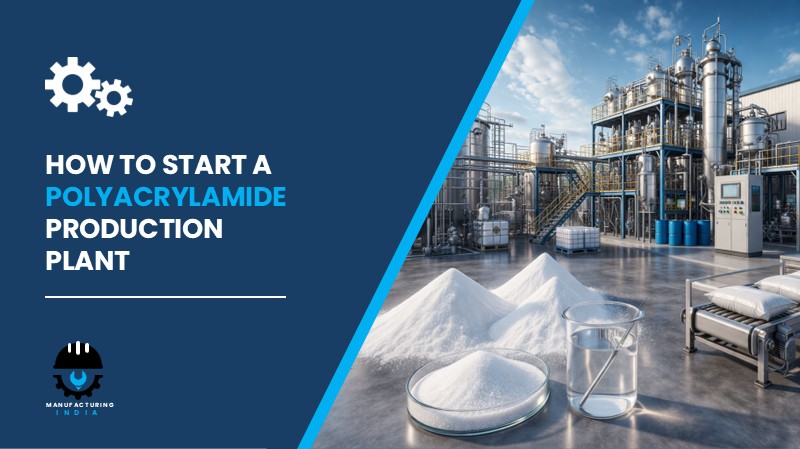
Setting up a polyacrylamide production plant in India presents a compelling investment case driven by accelerating demand across water and wastewater treatment, oil and gas, and mining and mineral processing industries. Polyacrylamide is a synthetic, high-molecular-weight polymer valued for its exceptional flocculation, thickening, binding, and drag-reduction properties capabilities that make it indispensable to municipal water authorities, oilfield operators, and mineral beneficiation plants alike. As India’s industrial base expands and environmental compliance requirements tighten, domestic consumption of polyacrylamide is set to grow alongside the country’s infrastructure ambitions.
India’s strategic advantages make it an ideal location for this investment. The combination of lower land and labour costs, a maturing chemicals production ecosystem in states such as Gujarat and Maharashtra, and the central government’s Make in India initiative collectively reduce entry barriers for new producers. Multiple regions currently depend on imports for specialty grades of polyacrylamide, creating a clear localization opportunity for investors who can supply custom products with shorter lead times. A domestic production facility positioned near industrial clusters or oilfield zones can capture margin that currently flows to overseas suppliers.
Setting up a polyacrylamide production unit in India offers policy-backed, cost-competitive production aligned with growing institutional demand from water treatment authorities, oilfield operators, and mining companies. With gross margins of 25–35% and a net profit range of 12–20%, the financial case is robust across plant capacities, making this a viable long-term investment.
What is Polyacrylamide?
Polyacrylamide is a synthetic polymer that can dissolve in water and consists of high-molecular-weight chains formed through acrylamide monomer polymerization. The product exists in three distinct forms anionic, cationic, and non-ionic engineered to serve different industrial purposes. These variants allow manufacturers to tailor the polymer’s charge density and molecular weight for specific applications, from municipal sludge dewatering to oilfield polymer flooding.
The material demonstrates exceptional performance in flocculation, thickening, binding, and drag-reduction functions, enabling effective separation of solids from liquids across challenging process environments. Its strong adsorption capacity, chemical stability, and adjustable molecular structure make it a preferred material in water purification, sludge dewatering, oilfield recovery, and mineral beneficiation. The production process uses acrylamide polymerization, drying, granulation, and packaging as the primary production method. End-use industries served include water and wastewater treatment, oil and gas, mining and mineral processing, and paper and pulp production.
Cost of Setting Up a Polyacrylamide Production Plant in India
The cost of establishing a polyacrylamide production plant in India depends on capacity, technology selection, plant location, degree of automation, and regulatory compliance obligations. Investors must account for both one-time capital expenditure and recurring operational costs to arrive at a realistic financial model.
1. Capital Expenditure (CapEx)
The total capital investment covers several categories, with machinery costs accounting for the largest single portion of total CapEx. Land and site development including charges for land registration, boundary development, and other related expenses forms a substantial part of the overall investment. Locating the plant within a Special Economic Zone or a notified industrial estate can reduce land costs and offer fiscal incentives such as stamp duty exemptions and accelerated depreciation.
Civil works costs include construction of the production shed, laboratory block, raw material storage area, finished goods warehouse, and administrative facilities. These structures must comply with industrial safety codes and accommodate future capacity expansion. Key machinery required for a polyacrylamide production plant includes:
- Polymerization reactors
- Mixing tanks
- Dosing systems
- Cooling and heating systems
- Filtration units
- Drying and granulation equipment
- Packaging and sealing machines
- Instrumentation and control systems
- Dust-collection systems
Other capital costs include effluent treatment plant (ETP) installation, pre-operative expenses, commissioning charges, and import duties on specialised equipment not available domestically.
Request a Sample Report for In-Depth Market Insights: https://www.imarcgroup.com/polyacrylamide-manufacturing-plant-project-report/requestsample
2. Operational Expenditure (OpEx)
Raw material cost is the dominant driver of operational expenditure. The key raw materials required for polyacrylamide production include acrylamide monomer, initiators such as ammonium persulfate or redox systems, catalysts or cross-linking agents for specialty grades, deionized water, and stabilizers. Raw materials collectively account for 60–70% of total OpEx, making supplier contract strategy critical. Long-term procurement agreements with reliable domestic or regional suppliers are advisable to mitigate price volatility and ensure continuity of supply.
Utility cost covering electricity, water, and steam represents approximately 20–25% of OpEx, reflecting the energy-intensive nature of the polymerization and drying stages. Other recurring operating costs include transportation, packaging, salaries and wages, maintenance, depreciation, and applicable taxes. By the fifth year of operations, total operational cost is expected to increase substantially due to inflation, market fluctuations, and potential rises in the cost of key raw materials such as acrylonitrile. Supply chain disruptions, rising consumer demand, and shifts in the global economy are additional factors expected to contribute to this increase.
3. Plant Capacity
The proposed production facility is designed with an annual capacity of up to 50,000 MT, enabling economies of scale while maintaining operational flexibility. Investors may customise capacity based on target market size, available capital, and phased expansion plans. Profitability improves meaningfully as capacity utilisation increases, since fixed costs — including depreciation, maintenance, and overheads — are spread across a larger production volume.
4. Profit Margins and Financial Projections
The polyacrylamide production plant project demonstrates healthy profitability potential under normal operating conditions. Gross profit margins typically range between 25–35%, supported by stable demand and value-added applications across critical industries. Net profit margins fall in the range of 12–20%, reflecting the operational cost structure and financing requirements. Financial projections are developed on the basis of capital investment, operating costs, production capacity utilisation, pricing trends, and demand outlook. The comprehensive analysis covers NPV, IRR, payback period, profit and loss accounts, sensitivity analysis, and liquidity assessment, providing a clear picture of long-term financial sustainability.
Why Set Up a Polyacrylamide Plant in India?
Rising Demand from Water and Wastewater Treatment: Polyacrylamide serves as the main chemical component in municipal and industrial wastewater treatment systems, facilitating sludge disposal and water reclamation. As urban areas and industrial facilities produce increasing volumes of wastewater, treatment facilities are installing advanced flocculation and sludge-dewatering systems, and polyacrylamide remains the polymer of choice for its effectiveness at low dosage levels.
Stable Industrial Demand from Oil and Gas and Mining: The oil and gas sector applies polyacrylamide in enhanced oil recovery operations and as a drilling fluid additive in mature oilfields, creating consistent, recurring demand. The mining industry relies on the polymer for tailings thickening, flotation, and sedimentation processes to achieve better recovery rates while reducing environmental impact — demand patterns that are structurally independent of economic cycles.
Alignment with Sustainability and ZLD Goals: Global attention on water recycling, zero-liquid-discharge standards, and sustainable mining operations is accelerating adoption of advanced flocculants. The chemicals industry is implementing sustainable production technologies to comply with increasing environmental standards, and polyacrylamide is central to this transition.
Cost-Competitive Production Base: India offers significantly lower land acquisition costs, competitive labour rates, and a maturing supply chain for chemicals production compared to developed markets. These structural advantages allow Indian producers to compete on price for standard grades while also serving the growing domestic demand for specialty grades currently met through imports.
Active Industry Investment and Capacity Expansion: In May 2025, construction of a $300 million polymer production project at Sohar Port and Freezone continued to advance on schedule, with Phase 1 set to begin operations in early 2026, targeting a full production capacity of 350,000 tonnes per year of acrylamide and polyacrylamide for enhanced oil recovery applications. In June 2024, SNF Australia completed an $18 million expansion of its polyacrylamide manufacturing facility in Lara, significantly boosting capacity and securing domestic acrylamide supply. These investments confirm that global players are actively scaling capacity to meet rising demand.
Localization Opportunity and Import Substitution: Multiple regions, including India, currently depend on imports for specialty grades of polyacrylamide. A domestic facility can deliver custom formulations within shorter lead times and at lower logistics costs, positioning Indian manufacturers to capture both import substitution value and export potential across South and Southeast Asia.
Production Process – Step by Step
The polyacrylamide production process uses acrylamide polymerization, drying, granulation, and packaging as the primary production method. Production is a multi-step operation involving several unit operations, material handling stages, and quality checks.
- Preparation of acrylamide solution: Acrylamide monomer is dissolved in deionized water to prepare the feed solution at the required concentration and pH level.
- Initiator and catalyst dosing: Initiators such as ammonium persulfate or redox systems, along with catalysts or cross-linking agents for specialty grades, are measured and introduced into the reactor using precision dosing systems.
- Controlled polymerization: The mixture undergoes polymerization in specialized polymerization reactors under specific temperature and pH conditions, forming high-molecular-weight polymer chains through controlled exothermic reaction.
- Cooling and stabilization: The polymer solution is cooled using cooling systems and stabilized to arrest further reaction and maintain product integrity.
- Filtration: Filtration units remove any undissolved particles or impurities from the polymer solution.
- Drying: The polymer mass is processed through drying equipment to reduce moisture content to the required level for the intended product form.
- Granulation: Granulation equipment converts the dried polymer into uniform granules, improving flowability, handling, and dissolution performance in end-use applications.
- Quality testing: Analytical instruments monitor product concentration, purity, molecular weight, and stability at defined intervals to ensure conformance with customer specifications.
- Packaging and dispatch: Packaging and sealing machines fill and seal the finished granules into bags or bulk containers for dispatch to water treatment plants, oilfields, mining operations, and paper mills.
Key Applications
Polyacrylamide serves a broad range of industries that depend on its flocculation, thickening, and separation capabilities:
- Water and Wastewater Treatment: Used as a flocculant to improve solid-liquid separation efficiency in municipal and industrial wastewater treatment plants.
- Oil and Gas: Applied in enhanced oil recovery and used as a drilling fluid additive in mature oilfield operations.
- Mining and Mineral Processing: Plays a critical role in tailings thickening, flotation, and sedimentation processes to improve recovery rates and reduce environmental impact.
- Paper and Pulp: Functions as a retention and drainage aid, improving paper strength and production efficiency while lowering fibre losses.
Leading Manufacturers
The global polyacrylamide market is served by several multinational producers with extensive production capacities and diverse application portfolios. Key players in the industry include:
- SNF Group
- Solvay S.A.
- Ashland Inc.
- BASF SE
- Kemira Oyj
- Shandong Tongli Chemical Co. Ltd.
- Beijing Hengju Chemical Group Co. Ltd.
- Black Rose Industries Ltd.
- China National Petroleum Corporation
- Envitech Chemical Specialities Pvt. Ltd.
Timeline to Start the Plant
- Feasibility study and project report preparation
- Land acquisition and site development
- Regulatory approvals and environmental clearances
- Factory licence and fire safety compliance
- Machinery procurement and installation
- Raw material supplier agreements and supply chain setup
- Trial production and quality testing
- Commercial production launch
Licences and Regulatory Requirements
Starting a polyacrylamide production unit in India requires several approvals:
- Business registration (Proprietorship, LLP, or Pvt Ltd)
- Factory Licence under the Factories Act
- Environmental Clearance from State Pollution Control Board
- GST Registration
- Fire Safety NOC
- Hazardous/Chemical compliance (applicable given the use of acrylamide monomer and initiators)
- Effluent Treatment Plant (ETP) operational clearance
- Occupational Health and Safety compliance
Key Challenges to Consider
High Capital Requirements: Establishing a polyacrylamide production facility involves significant upfront investment in land, civil construction, polymerization reactors, drying and granulation equipment, and effluent treatment infrastructure, requiring careful financial planning and phased funding.
Raw Material Price Volatility: The cost of key raw materials — including acrylamide monomer, acrylonitrile (which accounts for approximately 60–70% of OpEx), initiators, and deionized water — is subject to fluctuations driven by global petrochemical market dynamics, requiring robust supplier contract strategies.
Regulatory Compliance: The use of acrylamide monomer and chemical initiators subjects the facility to stringent environmental, chemical handling, and occupational safety regulations, necessitating ongoing compliance investment and monitoring systems.
Technology and Innovation Pressure: The industry is moving toward sustainable production; in February 2022, Kemira commenced the world’s first full-scale commercial production of biobased water-soluble polymers, setting a precedent that Indian producers may need to match over time.
Competition from Global Players: Established multinational producers such as SNF Group, BASF SE, and Solvay S.A. operate at significant scale and may compete on pricing, product breadth, and technical service.
Skilled Manpower: Operating polymerization reactors, maintaining quality control instrumentation, and managing ETP systems require trained chemical engineers and technicians, which may necessitate investment in workforce development.
Frequently Asked Questions
1. How much does it cost to set up a polyacrylamide production plant in India?
The total cost depends on plant capacity, technology, location, and automation level, covering land, civil works, machinery, utilities, and pre-operative expenses. A detailed project report provides capacity-specific CapEx figures.
2. Is polyacrylamide production profitable in India in 2026?
Yes. The facility demonstrates gross profit margins of 25–35% and net margins of 12–20%, supported by stable demand across water treatment, oil and gas, and mining sectors.
3. What machinery is required for a polyacrylamide plant in India?
Key equipment includes polymerization reactors, mixing tanks, dosing systems, cooling and heating systems, filtration units, drying and granulation equipment, packaging and sealing machines, instrumentation and control systems, and dust-collection systems.
4. What licences and approvals are required to start a polyacrylamide plant in India?
Required approvals include business registration, Factory Licence, Environmental Clearance, GST Registration, Fire Safety NOC, chemical/hazardous materials compliance, ETP operational clearance, and occupational health and safety compliance.
5. What raw materials are needed for polyacrylamide production?
Key raw materials include acrylamide monomer, initiators (such as ammonium persulfate or redox systems), catalysts or cross-linking agents for specialty grades, deionized water, and stabilizers.
6. What are the environmental compliance requirements for a polyacrylamide plant in India?
The plant must obtain Environmental Clearance from the State Pollution Control Board, install and operate an effluent treatment plant, comply with chemical handling and emission standards, and maintain documentation for traceability and regulatory reporting.
7. What is the best location to set up a polyacrylamide plant in India?
Ideal locations offer proximity to acrylamide monomer suppliers and target markets, robust utility infrastructure, reliable transportation, and compliance with local zoning regulations. Industrial estates in Gujarat and Maharashtra are established chemical production hubs worth evaluating.
8. What is the break-even period for this type of plant in India?
The break-even period depends on plant capacity, utilisation rate, and financing structure. A detailed financial analysis covering payback period, NPV, and IRR is provided in the project report.
9. What government incentives are available for manufacturers in India?
Incentives available under schemes such as Make in India, PLI programmes, SEZ benefits, and state industrial policies include capital subsidies, stamp duty exemptions, power tariff concessions, and accelerated depreciation, depending on location and product category.
Key Takeaways for Investors
The polyacrylamide production plant in India represents a strategically sound investment opportunity underpinned by structural demand from water and wastewater treatment authorities, oil and gas operators, and mining companies that require the polymer as an operational essential. The investment demonstrates financial viability across plant capacities, with gross margins of 25–35% and net margins of 12–20% reflecting the value-added nature of the product and the stability of its demand base. The global polyacrylamide market was valued at USD 6.09 billion in 2025 and is projected to reach USD 9.50 billion by 2034, growing at a CAGR of 5.1% imarcgroup, confirming that long-term demand expansion will sustain pricing and volume for well-positioned domestic producers. With import substitution opportunity, active global capacity investment, and alignment with India’s sustainability and industrialisation goals, a well-planned polyacrylamide production unit is positioned for durable profitability over a long operational horizon.
About the Author