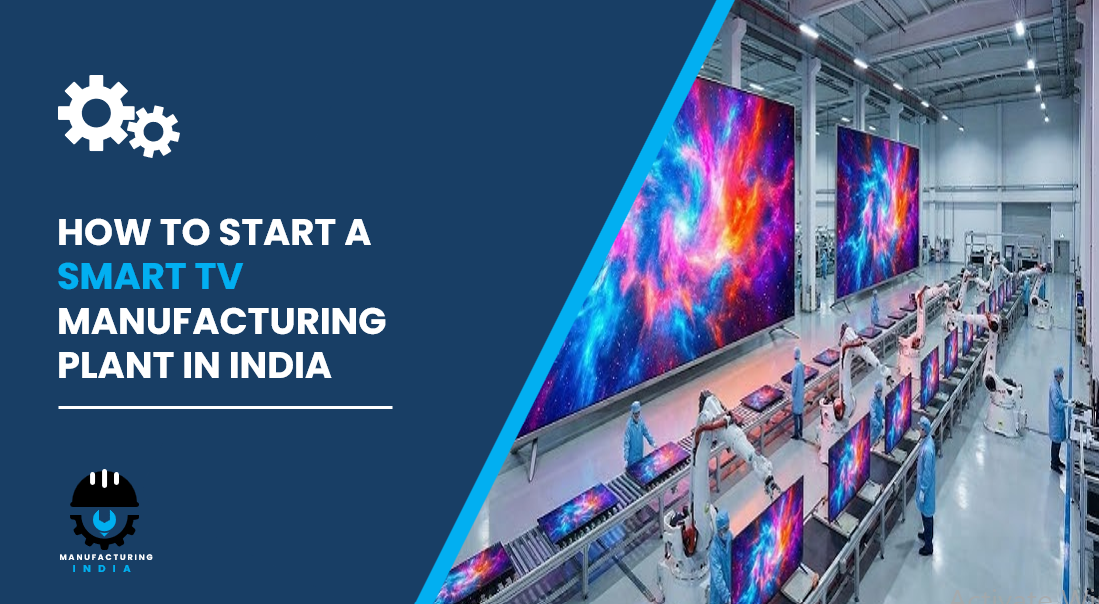
Setting up a smart TV manufacturing plant in India presents a compelling investment case built on the country’s surging appetite for connected home entertainment, rapid expansion of OTT streaming adoption, rising household incomes, and one of the world’s largest and fastest-growing consumer electronics markets. Smart TVs — integrating display modules, internet connectivity, operating systems, streaming apps, voice control, and increasingly AI-powered picture and audio processing — have emerged as the central device in India’s digital living room, displacing traditional broadcast television across urban and semi-urban households alike. As screen sizes grow, display technologies such as OLED, QLED, and Mini LED gain traction, and software ecosystems deepen, the replacement cycle for smart TVs is accelerating, creating consistent and high-volume throughput demand for well-positioned domestic manufacturers.
India’s advantages for this investment are substantial. Cost-competitive assembly labour, a growing electronics component supplier ecosystem, strong Make in India and PLI scheme incentives for consumer electronics manufacturing, and the active development of electronics manufacturing clusters in states such as Uttar Pradesh, Andhra Pradesh, Tamil Nadu, and Karnataka make the country a strategically sound location for smart TV production. Regional assembly operations also reduce logistics costs for large-format products — a meaningful saving on bulky goods — and improve responsiveness to local retail demand spikes and product customisation requirements for Indian standards and labelling. With around 74% of the global population (~6 billion people) online in 2025 according to the ITU, and internet penetration in India continuing its upward trajectory, the demand base for connected consumer electronics has never been broader.
A smart TV manufacturing plant in India sits at the intersection of digital consumption megatrends, government electronics manufacturing incentives, and a consumer market of unparalleled scale. With a global market valued at USD 306.8 billion in 2025 and projected to reach USD 487.5 billion by 2034 at a CAGR of 5.28%, and gross margins of 15–25%, this production facility offers a financially viable and strategically well-timed investment for electronics manufacturers targeting India’s premium and mass-market segments alike.
What is a Smart TV?
A smart TV is a television integrated with an operating system and network connectivity — via Wi-Fi or Ethernet — that enables streaming apps, internet services, voice control, device casting, and software updates. It combines a display module (available in LCD/LED, QLED, OLED, or Mini LED backlit configurations), a mainboard with processor and memory, connectivity components including HDMI, USB, and Bluetooth, and audio hardware into a single consumer device. Smart TVs support app ecosystems, content recommendation engines, and increasingly AI-enabled picture and audio optimisation.
Key performance attributes include panel quality — covering brightness, contrast, and colour gamut — motion handling, processing speed, connectivity stability, power efficiency, long-term software support, and security patching. The primary production method spans display module manufacturing, PCB/SMT manufacturing, mechanical enclosure manufacturing, final assembly, calibration, testing, and packaging. The product serves end-use industries including consumer electronics and home entertainment, hospitality, corporate and educational institutions, and retail and commercial display segments.
Cost of Setting Up a Smart TV Manufacturing Plant in India
The total cost of establishing a smart TV manufacturing plant in India depends on production capacity, the degree of vertical integration (panel import vs. full module manufacturing), plant location, automation level, and regulatory compliance requirements.
1. Capital Expenditure (CapEx)
The capital investment required to set up this facility covers several major cost heads. Land and site development — including land registration, boundary development, and related site infrastructure — forms a substantial portion of total CapEx. Investors can consider establishing the unit within electronics manufacturing clusters or Special Economic Zones (SEZs) in Uttar Pradesh (Noida), Andhra Pradesh, or Tamil Nadu (Sriperumbudur) to benefit from PLI scheme eligibility, concessional land rates, pre-built infrastructure, and proximity to established component supplier networks.
Civil works and construction costs encompass the main assembly hall, SMT and PCB integration zones, panel handling and lamination areas, quality control and calibration rooms, anti-static flooring and ESD-protected work areas, finished goods warehouse, and administrative block. Smart TV assembly requires electrostatic discharge (ESD) controlled environments for sensitive electronics handling, adding specificity to civil works design.
Machinery and equipment represent the largest component of total capital expenditure for this smart TV manufacturing plant. Key machinery required includes:
- SMT (Surface Mount Technology) lines
- Injection moulding machines
- Panel handling tools
- Lamination tools
- Functional test rigs
- Calibration systems
- Display panel manufacturing machines
- PCB assembly machines
- Screen testing and quality control equipment
- CNC machines for metal cutting
- Environmental testing chambers
- Packaging and assembly lines
Other capital costs include effluent treatment systems, pre-operative and commissioning expenses, ESD protection infrastructure throughout the production floor, and any applicable import duties on high-precision SMT and display handling equipment.
2. Operational Expenditure (OpEx)
The operating cost structure of a smart TV manufacturing plant is overwhelmingly dominated by raw material procurement. Raw material cost — covering LCD/LED panels, smart boards (SOC), chassis, power supply units, and speakers — accounts for approximately 80–85% of total OpEx, with LCD/LED panels alone constituting the single largest cost element in the bill of materials. Given this concentration, investors must establish long-term supply contracts with panel suppliers and explore strategic vendor agreements for key electronic components to manage price volatility and ensure supply continuity across product generations.
Utility costs, covering electricity, water, and climate-controlled facility operation for ESD-sensitive assembly environments, account for 5–10% of OpEx — relatively low for a manufacturing segment, reflecting the assembly-dominant nature of smart TV production. Other operating costs include transportation and logistics for finished unit dispatch to retail and distribution channels, packaging materials, salaries and wages for assembly and technical staff, maintenance and calibration of precision equipment, depreciation of fixed assets, and applicable taxes. By the fifth year of operations, total operational costs are projected to increase substantially due to inflation, supply chain disruptions, market fluctuations, and rising costs of key components such as display panels and semiconductor ICs.
Request a Sample Report for In-Depth Market Insights: https://www.imarcgroup.com/smart-tv-manufacturing-plant-project-report/requestsample
3. Plant Capacity
The proposed manufacturing facility is designed with an annual production capacity ranging between 500,000 and 2 million units, enabling economies of scale while maintaining operational flexibility. Capacity can be customised based on investor requirements, target retail and institutional channels, and available capital. At scale, unit assembly costs decline meaningfully and PLI scheme benefit thresholds are met, making higher-capacity production planning a core strategic consideration from project inception.
4. Profit Margins and Financial Projections
The smart TV manufacturing plant demonstrates solid profitability potential under normal operating conditions. Gross profit margins typically range between 15–25%, supported by stable and growing end-consumer demand, increasing average selling prices as display technology upgrades accelerate, and the value captured through precision integration, calibration, and quality control in assembly operations. Net profit margins are projected in the range of 5–12%. Key financial indicators including NPV, IRR, payback period, liquidity analysis, and sensitivity analysis are covered comprehensively in the full project report. Break-even for this type of plant typically ranges from three to five years, dependent on capacity utilisation, component pricing, brand development investment, and market competition intensity.
Why Set Up a Smart TV Manufacturing Plant in India?
High-Volume Electronics Segment with Steady Replacement Demand. Smart TVs follow predictable refresh cycles driven by new screen sizes, display technologies, and software features — creating consistent, forecastable throughput opportunities for efficient assembly and testing operations. India’s large aspirational consumer base and rapidly expanding middle class are powering both first-time purchases and technology-led upgrades across urban and semi-urban markets.
OTT Streaming and Digital Content Consumption Driving Adoption. The rapid shift toward digital and streaming-based content consumption — as consumers increasingly prefer on-demand OTT platforms over traditional broadcast television — is making smart TVs the central device for India’s connected home. The integration of smart operating systems, voice assistants, and app ecosystems is expanding functionality and enhancing user engagement, accelerating both unit sales and replacement demand.
Advanced Display Technology Upgrades Creating Premium Demand. Advances in display technologies such as OLED, QLED, and Mini LED — along with AI-enabled picture and sound processing — are improving viewing quality and driving replacement demand at higher average selling prices. In September 2025, Dish TV India Ltd. launched its new VZY Smart TV range featuring models from 32-inch HD to 55-inch 4K QLED that integrate DTH and OTT content in a single device, illustrating the product innovation pace in India’s domestic market.
Localisation Benefits and Supply Chain Resilience. Regional assembly can significantly reduce logistics costs for large-format products, improve responsiveness to demand spikes, and support faster customisation for local standards, labelling, and retail configurations — all of which are meaningful commercial advantages in India’s diverse and geographically distributed retail market.
Active Global Industry Investment and Strategic Partnerships. In January 2026, Sony Electronics announced its plans for a joint venture with TCL Electronics Holdings Limited, covering the designing and manufacturing of smart TVs and related audio products that will carry the Sony and BRAVIA brands — reflecting continued global strategic investment in manufacturing scale and capability. This signals the accelerating global trend of brand-plus-manufacturer partnerships that create new contract assembly and component supply opportunities for India-based facilities.
Manufacturing Ecosystem Spillovers. Smart TV production strengthens upstream and downstream capabilities across plastics, PCBA, speakers, packaging, and logistics sectors — creating broader electronics manufacturing base benefits for India’s industrial ecosystem and reinforcing the value of clustering this investment within established electronics manufacturing zones.
Manufacturing Process — Step by Step
The smart TV manufacturing process uses display module manufacturing, PCB/SMT manufacturing, mechanical enclosure manufacturing, final assembly, calibration, testing, and packaging as the primary production method. The process involves multiple precision unit operations, material handling stages, and quality verification checkpoints throughout.
- Raw Material Sourcing and Incoming Inspection: LCD/LED panels, smart boards (SOC), chassis, power supply units, speakers, and electronic components are received, inspected for quality conformity, and staged for production entry.
- Display Panel Manufacturing and Testing: Display panels are assembled or received and tested for brightness uniformity, dead pixels, colour accuracy, and contrast performance before entering the main assembly line.
- PCB Assembly and SMT Integration: Printed circuit boards are populated with semiconductors, integrated circuits, capacitors, and connectors using SMT (Surface Mount Technology) lines. The mainboard, power board, and T-con board are assembled and soldered.
- PCB Integration with Display Panel: The mainboard and associated PCBs are connected to the display panel and tested for signal integrity and functional operation.
- Mechanical Enclosure Manufacturing: Plastic housings, bezels, stands, and metal chassis components are produced using injection moulding machines and CNC machines for metal cutting, then assembled into the TV enclosure.
- Panel Handling and Lamination: Display panels are handled using specialised panel handling tools and laminated with protective glass and optical bonding layers using lamination tools.
- Final Assembly: All sub-assemblies — display panel, mainboard, power supply, speakers, casing, and connectivity ports — are integrated into the finished TV body on the main assembly line.
- Software Loading and Calibration: The smart TV operating system and firmware are flashed onto the mainboard, and the display is calibrated for colour temperature, brightness, and picture settings using calibration systems.
- Quality Control and Functional Testing: Finished units undergo comprehensive functional testing using functional test rigs — including screen calibration verification, electrical safety testing, Wi-Fi and connectivity checks, remote control pairing, and app ecosystem verification.
- Environmental Testing: Units are subjected to environmental testing chambers to verify performance across temperature and humidity conditions meeting export and domestic compliance standards.
- Packaging and Dispatch: Approved units are packaged with accessories — remote control, stand, cables, and documentation — and dispatched to consumer electronics retailers, e-commerce platforms, hospitality customers, and corporate and institutional buyers.
Key Applications
The smart TV manufacturing plant serves multiple high-growth end-use industries with strong and expanding demand for connected display products:
- Consumer Electronics and Home Entertainment: Streaming, live TV aggregation, AI picture and audio enhancement, gaming modes, device casting, and smart home control integration — the primary and dominant application segment driving unit volumes.
- Hospitality: In-room entertainment platforms, centralised content control, guest-mode settings, and app-based streaming experiences in hotels, resorts, and serviced apartments.
- Corporate and Education: Wireless screen sharing, presentation display, video conferencing support, and large-format collaboration in offices, boardrooms, classrooms, and training facilities.
- Retail and Commercial Display: Menu boards, promotional loops, product showcases, and informational displays using commercial and retail-optimised smart TV variants for high-traffic environments.
Leading Manufacturers
The global smart TV industry is served by several major multinational manufacturers with extensive production capacities and diversified application portfolios. Key players include:
- Haier Inc.
- Hisense International
- Intex Technologies
- Koninklijke Philips N.V.
- LG Electronics Inc.
- Panasonic Corporation
- Samsung Electronics Co. Ltd.
Timeline to Start the Plant
- Feasibility study and project report preparation
- Land acquisition and site development
- Regulatory approvals and environmental clearances
- Factory licence and fire safety compliance
- Machinery procurement and installation
- Raw material supplier agreements and supply chain setup
- Trial production and quality testing
- Commercial production launch
The overall timeline from project initiation to commercial production typically ranges from 12 to 18 months.
Licences and Regulatory Requirements
Starting a smart TV manufacturing unit in India requires several approvals:
- Business registration (Proprietorship, LLP, or Pvt Ltd)
- Factory Licence under the Factories Act
- Environmental Clearance from State Pollution Control Board
- GST Registration
- Fire Safety NOC
- Bureau of Indian Standards (BIS) certification — mandatory for electronic goods sold in India under the Electronics and Information Technology Goods (EITG) order
- E-waste management compliance under the E-Waste (Management) Rules
- Effluent Treatment Plant (ETP) operational clearance
- Occupational Health and Safety compliance
Key Challenges to Consider
High Capital Requirements. Precision equipment — including SMT lines, injection moulding machines, panel handling tools, lamination systems, functional test rigs, and environmental testing chambers — constitutes the largest CapEx component. ESD-protected facility construction adds further upfront investment, requiring careful financial planning and access to PLI scheme benefits or institutional funding.
Raw Material Price Volatility. LCD/LED panels, SOC smart boards, power supply units, and speakers account for 80–85% of total OpEx, making the bill of materials extremely sensitive to global display panel and semiconductor pricing cycles. Long-term supply agreements and diversified component sourcing are essential cost management tools.
Regulatory Compliance. Meeting BIS certification requirements, E-Waste Management Rule obligations, environmental clearances, and import duty structures on panel and component procurement requires dedicated compliance management and ongoing investment in documentation and third-party testing.
Technology and Innovation Pressure. Rapid advances in OLED, QLED, Mini LED, and AI-powered processing — alongside evolving OS platform requirements — necessitate continuous product generation management and periodic manufacturing line upgrades to remain competitive with global players and meet retailer specifications.
Competition. Global players such as Samsung Electronics, LG Electronics, Hisense International, Haier, and Panasonic Corporation maintain dominant market positions with established brand equity and scale. Domestic producers must leverage India-specific policy tailwinds, PLI benefits, localisation advantages, and competitive retail pricing to grow market share.
Skilled Manpower. Operating SMT assembly lines, calibration systems, and electronic testing equipment to international quality standards requires a skilled technical and engineering workforce, which can present sourcing and retention challenges particularly during initial production ramp-up phases.
Frequently Asked Questions
1. How much does it cost to set up a smart TV manufacturing plant in India? Total investment depends on production capacity (500,000 to 2 million units annually), technology choices, location, and automation level. Key cost components include land and site development, civil and ESD-protected construction, machinery (SMT lines, injection moulding machines, panel handling tools, lamination tools, test rigs, calibration systems), utilities, and working capital. A detailed project report provides capacity-specific CapEx and OpEx estimates.
2. Is smart TV manufacturing profitable in India in 2026? Yes. The facility demonstrates gross profit margins of 15–25% and net profit margins of 5–12% under normal operating conditions. Profitability improves with higher capacity utilisation, effective LCD/LED panel procurement cost management, and PLI scheme benefit realisation.
3. What machinery is required for a smart TV plant in India? Key equipment includes SMT lines, injection moulding machines, panel handling tools, lamination tools, functional test rigs, calibration systems, display panel manufacturing machines, PCB assembly machines, screen testing and quality control equipment, CNC machines for metal cutting, environmental testing chambers, and packaging and assembly lines.
4. What licences and approvals are required to start a smart TV plant in India? Required approvals include business registration, Factory Licence under the Factories Act, Environmental Clearance from the State Pollution Control Board, GST registration, BIS certification for electronics goods, E-Waste Management Rule compliance, ETP operational clearance, Fire Safety NOC, and Occupational Health and Safety certification.
5. What raw materials are needed for smart TV manufacturing? Key raw materials include LCD/LED panels (the dominant cost input), smart boards (SOC), chassis, power supply units, and speakers, along with display panels, semiconductors, integrated circuits, PCBs, plastic and metal housing components, glass, capacitors, connectors, and sensors.
6. What are the environmental compliance requirements for a smart TV plant in India? Operators must comply with E-Waste (Management) Rules for electronics manufacturing, obtain Environmental Clearance, maintain an operational ETP for any process waste streams, and adhere to State Pollution Control Board guidelines on hazardous material handling and disposal applicable to electronics production.
7. What is the best location to set up a smart TV plant in India? Ideal locations offer proximity to established electronics component suppliers, reliable and affordable power supply, strong logistics connectivity to retail distribution hubs, and access to PLI scheme-eligible electronics manufacturing zones. Uttar Pradesh (Noida/Greater Noida), Andhra Pradesh (SriCity), and Tamil Nadu (Sriperumbudur) are well-positioned given their active electronics manufacturing ecosystems and government incentive frameworks.
8. What is the break-even period for this type of plant in India? Break-even typically ranges from three to five years, depending on scale, component pricing, capacity utilisation, brand development investment, and market competition. Strategic retail partnerships and strong distribution channel development can help accelerate profitability.
9. What government incentives are available for manufacturers in India? Smart TV manufacturers in India can benefit from the PLI scheme for large-scale electronics manufacturing, capital subsidies and tax exemptions under state industrial promotion policies, concessional land and utility rates in electronics manufacturing zones, export-linked benefits, and preferential import duty structures on components used in domestic assembly. Make in India policies specifically support electronics manufacturing localisation.
Key Takeaways for Investors
The smart TV manufacturing plant opportunity in India is underpinned by powerful, converging demand drivers — OTT streaming adoption, rising household incomes, display technology upgrades, and expanding internet penetration across 6 billion connected users globally in 2025 — all of which are translating into consistent and high-volume unit demand across consumer electronics, hospitality, corporate, and retail display segments. The financial profile is viable across the 500,000 to 2 million unit annual capacity range, with gross margins of 15–25% and net margins of 5–12%, supported by PLI scheme benefits and a large, brand-loyal domestic buyer base. The global smart TV market, valued at USD 306.8 billion in 2025, is projected to reach USD 487.5 billion by 2034 at a CAGR of 5.28%, confirming a long and stable demand runway. As global manufacturers such as Sony and TCL Electronics formalise joint ventures and India’s domestic players such as Dish TV introduce integrated smart TV ranges, the competitive and commercial ecosystem for Indian smart TV production is deepening rapidly — making this a well-timed and strategically sound investment for electronics manufacturers ready to scale.
About the Author