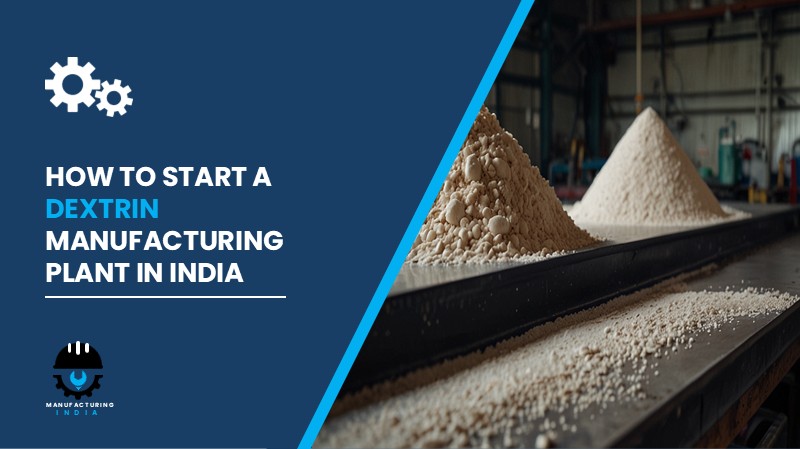
Setting up a dextrin manufacturing plant in India presents a compelling investment case at a time when demand for functional starch derivatives and clean-label ingredients is rising across the country’s expanding food processing, pharmaceutical, paper and packaging, textile, and industrial adhesives sectors. Dextrin — a low-molecular-weight carbohydrate produced through the controlled hydrolysis of starch using heat, acids, or enzymes — serves as an indispensable multifunctional input valued for its bonding, thickening, film-forming, and adhesive properties across a breadth of industrial applications that few specialty ingredients can match. India’s rapid growth in packaged food consumption, the robust expansion of its generic pharmaceutical industry, and the accelerating shift toward sustainable paper and corrugated packaging materials are together generating a structural, multi-sector demand environment for domestically produced dextrin that is both immediate in its current volumes and durable in its long-term trajectory.
India’s structural advantages make it one of the Asia-Pacific region’s most strategically sound locations for establishing dextrin production. The country is identified as a key growth market within the fastest-growing regional segment for the global dextrin industry, supported by abundant availability of starch raw materials — including corn, potato, and cassava — from established domestic agricultural supply chains. The Make in India initiative provides policy support for food processing and specialty chemical manufacturing, and industrial estates in starch-producing states such as Uttar Pradesh, Maharashtra, Gujarat, and Karnataka offer proximity to raw material sources, reliable utilities infrastructure, and logistics connectivity to pharmaceutical, food processing, and paper manufacturing customer clusters. Local production further reduces India’s import dependence for specialty starch derivatives, strengthening supply chain resilience for downstream industrial buyers.
Investing in a dextrin manufacturing plant in India today aligns rising multi-sector demand across food and beverages, pharmaceuticals, and paper and packaging with cost-competitive starch-based production economics, abundant domestic raw material availability, and strong policy support under Make in India. With gross profit margins of 25–35% and net profit margins of 10–15%, the financial case is compelling, and the facility’s scalable production model — designed for annual capacities of 10,000 to 20,000 MT — supports commercially viable break-even outcomes across a well-defined investment horizon.
What is Dextrin?
Dextrin is a common term for a variety of low-molecular-weight carbohydrates that are products of starch, formed during controlled hydrolysis using heat, acids, or enzymes. It presents as a white to pale yellow powder and functions as a water-soluble coagulant and thickener capable of producing several types of viscous solutions. The food industry and other industrial sectors highly value dextrin for its excellent bonding, thickening, film-forming, and adhesive properties, which make it a versatile functional ingredient across a wide range of manufacturing processes.
Depending on the method of production, dextrin can be further categorised into white dextrin, yellow dextrin, and British gum — each developed and optimised for specific industrial applications. White dextrin is predominantly used in food and pharmaceutical applications, yellow dextrin in industrial adhesives and paper coating, and British gum in textile sizing and heavy-duty adhesive formulations. Across all variants, dextrin is highly valued for its biodegradable nature, non-toxicity, and cost-effectiveness relative to synthetic alternatives, making it a strong candidate for the growing clean-label and sustainability-oriented ingredient market.
The primary production process covers starch roasting, acid hydrolysis, drying, milling, and packaging. End-use industries served include food and beverages, paper and packaging, pharmaceuticals, textiles, and adhesives. Core applications encompass use as a binder, thickener, coating agent, stabiliser, and adhesive component across these diverse sectors.
Cost of Setting Up a Dextrin Manufacturing Plant in India
The cost of establishing a dextrin manufacturing plant in India depends on plant capacity, technology selection, starch feedstock type, geographic location, degree of automation, and the food-grade and pharmaceutical-grade regulatory compliance requirements applicable to the production facility.
1. Capital Expenditure (CapEx)
Land and Site Development forms a foundational component of total capital investment, covering land registration charges, boundary development, drainage and effluent containment infrastructure, and site utilities. Investors may explore agro-processing zones or established industrial estates in starch-belt states such as Uttar Pradesh and Maharashtra, where proximity to corn and potato starch suppliers significantly reduces inbound logistics costs and land acquisition is facilitated through state industrial promotion agencies. Special Economic Zones may also offer fiscal benefits for export-oriented dextrin production.
Civil Works and Construction cover the main production building housing roasting or reaction systems and drying lines, raw material storage facilities for bulk starch and acid inputs with appropriate containment, a quality control laboratory equipped for purity, moisture, viscosity, and colour testing, finished goods warehousing for packaged dextrin, an administrative block, and utilities infrastructure including steam generation and distribution for process heating requirements.
Machinery and Equipment represent the largest single component of total CapEx for a dextrin manufacturing plant. Key machinery required includes:
- Roasters or reactors
- Dryers
- Grinders
- Blenders
- Automated packaging systems
Other Capital Costs include an effluent treatment plant (ETP) for managing acid-containing process effluents, dust collection and air pollution control systems for milling and powder handling operations, pre-operative expenses, commissioning charges, and import duties on specialised continuous roasting or spray-drying equipment where domestic alternatives are unavailable.
Request a Sample Report for In-Depth Market Insights: https://www.imarcgroup.com/dextrin-manufacturing-plant-project-report/requestsample
2. Operational Expenditure (OpEx)
Raw Material Cost is the dominant operational expense, accounting for approximately 70–80% of total OpEx. The primary raw materials are starch — sourced from corn, potato, or cassava depending on availability and product grade requirements — and acids used as hydrolysis catalysts in the conversion process. Starch, as the base feedstock consumed in the largest volumes, drives the majority of input cost. Long-term procurement contracts with reliable starch suppliers are strongly advisable to stabilise production costs and protect margins against agricultural commodity price cycles. Selecting plant locations in proximity to domestic starch processing clusters reduces the freight burden on this highest-volume input category.
Utility Cost is the second-largest OpEx component, representing 10–15% of total operating expenses, covering steam for roasting and reaction vessels, electricity for dryers, grinders, blenders, and packaging systems, and water for process operations and facility hygiene. Steam consumption in the roasting and drying stages is the most energy-intensive element of the utility profile.
Other Operating Costs include transportation and distribution to food processing, pharmaceutical, paper and packaging, textile, and adhesives customers, packaging materials for bulk bags and multi-wall sacks, salaries and wages for production operators and quality control chemists, routine machinery maintenance including reactor and dryer upkeep, depreciation on production equipment, and applicable taxes. By the fifth year of operations, total operational costs are projected to increase substantially due to inflation, market fluctuations, potential rises in starch and acid prices, supply chain disruptions, rising consumer demand across end-use sectors, and shifts in the global economy — all variables that must be incorporated carefully into the five-year financial model.
3. Plant Capacity
The proposed manufacturing facility for a dextrin plant is designed with an annual production capacity ranging between 10,000 and 20,000 metric tonnes, enabling economies of scale while maintaining operational flexibility suited to India’s diverse and geographically dispersed customer base across food, pharmaceutical, and industrial segments. Plant capacity can be customised per investor requirements and phased in line with demand ramp-up from secured supply agreements with anchor customers in food processing or pharmaceutical manufacturing. As with all starch-derivative processing, profitability improves meaningfully with higher capacity utilisation, making established customer relationships across multiple end-use sectors a strategic commercial foundation for the investment from the outset.
4. Profit Margins and Financial Projections
The financial projections for a dextrin manufacturing plant demonstrate healthy profitability potential under normal operating conditions. Gross profit margins typically range between 25–35%, supported by stable multi-sector demand and the value-added functional properties that dextrin delivers across food, pharmaceutical, and industrial applications relative to its starch raw material cost. Net profit margins are projected at 10–15%. A comprehensive financial analysis covering NPV (net present value), IRR (internal rate of return), payback period, gross margin progression, and net margin development across a five-year horizon is essential before committing capital. The project’s ROI profile and long-term sustainability are assessed against realistic assumptions on capital investment, production capacity utilisation, starch pricing trends, and demand outlook from the food and beverages, paper and packaging, pharmaceutical, textile, and adhesives end-use sectors.
Why Set Up a Dextrin Plant in India?
Versatile Multi-Sector Demand Across Food, Pharma, and Industrial Applications. The multifunctional characteristics of dextrin make it indispensable as an input across food processing, pharmaceutical, paper, and industrial adhesive manufacturing, securing a stable and varied demand base that insulates producers from single-sector cyclicality. India’s simultaneous expansion across all of these end-use industries creates a particularly favourable demand environment for domestic dextrin production that few other starch-derivative products can match.
Pharmaceutical Sector Growth and Dextrin as a Key Excipient. The pharmaceutical industry continues to expand its use of dextrin as an excipient — as a tablet binder, disintegrant, and carrier for active pharmaceutical ingredients — driven by growth in generic drug production and nutraceutical formulations. According to the India Brand Equity Foundation (IBEF), India’s pharmaceutical sector is expected to expand at an annual growth rate exceeding 10%, with the market projected to reach approximately USD 130 billion by 2030. This sustained growth outlook directly expands the addressable market for pharmaceutical-grade dextrin produced domestically.
Clean-Label and Sustainability Trends Driving Food Industry Demand. In the food and beverage sector, dextrin is gaining traction due to its functional benefits, clean-label appeal, and compatibility with low-fat and processed food formulations. As Indian consumers and food manufacturers increasingly seek biodegradable, plant-based, and food-grade additives over synthetic alternatives, dextrin’s profile as a naturally derived, non-toxic functional ingredient positions it strongly within this trend.
Sustainable Packaging Shift Expanding Paper and Packaging Demand. The shift toward sustainable and recyclable packaging materials is encouraging higher dextrin consumption in paper coating and corrugated packaging applications. As India’s e-commerce sector drives growth in corrugated box consumption and brand owners transition away from plastic-based coatings, the demand for dextrin as a surface sizing and coating binder for paper and packaging is growing structurally.
Active Global Innovation in Dextrin Applications. In November 2025, ZymeBase’s functional ingredient SusCarb™ Dextrin received the Very Food Annual VERY Award in the “Sports Nutrition” category — a highly branched cyclic dextrin designed using proprietary enzymatic hydrolysis technology to provide rapid and sustained energy for sports drinks, energy gels, protein powders, and performance nutrition products. In March 2025, Kirin Holdings and Blackmores introduced a new LC-Plasma probiotic powder combining indigestible dextrin to support gut and immune health, targeting growing regional demand for preventive nutrition solutions. These developments signal expanding high-value application segments for dextrin that India-based producers can participate in as the domestic nutraceutical and sports nutrition market scales.
Beneficial Production Economics and Regional Supply Chain Advantages. The production method is based on starch sources that are widely available domestically — including corn, potato, and cassava — enabling cost-efficient production with scalable plant capacities. Production in the region means import dependence can be lowered, supply chains can be stabilised, and industrial specifications of local food, pharmaceutical, and packaging customers can be met directly, giving domestic producers clear commercial advantages over import-dependent competitors.
Manufacturing Process — Step by Step
The dextrin manufacturing process uses starch roasting, acid hydrolysis, drying, milling, and packaging as the primary production method. Each stage requires carefully controlled temperature, moisture, and acid concentration parameters to produce dextrin of the specified colour, molecular weight, viscosity, and solubility characteristics required by food, pharmaceutical, and industrial end-use customers.
- Starch Preparation: Incoming starch — corn, potato, or cassava depending on feedstock selection — is received, inspected for purity and moisture content, and transferred to starch storage silos or hoppers in preparation for controlled conversion.
- Acid Treatment (Acid Hydrolysis): Starch is treated with dilute acid in controlled quantities to partially hydrolyse the starch polymer chains, initiating the breakdown of molecular weight that characterises dextrin. Acid concentration, temperature, and contact time are precisely controlled to target the desired dextrin grade.
- Roasting: Acid-treated starch is fed into roasters or reactors where controlled dry-heat roasting completes the conversion process, further reducing molecular weight and developing the colour, solubility, and adhesive properties characteristic of white dextrin, yellow dextrin, or British gum depending on roasting temperature and duration.
- Drying: Converted dextrin material is passed through dryers to reduce moisture content to specification levels required for storage stability, caking resistance, and downstream application performance in food, pharmaceutical, and industrial processes.
- Milling and Grinding: Dried dextrin is processed through grinders to achieve the required particle size distribution — fine powder for food and pharmaceutical applications, or coarser grades for industrial adhesive and paper sizing uses.
- Blending: Milled dextrin is blended in blenders to ensure homogeneous product quality across each batch, with any required processing aids incorporated at this stage to meet specific customer formulation requirements.
- Quality Inspection: Finished dextrin undergoes laboratory testing for purity, moisture content, colour, viscosity, solubility, and microbiological compliance before release for packaging, ensuring specification conformance across food, pharmaceutical, and industrial grades.
- Automated Packaging: Inspected dextrin is weighed, filled, and sealed into multi-wall bags or bulk sacks using automated packaging systems for dispatch to food and beverage, paper and packaging, pharmaceutical, textile, and adhesives customers.
Key Applications
Dextrin manufactured in India serves a commercially broad and structurally growing range of industrial and food-grade applications across multiple sectors:
- Food Industry: Used as a thickening agent, fat replacer, and texture enhancer in bakery products, snacks, sauces, and confectionery formulations, and increasingly in sports nutrition and nutraceutical products.
- Paper and Packaging: Applied as a surface sizing and coating binder to improve paper strength, printability, and finish in corrugated packaging, offset paper, and specialty coated paper applications.
- Pharmaceuticals: Utilised as a tablet binder, disintegrant, and carrier for active pharmaceutical ingredients in solid dosage formulations and as an excipient in nutraceutical and healthcare products.
- Textiles and Adhesives: Employed in fabric finishing, warp sizing, labelling adhesives, and biodegradable glue formulations across textile manufacturing and industrial packaging applications.
Leading Manufacturers
The global dextrin industry is served by a group of large multinational corporations with extensive production capacities and diversified application portfolios across food, pharmaceutical, and industrial end-use segments. Key players in the global market include:
- Penford Corporation
- Tate & Lyle PLC
- AGRANA Group
- Merck KGaA
- Cargill, Incorporated
- Grain Processing Corporation
- Roquette Frères
- Matsutani Chemical Industry Co., Ltd.
- Ingredion Incorporated
Timeline to Start the Plant
Establishing a dextrin manufacturing plant in India involves a structured multi-phase development sequence. Investors should plan for the following phases:
- Feasibility study and project report preparation
- Land acquisition and site development
- Regulatory approvals and environmental clearances
- Factory licence and fire safety compliance
- Machinery procurement and installation
- Raw material supplier agreements and supply chain setup
- Trial production and quality testing
- Commercial production launch
Licences and Regulatory Requirements
Starting a dextrin manufacturing unit in India requires several approvals spanning business registration, food safety, environmental, chemical handling, and industrial compliance domains:
- Business registration (Proprietorship, LLP, or Pvt Ltd)
- Factory Licence under the Factories Act
- Environmental Clearance from the State Pollution Control Board
- GST Registration
- Fire Safety NOC
- FSSAI (Food Safety and Standards Authority of India) licence, applicable for dextrin grades supplied into food and pharmaceutical applications
- Effluent Treatment Plant (ETP) operational clearance for managing acid-containing process effluents
- Occupational Health and Safety compliance
Key Challenges to Consider
High Raw Material Cost Concentration. Starch and acids together account for 70–80% of total OpEx, making procurement strategy the dominant cost management lever for the investment. Starch pricing is subject to agricultural commodity cycles driven by monsoon patterns, crop yield variations, and competing demand from other starch-derivative industries. Long-term procurement contracts with multiple reliable starch suppliers across corn, potato, and cassava sources are essential for cost stability and supply resilience.
Stringent Quality and Grade Compliance Requirements. Supplying dextrin into food and pharmaceutical applications requires compliance with FSSAI food safety standards and pharmaceutical excipient grade specifications — including strict controls on purity, microbiological quality, heavy metal content, and moisture levels. Maintaining these compliance standards consistently across production batches demands robust quality management systems, calibrated laboratory instruments, and well-trained quality control personnel.
Competition from Established Global Players. The competitive landscape is dominated by large multinationals including Cargill, Incorporated, Tate & Lyle PLC, Ingredion Incorporated, Roquette Frères, and AGRANA Group, all of which carry significant scale, technology, and customer relationship advantages. New Indian entrants must compete on price competitiveness, delivery reliability, local service responsiveness, and product customisation capability to build and retain customer accounts across food, pharmaceutical, and industrial segments.
Acid Handling and Environmental Compliance. The use of acids in the starch hydrolysis stage creates chemical handling obligations and generates acid-containing process effluents that require proper ETP treatment before discharge. Air pollution control for dust generated during milling and powder handling operations adds an additional environmental compliance dimension that requires dedicated infrastructure and ongoing monitoring.
Technology and Innovation Pressure in High-Value Segments. The development of advanced dextrin variants — such as the proprietary enzymatic hydrolysis-based highly branched cyclic dextrin SusCarb™ recognised in November 2025, and CLUSTER DEXTRIN™ showcased at Natural Products Expo West in March 2025 — signals growing differentiation in high-value sports nutrition and nutraceutical segments. Producers who invest in specialised process technology and novel dextrin grades will access higher-margin application markets beyond commodity food and industrial grades.
Skilled Manpower for Process and Quality Control. Maintaining the process consistency and product specification compliance required to supply food-grade, pharmaceutical-grade, and industrial-grade dextrin requires trained chemical process engineers, experienced dryer and roaster operators, and analytical quality control chemists — a specialised technical workforce demanding ongoing investment in recruitment, training, and retention.
Frequently Asked Questions
1. How much does it cost to set up a dextrin manufacturing plant in India?
The total setup cost depends on plant capacity, technology selection, starch feedstock type, location, and automation level. CapEx covers land and site development, process-grade civil construction, core machinery including roasters or reactors, dryers, grinders, blenders, and automated packaging systems, along with ETP, dust collection, and other capital costs. A detailed project report with full CapEx and OpEx breakdowns is available on request.
2. Is dextrin manufacturing profitable in India in 2026?
Yes. The project demonstrates gross profit margins of 25–35% and net profit margins of 10–15% under normal operating conditions, supported by stable multi-sector demand from food and beverages, pharmaceuticals, paper and packaging, textiles, and adhesives industries that are all expanding robustly across India’s domestic market.
3. What machinery is required for a dextrin plant in India?
Key machinery includes roasters or reactors, dryers, grinders, blenders, and automated packaging systems. The scale and degree of automation across these core equipment categories determine the total production capacity and capital investment required.
4. What licences and approvals are required to start a dextrin plant in India?
Required approvals include business registration, a Factory Licence under the Factories Act, Environmental Clearance from the State Pollution Control Board, GST registration, a Fire Safety NOC, FSSAI food safety licensing for food and pharmaceutical grades, ETP operational clearance, and Occupational Health and Safety compliance.
5. What raw materials are needed for dextrin manufacturing?
The primary raw materials are starch — sourced from corn, potato, or cassava — and acids used as hydrolysis catalysts. Starch accounts for approximately 70–80% of total operating expenses, making feedstock procurement discipline the most critical cost management lever for the investment.
6. What are the environmental compliance requirements for a dextrin plant in India?
The unit must obtain Environmental Clearance from the State Pollution Control Board, operate a certified ETP for managing acid-containing process effluents, install dust collection and air pollution control systems for milling and powder handling operations, and maintain monitoring systems for wastewater discharge and emissions in line with applicable state pollution control standards.
7. What is the best location to set up a dextrin plant in India?
Optimal locations offer proximity to domestic starch processing and agricultural supply zones, reliable utilities including steam and electricity, access to food processing, pharmaceutical, and paper manufacturing customer clusters, and compliance with zoning and environmental regulations. Agro-processing zones and industrial estates in Uttar Pradesh, Maharashtra, Gujarat, and Karnataka are among the most strategically relevant options.
8. What is the break-even period for this type of plant in India?
The break-even period depends on plant capacity, capacity utilisation rate, starch and acid pricing trends, and demand conditions across food, pharmaceutical, and industrial segments. A detailed financial analysis including payback period, NPV, and IRR projections is included in the full project report, available via the sample request link.
9. What government incentives are available for manufacturers in India?
The Make in India initiative and food processing sector schemes provide financial and regulatory support for specialty starch derivative manufacturing investments. State agro-processing zone incentives, capital subsidy schemes under state investment promotion boards, and export promotion incentives may offer additional fiscal benefits depending on the chosen plant location and production profile.
Key Takeaways for Investors
A dextrin manufacturing plant in India represents a well-timed and financially sound investment opportunity underpinned by stable and growing demand from the food and beverages, paper and packaging, pharmaceuticals, textiles, and adhesives industries — a multi-sector customer base that provides demand diversification and resilience through different economic cycles. The project demonstrates financial viability across annual production capacities of 10,000 to 20,000 MT, with gross profit margins of 25–35% and net profit margins of 10–15% confirming healthy unit economics under normal operating conditions. The global dextrin market, valued at USD 3.361 Billion in 2025, is projected to reach USD 4.62 Billion by 2034, growing at a CAGR of 3.6% from 2026 to 2034, with Asia-Pacific — led by India, China, and Southeast Asia — identified as the fastest-growing regional market owing to abundant raw material availability, expanding food processing industries, and increasing export activity. With India’s pharmaceutical sector projected to reach USD 130 billion by 2030, clean-label food ingredient demand rising, and paper packaging sustainability trends accelerating dextrin adoption in corrugated applications, demand sustainability for India-based dextrin production is structurally robust across the full investment horizon.
About the Author