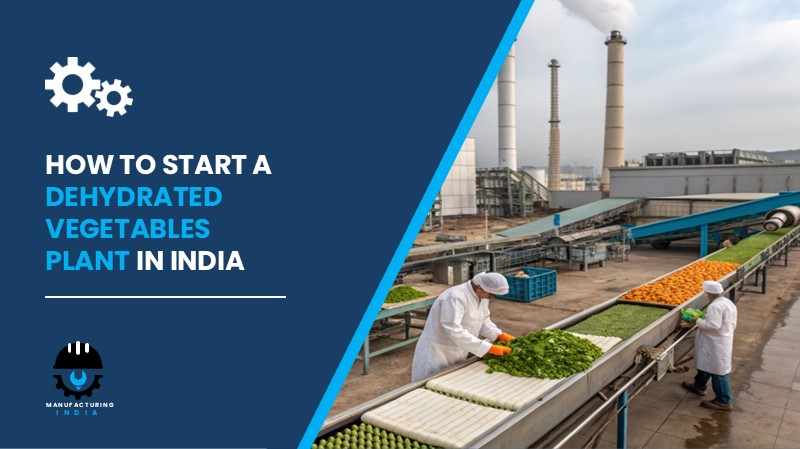
Setting up a dehydrated vegetables plant in India presents a compelling investment case rooted in the country’s rapidly expanding food processing industry, surging demand for shelf-stable food ingredients, and the accelerating adoption of convenience and ready-to-eat foods across urban and semi-urban markets. As one of the world’s largest producers of fresh vegetables — including onions, tomatoes, potatoes, carrots, peas, spinach, cabbage, and bell peppers — India holds a natural and strategic advantage in raw material availability, making it an ideal base for large-scale dehydrated vegetable production. The food processing industry, foodservice and HoReCa sector, ready-to-eat and convenience food industry, nutraceutical and health food segment, and institutional catering sector collectively represent a broad and growing demand base that positions this investment firmly on a long-term growth curve.
India’s structural advantages for setting up a dehydrated vegetables plant are compelling. The Make in India initiative, abundant agricultural output, a cost-competitive labour market, and improving cold chain and logistics infrastructure across states such as Gujarat, Maharashtra, Rajasthan, and Madhya Pradesh create an environment that is both operationally sound and financially attractive. According to IMARC Group, the Indian food processing market was valued at INR 30,498.0 billion in 2024 and is forecast to expand to INR 65,244.8 billion by 2033, registering a CAGR of 8.38% over the 2025–2033 period. This explosive sector growth translates directly into rising demand for processed vegetable ingredients — and for investors, a well-timed entry into dehydrated vegetables production offers access to both domestic and international markets with proven export potential.
India’s INR 30,498 billion food processing sector — forecast to more than double to INR 65,244.8 billion by 2033 — creates an unmatched demand foundation for a dehydrated vegetables manufacturing plant in India. With gross margins of 25–35% and net margins of 10–18%, supported by strong export potential and Make in India policy backing, this investment offers robust financial returns and long-term demand sustainability across the food processing, HoReCa, nutraceutical, and convenience food sectors.
What are Dehydrated Vegetables?
Dehydrated vegetables are fresh vegetables that have undergone controlled moisture removal to achieve significant water content reduction while keeping their nutritional value, flavour, and colour and texture intact. The selection of common dehydration methods requires assessment of end-use requirements, and the primary production methods used in the dehydrated vegetables manufacturing process include hot air drying, freeze drying, vacuum drying, and solar drying. The most common vegetables processed through this method include onions, garlic, carrots, tomatoes, peas, spinach, cabbage, and bell peppers. The products maintain their quality for extended periods without requiring refrigeration, which makes them ideal for bulk storage and transportation over long distances.
Dehydrated vegetables find extensive application in soups, sauces, ready meals, snacks, seasonings, instant noodles, and institutional catering. Food manufacturers use them as essential ingredients because they provide convenience and reduce wastage while maintaining year-round availability — helping food manufacturers, exporters, and foodservice operators achieve consistent product quality and cost savings. The end-use industries served include the food processing industry, ready-to-eat and convenience food sector, foodservice and HoReCa sector, nutraceutical and health food industry, and institutional catering.
Cost of Setting Up a Dehydrated Vegetables Plant in India
The total investment required for a dehydrated vegetables manufacturing plant depends on production capacity, technology selection, level of automation, geographic location, and regulatory compliance requirements. A thorough feasibility study is essential for generating accurate, project-specific cost estimates before capital commitment.
1. Capital Expenditure (CapEx)
Machinery costs account for the largest portion of total capital expenditure in a dehydrated vegetables plant. Land and site development — including charges for land registration, boundary development, and related infrastructure — form a substantial part of the overall investment and must be planned with access to raw vegetable supply chains in mind. Locating the facility within a food processing SEZ or agro-industrial estate in states such as Gujarat, Maharashtra, or Rajasthan can offer fiscal incentives including tax holidays, subsidised land, and single-window regulatory clearances under various state investment promotion programmes.
Civil works costs cover construction of processing sheds with food-grade flooring and wall finishes, raw vegetable intake and washing areas, drying and cooling halls, quality control laboratories, packaging rooms, finished goods warehouses, and administrative and utility blocks. Food safety regulations require dedicated zones for raw and processed material handling to prevent cross-contamination.
Key machinery required for a dehydrated vegetables plant includes:
- Washers
- Slicers
- Blanchers
- Dryers
- Graders
- Packaging systems
Other capital costs include effluent treatment plant (ETP) setup to manage vegetable wash water discharge, pre-operative expenses such as feasibility study fees and regulatory registration costs, plant commissioning expenses, and any applicable import duties on specialised drying technology not available domestically.
Request a Sample Report for In-Depth Market Insights: https://www.imarcgroup.com/dehydrated-vegetables-plant-project-report/requestsample
2. Operational Expenditure (OpEx)
The operating cost structure of a dehydrated vegetables plant is primarily driven by raw material consumption. Key raw materials include fresh vegetables — specifically onion, tomato, and potato — which collectively account for approximately 60–70% of total operating expenses. Given the seasonal nature of vegetable supply and the price volatility associated with agricultural commodities, negotiating long-term procurement contracts with farmer cooperatives, mandis, and contract farming arrangements is essential to stabilise input costs and ensure year-round supply continuity.
Utility costs — electricity, water, and steam — represent the second-largest operating cost component at approximately 20–25% of total OpEx. Dehydration is an energy-intensive process, and electricity costs for operating industrial dryers can be significant, particularly for continuous-production hot air or freeze-drying operations. Other operating costs include transportation and logistics for inbound raw vegetables and outbound finished product, packaging materials, salaries and wages for processing and quality staff, routine machinery maintenance and repairs, depreciation, and applicable taxes. By the fifth year, total operational costs are expected to increase substantially due to inflation, market fluctuations, and potential rises in fresh vegetable procurement costs, compounded by supply chain disruptions and rising consumer demand.
3. Plant Capacity
The proposed dehydrated vegetables facility is designed with an annual production capacity ranging between 1,000 and 5,000 MT, enabling economies of scale while maintaining operational flexibility. This capacity range allows investors to serve domestic food processors, institutional buyers, and export markets simultaneously. Capacity can be customised per investor requirements, and profitability improves significantly with higher capacity utilisation rates given the fixed cost structure of drying and processing operations.
4. Profit Margins and Financial Projections
The dehydrated vegetables manufacturing plant demonstrates healthy profitability under normal operating conditions. Gross profit margins typically range between 25–35%, supported by stable demand across food processing, HoReCa, and institutional end-use segments. Net profit margins are projected in the range of 10–18%, reflecting the cost efficiencies achievable through scale, supplier contract management, and capacity utilisation. Comprehensive financial projections include net present value (NPV), internal rate of return (IRR), payback period analysis, a five-year income and expenditure projection, and sensitivity analysis — collectively providing a complete picture of the project’s financial viability and return on investment.
Why Set Up a Dehydrated Vegetables Plant in India?
Rising Demand for Shelf-Stable Foods. Longer shelf life and ease of storage align with growing demand for convenient and non-perishable food products across India’s expanding urban consumer base. Rising demand for shelf-stable food ingredients is the primary driver of sustained market growth, as food manufacturers, institutional caterers, and exporters increasingly prefer dehydrated vegetable inputs for their logistical advantages and year-round availability compared to fresh produce.
India’s Booming Food Processing Sector. The Indian food processing market was valued at INR 30,498.0 billion in 2024 and is forecast to expand to INR 65,244.8 billion by 2033, registering a CAGR of 8.38% over the 2025–2033 period. This rapid growth is expected to boost the demand for dehydrated vegetables as core ingredients across soups, sauces, instant noodles, spice blends, snack foods, and ready meals, fuelling the sector’s overall development and creating a deep domestic demand base for the unit.
Urbanisation and Changing Dietary Habits. Urbanisation, shifting dietary habits, and rising demand for ready-to-eat meals have created expanding application opportunities for dehydrated vegetables across India’s food industry. The use of dehydrated ingredients has increased because food manufacturers prefer them for consistent product quality, extended shelf life, and simplified distribution logistics — all of which are particularly relevant to India’s geographically dispersed retail and foodservice ecosystem.
Strong Export Potential. The lightweight and shelf-stable nature of dehydrated vegetables makes them highly suitable for international trade. The global market continues to expand driven by increasing cross-border demand, particularly for dehydrated onions and garlic and mixed vegetables — product categories in which India has a well-established agricultural surplus and competitive processing cost advantage. This dual domestic-export revenue model enhances overall project financial resilience.
Active Industry Investment and Market Confidence. In August 2025, Sawaliya Foods Products Limited, a dehydrated vegetables manufacturer, launched its IPO on the NSE SME platform, with shares listing at approximately 90% above the IPO price — demonstrating strong investor confidence in dehydrated vegetable production and processing capabilities. In January 2025, German dehydrated potato manufacturer Emsland Group partnered with UniBourne Food Ingredients LLP to expand its presence in the Indian market, reinforcing the attractiveness of India as a strategic hub for dehydrated vegetable supply chain expansion.
Scalable, Technology-Driven Production. Modular drying systems allow capacity expansion with controlled operational costs, making the dehydrated vegetables plant a scalable investment that can grow in line with market demand. Policy support under the Make in India initiative, the Pradhan Mantri Kisan Sampada Yojana for agro-processing, and state-level food processing incentive programmes further enhance the economic case for establishing the facility in India’s agro-industrial belts.
Dehydrated Vegetables Manufacturing Process Step by Step
The dehydrated vegetables manufacturing process uses hot air drying, freeze drying, vacuum drying, and solar drying as the primary production methods, with hot air drying being the most widely adopted at industrial scale in India. The process is a multi-step operation involving several unit operations, material handling stages, mass balance controls, and quality checks at each stage.
- Raw Material Selection and Washing: Fresh vegetables — including onion, tomato, potato, carrots, peas, spinach, cabbage, and bell peppers — are inspected for quality, graded, and subjected to thorough washing using commercial washers to remove field dirt, pesticide residues, and surface contaminants.
- Cutting and Slicing: Washed vegetables are fed into slicers and cutting machinery, which reduce them to uniform pieces, rings, flakes, or powder form depending on the target product specification and end-use application.
- Blanching (where required): Selected vegetables are subjected to blanching — brief exposure to steam or hot water — to inactivate enzymes that cause colour and flavour degradation during drying, using industrial blanchers configured for the specific vegetable type.
- Dehydration and Drying: The prepared vegetables are loaded into industrial dryers — hot air tunnel dryers, freeze dryers, vacuum dryers, or solar dryers — where controlled temperature and airflow conditions reduce moisture content to the target level, typically below 5%.
- Cooling: Dried vegetables are conveyed through cooling sections to bring product temperature to ambient levels before further handling, preventing moisture re-absorption and condensation.
- Grading and Sorting: Cooled product passes through graders that separate pieces by size, shape, and colour uniformity, removing any substandard material before packaging.
- Quality Inspection: Comprehensive quality control checks assess moisture content, colour, aroma, microbial load, and compliance with food safety standards. Analytical instruments monitor product concentration, purity, and stability at this stage.
- Packaging and Dispatch: Approved product is filled into food-grade packaging using automated packaging systems — including bags, pouches, drums, and bulk containers — and dispatched to food processing companies, HoReCa operators, institutional caterers, nutraceutical manufacturers, and export buyers.
Key Applications of Dehydrated Vegetables in India
Dehydrated vegetables serve a wide range of industries in India and globally, with applications spanning mass-market processed food production to premium health and nutraceutical segments.
- Food Processing Industry: Used as reliable, consistent ingredients in soups and sauces, instant foods, spice blends, and processed meals, providing uniform flavour and quality throughout the year regardless of seasonal fresh vegetable availability.
- Foodservice and HoReCa Sector: Enable hotels, restaurants, and catering services to achieve faster food preparation while reducing storage waste and inventory management complexity, improving operational efficiency across large-volume kitchens.
- Ready-to-Eat and Convenience Food Industry: Used in instant meals, instant noodles and pasta, and snack products that maintain quality during lengthy storage periods, reducing distribution costs and enabling longer product shelf life for retail and export markets.
- Nutraceutical and Health Food Segment: Applied in health mixes and functional foods because dehydrated vegetables maintain original nutrient content and natural plant properties, supporting growing consumer demand for clean-label and fortified food products.
- Institutional Catering: Used in large-scale meal preparation across hospitals, school meal programmes, defence catering, and industrial canteens where consistent supply, long shelf life, and ease of rehydration are essential operational requirements.
Leading Dehydrated Vegetables Manufacturers Globally
The global dehydrated vegetables industry features several prominent companies with extensive production capacities and diverse application portfolios serving food processing, foodservice, nutraceutical, and retail segments worldwide. Key players operating in the industry include:
- BCFoods Europe B.V.
- Catz International B.V. (ACOMO Group)
- Green Rootz
- Harmony House Foods Inc.
- Mevive International Food Ingredients
Timeline to Start a Dehydrated Vegetables Plant in India
Establishing a dehydrated vegetables unit in India involves the following sequential phases:
- Feasibility study and project report preparation
- Land acquisition and site development
- Regulatory approvals and environmental clearances
- Factory licence and fire safety compliance
- Machinery procurement and installation
- Raw material supplier agreements and supply chain setup
- Trial production and quality testing
- Commercial production launch
Licences and Regulatory Requirements in India
Starting a dehydrated vegetables manufacturing unit in India requires several approvals:
- Business registration (Proprietorship, LLP, or Private Limited Company)
- Factory Licence under the Factories Act
- Environmental Clearance from State Pollution Control Board
- GST Registration
- Fire Safety NOC
- FSSAI (Food Safety and Standards Authority of India) licence — mandatory for all food processing establishments
- Effluent Treatment Plant (ETP) operational clearance
- Occupational Health and Safety compliance
Key Challenges to Consider
High Capital Requirements: Establishing a dehydrated vegetables plant with industrial-grade washers, slicers, blanchers, dryers, graders, and packaging systems requires substantial upfront capital. Securing project funding, managing cash flow through the ramp-up phase, and achieving breakeven utilisation are critical financial challenges for new entrants.
Raw Material Price Volatility: Fresh vegetables — particularly onion, tomato, and potato — which account for 60–70% of operating expenses, are subject to significant seasonal price swings and weather-driven supply disruptions. Building procurement buffers through contract farming, cold storage, and aggregator partnerships is essential to protect margins.
Regulatory Compliance: Food processing in India is subject to FSSAI regulations, state pollution control board requirements, and factory inspection regimes. Maintaining consistent compliance across food safety, effluent treatment, and worker safety standards requires dedicated quality management and regulatory affairs resources.
Technology and Innovation Pressure: Advances in freeze drying, vacuum drying, and modular solar drying create ongoing pressure to evaluate and upgrade production technology to meet evolving customer specifications and export market quality standards, requiring periodic capital reinvestment.
Competition from Global Players: Established international manufacturers such as BCFoods Europe B.V., Catz International B.V. (ACOMO Group), and Harmony House Foods bring significant scale, technology, and global distribution advantages. Domestic producers must differentiate through product quality, cost efficiency, and speed-to-market for Indian and regional customers.
Skilled Manpower: Dehydrated vegetable production requires trained food technologists, quality control analysts, dryer operation technicians, and packaging line supervisors. Attracting and retaining skilled food processing talent in agro-industrial locations — which may be outside major urban centres to remain proximate to raw material supply — requires competitive compensation and training investment.
Frequently Asked Questions (FAQs)
1. How much does it cost to set up a dehydrated vegetables manufacturing plant in India?
The total cost depends on capacity, technology, automation level, location, and regulatory compliance. The largest cost drivers are industrial dryers, slicers, blanchers, and packaging systems, followed by land and site development, civil construction, and utilities infrastructure. A detailed feasibility study covering CapEx, OpEx, and financial projections is recommended before committing capital.
2. Is dehydrated vegetables manufacturing profitable in India in 2026?
Yes. The project demonstrates healthy profitability with gross profit margins of 25–35% and net profit margins of 10–18% under normal operating conditions, supported by stable multi-sector demand and India’s large agricultural raw material base.
3. What machinery is required for a dehydrated vegetables plant in India?
Key equipment includes washers, slicers, blanchers, dryers (hot air, freeze, vacuum, or solar), graders, and packaging systems, along with supporting conveyors, quality testing instruments, and effluent treatment infrastructure.
4. What licences and approvals are required to start a dehydrated vegetables plant in India?
Required approvals include business registration, Factory Licence under the Factories Act, Environmental Clearance from the State Pollution Control Board, GST Registration, Fire Safety NOC, FSSAI licence for food processing, ETP operational clearance, and Occupational Health and Safety compliance.
5. What raw materials are needed for dehydrated vegetables manufacturing?
Core raw materials include fresh vegetables — particularly onion, tomato, and potato — along with other vegetables such as carrots, peas, spinach, cabbage, and bell peppers, and food-grade packaging materials. Fresh vegetables account for approximately 60–70% of total operating expenses.
6. What are the environmental compliance requirements for a dehydrated vegetables plant in India?
Plants must obtain Environmental Clearance from the State Pollution Control Board, operate a functional Effluent Treatment Plant (ETP) to treat vegetable wash water and process effluent, and comply with discharge standards for BOD and COD levels applicable to food processing operations.
7. What is the best location to set up a dehydrated vegetables plant in India?
Ideal locations offer proximity to major vegetable growing regions and mandis, reliable electricity and water supply, good road connectivity for inbound raw material and outbound distribution, and access to agro-processing SEZs or industrial estates offering fiscal incentives. Gujarat, Maharashtra, Rajasthan, and Madhya Pradesh are well-suited candidate states.
8. What is the break-even period for a dehydrated vegetables plant in India?
The break-even period depends on production capacity, capacity utilisation rate, selling price realisation, and specific cost structure. A project-specific financial analysis incorporating NPV, IRR, and payback period calculations is required for accurate estimation.
9. What government incentives are available for dehydrated vegetables manufacturers in India?
Applicable incentives include the Pradhan Mantri Kisan Sampada Yojana for agro-processing infrastructure, PLI schemes for food processing, tax holidays in agro-processing SEZs, and state-level investment incentives including subsidised land, power tariff concessions, and capital subsidy programmes for food processing units.
Key Takeaways for Investors
A dehydrated vegetables plant in India represents a high-potential investment opportunity anchored in multi-sector demand from India’s food processing industry, HoReCa sector, ready-to-eat and convenience food market, nutraceutical segment, and institutional catering operations. The project demonstrates strong financial viability across production capacities of 1,000–5,000 MT per annum, with gross profit margins of 25–35% and net margins of 10–18% achievable under realistic operating assumptions. The global dehydrated vegetables market — valued at USD 82.14 billion in 2025 — is projected to reach USD 119.36 billion by 2034 at a CAGR of 4.2% from 2026 to 2034, while India’s domestic food processing sector is forecast to more than double from INR 30,498 billion in 2024 to INR 65,244.8 billion by 2033. For investors seeking to capitalise on India’s agricultural surplus, food processing boom, and export market strength in dehydrated onions, garlic, and mixed vegetables, the dehydrated vegetables manufacturing plant offers a scalable, policy-supported, and financially compelling investment for 2026 and beyond.
About the Author