Setting up an electrical panel manufacturing plant in India presents a compelling investment case backed by accelerating demand across the residential, commercial, industrial, power generation, renewable energy, and marine sectors. Electrical panels serve as the nerve centre of every building’s power distribution system, managing circuit protection, switchgear, and power flow to critical infrastructure. As India’s cities expand, factories modernise, and the national grid integrates more renewable energy, the need for reliable electrical panels is rising sharply across every segment of the built environment, from high-rise apartments in Pune to heavy-manufacturing corridors in Haryana.
India offers a strategically sound platform for establishing this production. Rapid urbanisation, sustained infrastructure investment under flagship programmes such as Smart Cities and PM Gati Shakti, and the government’s Make in India initiative create a favourable environment for domestic electrical panel manufacturers. States such as Gujarat, Maharashtra, Rajasthan, and Uttar Pradesh combine affordable industrial land, established electrical-component supply chains, and strong logistics connectivity — all critical requirements for a capital-efficient, export-ready manufacturing unit. An investor who sets up production now will be well positioned to capture domestic demand growth while also serving markets in South Asia, the Middle East, and Africa.
India’s combination of policy support, cost-competitive land and labour, and surging demand from smart-building, renewable energy, and industrial modernisation projects makes an electrical panel manufacturing plant a financially viable, long-horizon investment with healthy gross margins and a credible break-even trajectory.
What is an Electrical Panel?
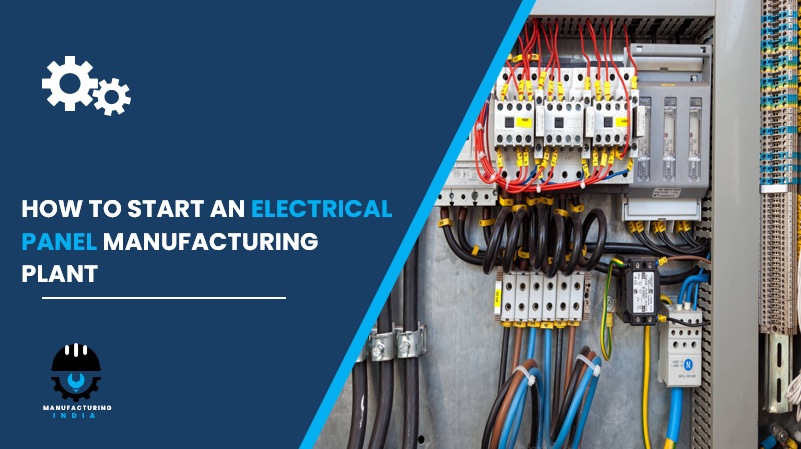
An electrical panel is a critical component in the electrical distribution system that controls and distributes electrical power throughout a building or facility. Essentially a metal enclosure housing circuit breakers, fuses, and other electrical components, it is engineered to protect circuits from overcurrent and short circuits while enabling safe and controlled distribution of power to all connected systems. Electrical panels are also equipped with switchgear to safely disconnect circuits and manage electrical flows, making them indispensable to any powered structure.
These panels come in multiple configurations. Main distribution panels (MDPs) serve as the primary power entry point for a facility, subpanels extend power distribution to specific zones, and motor control centres (MCCs) manage the starting, stopping, and protection of industrial motors. Each variant is selected based on the load profile and operational requirements of the application it serves.
The core production method is a multi-stage process that spans material selection, designing and prototyping, assembly, testing and quality control, and packaging and distribution. End-use industries served include residential buildings, commercial complexes, industrial facilities, power generation plants, renewable energy systems, and marine and offshore installations.
Cost of Setting Up an Electrical Panel Manufacturing Plant in India
The total cost of an electrical panel manufacturing plant depends on capacity, technology choices, plant location, degree of automation, and regulatory compliance obligations. Investors should plan for both one-time capital expenditure and recurring operational costs across a five-year horizon.
1. Capital Expenditure (CapEx)
The capital investment in an electrical panel manufacturing plant in India spans several categories. Land and site development is a foundational outlay and investors may choose to acquire plots in state-designated industrial estates or Special Economic Zones (SEZs) to benefit from stamp duty concessions and ready-made infrastructure. Civil works costs cover the construction of the production shed, raw material storage godowns, finished goods warehousing, a quality testing laboratory, and an administrative block.
Machinery costs account for the largest portion of total capital expenditure. Key machinery required includes:
- Extrusion machines
- Cutting machines
- Forming and moulding machines
- Welding equipment
- Testing and quality control machines
Other capital costs include effluent treatment plant (ETP) setup, pre-operative expenses such as feasibility studies and project report preparation, commissioning charges, and applicable import duties on specialised equipment procured from overseas.
Request a Sample Report for In-Depth Market Insights: https://www.imarcgroup.com/electrical-panel-manufacturing-plant-project-report/requestsample
2. Operational Expenditure (OpEx)
Raw material cost dominates the operating expenditure of this facility, accounting for approximately 70–80% of total OpEx. The primary raw materials are enclosures such as sheet metal (CRCA and aluminum), powder coating and painting materials, electrical components including circuit breakers (MCB, MCCB), contactors, relays, PLCs, and meters, wiring materials such as cables and busbars, and ancillaries including DIN rails, terminal blocks, cooling fans, labels, and manuals. Establishing long-term supply contracts with reliable sheet metal processors and electrical component distributors is essential to stabilise input costs and prevent production disruptions.
Utility costs — electricity, water, and compressed air for the production line — represent 5–10% of OpEx. Additional operating costs include inbound and outbound transportation, packaging materials for finished panels, employee salaries and contract labour, routine machinery maintenance, depreciation on fixed assets, and applicable taxes including GST. By the fifth year of operations, the total operational cost is expected to increase substantially due to inflation, market fluctuations, and potential rises in the cost of key materials such as sheet metal and copper-based components.
3. Plant Capacity
The proposed manufacturing facility is designed with an annual production capacity ranging between 10,000 and 30,000 panels, enabling economies of scale while maintaining operational flexibility. Capacity can be customised per investor requirements — a smaller entry-level plant targeting local demand and a larger facility serving institutional buyers or export markets are both viable models. Profitability improves meaningfully with higher capacity utilisation, as fixed costs such as land lease, depreciation, and supervisory salaries are spread across a larger output volume.
4. Profit Margins and Financial Projections
The project demonstrates healthy profitability potential under normal operating conditions. Gross profit margins typically range between 30–40%, supported by stable demand and value-added applications across sectors. Net profit margins range between 12–18%, reflecting the impact of depreciation, taxation, and financing costs. A comprehensive financial model covering net present value (NPV), internal rate of return (IRR), payback period, liquidity analysis, and sensitivity analysis is essential before committing capital. These metrics allow investors to stress-test the project against raw material price volatility and capacity utilisation risks and to secure debt financing from Indian banks and NBFCs.
Why Set Up an Electrical Panel Plant in India?
Demand for Smart Infrastructure. With the growing adoption of smart buildings and smart grids across India’s Tier-1 and Tier-2 cities, the demand for intelligent electrical panels that can monitor, control, and optimise energy usage is increasing rapidly. Government-backed smart city projects are creating sustained procurement pipelines for advanced panel solutions.
Rising Energy Efficiency and Renewable Integration. The emphasis on energy-efficient construction and green buildings is driving demand for advanced panels that support renewable energy systems, low-energy devices, and smart energy management solutions. As of October 2025, 37.3% of electricity generation in the OECD was derived from renewable sources, reflecting a global shift that India’s own energy transition mirrors — creating long-horizon demand for panels that integrate with solar and wind installations.
Increasing Demand for Safe and Reliable Power Distribution. As Indian industries continue to expand and modernise, the need for safe, reliable, and cost-effective power distribution systems grows across heavy manufacturing, pharmaceuticals, food processing, and data centres.
Growing Infrastructure Development. The demand for electrical panels is heavily influenced by growth in infrastructure development, particularly in emerging economies. India’s ongoing investment in highways, airports, metro rail, and industrial corridors directly drives procurement of panels for construction and permanent facility operations.
Active Industry Investment. In August 2025, SPAN — the creator of smart electrical panels — launched two new models, the SPAN Panel MAIN 16 and MLO 24, designed to support solar and battery installations, ADUs, EV chargers, and other home electrification projects. This signals that the global industry is innovating rapidly and that early movers in the Indian market who adopt advanced panel technology stand to capture premium pricing.
Cost-Competitive Manufacturing and Local Supply Chain Preference. India’s competitive land costs, lower labour rates compared to developed economies, and a maturing domestic supply base for sheet metal, copper busbars, and electrical components make the economics of local production compelling. Residential developers, industrial project contractors, and commercial real estate companies increasingly prefer sourcing from domestic manufacturers for faster delivery, easier after-sales support, and reduced import exposure.
Manufacturing Process – Step by Step
The electrical panel manufacturing process uses material selection, designing and prototyping, assembly, testing and quality control, and packaging and distribution as the primary production method.
- Material Selection: Sheet metal (CRCA, aluminum) is evaluated and procured along with circuit breakers (MCB, MCCB), contactors, relays, PLCs, meters, cables, busbars, DIN rails, terminal blocks, cooling fans, labels, and manuals. Quality of incoming materials is verified before release to production.
- Designing and Prototyping: Engineers prepare electrical schematics and panel layout drawings. Prototypes are fabricated using forming and moulding machines and cutting machines to validate the design against load specifications before batch production begins.
- Assembly: The enclosure is prepared using extrusion machines, cutting machines, and welding equipment. Internal components — circuit breakers, contactors, relays, PLCs, busbars, and wiring — are mounted and connected within the enclosure per the approved schematic.
- Surface Treatment: Powder coating or painting is applied to the metal enclosure for corrosion resistance and finish quality.
- Testing and Quality Control: Every assembled panel is subjected to systematic testing using dedicated testing and quality control machines. Tests verify insulation resistance, dielectric strength, trip response, and load-carrying capacity against applicable standards.
- Packaging and Distribution: Approved panels are labelled, packaged with manuals and accessories, and dispatched to residential, commercial, industrial, power generation, renewable energy, and marine end-use sectors.
Key Applications
Electrical panels serve a diverse range of industries, each with specific power distribution and protection requirements.
- Residential: Used to manage the distribution of electrical power to lighting, heating, cooling, and appliances within homes and apartment complexes.
- Commercial: Designed to handle higher loads and distribute power to HVAC, lighting, and computing systems in office buildings, hotels, and retail spaces.
- Industrial: Used to distribute power to heavy machinery and equipment across manufacturing, processing, and warehousing facilities.
- Power Generation and Renewable Energy: Manages distribution of power from solar, wind, and hydroelectric sources to the grid or storage systems.
- Marine and Offshore: Distributes power and ensures safety of onboard electrical systems including lighting, navigation, and communication equipment.
Leading Manufacturers
The global electrical panel market features several multinational companies with extensive production capacities and diverse application portfolios. Key players include:
- Schneider Electric
- Accu Panels
- Chint Group
- EcoFlow Technology
- Emerson Electric
- General Electric
- Havells India
- Honeywell International
Timeline to Start the Plant
- Feasibility study and project report preparation
- Land acquisition and site development
- Regulatory approvals and environmental clearances
- Factory licence and fire safety compliance
- Machinery procurement and installation
- Raw material supplier agreements and supply chain setup
- Trial production and quality testing
- Commercial production launch
Licences and Regulatory Requirements
Starting an electrical panel manufacturing unit in India requires several approvals:
- Business registration (Proprietorship, LLP, or Pvt Ltd)
- Factory Licence under the Factories Act
- Environmental Clearance from State Pollution Control Board
- GST Registration
- Fire Safety NOC
- Hazardous/Chemical compliance (relevant for chemical coating and surface treatment processes)
- Effluent Treatment Plant (ETP) operational clearance
- Occupational Health and Safety compliance
Key Challenges to Consider
High Capital Requirements. The initial investment in land, civil construction, and specialised machinery represents a significant financial commitment, particularly for investors targeting higher capacity ranges of 20,000–30,000 panels per year.
Raw Material Price Volatility. The cost of sheet metal (CRCA and aluminum), copper busbars, and imported PLCs and relays is subject to global commodity price cycles and currency fluctuations, which can compress margins if not hedged through long-term supplier contracts.
Regulatory Compliance. Obtaining environmental clearances, ETP approvals, factory licences, and fire safety NOCs involves multi-authority coordination and can extend the pre-production timeline if not managed proactively.
Technology and Innovation Pressure. The launch of smart panels such as the SPAN Panel MAIN 16 and MLO 24 in August 2025 signals that the market is evolving toward intelligent, connected products. Manufacturers who do not invest in smart panel capabilities risk commoditisation.
Competition. The presence of well-capitalised global players — including Schneider Electric, General Electric, Emerson Electric, Havells India, and Honeywell International — means that new entrants must compete on price, delivery speed, or product differentiation to win market share.
Skilled Manpower. Assembling and testing electrical panels requires trained electricians and quality control technicians familiar with national and international wiring standards. Sourcing and retaining such talent, particularly in Tier-2 industrial locations, is an ongoing operational challenge.
Frequently Asked Questions
1. How much does it cost to set up an electrical panel manufacturing plant in India?
The total investment depends on plant capacity (ranging between 10,000 and 30,000 panels per year), location, technology, and automation level. A detailed CapEx breakdown covering land, civil works, machinery, and pre-operative costs is available in the full project report.
2. Is electrical panel manufacturing profitable in India in 2026?
Yes. The project demonstrates healthy profitability potential, with gross profit margins of 30–40% and net profit margins of 12–18% under normal operating conditions, supported by stable demand across residential, commercial, and industrial sectors.
3. What machinery is required for an electrical panel plant in India?
Key machinery includes extrusion machines, cutting machines, forming and moulding machines, welding equipment, and testing and quality control machines.
4. What licences and approvals are required to start an electrical panel plant in India?
Required approvals include business registration, Factory Licence, Environmental Clearance from the State Pollution Control Board, GST Registration, Fire Safety NOC, ETP operational clearance, and Occupational Health and Safety compliance.
5. What raw materials are needed for electrical panel manufacturing?
Core raw materials include sheet metal enclosures (CRCA and aluminum), powder coating/painting, circuit breakers (MCB, MCCB), contactors, relays, PLCs, meters, cables, busbars, DIN rails, terminal blocks, cooling fans, labels, and manuals.
6. What are the environmental compliance requirements for an electrical panel plant in India? The facility must obtain Environmental Clearance from the State Pollution Control Board, operate a certified Effluent Treatment Plant, and comply with emission and waste disposal norms applicable to metal fabrication and surface coating operations.
7. What is the best location to set up an electrical panel plant in India?
Industrial estates in Gujarat, Maharashtra, Rajasthan, and Uttar Pradesh offer access to raw material suppliers, skilled labour, and logistics infrastructure. Proximity to major construction markets and electrical component distributors is a key site selection criterion.
8. What is the break-even period for this type of plant in India?
The break-even period depends on plant capacity, utilisation rate, and financing structure. A detailed payback period analysis and NPV calculation are covered in the project report. Investors are encouraged to request a sample report for plant-specific projections.
9. What government incentives are available for manufacturers in India?
Manufacturers may access incentives under the Make in India initiative, state industrial promotion schemes, capital subsidy programmes for MSMEs, and PLI schemes applicable to the electronics and electrical equipment sectors. Specific incentive eligibility depends on plant location and investment scale.
Key Takeaways for Investors
The electrical panel manufacturing plant in India represents a well-rounded investment opportunity, underpinned by demand across residential, commercial, industrial, renewable energy, and marine sectors. The project is financially viable across a range of plant capacities — from 10,000 to 30,000 panels per year — with gross margins of 30–40% and net margins of 12–18% providing a credible return profile for equity and debt investors alike. APAC currently accounts for approximately 38.9% of the global electrical panel market, reflecting the region’s outsized role in driving global demand — a trend India is central to as urbanisation, infrastructure build-out, and energy transition accelerate simultaneously. With smart building adoption, renewable energy integration, and industrial modernisation all serving as long-duration tailwinds, demand sustainability for well-positioned Indian electrical panel manufacturers is strong well into the next decade.
About the Author