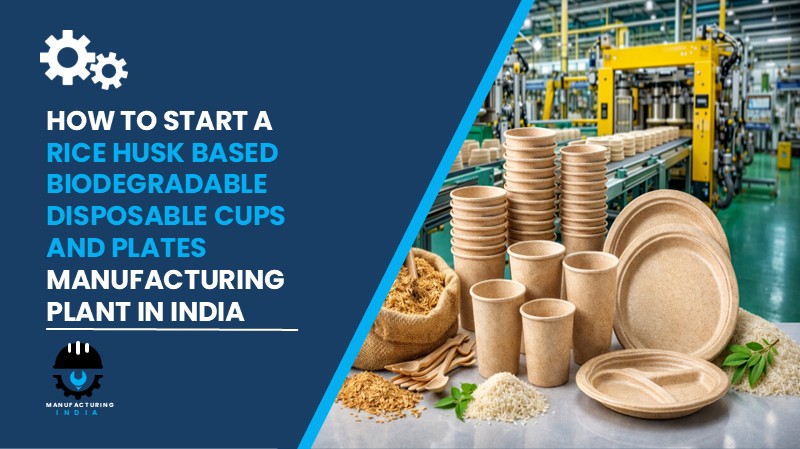
Setting up a rice husk based biodegradable disposable cups and plates manufacturing plant in India presents a compelling investment case, driven by accelerating demand across the foodservice, hospitality, events and catering, institutional catering, and retail packaging industries. As global bans on single-use plastics intensify, businesses across restaurants, hotels, schools, hospitals, and corporate cafeterias are actively transitioning to compostable, plant-derived alternatives. Rice husk based biodegradable disposable cups and plates directly replace single-use plastics and foams, making them central to India’s rapidly evolving sustainable packaging economy.
India’s strategic advantages for this production are substantial. The country is one of the world’s largest rice producers, which ensures an abundant, low-cost, and locally accessible supply of rice husk the primary agricultural by-product used in manufacturing. Government initiatives such as Make in India and increasingly stringent national regulations on plastic disposables are creating strong policy momentum for manufacturers. States such as Gujarat, Maharashtra, Uttar Pradesh, and Punjab with well-developed industrial estates, logistics infrastructure, and proximity to rice-growing belts offer ideal conditions for establishing a rice husk based biodegradable disposable cups and plates manufacturing plant.
India’s combination of abundant agricultural raw material, cost-competitive manufacturing, and a policy environment favouring eco-friendly alternatives makes this investment both timely and financially viable. With gross margins of 35-40% and a net margin range of 18-25%, a well-structured plant delivering 500 to 1,000 million pieces annually can achieve break-even within 3 to 6 years, supporting a credible long-term return on capital.
What Are Rice Husk Based Biodegradable Disposable Cups and Plates?
Rice husk based biodegradable disposable cups and plates are eco-friendly tableware products made from rice husk fibers a by-product of rice milling mixed with natural binders and biodegradable additives. These products are compostable, light in weight, resistant to heat, and contain no petroleum-based plastic content. Rice husk fibers provide structural support, thermal insulation, and moisture resistance, making them suitable for both hot and cold food applications. The products break down naturally in compost conditions, causing no landfill accumulation and no plastic pollution, and they comply with food safety standards positioning them as a sustainable alternative to conventional plastic and foam disposables.
The production method is a multi-stage operation encompassing rice husk processing, fiber pulping, molding, drying, and finishing. Product variants include disposable cups, plates, bowls, trays, and food containers. End-use industries served include foodservice, hospitality, events and catering, institutional catering, and retail packaging.
Cost of Setting Up a Rice Husk Based Biodegradable Disposable Cups and Plates Manufacturing Plant in India
The total investment required for establishing a rice husk based biodegradable disposable cups and plates manufacturing plant in India depends on several factors, including plant capacity, technology selected, degree of automation, geographic location, and regulatory compliance obligations.
1. Capital Expenditure (CapEx)
Capital expenditure for a rice husk based biodegradable disposable cups and plates plant covers multiple cost heads. Land and site development including land registration, boundary development, and related infrastructure forms a substantial part of the overall investment and is best optimised by locating the unit within a Special Economic Zone (SEZ) or designated industrial estate, which also offers tax and regulatory benefits. Civil works encompass the construction of production sheds, quality control laboratories, raw material storage, finished goods warehouses, and administrative blocks, all designed to support safe and efficient plant operations.
Machinery costs account for the largest single portion of total capital expenditure. Key machinery required includes:
- Rice husk grinder and pulverizer
- Fiber mixing and blending unit
- Thermoforming or compression molding machines
- Hydraulic forming presses
- Trimming and cutting machines
- Drying ovens and finishing equipment
- Automatic packing units
Other capital costs include effluent treatment plant (ETP) installation, pre-operative and commissioning expenses, and import duties applicable to specialised machinery components.
Request a Sample Report for In-Depth Market Insights: https://www.imarcgroup.com/rice-husk-based-biodegradable-disposable-cups-plates-manufacturing-plant-project-report/requestsample
2. Operational Expenditure (OpEx)
Raw material cost is the dominant driver of operating expenditure, accounting for approximately 40-45% of total OpEx. Key raw materials include rice husk powder, binders (starch-based), water, and natural dyes; sugarcane bagasse or corn starch may also be incorporated to enhance product durability. Entering long-term supply contracts with reliable local suppliers is a recommended strategy to mitigate price volatility and ensure continuity of production.
Utility costs covering electricity, water, and process energy requirements represent approximately 8-10% of total operating expenses. Additional operating cost components include transportation, packaging materials, salaries and wages, routine maintenance, depreciation, and applicable taxes. By the fifth year of operations, total OpEx is projected to increase substantially due to inflation, market fluctuations, potential rises in key material costs, and the effects of rising consumer demand and global supply chain dynamics.
3. Plant Capacity
The proposed processing facility is designed with an annual production capacity ranging between 500 million and 1,000 million pieces, enabling economies of scale while maintaining operational flexibility. Capacity can be customised per individual investor requirements, and profitability improves meaningfully with higher capacity utilisation rates across both fixed and variable cost categories.
4. Profit Margins and Financial Projections
The financial projections for a rice husk based biodegradable disposable cups and plates plant demonstrate healthy profitability under normal operating conditions. Gross profit margins typically range between 35-40%, supported by stable demand and value-added applications. Net profit margins range between 18-25%. A comprehensive financial analysis covering NPV, IRR, payback period, profit and loss account, sensitivity analysis, and break-even modelling is essential for securing funding and formulating a clear investment strategy. The break-even period for this type of plant typically ranges from 3 to 6 years, depending on scale, raw material pricing, regulatory compliance costs, and prevailing market demand.
Why Set Up a Rice Husk Based Biodegradable Disposable Cups and Plates Plant in India?
Plastic Waste Reduction Imperative. According to the Organisation for Economic Co-operation and Development (OECD), global plastic waste generation is projected to nearly triple by 2060, with approximately half expected to be disposed of in landfills and less than 20% being recycled. This creates an irreversible, long-term structural shift toward compostable disposables, placing manufacturers of rice husk based products at the centre of a global demand transformation.
Abundant and Low-Cost Raw Material Availability. Rice husk, an agricultural residue from rice milling, is available in large volumes across India’s major rice-producing states. This not only ensures a consistent, low-cost supply but also supports the country’s waste-to-product and circular economy priorities, reducing raw material import dependency.
Regulatory Tailwinds and Policy Support. In August 2025, India’s Ministry of Environment, Forest and Climate Change observed World Environment Day 2025 under the theme “One Nation, One Mission,” hosting approximately 69,000 events with participation from nearly 21 lakh people nationwide. The initiative promoted reduced single-use plastic consumption through stricter enforcement and active promotion of eco-friendly alternatives directly benefiting producers in this segment. Make in India further incentivises domestic manufacturing scale-up.
Cost-Competitive Manufacturing. India offers significant cost advantages in land acquisition, civil construction, labour, and utility tariffs relative to other major manufacturing destinations. Industrial estates across Gujarat, Maharashtra, and Uttar Pradesh provide ready infrastructure, reducing pre-operational timelines and capital outlay for greenfield investors.
Active Industry Investment and Innovation. In June 2025, Bengaluru-based startups Turtle Tales, Eha, and Irida Naturals expanded their portfolios of drinkware and tableware made from rice husk waste to mark World Environment Day, with Turtle Tales rolling out its HuskMade range of insulated mugs and cups sourced from local Karnataka rice mills. In March 2025, Eha introduced its HuskMade Cutting Chai Cups microwave- and dishwasher-safe cups manufactured from rice husk reinforcing the growing commercial appetite for this product category.
Asia-Pacific Market Leadership. The Asia-Pacific region dominates the global market, holding approximately 48% of the rice husk based biodegradable disposable cups and plates market share, driven by abundant rice production, low-cost raw material availability, and supportive government policies. India’s position within this dominant region offers additional export opportunity alongside domestic demand growth.
Manufacturing Process Step by Step
The rice husk based biodegradable disposable cups and plates manufacturing process uses rice husk processing, fiber pulping, molding, drying, and finishing as the primary production method. The full sequence of unit operations is as follows:
- Collection and Cleaning: Rice husk is collected and cleaned to remove impurities and prepare it for downstream processing.
- Pulverizing: The cleaned rice husk is fed into a rice husk grinder and pulverizer, reducing it to fine, uniform powder particles suitable for mixing.
- Mixing and Blending: The pulverized powder is combined with natural binders (starch-based) and additives such as natural dyes using a fiber mixing and blending unit to achieve a homogeneous feedstock.
- Molding: The blended mixture is shaped into cup, plate, bowl, tray, or container forms using thermoforming or compression molding machines and hydraulic forming presses under controlled heat and pressure.
- Drying: Molded products pass through drying ovens to remove residual moisture and achieve structural hardness and dimensional stability.
- Trimming and Finishing: Excess material is removed using trimming and cutting machines, and finishing equipment is applied to achieve the required surface quality and food-contact compliance.
- Quality Inspection and Packaging: Finished products are inspected against food safety and compostability standards before being packed using automatic packing units.
- Storage and Dispatch: Completed stock is stored in the finished goods warehouse and dispatched to foodservice, hospitality, events, institutional, and retail packaging customers.
Key Applications
Rice husk based biodegradable disposable cups and plates serve a broad range of industries where single-use, compostable tableware is in active demand:
- Foodservice Industry: Applicable for serving hot and cold drinks, food items, and takeaway across restaurants and cafes.
- Hospitality Sector: Used in hotels, resorts, and banquets for eco-friendly dining options aligned with sustainability commitments.
- Events and Catering: Chosen for weddings, conferences, and large gatherings because of their sustainability compliance and ease of disposal.
- Institutional Catering: Common in schools, offices, hospitals, and cafeterias for single-use dining in high-volume settings.
- Retail and Packaging: Used for ready-to-eat goods packaging and increasingly preferred by eco-conscious retail brands.
Leading Manufacturers
The global rice husk based biodegradable disposable cups and plates industry includes a growing number of processors with diverse production capacities serving end-use sectors across foodservice, hospitality, and retail packaging. Key players identified in the market include:
- Biofutura
- EcoSoul Home
- Bionatic GmbH
- Earthens
- Ecoware
- Envigreen
- Biotrem
- Green Home
- Nature Bio Foods
- GreenGood
- Pappco Greenware
- Green Man Packaging
- Greenvale Eco Products
- Natural Tableware
- Saattvic EcoCare Products
- Ecoware Solutions Pvt. Ltd.
- Shandong Tranlin Straw New Environmental Technology
- Cangzhou Weikang Food & Pharmaceutical
- Behzist Biodegradable Tableware
- Thooshan
Timeline to Start the Plant
Establishing a rice husk based biodegradable disposable cups and plates manufacturing plant in India typically requires 12 to 24 months from concept to commercial launch. The key phases are:
- Feasibility study and project report preparation
- Land acquisition and site development
- Regulatory approvals and environmental clearances
- Factory licence and fire safety compliance
- Machinery procurement and installation
- Raw material supplier agreements and supply chain setup
- Trial production and quality testing
- Commercial production launch
Licences and Regulatory Requirements
Starting a rice husk based biodegradable disposable cups and plates manufacturing unit in India requires several approvals:
- Business registration (Proprietorship, LLP, or Pvt Ltd)
- Factory Licence under the Factories Act
- Environmental Clearance from State Pollution Control Board
- GST Registration
- Fire Safety NOC
- Effluent Treatment Plant (ETP) operational clearance
- Occupational Health and Safety compliance
Key Challenges to Consider
High Capital Requirements. Establishing the facility demands significant upfront capital investment covering land, civil works, and specialised machinery including pulverizers, molding machines, and drying ovens. Investors should plan for adequate working capital headroom through the ramp-up phase.
Raw Material Price Volatility. The cost of rice husk powder, starch-based binders, and natural dyes can fluctuate with agricultural cycles and seasonal availability. Long-term supplier contracts and strategic inventory management are critical to protecting operating margins.
Regulatory Compliance. Environmental clearances, ETP operations, and food-contact safety certifications require ongoing management. Non-compliance can result in production stoppages and financial penalties, making proactive regulatory engagement essential.
Technology and Innovation Pressure. The biodegradable tableware sector is witnessing rapid product development, as demonstrated by new market entries such as the HuskMade range (June 2025) and Eha’s microwave-safe Cutting Chai Cups (March 2025). Manufacturers must invest in process optimisation to remain competitive.
Competition from Established Players. The market includes well-established players such as Ecoware, Envigreen, Pappco Greenware, EcoSoul Home, and GreenGood, among others. New entrants must differentiate through product quality, pricing strategy, and distribution reach.
Skilled Manpower. Operating thermoforming, compression molding, and quality assurance systems requires trained technical personnel. Recruiting and retaining skilled operators and quality control staff is an ongoing operational priority.
Frequently Asked Questions
1. How much does it cost to set up a rice husk based biodegradable disposable cups and plates manufacturing plant in India? Total investment depends on plant capacity, technology, automation level, and location. Capital costs cover land and site development, civil construction, machinery procurement, and pre-operative expenses. A detailed project report provides plant-specific cost modelling.
2. Is rice husk based biodegradable disposable cups and plates manufacturing profitable in India in 2026? Yes. The unit demonstrates gross margins of 35–40% and net margins of 18–25% under normal operating conditions, supported by strong demand growth and regulatory tailwinds favouring compostable tableware.
3. What machinery is required for a rice husk based biodegradable disposable cups and plates plant in India? Key equipment includes a rice husk grinder and pulverizer, fiber mixing and blending unit, thermoforming or compression molding machines, hydraulic forming presses, trimming and cutting machines, drying ovens and finishing equipment, and automatic packing units.
4. What licences and approvals are required to start a rice husk based biodegradable disposable cups and plates plant in India? Required approvals include business registration, Factory Licence under the Factories Act, Environmental Clearance from the State Pollution Control Board, GST Registration, Fire Safety NOC, ETP operational clearance, and Occupational Health and Safety compliance.
5. What raw materials are needed for rice husk based biodegradable disposable cups and plates manufacturing? Primary raw materials are rice husk powder, starch-based binders, water, and natural dyes. Sugarcane bagasse or corn starch may also be incorporated to enhance product durability.
6. What are the environmental compliance requirements for a rice husk based biodegradable disposable cups and plates plant in India? Plants must obtain Environmental Clearance from the State Pollution Control Board, install and operate an Effluent Treatment Plant, and comply with emission standards and Occupational Health and Safety requirements. Advanced monitoring systems should be deployed to detect process deviations.
7. What is the best location to set up a rice husk based biodegradable disposable cups and plates plant in India? Ideal locations combine proximity to rice-growing regions (ensuring low-cost raw material access), robust logistics and utilities infrastructure, and availability within industrial estates or SEZs. States such as Punjab, Uttar Pradesh, West Bengal, and Andhra Pradesh are well-positioned given their rice production volumes.
8. What is the break-even period for this type of plant in India? The break-even period typically ranges from 3 to 6 years, depending on plant scale, raw material pricing, regulatory compliance costs, and prevailing market demand. Higher capacity utilisation accelerates the payback timeline.
9. What government incentives are available for manufacturers in India? Governments may offer incentives such as capital subsidies, tax exemptions, reduced utility tariffs, export benefits, and interest subsidies to promote biodegradable manufacturing under various national and regional industrial policies. Make in India provides an overarching framework supporting domestic manufacturing investment.
Key Takeaways for Investors
The rice husk based biodegradable disposable cups and plates manufacturing plant in India represents a high-relevance investment opportunity anchored in structural demand growth across foodservice, hospitality, institutional catering, and retail packaging sectors all of which are rapidly transitioning away from single-use plastics under regulatory and consumer pressure. The financial profile is compelling across a range of plant capacities, with gross margins of 35-40%, net margins of 18-25%, and a break-even window of 3 to 6 years making this investment viable for both mid-scale and larger industrial investors. Asia-Pacific already commands approximately 48% of the global market, and India’s position at the heart of this growth region combining abundant rice husk availability, cost-competitive manufacturing, and active policy support provides a structurally sound foundation for long-term demand sustainability. As OECD data projects global plastic waste to nearly triple by 2060 with less than 20% recycled, the transition to compostable tableware is not a cyclical trend but a permanent market shift, ensuring durable demand for well-positioned Indian manufacturers.
About the Author