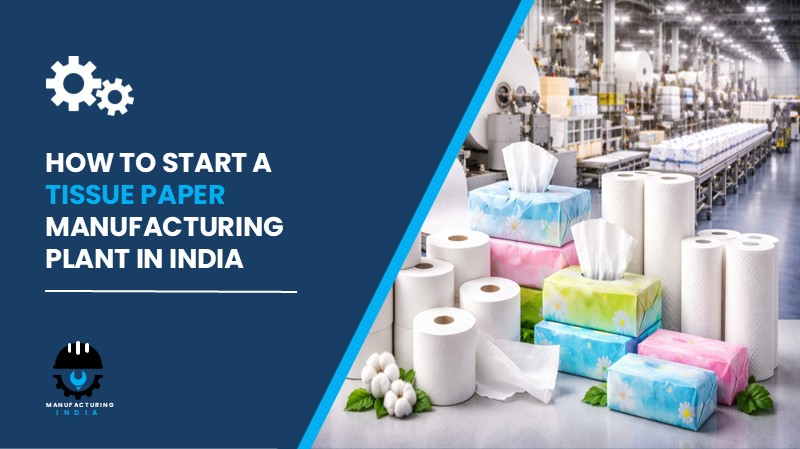
Setting up a tissue paper manufacturing plant in India presents a compelling investment case driven by surging demand from household and residential consumers, the expanding hospitality and HoReCa sector, and the rapid growth of healthcare and pharmaceutical facilities. Rising hygiene awareness, increasing urbanisation, and a decisive shift toward disposable and single-use paper products have created a consistent, repeat-demand market that rewards investors at virtually every plant capacity. The growing population base and evolving consumer lifestyles continue to strengthen offtake across both residential and commercial segments, making this one of the most resilient manufacturing opportunities in the consumer goods space today.
India’s unique combination of cost-competitive land, a large and trainable workforce, proximity to raw material supply chains, and strong policy momentum under the Make in India initiative makes it strategically sound for this type of production. Industrial estates and Special Economic Zones in states such as Gujarat, Maharashtra, Uttar Pradesh, and Andhra Pradesh offer ready infrastructure, utility connectivity, and regulatory facilitation for new manufacturing units. With the global tissue paper market valued at USD 81.27 billion in 2025 and projected to reach USD 126.08 billion by 2034 at a CAGR of 5.0%, an India-based plant is well-positioned to serve both domestic consumption growth and export demand across South and Southeast Asia.
India combines a high-growth domestic market, policy support through Make in India, and cost-competitive manufacturing to create one of the most viable environments for tissue paper production. With gross margins typically ranging between 25-35% and a break-even window of two to four years, this investment offers both near-term profitability and long-term demand sustainability across household, hospitality, and healthcare end-use sectors.
What is Tissue Paper?
Tissue paper is a soft, light, and absorbent paper product produced from virgin pulp, recycled paper, or a combination of both. It is a single-use product defined by its core properties of hygiene, cleanliness, and ease of use. Key product variants produced in this category include toilet paper, paper towels, paper napkins, kitchen towels, and wiping cloths. All variants share the characteristics of softness, absorbency, tensile strength, and rapid biodegradability, making them suitable for a wide range of consumer and institutional applications.
The primary production method is a multi-stage process involving pulping, stock dilution, sheet making, pressing and drying, creping, rewinding and cutting, quality checking, and packing. Advancements in pulp processing and papermaking technologies now allow manufacturers to produce higher-quality products while reducing fiber and water consumption. Growing environmental consciousness has further accelerated adoption of recyclable and sustainably sourced raw materials. End-use industries served by tissue paper production include the household and residential sector, the hospitality and HoReCa sector, healthcare and pharmaceutical facilities, commercial offices, and industrial cleaning applications.
Cost of Setting Up a Tissue Paper Manufacturing Plant in India
The total cost of establishing a tissue paper manufacturing plant in India depends on plant capacity, technology selection, geographic location, degree of automation, and regulatory compliance requirements. Investors should evaluate both capital and operational expenditure carefully before committing to a project.
1. Capital Expenditure (CapEx)
The largest component of CapEx for a tissue paper plant is machinery, followed by civil construction and land. Land and site development costs include charges for land registration, boundary development, and related site preparation. Locating the facility within an industrial estate or SEZ can reduce land costs, accelerate regulatory approvals, and improve access to utilities and logistics infrastructure.
Civil works and construction covers the main production shed, quality control laboratory, raw material and finished goods warehouses, utility blocks, and administrative offices. The layout must accommodate separate zones for raw material storage, production, quality control, and finished product dispatch, with planned space for future capacity expansion.
Machinery and equipment represent the highest single-line item in the capital budget. Key machinery required includes:
- Pulping machines to break down wood or recycled paper into pulp
- Papermaking machines for forming sheets of paper from the pulp
- Pressing and drying machines to remove moisture from the formed paper
- Creping systems for texture and softness development
- Rewinding machines to convert large paper rolls into manageable rolls
- Cutting machines to convert rolls into finished tissue products
- Packaging machines for bundling or boxing finished products for distribution
Other capital costs include effluent treatment plant (ETP) installation, pre-operative and commissioning expenses, and any applicable import duties on specialised paper machine components.
Request a Sample Report for In-Depth Market Insights: https://www.imarcgroup.com/tissue-paper-manufacturing-plant-project-report/requestsample
2. Operational Expenditure (OpEx)
Raw material cost is the dominant driver of ongoing operational expenses. Primary inputs for tissue paper production include wood pulp, paper fibre, water, and softening or strengthening agents. Optional bleaching chemicals enhance whiteness, while additives fine-tune softness and absorbency based on end use. Raw materials collectively account for approximately 55-65% of total OpEx. Investors should negotiate long-term contracts with reliable domestic pulp and recycled paper suppliers to stabilise pricing and mitigate supply chain disruptions.
Utility cost covering electricity, water, and steam accounts for approximately 20-25% of total OpEx and represents the second-largest ongoing expense category. Energy-efficient paper machines and water recycling systems are recommended to manage utility costs over the plant’s lifecycle.
Other operating costs include transportation and logistics, packaging materials, salaries and wages, routine maintenance, depreciation, and applicable taxes. By the fifth year of operations, total operational costs are expected to increase substantially due to inflation, market fluctuations, and potential rises in key raw material prices. Supply chain disruptions, rising consumer demand, and shifts in the global economy are also expected to contribute to cost escalation, making a 5-year cost projection essential for sound financial planning.
3. Plant Capacity
The proposed manufacturing facility is designed with an annual production capacity ranging between 30,000 and 60,000 MT, enabling economies of scale while maintaining operational flexibility. Capacity can be customised to suit individual investor requirements, with smaller entry-scale configurations available for first-time entrants. Profitability improves measurably with higher capacity utilisation, as fixed costs are distributed across a larger production volume, directly improving gross and net margins.
4. Profit Margins and Financial Projections
The tissue paper manufacturing plant project demonstrates healthy profitability potential under normal operating conditions. Gross profit margins typically range between 25-35%, supported by stable and recurring demand across all end-use sectors. Net profit margins typically fall in the range of 10-15%. A full financial model covers NPV, IRR, payback period, gross margin, and net margin across a five-year projection horizon. The break-even period for a tissue paper plant in India typically ranges from two to four years, depending on production scale, market demand, operational efficiency, and raw material cost management.
Why Set Up a Tissue Paper Plant in India?
Rising Hygiene Awareness. Increased focus on cleanliness and sanitation continues to drive demand for disposable tissue paper products. The World Health Organization’s latest monitoring estimated that coverage of basic hygiene services reached approximately 88.8% in 2025 due to global expansion of safely managed services, further boosting institutional and household demand for tissue products.
Consistent and Repeat Demand. A high-frequency consumption pattern across residential and commercial sectors guarantees stable, recurring offtake volumes throughout the year. This demand consistency is a key risk-mitigation factor that distinguishes tissue paper from cyclical manufacturing opportunities.
Growth in Hospitality and Healthcare. The increasing number of hotels, restaurants, hospitals, and clinics across India’s Tier 1 and Tier 2 cities creates a structural, long-term growth channel for tissue paper manufacturers. Sanitation, patient care, and infection control requirements in healthcare settings make tissue paper a non-discretionary procurement item.
Sustainability and Recycling Opportunities. Recycled paper usage and eco-friendly production methods help manufacturers achieve environmental compliance while improving brand value among institutional buyers. Growing sustainability mandates from hospitality chains and healthcare networks are favouring suppliers with verifiable green manufacturing credentials.
Scalable Production Model. The tissue paper manufacturing model permits gradual capacity expansion with effective cost control, making it suitable for both greenfield investors and established paper companies looking to diversify into hygiene products.
Active Industry Investment. In August 2025, Jani Sales finalised a deal for its 80 TPD PM 3 Tissue Paper Machine, set to begin production in 2026, bringing total annual tissue paper output to 82,000 tons across three machines. In March 2025, Metsä Group continued investments in fresh-fibre tissue production, including a new hand towel line under the EUR 100 million Future Mill programme expected to start in 2026, targeting a 75-80% reduction in water use and a 25% improvement in energy efficiency.
Manufacturing Process – Step by Step
The tissue paper manufacturing process uses pulping, sheet formation, pressing and drying, and downstream converting operations as the primary production method. Each stage requires specialised equipment and stringent quality checks.
- Pulp Preparation: Wood pulp or recycled paper fibre is broken down in pulping machines with water to create a uniform pulp slurry ready for sheet formation
- Sheet Formation: Papermaking machines form continuous sheets of paper from the diluted pulp slurry on a wire mesh
- Pressing and Drying: Pressing and drying machines remove moisture from the formed sheet, increasing tensile strength
- Creping and Reeling: Creping systems impart softness and texture to the paper sheet, which is then wound onto large parent reels
- Rewinding and Slitting: Rewinding machines convert large parent rolls into smaller, commercial-sized rolls at specified widths
- Embossing: Embossing units apply patterns that enhance softness, absorbency, and aesthetic appeal
- Quality Checking: Analytical instruments and quality control systems monitor product concentration, purity, softness, and dimensional stability throughout production
- Packaging and Dispatch: Packaging machines bundle or box finished products for distribution to household, hospitality, healthcare, and industrial end-use customers
Key Applications
Tissue paper serves a broad range of industries and end-use segments across India’s consumer and institutional markets.
- Household and Residential Use: Widely used for daily hygiene needs, offering convenience, softness, and disposable functionality for consumers
- Hospitality and HoReCa Sector: Essential in hotels, restaurants, and catering services for maintaining hygiene standards and enhancing customer satisfaction
- Healthcare and Medical Facilities: Used in hospitals and clinics for sanitation, patient care, and infection control
- Commercial and Industrial Use: Supplied to offices and industrial units for workplace maintenance, cleaning, and hygiene management
Leading Manufacturers
The global tissue paper industry is served by several multinational companies with extensive production capacities and diverse application portfolios. Key players include:
- Asia Pulp and Paper Group (APP)
- Georgia-Pacific LLC
- Kimberly-Clark Corporation
- Procter & Gamble Company
- Hengan International Group Company Limited
Timeline to Start the Plant
- Feasibility study and project report preparation
- Land acquisition and site development
- Regulatory approvals and environmental clearances
- Factory licence and fire safety compliance
- Machinery procurement and installation
- Raw material supplier agreements and supply chain setup
- Trial production and quality testing
- Commercial production launch
The overall timeline typically ranges from 12 to 15 months, covering site setup, machinery installation, regulatory approvals, and workforce training.
Licences and Regulatory Requirements
Starting a tissue paper manufacturing unit in India requires several approvals:
- Business registration (Proprietorship, LLP, or Private Limited Company)
- Factory Licence under the Factories Act
- Environmental Clearance from the State Pollution Control Board
- GST Registration
- Fire Safety NOC
- Effluent Treatment Plant (ETP) operational clearance
- Occupational Health and Safety compliance
- Industry-specific permits as mandated by local, state, or national regulations
Key Challenges to Consider
High Capital Requirements. Land acquisition, civil construction, and paper machine procurement represent a substantial upfront investment that requires careful financial planning and funding strategy.
Raw Material Price Volatility. Key inputs including wood pulp, paper fibre, and bleaching chemicals are subject to global commodity price fluctuations, requiring long-term supplier contracts and hedging strategies to protect margins.
Regulatory Compliance. Environmental clearances, effluent treatment obligations, and factory safety standards require dedicated compliance resources and ongoing monitoring systems throughout the plant’s operational life.
Technology and Innovation Pressure. Advances in paper machine efficiency, water recycling, and energy consumption reduction as demonstrated by Metsa Group’s EUR 100 million Future Mill programme require manufacturers to invest continually in technology upgrades to remain competitive.
Competition. Global players including Asia Pulp and Paper Group (APP), Georgia-Pacific LLC, Kimberly-Clark Corporation, Procter & Gamble Company, and Hengan International Group represent formidable competition, particularly in the premium and branded tissue segments.
Skilled Manpower. Operating papermaking machines, maintaining creping and rewinding systems, and managing quality assurance processes require trained technicians and engineers who must be recruited and retained proactively.
Frequently Asked Questions
1. How much does it cost to set up a tissue paper manufacturing plant in India? Capital requirements depend on plant capacity, technology selection, and location. Costs cover land acquisition, civil construction, paper machinery, utilities, pre-operative expenses, and initial working capital. A detailed feasibility report provides location- and capacity-specific estimates.
2. Is tissue paper manufacturing profitable in India in 2026? Yes. Gross profit margins typically range between 25-35% and net profit margins between 10-15%, with profitability improving with higher capacity utilisation and efficient raw material procurement.
3. What machinery is required for a tissue paper plant in India? Key machinery includes pulping machines, papermaking machines, pressing and drying machines, creping systems, rewinding machines, cutting machines, and packaging machines.
4. What licences and approvals are required to start a tissue paper plant in India? Requirements include business registration, Factory Licence, Environmental Clearance from the State Pollution Control Board, GST Registration, Fire Safety NOC, ETP clearance, and occupational health and safety compliance.
5. What raw materials are needed for tissue paper manufacturing? Primary raw materials include wood pulp, paper fibre, water, and softening or strengthening agents. Optional bleaching chemicals and performance additives are used based on end-use product specifications.
6. What are the environmental compliance requirements for a tissue paper plant in India? Investors must obtain Environmental Clearance from the State Pollution Control Board, install and operate an effluent treatment plant, comply with emission standards, and maintain documentation for regulatory traceability.
7. What is the best location to set up a tissue paper plant in India? Locations that offer proximity to pulp and recycled paper suppliers, reliable utility supply, strong logistics connectivity, and access to industrial estate or SEZ infrastructure such as those in Gujarat, Maharashtra, or Uttar Pradesh are strategically advantageous.
8. What is the break-even period for this type of plant in India? The break-even period typically ranges from two to four years, depending on production scale, market demand, operational efficiency, and raw material cost management.
9. What government incentives are available for manufacturers in India? Governments may offer capital subsidies, tax exemptions, reduced utility tariffs, export benefits, or interest subsidies under various national and regional industrial policies, including Make in India and state-level manufacturing promotion schemes.
Key Takeaways for Investors
The tissue paper manufacturing plant investment opportunity in India is supported by strong and recurring demand from household consumers, the hospitality and HoReCa sector, healthcare facilities, and commercial and industrial end-users. The production model is financially viable across a range of plant capacities, with gross margins of 25-35% and net margins of 10-15% achievable under normal operating conditions. The global tissue paper market, valued at USD 81.27 billion in 2025, is on a clear growth trajectory toward USD 126.08 billion by 2034 at a CAGR of 5.0%, providing a long runway for capacity expansion and export revenue. With hygiene awareness rising, urbanisation accelerating, and institutional procurement of disposable paper products growing structurally across South Asia, demand sustainability for India-based tissue paper manufacturers is strong and enduring.
About the Author