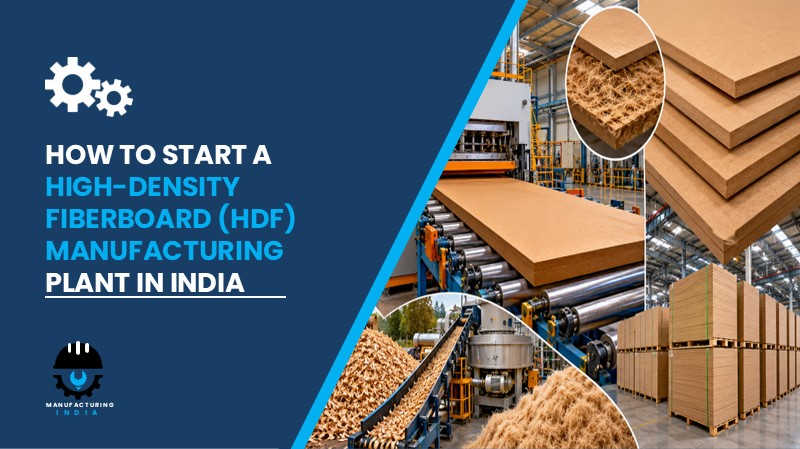
Setting up a high-density fiberboard manufacturing plant in India presents a compelling investment case driven by the expanding construction and furniture sectors, rising demand for engineered wood panels, increasing urbanisation, and the growing preference for cost-effective and sustainable wood alternatives. The global high-density fiberboard (HDF) market was valued at USD 11.28 Billion in 2025 and is projected to reach USD 21.63 Billion by 2034, exhibiting a CAGR of 7.5% from 2026 to 2034. India’s booming real estate and infrastructure development activities — fuelling demand for flooring substrates, furniture panels, interior panelling, and wall cladding — position domestic production as a commercially compelling opportunity with a long and predictable demand horizon.
India’s structural advantages make it a strategically sound location for this type of investment. Rapid urbanisation and infrastructure growth across Tier-1 and Tier-2 cities are creating sustained demand for wood panels in residential and commercial construction. The Make in India initiative, combined with the availability of wood fibre residues from domestic sawmills in states such as Madhya Pradesh, Maharashtra, and Andhra Pradesh, supports cost-competitive local production. With construction and modular furniture companies increasingly preferring locally sourced panels to reduce import dependence and lead times, the strategic rationale for establishing a plant within India is strong and compelling.
A high-density fiberboard manufacturing plant in India benefits from robust policy support, competitive raw material availability, and consistent demand from construction, furniture, and flooring sectors. With gross margins of 25–35% and net margins of 12–18% achievable across capacities of 100,000–300,000 cubic metres annually, this is a financially viable, long-horizon investment with clear break-even potential.
What is High-Density Fiberboard (HDF)?
High-density fiberboard (HDF) is an engineered wood product manufactured from compressed wood fibres bonded with resins under high pressure and temperature. It is characterised by its high density, smooth surface finish, and superior strength compared to other fiberboards such as MDF. The panels are widely used in applications requiring durability, dimensional stability, and precision machining. They offer excellent resistance to wear and impact, making them suitable for flooring substrates, laminated panels, doors, and furniture components.
The product is compatible with various surface treatments including laminates, veneers, and coatings, enabling aesthetic versatility across interior applications. It is also considered an eco-friendly alternative because it utilises wood residues and by-products from sawmills, supporting sustainable manufacturing practices. The production method — wood chipping and refining, fibre drying, resin blending, mat formation, hot pressing, panel trimming, sanding, and finishing — results in a highly consistent, dense panel. End-use industries served include the construction industry, furniture manufacturing, flooring industry, interior design and décor sector, and packaging industry.
Cost of Setting Up a High-Density Fiberboard Manufacturing Plant in India
The total investment for a high-density fiberboard manufacturing plant depends on production capacity, automation level, technology configuration, location, and regulatory compliance requirements. A well-structured financial plan covering both capital expenditure (CapEx) and operational expenditure (OpEx) is essential for determining viability and break-even timelines. Understanding the HDF manufacturing process is also critical for accurately sizing machinery and estimating infrastructure needs.
1. Capital Expenditure (CapEx)
Capital expenditure represents the one-time investment required to bring the facility into operation. Machinery costs account for the largest portion of total CapEx given the scale and technical complexity of continuous pressing and fibre processing operations.
Land and Site Development costs cover land acquisition, boundary development, registration charges, and site preparation. Locating within a Special Economic Zone (SEZ) or established wood-products industrial estate provides access to fiscal incentives and shared infrastructure. States such as Madhya Pradesh, Andhra Pradesh, and Maharashtra offer natural raw material proximity advantages.
Civil Works and Construction include the main production shed, fibre storage silos, resin storage and blending area, finished goods warehouse, quality control laboratory, and the administrative block. The layout must accommodate heavy-duty hot press equipment and adequate material flow between processing stages.
Machinery and Equipment: Key machinery required includes:
- Debarkers
- Chippers
- Refiners
- Dryers
- Resin blending systems
- Forming machines
- Hot presses
- Sanding machines
- Finishing lines
Other Capital Costs include installation of an Effluent Treatment Plant (ETP), dust collection and emission control systems, pre-operative expenses, machinery commissioning costs, and import duties on technology-specific press or refiner equipment.
Request a Sample Report for In-Depth Market Insights: https://www.imarcgroup.com/high-density-fiberboard-manufacturing-plant-project-report/requestsample
2. Operational Expenditure (OpEx)
Raw Material Cost is the dominant OpEx component, accounting for approximately 60–70% of total operating expenses. Core inputs include wood fibres, resin binders, wax, and hardeners. Wood fibres represent the largest single cost, making proximity to sawmill clusters a critical site selection criterion. Long-term supply contracts with reliable wood fibre and resin suppliers are essential for stabilising input costs.
Utility Cost is the second most significant component, accounting for approximately 20–25% of total OpEx — a notably high share reflecting the energy intensity of hot pressing and fibre drying. Electricity, water, and steam infrastructure must be factored into site selection from the outset. Other Operating Costs include transportation, packaging, salaries and wages, equipment maintenance, depreciation, and applicable taxes. By the fifth year, total operational costs are projected to increase substantially due to inflation, market fluctuations, supply chain disruptions, and rising consumer demand.
3. Plant Capacity
The proposed facility is designed with an annual production capacity of 100,000–300,000 cubic metres, enabling economies of scale while maintaining operational flexibility. Capacity can be customised per investor requirements, and profitability improves significantly with higher capacity utilisation, making ramp-up planning a critical element of the feasibility strategy.
4. Profit Margins and Financial Projections
The investment demonstrates healthy profitability under normal operating conditions. Gross margins typically range between 25–35%, supported by stable demand from construction, flooring, and furniture sectors. Net margins range between 12–18%, reflecting the cost structure achievable at optimal utilisation. Financial analysis covers net present value (NPV), internal rate of return (IRR), payback period, a profit and loss account, and sensitivity analysis — enabling investors to comprehensively assess long-term viability.
Why Set Up a High-Density Fiberboard Plant in India?
Growing Demand for Wood Panels. Increasing construction and furniture activity has accelerated adoption of HDF as a cost-effective alternative to solid wood across India. Developers of residential complexes, commercial offices, and hospitality properties are specifying the boards for flooring, interior panelling, and cabinetry — driving durable, multi-sector demand for domestically manufactured panels.
Real Estate and Infrastructure Expansion. As reported by IMARC, the global real estate market was valued at USD 7,517.4 Billion in 2025, reflecting strong expansion in construction and housing that is fuelling demand for the product. India’s urban infrastructure initiatives — including smart cities, affordable housing schemes, and commercial real estate — are increasing demand for flooring materials, furniture products, and interior panelling solutions.
Sustainability Advantage. Production utilises wood residues and recycled fibres from sawmill operations, aligning with India’s environmental regulations and green building trends. The use of wood waste as a primary raw material reduces dependency on virgin timber, supporting sustainable manufacturing credentials increasingly required by institutional buyers and green-certified construction projects.
Technology-Driven Product Differentiation. Modern continuous pressing and automation technologies enhance production efficiency and quality. In December 2025, Greenpanel Industries Limited launched Duroboil BWP HDF with an ultra-high density of 1,100 kg/m³ and advanced boiling-water-proof performance using German Dieffenbacher CPS technology, targeting marine environments, modular kitchens, and high-traffic commercial spaces — establishing a new benchmark in India’s market.
Active Domestic Industry Innovation. In January 2026, a research study published by the National Library of Medicine demonstrated a formaldehyde-free, low-odour production method using supramolecular tannic acid interactions, producing HDF panels with strong mechanical strength, low benzene emissions, and recyclable fibres — showing that sustainable, regulatory-compliant manufacturing methods are advancing rapidly in the sector.
Modular Interior Solutions Demand. The market has grown because of increasing popularity of ready-to-install interior solutions that require products with consistent density and smooth surface finishes. Construction and furniture companies are prioritising locally manufactured boards to reduce import dependency and benefit from shorter lead times, creating a structurally growing addressable market for domestic producers.
Manufacturing Process – Step by Step
The HDF manufacturing process uses wood chipping and refining as the primary production method, transforming raw wood residues into dense panels through a series of controlled mechanical and thermal operations.
- Wood Chipping: Raw logs and sawmill residues pass through debarkers to remove bark, then feed into chippers to produce uniform wood chips for further processing.
- Refining: Wood chips are steam-treated and fed through refiners that mechanically separate the material into individual wood fibres — the core raw material for panel production.
- Fibre Drying: Refined fibres pass through dryers to reduce moisture content to levels required for consistent board density and resin bonding performance.
- Resin Blending: Resin binders, wax, and hardeners are blended with dried fibres in resin blending systems to prepare the mixture for mat formation.
- Mat Formation: The blended mixture is uniformly distributed by forming machines into a continuous mat of consistent thickness and density in preparation for pressing.
- Hot Pressing: The fibre mat is fed into hot presses operating under high pressure and temperature, bonding fibres and resins into rigid panels with the required structural properties.
- Panel Trimming: Pressed panels are trimmed to specified dimensions using precision cutting equipment.
- Sanding and Finishing: Panels pass through sanding machines to achieve the required smooth surface finish, followed by finishing lines for laminate, veneer, or coating applications.
- Quality Testing and Dispatch: Finished panels undergo inspection for density, dimensional accuracy, and surface quality before being packaged and dispatched to construction, flooring, furniture, and interior design end-use sectors.
Key Applications
The product serves a wide spectrum of industries, combining durability, machinability, and aesthetic versatility in a single engineered panel format.
- Construction Industry: Panels are used in flooring substrates, wall panelling, and structural interior applications due to their durability and smooth finish.
- Furniture Manufacturing: The boards are widely used in cabinets, wardrobes, and furniture components owing to their machinability and strength.
- Flooring Industry: Serves as a base material in laminate flooring systems, providing stability and wear resistance across residential and commercial applications.
- Interior Design and Décor: Enables decorative finishes through laminates and veneers for aesthetic interior applications in residential, hospitality, and commercial spaces.
- Doors and Partitions: Used in the manufacture of flush doors and partition systems requiring dimensional stability and a smooth paintable surface.
- Packaging Industry: Dense and uniform panels provide structural integrity for specialised packaging applications requiring precision-machined components.
Leading Manufacturers
The global high-density fiberboard industry includes several multinational companies with extensive production capacities and diverse application portfolios. Key players in HDF manufacturing include:
- ARAUCO
- Kronospan
- Weyerhaeuser
- Pfleiderer Group
- Woodeco Group
- Greenpanel Industries Limited
- SWISS KRONO GROUP
These manufacturers serve sectors spanning construction, furniture, flooring, interior design and décor, and packaging — setting the product quality and technology benchmarks that new entrants must align with.
Timeline to Start the Plant
Establishing a production unit in India typically requires 18–30 months from initial planning to commercial launch. Key phases include:
- Feasibility study and project report preparation
- Land acquisition and site development
- Regulatory approvals and environmental clearances
- Factory licence and fire safety compliance
- Machinery procurement and installation
- Raw material supplier agreements and supply chain setup
- Trial production and quality testing
- Commercial production launch
Licences and Regulatory Requirements
Starting a high-density fiberboard manufacturing unit in India requires several approvals:
- Business registration (Proprietorship, LLP, or Pvt Ltd)
- Factory Licence under the Factories Act
- Environmental Clearance from the State Pollution Control Board
- GST Registration
- Fire Safety NOC
- Hazardous/Chemical compliance (applicable for resin binders and hardeners handling)
- Effluent Treatment Plant (ETP) operational clearance
- Occupational Health and Safety compliance
Key Challenges to Consider
High Capital Requirements. Establishing this type of plant with industrial-scale hot presses, refiners, dryers, and finishing lines demands significant upfront investment. Structured project finance and equity planning are critical to successfully funding the CapEx phase.
Raw Material Price Volatility. The cost of wood fibres, resin binders, wax, and hardeners is subject to supply-side fluctuations driven by forestry policy changes, sawmill output variability, and global resin pricing trends. Securing long-term supplier contracts and diversified sourcing mitigates this risk.
Regulatory Compliance. Navigating factory licensing, environmental clearances for wood processing and resin use, ETP operations, and dust emission control standards adds time and cost to project execution and requires specialist regulatory advisory support.
Technology and Innovation Pressure. The sector is experiencing rapid innovation, with formaldehyde-free bonding methods and ultra-high density products setting new market benchmarks. Manufacturers must plan for technology upgrades to remain competitive.
Competition from Established Players. Competing against ARAUCO, Kronospan, Weyerhaeuser, Pfleiderer Group, Woodeco Group, Greenpanel Industries Limited, and SWISS KRONO GROUP requires differentiated product strategies and efficient cost management across the value chain.
Skilled Manpower. Operating hot presses, refiner systems, and quality testing equipment requires trained technical personnel, making talent acquisition and retention an ongoing operational priority.
Frequently Asked Questions
1. How much does it cost to set up an HDF manufacturing plant in India?
The total investment depends on plant capacity (100,000–300,000 cu.m annually), technology selection, location, and automation level, covering land, civil works, and machinery including debarkers, refiners, hot presses, sanding machines, and finishing lines. A detailed feasibility report with site-specific cost estimates is essential.
2. Is high-density fiberboard manufacturing profitable in India in 2026?
Yes. The unit demonstrates gross margins of 25–35% and net margins of 12–18%, backed by a global market growing at 7.5% CAGR through 2034 and strong domestic demand from construction and furniture sectors.
3. What machinery is required for an HDF plant in India?
Essential equipment includes debarkers, chippers, refiners, dryers, resin blending systems, forming machines, hot presses, sanding machines, and finishing lines.
4. What licences and approvals are required to start an HDF plant in India?
Key requirements include business registration, Factory Licence, Environmental Clearance, GST Registration, Fire Safety NOC, ETP operational clearance, and Occupational Health and Safety compliance.
5. What raw materials are needed for high-density fiberboard manufacturing?
Core inputs are wood fibres, resin binders, wax, and hardeners. Wood fibres are the dominant cost input, accounting for the largest share of the 60–70% raw material portion of total OpEx.
6. What are the environmental compliance requirements for an HDF plant in India?
Manufacturers must obtain Environmental Clearance from the State Pollution Control Board, operate an approved ETP, install dust collection and emission control systems, and comply with hazardous materials regulations for resin binders and hardeners.
7. What is the best location to set up a high-density fiberboard plant in India?
Locations with proximity to sawmill clusters and forest-based raw material supply — such as Madhya Pradesh, Andhra Pradesh, and Maharashtra — are well-suited. Industrial estates and SEZ locations offer fiscal incentives and logistics connectivity.
8. What is the break-even period for this type of plant in India?
Break-even depends on capacity, capital investment, utilisation rate, and product pricing. A full financial analysis covering NPV, IRR, and payback period projections is available in the detailed project report.
9. What government incentives are available for manufacturers in India?
Manufacturers can access Make in India programme incentives, state-level capital and interest subsidy schemes, SEZ tax benefits, and support from the Ministry of Environment for sustainable wood-based manufacturing initiatives.
Key Takeaways for Investors
This high-density fiberboard manufacturing plant project in India represents a well-founded opportunity anchored in consistent demand from the construction industry, furniture manufacturing, flooring industry, interior design and décor sector, and packaging industry. The financial model is viable across the 100,000–300,000 cu.m annual capacity range, with gross margins of 25–35% and net margins of 12–18% confirming robust returns under normal operating conditions. The global market, valued at USD 11.28 Billion in 2025 and projected to reach USD 21.63 Billion by 2034 at a CAGR of 7.5%, provides a long-horizon growth runway strongly supporting new domestic manufacturing capacity. With Greenpanel Industries Limited establishing new product benchmarks and a strong real estate sector creating structural demand, locally manufactured panels are positioned for durable and expanding market uptake.
About the Author