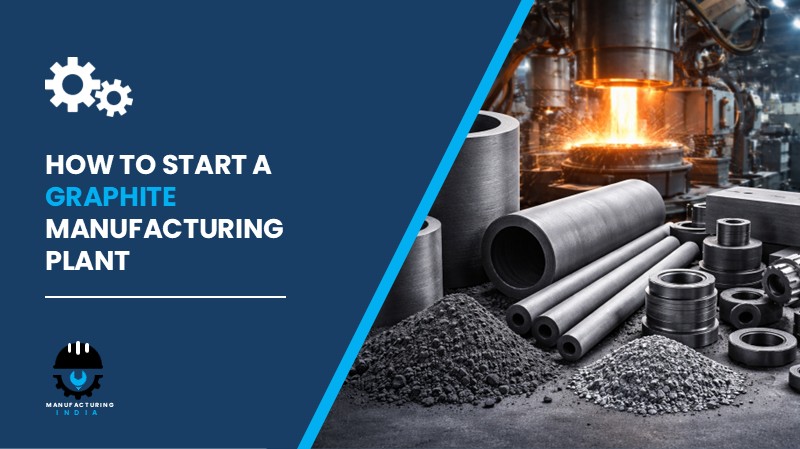
Setting up a graphite manufacturing plant in India presents a compelling investment case driven by the country’s rapidly expanding energy storage, steel, electronics, and industrial manufacturing sectors. Graphite is an indispensable input across lithium-ion battery anodes, refractory linings, electrodes, and industrial lubricants – all industries that are scaling aggressively as India advances its infrastructure, electrification, and industrial modernisation agenda. With electric vehicle adoption accelerating and grid-scale battery storage gaining policy priority, the demand for high-quality graphite is structurally anchored in India’s long-term industrial growth story.
India’s unique combination of cost-competitive land and labour, an expanding domestic supply chain, and strong government thrust under the Make in India initiative makes it one of the most strategically sound locations for establishing a graphite production facility. States such as Gujarat, Maharashtra, and Rajasthan offer proximity to mineral-rich corridors, reliable logistics infrastructure, and established chemical and manufacturing industrial estates that further reduce setup timelines and capital outlay. As domestic battery manufacturers, steel producers, and electronics OEMs increasingly prefer local supply relationships to minimise import risk, a greenfield graphite plant in India is positioned to capture this transition.
Graphite manufacturing in India combines policy support for domestic mineral processing, a cost-competitive production environment, and deep structural demand from energy storage, metallurgy, and electronics sectors – delivering gross margins of 35–45% and net margins of 15–20% that make the break-even case financially compelling across production scales.
What is Graphite?
Graphite is a crystalline variant of carbon, distinguished by its hexagonal layered structure that delivers high electrical conductivity, exceptional thermal stability, chemical inertness, and natural lubricating properties. Raw forms of graphite include flake, amorphous, and vein graphite, while synthetic graphite is produced through high-temperature processing of carbon-rich feedstocks such as petroleum coke and coal tar pitch. Its very high melting point, low friction coefficient, and excellent corrosion resistance make it the material of choice for demanding industrial environments. One of its most commercially significant properties is the ability to intercalate lithium ions, which has established graphite as the dominant anode material in lithium-ion batteries.
The production of graphite involves a multi-step process of crushing, grinding, purification, milling, and classification. The product serves a wide range of end-use industries including energy storage, metallurgy, refractories, electronics, and industrial manufacturing, making it one of the most versatile critical materials in modern industrial supply chains.
Cost of Setting Up a Graphite Manufacturing Plant in India
The overall cost of establishing a graphite manufacturing plant depends on several interrelated factors including annual production capacity, technology choice, degree of automation, selected location, and regulatory compliance obligations. A structured understanding of both capital and operational expenditure is essential for accurate feasibility planning.
1. Capital Expenditure (CapEx)
Land and Site Development: forms a substantial part of the total capital investment. Locating the facility within an SEZ or notified industrial estate can reduce land registration charges, offer infrastructure advantages, and expedite environmental approvals. Boundary development and utility connection charges are typically included at this stage.
Civil Works and Construction: costs cover the main production shed, raw material storage yards, finished goods warehouse, quality control laboratory, effluent treatment area, and the administrative block. Structural specifications must account for the weight of industrial milling and furnace equipment.
Machinery and Equipment: accounts for the largest single portion of total CapEx in a graphite manufacturing plant. Key machinery required includes:
- Crushers for primary and secondary size reduction of raw material
- Grinders and milling machines for particle refinement
- Flotation cells or flotation units for natural graphite ore processing
- Purification systems and purification units for removal of impurities
- High-temperature furnaces and kilns for synthetic graphite graphitization
- Dryers for moisture reduction post-processing
- Classifiers and screening equipment for particle size separation
- Mixing equipment for blending in synthetic graphite lines
- Packaging systems for finished product despatch
Other Capital Costs: include effluent treatment plant (ETP) construction, pre-operative expenses such as feasibility study fees, commissioning costs, and import duties on specialised furnace and purification equipment where applicable.
Request a Sample Report for In-Depth Market Insights: https://www.imarcgroup.com/graphite-manufacturing-plant-project-report/requestsample
2. Operational Expenditure (OpEx)
Raw Material Cost – is the single largest component of operating expenses, accounting for approximately 50–60% of total OpEx. Key raw materials required include natural graphite ore for flake-based production lines, and carbon-rich feedstocks such as petroleum coke and coal tar pitch for synthetic graphite production. Establishing long-term supplier contracts with regional mineral processors is the recommended strategy to stabilise input pricing and ensure supply continuity.
Utility Cost – comprising electricity, water, and steam – represents 25–30% of total OpEx. Graphitization furnaces are particularly energy-intensive, making reliable power access a critical site selection criterion. Proximity to industrial power grids or captive power options can materially reduce per-unit utility costs over the plant’s operational life.
Other Operating Costs – include transportation and inbound logistics for raw materials, outbound packaging and dispatch costs, salaries and wages for technical and operational staff, routine machinery maintenance, depreciation on capital assets, and applicable taxes. By the fifth year of operations, total operational costs are projected to increase substantially owing to inflation, market fluctuations, and potential rises in the cost of key raw materials, with additional pressures from supply chain disruptions and shifts in the global economy.
3. Plant Capacity
The proposed facility design for a graphite manufacturing plant supports an annual production capacity ranging between 10,000 and 20,000 MT, enabling economies of scale while maintaining operational flexibility. Capacity can be customized based on investor requirements and market offtake agreements. Profitability improves meaningfully with higher capacity utilisation rates, as fixed costs are spread across a greater production volume.
4. Profit Margins and Financial Projections
A graphite manufacturing plant demonstrates healthy profitability potential under normal operating conditions. Gross profit margins typically range between 35–45%, supported by stable industrial demand and value-added product applications. Net profit margins range between 15–20% on average across the five-year projection period. The financial model incorporates NPV and IRR calculations, payback period analysis, sensitivity analysis, and uncertainty analysis. Break-even in a graphite manufacturing business typically ranges from 3 to 5 years, depending on production capacity, market demand, raw material cost management, and operational efficiency.
Why Set Up a Graphite Plant in India?
Critical Role in Energy Storage Transition: Graphite is the primary anode material in lithium-ion batteries that power electric vehicles, portable electronics, and grid-scale stationary energy storage systems. As India accelerates EV adoption and deploys renewable energy infrastructure, domestic demand for battery-grade graphite is growing at a structural pace that makes local manufacturing commercially viable.
Steel and Metallurgy Demand: Increasing steel production in India continues to drive demand for graphite electrodes used in electric arc furnaces and refractory linings in crucibles and furnaces. India’s ambitious infrastructure expansion programmes directly underpin sustained graphite consumption in this segment.
Electronics and Advanced Manufacturing Growth: Growth in India’s electronics manufacturing sector has increased consumption of high-purity graphite for thermal management, conductive coatings, and electromagnetic shielding components – applications that require consistently uniform particle size and purity, favouring technically capable domestic producers.
Policy and Regulatory Tailwinds: Government initiatives supporting EV adoption, battery manufacturing, steel production, and domestic mineral processing are creating a favourable regulatory environment for graphite producers. The alignment between Make in India objectives and graphite’s critical material status positions this investment to benefit from multiple policy incentive streams.
Active Industry Investment: The global graphite industry is expanding production capacity to meet evolving demand. In July 2023, Mersen inaugurated new graphite manufacturing facilities at its Columbia plant in the United States, backed by nearly USD 70 million in investments since 2019, with the site primarily serving the semiconductor industry and expanding to support the company’s 2027 strategic growth plan. In December 2025, Graphite India Limited entered into an exclusive distribution and commercial partnership with Kivoro for graphene-based heat transfer additives in India’s corrugated paperboard sector. In July 2025, Graphite One Inc. signed an MOU with electric vehicle manufacturer Lucid Group under the MINAC initiative to strengthen domestic graphite supply chains for battery materials. These developments signal long-term industry confidence in graphite’s expanding industrial role.
Local Supply Chain Preference: Battery makers and OEMs in the automotive, electronics, and steel sectors are actively seeking reliable local suppliers to reduce import dependence and mitigate raw material market volatility. An India-based graphite facility is well-positioned to secure offtake agreements with these buyers.
Manufacturing Process – Step by Step
The graphite manufacturing process uses crushing, grinding, purification, milling, and classification as the primary production method. The main stages are as follows:
- Mining or Raw Material Preparation: Natural graphite ore is sourced or carbon-rich feedstocks such as petroleum coke and coal tar pitch are prepared for synthetic graphite production.
- Crushing and Grinding: Raw material undergoes primary and secondary crushing followed by grinding to reduce particle size for downstream processing.
- Flotation (natural graphite) or Mixing (synthetic graphite): Natural graphite undergoes flotation cell processing for ore beneficiation; synthetic graphite lines use mixing equipment to blend feedstocks.
- Drying and Shaping: Processed material is dried to remove moisture and shaped for subsequent thermal treatment.
- High-Temperature Treatment / Graphitization: For synthetic graphite, high-temperature furnaces and kilns are used to graphitize the material at extreme temperatures.
- Purification and Quality Testing: Purification units remove residual impurities; quality assurance criteria and technical tests are applied to verify purity, particle size, and conductivity.
- Classification and Screening: Classifiers and screening equipment separate product into required particle size grades.
- Packaging and Despatch: Finished graphite is packaged using dedicated packaging systems and despatched to end-use industries including battery manufacturers, steel producers, electronics companies, and industrial lubricant producers.
Key Applications
Graphite produced from this facility serves a broad range of industries, with demand anchored in both traditional industrial applications and high-growth advanced technology sectors:
- Battery Manufacturing Industry: Used as anode material in lithium-ion batteries for electric vehicles, stationary energy storage systems, and consumer electronics.
- Steel and Metallurgy Industry: Used in refractory linings, crucibles, and electrodes for electric arc furnaces due to its heat resistance and conductivity.
- Electronics Industry: Applied in conductive coatings, heat dissipating components, and electromagnetic interference shielding materials.
- Automotive and Aerospace Industry: Used in brake linings, seals, gaskets, and lightweight composite materials for high-performance applications.
- Industrial Lubricants Industry: Employed as a dry lubricant in high-temperature and high-pressure industrial applications.
Leading Graphite Manufacturers
The global graphite industry is served by several multinational companies with extensive production capacities and diverse application portfolios. Key players in the global graphite market include:
- Focus Graphite
- GrafTech International
- Graphite India Limited
- Mason Resources Inc.
- Nippon Carbon Co Ltd.
- AMG Graphite (Graphit Kropfmühl GmbH)
Timeline to Start the Plant
Setting up a graphite manufacturing plant in India follows a structured multi-phase execution plan:
- Feasibility study and project report preparation
- Land acquisition and site development
- Regulatory approvals and environmental clearances
- Factory licence and fire safety compliance
- Machinery procurement and installation
- Raw material supplier agreements and supply chain setup
- Trial production and quality testing
- Commercial production launch
The full timeline from feasibility to commercial launch typically ranges from 18 to 24 months, depending on plant capacity, complexity of purification and graphitization systems, and the speed of regulatory approvals.
Licences and Regulatory Requirements
Starting a graphite manufacturing unit in India requires several approvals:
- Business registration (Proprietorship, LLP, or Pvt Ltd)
- Factory Licence under the Factories Act
- Environmental Clearance from State Pollution Control Board
- GST Registration
- Fire Safety NOC
- Hazardous/Chemical compliance (applicable given the use of petroleum coke, coal tar pitch, and high-temperature processes)
- Effluent Treatment Plant (ETP) operational clearance
- Occupational Health and Safety compliance
Key Challenges to Consider
High Capital Requirements: Establishing a graphite manufacturing plant involves significant upfront investment in land, civil construction, and specialised machinery including high-temperature furnaces and purification systems, making capital planning and funding strategy critical.
Raw Material Price Volatility: Natural graphite ore, petroleum coke, and coal tar pitch are subject to global price fluctuations driven by mining output, energy markets, and geopolitical supply chain disruptions, directly impacting the 50–60% raw material share of total OpEx.
Regulatory Compliance: Graphite processing involves high-temperature treatment and chemical purification that triggers multiple environmental and safety compliance obligations, requiring proactive engagement with pollution control boards and factory inspectorates.
Technology and Innovation Pressure: The industry is advancing rapidly in particle size engineering, high-purity processing, and synthetic graphite formulations, creating pressure on producers to invest in continuous process improvement and quality systems.
Competition from Established Players: Competing against globally scaled manufacturers such as GrafTech International, Graphite India Limited, Nippon Carbon Co Ltd., and AMG Graphite requires differentiation through application-specific quality, customer service, and supply reliability.
Skilled Manpower: Operating crushers, flotation cells, high-temperature graphitization furnaces, and purification systems requires technically trained engineers and process operators, making recruitment and workforce development a sustained operational investment.
Frequently Asked Questions
1. How much does it cost to set up a graphite manufacturing plant in India?
Total capital investment covers land, civil construction, machinery including crushers, mills, flotation cells, purification units, classifiers, and packaging systems, plus pre-operative and commissioning expenses. Exact figures vary by capacity, technology, and location.
2. Is graphite manufacturing profitable in India in 2026?
Yes. The project demonstrates gross profit margins of 35–45% and net profit margins of 15–20% under normal operating conditions, underpinned by strong demand from battery, steel, and electronics sectors.
3. What machinery is required for a graphite plant in India?
Essential machinery includes crushers, grinders, milling machines, flotation cells, purification units, high-temperature furnaces and kilns, classifiers, screening equipment, dryers, mixing equipment, and packaging systems.
4. What licences and approvals are required to start a graphite plant in India?
Required approvals include business registration, Factory Licence, Environmental Clearance, GST Registration, Fire Safety NOC, chemical/hazardous material compliance, ETP clearance, and occupational health and safety certification.
5. What raw materials are needed for graphite manufacturing?
Raw materials include natural graphite ore for natural graphite production lines, and petroleum coke and coal tar pitch for synthetic graphite manufacturing.
6. What are the environmental compliance requirements for a graphite plant in India?
Compliance requirements include Environmental Clearance from the State Pollution Control Board, ETP operational approval, emission standards adherence, and chemical handling safety protocols given the high-temperature and purification processes involved.
7. What is the best location to set up a graphite plant in India?
Ideal locations offer proximity to mineral supply chains, reliable power infrastructure for energy-intensive graphitization, established industrial estates with utilities, and transport access to steel, battery, and electronics manufacturing clusters in states such as Gujarat, Maharashtra, and Rajasthan.
8. What is the break-even period for this type of plant in India?
Break-even typically ranges from 3 to 5 years depending on production capacity, market demand, raw material cost management, and operational efficiency.
9. What government incentives are available for manufacturers in India?
Governments may offer capital subsidies, tax exemptions, reduced utility tariffs, export benefits, and interest subsidies under national and state-level industrial policy schemes supporting mineral processing and manufacturing under Make in India.
Key Takeaways for Investors
A graphite manufacturing plant in India represents a compelling long-term investment opportunity anchored in structural demand from lithium-ion battery manufacturing, steelmaking refractories, electronics thermal management, and industrial lubricant sectors. The project demonstrates financial viability across the 10,000–20,000 MT annual capacity range, with gross margins of 35–45% and net margins of 15–20% delivering a break-even horizon of 3 to 5 years. The global graphite market, valued at USD 8.35 Billion in 2025, is projected to reach USD 15.22 Billion by 2034, growing at a CAGR of 6.9% from 2026 to 2034 according to IMARC Group estimates, providing a long runway of demand growth to underpin plant utilisation and revenue projections. With supply chain localisation accelerating among Indian battery makers, automotive OEMs, and steel producers, a domestically established graphite manufacturing facility is positioned to capture sustained offtake demand well into the next decade.
About the Author