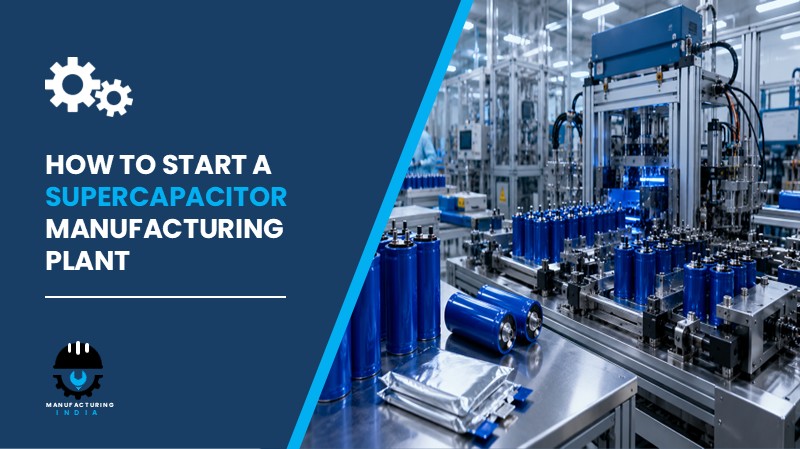
Setting up a supercapacitor manufacturing plant in India presents a compelling investment case, anchored by surging demand across automotive and transportation, consumer electronics, renewable energy and grid systems, industrial automation, and telecommunications and data centers. Supercapacitors – also known as electrochemical capacitors or ultracapacitors – are rapidly becoming indispensable in applications requiring instant energy delivery, long cycle life, and tolerance to extreme charge/discharge conditions. As India accelerates its transition toward electric vehicles, renewable energy integration, and AI-driven data infrastructure, domestic production of supercapacitors addresses a growing and strategically significant gap in the country’s energy storage supply chain.
India’s structural advantages make it an ideal location for establishing a supercapacitor manufacturing unit. The country’s expanding urbanisation, infrastructure investment under the Make in India initiative, and cost-competitive industrial ecosystems in states such as Gujarat, Maharashtra, and Uttar Pradesh provide a strong foundation for capital-intensive, technology-driven manufacturing. With raw material sourcing, skilled engineering talent, and a large and diversifying end-use base, India offers investors the dual advantage of low operational costs and a high-growth domestic market. Establishing a supercapacitor facility here positions manufacturers at the intersection of clean energy policy, next-generation mobility, and digital infrastructure expansion.
Setting up a supercapacitor manufacturing plant in India is a high-return investment opportunity backed by government policy support, cost-competitive production conditions, and multi-sector demand from EVs, renewable energy, and data centres. With gross profit margins of 30-50% and a net margin of 10-20%, this facility type demonstrates strong financial viability and break-even sustainability across varying plant scales.
What is a Supercapacitor?
A supercapacitor, commonly referred to as an electrochemical capacitor or an ultracapacitor, is a capacitance-based energy storage device with a capacity significantly higher than standard capacitors. It employs the principle of electrostatic double-layer capacitance and, in some cases, pseudocapacitance, resulting in very quick energy charge/discharge cycles, high power density, and long cycle life compared to batteries. Supercapacitors thus partially or completely take over the role of conventional capacitors in the area of energy storage or delivery, since they possess the qualities of fast energy delivery, long service life, and tolerance to the most extreme charge/discharge conditions.
The production process involves electrode preparation, mixing and coating, assembling electrodes with separators, filling with electrolyte, sealing, and testing. End-use industries served include automotive and transportation, consumer electronics, renewable energy and grid systems, industrial automation, and telecommunications and data centers. Their diverse applications include powering methods where instant energy is required – mainly in the mobility sector, industrial applications, and backup power systems.
Cost of Setting Up a Supercapacitor Manufacturing Plant in India
The cost of establishing a supercapacitor manufacturing plant in India depends on several interrelated factors including plant capacity, technology selection, geographic location, degree of automation, and compliance with environmental and safety regulations.
1. Capital Expenditure (CapEx)
Capital investment for a supercapacitor plant covers four primary heads. Land and site development forms a substantial portion of initial outlay, encompassing land registration charges, boundary development, and site preparation costs; investors may explore SEZ or industrial estate options to benefit from fiscal incentives and pre-developed infrastructure. Civil works and construction account for the production shed, quality control laboratory, raw material storage bays, finished goods warehousing, and the administrative block.
Machinery and equipment costs represent the largest individual component of total capital expenditure. Key machinery required includes:
- Electrode coating and calendaring machines
- Electrolyte filling units
- Vacuum drying and sealing equipment
- Precision assembly and testing stations
Other capital costs include effluent treatment plant (ETP) installation, pre-operative expenses, plant commissioning costs, and applicable import duties on specialist machinery components not manufactured domestically.
Request a Sample Report for In-Depth Market Insights: https://www.imarcgroup.com/supercapacitor-manufacturing-plant-project-report/requestsample
2. Operational Expenditure (OpEx)
Raw material cost is the dominant driver of operating expenditure, accounting for approximately 55-65% of total OpEx. Key raw materials required for supercapacitor production include activated carbon, aluminum foil, electrolyte salts, solvents, and separator films. Investors should negotiate long-term supply contracts with reliable domestic and international suppliers to mitigate price volatility and ensure production continuity. Utility costs – covering electricity, water, and steam – represent a further 10-15% of total OpEx. Other recurring operating costs include transportation and logistics, packaging materials, salaries and wages, maintenance and repairs, depreciation on assets, and applicable taxes. By the fifth year of operations, total operational costs are expected to increase substantially due to inflation, market fluctuations, and potential rises in the cost of key input materials, in addition to supply chain disruptions and shifts in the global economy.
3. Plant Capacity
The proposed manufacturing facility is designed with an annual production capacity ranging between 2-6 million cells, enabling economies of scale while maintaining operational flexibility. Capacity can be customised based on investor requirements, market projections, and available capital. As with most process manufacturing operations, profitability improves materially with higher capacity utilisation, making it essential to develop a realistic demand pipeline before finalising plant scale.
4. Profit Margins and Financial Projections
The supercapacitor manufacturing plant project demonstrates healthy profitability potential under normal operating conditions. Gross profit margins typically range between 30-50%, supported by stable demand and value-added applications across multiple end-use sectors. Net profit margins range between 10-20%. Financial projections covering NPV, IRR, payback period, income and expenditure breakdowns, and sensitivity analysis are available in the detailed project report, enabling investors to assess the plant’s long-term financial sustainability across different capacity and pricing scenarios.
Why Set Up a Supercapacitor Plant in India?
Growing Electric Vehicle and Transportation Demand: Supercapacitors are used widely in regenerative braking for electric vehicles, buses, and trains, enabling rapid energy recapture. As India accelerates its EV transition, the demand for domestic supercapacitor supply will increase structurally, reducing dependence on imports and shortening supply chains for automotive OEMs.
Renewable Energy and Grid Stabilisation Requirements: Supercapacitors serve as short-duration energy buffers to smooth output in renewable installations and stabilise grid systems. India’s ambitious renewable energy capacity additions make grid stabilisation technologies critical, creating a sustained and policy-backed demand pipeline for supercapacitor production.
Telecommunications and Data Centre Expansion: Supercapacitors offer data centre systems with quick backup and power conditioning, ensuring voltage dips are avoided. With India rapidly expanding its data centre and 5G infrastructure, this application segment represents a fast-growing, high-value domestic market for manufacturers.
Policy and Regulatory Tailwinds: India’s Make in India initiative and industrial policy support for advanced energy storage manufacturing create a favourable regulatory environment. PLI schemes and state-level industrial incentives make large-scale capital investment in high-technology sectors financially attractive for both domestic and foreign investors.
Cost-Competitive Manufacturing: India offers comparatively lower land, labour, and construction costs relative to established supercapacitor manufacturing hubs in Asia, Europe, and North America. Combined with proximity to a large domestic market, this structural cost advantage directly improves margin realisation and competitiveness.
Active Global Industry Investment: In July 2025, Allotrope Energy unveiled new supercapacitor technology using Lignavolt, a nano-porous carbon material derived from pulp industry byproducts, delivering energy densities of 14-15 Wh/kg. In April 2025, Paladin Power entered a joint venture with Emtel Energy USA to develop an integrated, lithium-free energy storage system combining graphene-based supercapacitor cells. In March 2025, NVIDIA revealed its upcoming GB300 server featuring supercapacitors within its power architecture, driving capacity expansion among suppliers across Asia, the US, and Europe.
Manufacturing Process – Step by Step
The supercapacitor manufacturing process uses electrode preparation, mixing and coating, assembling electrodes with separators, filling with electrolyte, sealing, and testing as the primary production method.
- Electrode Preparation: Raw materials including activated carbon and aluminum foil are sourced and processed into electrode substrates meeting dimensional and purity specifications.
- Mixing and Coating: Active electrode materials are mixed with binders and solvents, then coated onto current collector foils using electrode coating and calendaring machines to achieve uniform layer thickness.
- Assembly with Separators: Coated electrodes are assembled with separator films under controlled conditions to prevent contamination and ensure electrochemical isolation between positive and negative electrodes.
- Electrolyte Filling: The assembled cell stack is filled with electrolyte salts and solvents using electrolyte filling units, with precise volume control to meet performance specifications.
- Vacuum Drying and Sealing: Cells undergo vacuum drying to remove residual moisture, followed by hermetic sealing using vacuum drying and sealing equipment to ensure long-term performance stability.
- Precision Assembly and Testing: Completed cells are assembled into modules or packs and subjected to comprehensive testing at precision assembly and testing stations, covering capacitance, internal resistance, leakage, and cycle life.
- Packaging and Dispatch: Finished supercapacitors are packaged per customer specifications and dispatched to end-use industries across automotive, electronics, energy, industrial automation, and telecommunications sectors.
Key Applications
Supercapacitors serve a broad range of industries requiring high-power, fast-cycle energy storage solutions:
- Automotive and Transportation: Used in regenerative braking systems for electric vehicles, buses, and trains for rapid energy recapture and peak power support.
- Consumer Electronics: Applied in cameras and portable tooling for power smoothing, quick charge support, and flash energy delivery.
- Renewable Energy and Grid Storage: Functions as short-duration energy buffers to smooth output in renewable installations and stabilise grid systems including STATCOMs.
- Industrial Automation: Provides peak power supplements and backup energy for automated industrial processes requiring reliable, instantaneous power delivery.
- Telecommunications and Data Centers: Delivers quick backup and power conditioning to data centre systems, ensuring voltage dips are avoided and uptime is maintained.
Leading Manufacturers
The global supercapacitor industry is served by several multinational companies with extensive production capacities and diverse application portfolios. Key players in the global market include:
- Cap-XX Limited
- Eaton
- Yunasko
- Skeleton Technologies Inc.
- Maxwell Technologies
- Cornell-Dubilier
- AVX Corporation
- Tecate Group
- VINATech Co. Ltd.
- Nippon Chemi-Con Corp.
- TDK Corporation
- Panasonic Corporation
- Nanoramic Laboratories
- Murata Manufacturing Co., Ltd.
- FastCAP Ultracapacitors Corporation
Timeline to Start the Plant
Investors should plan for a structured, phased project execution timeline:
- Feasibility study and project report preparation
- Land acquisition and site development
- Regulatory approvals and environmental clearances
- Factory licence and fire safety compliance
- Machinery procurement and installation
- Raw material supplier agreements and supply chain setup
- Trial production and quality testing
- Commercial production launch
Licences and Regulatory Requirements
Starting a supercapacitor manufacturing unit in India requires several approvals:
- Business registration (Proprietorship, LLP, or Pvt Ltd)
- Factory Licence under the Factories Act
- Environmental Clearance from State Pollution Control Board
- GST Registration
- Fire Safety NOC
- Hazardous and chemical substance compliance (relevant given electrolyte salts and solvents used in production)
- Effluent Treatment Plant (ETP) operational clearance
- Occupational Health and Safety compliance
Key Challenges to Consider
High Capital Requirements: Establishing a supercapacitor manufacturing plant involves substantial upfront investment in land, civil construction, and specialised equipment, necessitating robust financial planning and access to institutional or equity financing.
Raw Material Price Volatility: Key inputs including activated carbon, aluminum foil, electrolyte salts, solvents, and separator films are subject to global commodity price fluctuations and supply chain disruptions, which can compress margins if not mitigated through long-term procurement contracts.
Regulatory Compliance: Environmental and safety compliance requirements – including ETP installation, hazardous chemical handling approvals, and pollution control board clearances – add to both capital costs and operational complexity, demanding dedicated compliance resources.
Technology and Innovation Pressure: The global supercapacitor industry is evolving rapidly, with companies such as Skeleton Technologies, Allotrope Energy, and Paladin Power launching advanced graphene-based and lithium-free supercapacitor technologies. Domestic manufacturers must plan for technology refresh cycles to remain competitive.
Competition from Established Global Players: The market is served by large, well-capitalised global manufacturers including Panasonic Corporation, TDK Corporation, Murata Manufacturing Co. Ltd., and Maxwell Technologies, all of which benefit from scale efficiencies that new entrants must strategically counter.
Skilled Manpower: Supercapacitor manufacturing requires expertise in electrochemistry, precision assembly, and quality assurance. Attracting and retaining qualified engineers and technicians in niche energy storage technology is a sustained operational challenge.
Key Takeaways for Investors
A supercapacitor manufacturing plant in India represents a strategically positioned investment opportunity, driven by multi-sector demand from automotive and transportation, renewable energy, industrial automation, consumer electronics, and telecommunications and data centers. The facility demonstrates financial viability across a range of plant capacities, with gross margins of 30-50% and net margins of 10-20% confirming strong return potential even at conservative production assumptions. The global supercapacitor market was valued at USD 7.63 billion in 2025 and is projected to reach USD 36.7 billion by 2034, expanding at a CAGR of 19.07% from 2026 to 2034, underscoring the long-run demand sustainability that underpins investment confidence in this facility type.
About the Author