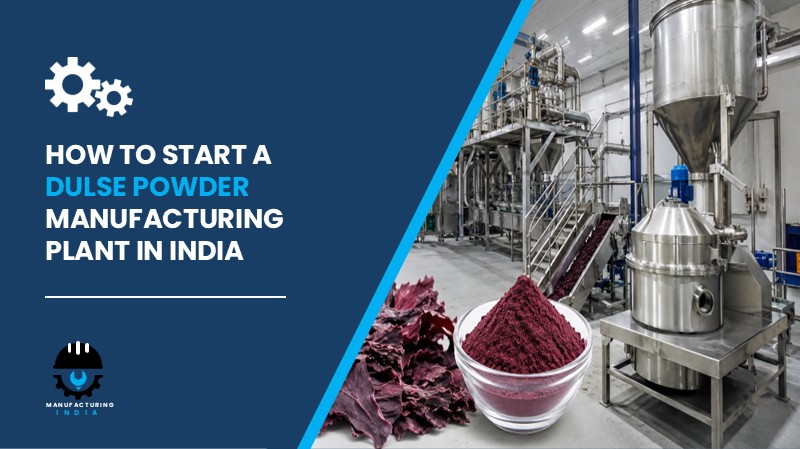
Setting up a dulse powder manufacturing plant in India presents a compelling investment case at a time when the country’s food processing industry is among the fastest growing in the world, its nutraceutical and functional food sectors are expanding at double-digit rates, its cosmetics and personal care market is scaling rapidly with rising disposable incomes, and consumer interest in marine-sourced, plant-based, and sustainably produced ingredients is accelerating across both urban and export-oriented markets. Dulse powder — the fine, nutrient-dense powder produced from dulse seaweed (Palmaria palmata), a red marine alga rich in protein, dietary fibre, vitamins, minerals, and antioxidants — is emerging as one of the most commercially versatile and nutritionally distinctive specialty ingredients in the global plant-based food and functional nutrition market. Its unique combination of umami flavour, exceptional mineral density, and adaptability across food, supplement, and personal care applications makes it a premium ingredient whose demand is growing structurally as consumers, food manufacturers, and health product formulators seek out sustainably sourced, ocean-derived nutritional solutions.
India’s structural positioning for dulse powder manufacturing is strongly supported by the country’s booming food processing sector. According to the India Brand Equity Foundation, from April 2000 to June 2025, India’s food processing industry received Rs. 1,15,596 Crore (USD 13.4 Billion) in FDI — a landmark investment that reflects both the scale of opportunity and the depth of commercial confidence in India’s food processing infrastructure. India’s coastal geography, combined with growing seaweed cultivation initiatives in Tamil Nadu, Gujarat, Odisha, and Andhra Pradesh, creates a developing domestic raw material supply pathway for marine algae-based products. The Make in India initiative and government support for food processing, nutraceutical manufacturing, and marine product value-addition provide policy tailwinds, while food and nutraceutical industrial parks in Gujarat, Maharashtra, and Tamil Nadu offer the cold chain infrastructure, food-grade processing environments, and logistics connectivity that a dulse powder manufacturing facility requires.
Investing in a dulse powder manufacturing plant in India today aligns rising demand for natural, plant-based, and marine-sourced functional ingredients with India’s USD 13.4 Billion FDI-backed food processing expansion, growing health-conscious consumer base, and export access to premium organic and nutraceutical markets. With gross profit margins of 35–40% and net profit margins of 15–18% at an annual production capacity of 200–500 MT, the unit economics are commercially attractive, and the investment’s premium specialty food ingredient positioning supports strong long-term returns across India’s rapidly evolving functional food and wellness industry.
What is Dulse Powder?
Dulse powder is a fine, nutrient-rich powder produced by harvesting, cleaning, drying, and milling dulse seaweed — the red marine alga Palmaria palmata — into a versatile ingredient used across food, nutraceutical, cosmetics, and animal nutrition applications. Dulse is a naturally occurring seaweed species found in cold Atlantic and Pacific coastal waters, prized for its exceptionally high mineral content — particularly iodine, potassium, iron, and magnesium — alongside its protein richness, dietary fibre, vitamins B12 and C, and naturally occurring antioxidants including phycoerythrin. Its distinctive umami flavour profile, reminiscent of bacon when roasted, makes it a sought-after clean-label flavour ingredient alongside its nutritional functionality.
Dulse powder is used as a nutritional supplement for its health benefits including thyroid support, cardiovascular health, immune function, and antioxidant properties. In food manufacturing, it serves as a flavouring and nutritional fortification ingredient across snacks, seasonings, soups, salads, and plant-based meat alternatives. In cosmetics, it functions as a skin-nourishing active ingredient in masks, serums, and exfoliants. The primary production process covers seaweed harvesting, washing and inspection, dehydration, milling and grinding, sieving and screening, quality inspection, and packaging. End-use industries served include food and beverages, nutraceuticals, cosmetics and personal care, animal feed, and aquaculture. Applications span nutritional supplements, functional food ingredients, flavouring agents, cosmetic actives, and livestock feed additives.
Cost of Setting Up a Dulse Powder Manufacturing Plant in India
The cost of establishing a dulse powder manufacturing plant in India depends on production capacity, raw material sourcing strategy between domestic coastal seaweed and imported dulse, drying technology selection, geographic location — particularly coastal proximity and food processing zone access — degree of automation, and the FSSAI food safety and organic certification requirements applicable to dulse powder supplied to food, nutraceutical, and export customers.
1. Capital Expenditure (CapEx)
Land and Site Development forms a foundational component of total capital investment, covering land acquisition charges, site registration, boundary development, drainage infrastructure, and site utilities. The location must offer easy access to key raw materials such as fresh or frozen dulse seaweed, with proximity to coastal seaweed cultivation and harvesting zones reducing inbound logistics costs on the perishable primary input. Proximity to target markets — particularly the large food processing, nutraceutical manufacturing, and cosmetics clusters in Gujarat, Maharashtra, and Tamil Nadu — minimises distribution costs. The site must have robust infrastructure including reliable transportation, cold chain utilities, and waste management systems, with compliance with local zoning laws and FSSAI food processing facility regulations ensured from the outset.
Plant Layout Optimisation is critical for a food-grade dulse powder manufacturing facility. The layout must be optimised to enhance workflow efficiency, hygiene, and minimise handling distances between the washing, drying, milling, and packaging stages. Separate areas for raw material storage with cold chain capability for fresh dulse, dehydration and drying operations, milling and grinding rooms with dust containment, quality control testing laboratory, finished goods storage with humidity and temperature control, and dispatch must be designated. Space for future capacity expansion should be incorporated to accommodate growth as export market access and domestic nutraceutical customer volumes develop.
Machinery and Equipment represent the largest single component of total CapEx for a dulse powder manufacturing plant. Essential equipment includes:
- Seaweed washing and cleaning systems
- Dehydration units
- Milling and grinding machines
- Sieving and screening equipment
- Packaging and sealing machines
- Quality inspection and moisture control systems
Other Capital Costs include an effluent treatment plant (ETP) for managing process water from seaweed washing operations, dust containment and collection systems for milling operations, food-grade facility compliance infrastructure for FSSAI licensing, organic certification audit infrastructure where organic-grade product lines are targeted, pre-operative expenses, commissioning charges, and any import duties on specialised dehydration systems or precision milling equipment not available domestically.
Request a Sample Report for In-Depth Market Insights: https://www.imarcgroup.com/dulse-powder-manufacturing-plant-project-report/requestsample
2. Operational Expenditure (OpEx)
Raw Material Cost is the dominant operational expense, accounting for approximately 60–70% of total OpEx. The primary raw materials are fresh or frozen dulse seaweed, drying energy, and moisture-proof packaging materials. Fresh or frozen dulse seaweed — as the primary feedstock consumed in the largest volumes — drives the majority of raw material cost. Given India’s currently limited commercial dulse seaweed cultivation base, raw material sourcing strategy must navigate between developing domestic coastal supply agreements with seaweed farmers in Tamil Nadu, Odisha, and Gujarat, and import-route procurement from established Atlantic dulse producers in Ireland, Iceland, Canada, and the United States. Drying energy — electricity, LPG, or solar — constitutes the second most significant variable cost. Long-term contracts with reliable seaweed suppliers must be negotiated to stabilise pricing and ensure a steady supply.
Utility Cost is the second-largest OpEx component, representing approximately 15–25% of total operating expenses — a relatively elevated proportion reflecting the energy intensity of dehydration unit operations, which constitute the most energy-demanding stage of dulse powder production. Electricity or fuel for dehydration units, combined with electricity for milling, sieving, and packaging equipment, constitutes the primary utility requirement. Managing utility costs through solar-assisted drying where feasible, and efficient dehydrator operation scheduling, are important levers for improving facility economics.
Other Operating Costs include transportation and distribution to food manufacturers, nutraceutical supplement producers, cosmetics ingredient formulators, specialty food retailers, and export buyers, moisture-proof sealed packaging materials for dulse powder in consumer retail and bulk institutional formats, salaries and wages for food processing operators and quality control technicians, routine machinery maintenance including dehydrator element servicing and milling screen replacement, FSSAI compliance and audit costs, depreciation on production equipment, and applicable taxes. By the fifth year, the total operational cost is expected to increase substantially due to factors such as inflation, market fluctuations, and potential rises in the cost of key materials. Additional factors, including supply chain disruptions, rising consumer demand, and shifts in the global economy, are expected to contribute to this increase.
3. Plant Capacity
The proposed manufacturing facility for dulse powder is designed with an annual production capacity ranging between 200 and 500 metric tonnes, reflecting the specialty premium ingredient nature of this product and the current scale of addressable demand across India’s food processing, nutraceutical, and cosmetics sectors. Plant capacity can be customised per investor requirements and scaled through additional dehydration and milling capacity as domestic raw material supply chains develop and export market volumes grow. Profitability improves with higher capacity utilisation, making established supply agreements with domestic seaweed farmers or import procurement relationships alongside secured offtake contracts with nutraceutical manufacturers and food ingredient distributors a strategic commercial foundation for the investment.
4. Profit Margins and Financial Projections
The financial projections for a dulse powder manufacturing plant demonstrate healthy profitability potential under normal operating conditions. Gross profit margins typically range between 35–40%, supported by stable and growing demand across food and beverage, nutraceutical, cosmetics, and animal feed customer segments and the premium pricing that dulse powder commands as a certified organic, marine-sourced, clean-label functional ingredient. Net profit margins are projected at 15–18%. A comprehensive financial analysis covering NPV (net present value), IRR (internal rate of return), payback period, gross margin progression, and net margin development across a five-year horizon is essential before committing capital, with projections developed based on realistic assumptions related to capital investment, operating costs, production capacity utilisation, seaweed feedstock pricing trends, and demand outlook.
Why Set Up a Dulse Powder Manufacturing Plant in India?
Rising Demand for Natural, Plant-Based, and Marine-Sourced Functional Ingredients. The dulse powder market is primarily driven by the rise in demand for natural plant-based ingredients, growth of functional food products, and increased use of seaweed-based food products. Rising consumer awareness regarding marine nutrition and sustainable food sources is driving demand across both developed export markets and India’s own rapidly growing domestic health food and nutraceutical sector. The growth of plant-based diets and functional foods is encouraging manufacturers to incorporate dulse powder for both nutritional enhancement and flavour improvement — a commercial trend with strong structural momentum across all major food manufacturing categories.
India’s Food Processing FDI Boom Creating Market Foundation. According to the India Brand Equity Foundation, from April 2000 to June 2025, India’s food processing industry received Rs. 1,15,596 Crore (USD 13.4 Billion) in FDI — a level of investment that confirms the scale of commercial confidence in India’s food processing infrastructure and creates a large and growing institutional buyer base for specialty food ingredients including dulse powder. This FDI-driven expansion of organised food manufacturing directly expands the addressable domestic market for premium functional ingredients.
Growing Health-Conscious Consumer Base Driving Nutraceutical and Supplement Demand. Rising consumer awareness regarding the health benefits of marine-sourced ingredients — including dulse powder’s iodine content for thyroid health, protein density for plant-based protein supplementation, and antioxidant properties for immune support — is expanding adoption across India’s nutraceutical, sports nutrition, and functional food sectors. Changing lifestyles, urbanisation, and interest in natural health products are further supporting market expansion as India’s middle class grows and health expenditure per capita increases.
Active Global Industry Development Confirming Category Momentum. In September 2025, VIMERGY launched its first culinary partnership with vegan restaurant Christopher’s Kitchen at a private tasting event in Palm Beach Gardens, featuring a daily VIMERGY-infused menu integrating herbal extracts including Atlantic dulse, lemon balm, and wild blueberry powder to highlight holistic, nutrient-focused plant-based dining — demonstrating the growing integration of dulse as a premium ingredient in upscale culinary and wellness hospitality applications. This commercial partnership signals the category’s transition from specialty health food niche to mainstream premium dining ingredient, a trajectory that India’s expanding premium food service and nutraceutical sectors are increasingly positioned to participate in.
Cosmetics and Personal Care Market Growth Expanding Application Range. The cosmetics and personal care application of dulse powder — as a skin-nourishing active ingredient in masks, serums, exfoliants, and marine botanical formulations — is growing with India’s premium beauty and personal care market expansion. Rising consumer preference for natural, marine-derived, and sustainably sourced cosmetic actives is creating premium retail and professional skincare demand for dulse powder that complements the food and nutraceutical revenue base, providing product diversification for the manufacturing investment.
Improved Supply Chains and Organised Retail Penetration. Improved supply chains and wider availability through organised retail and specialty stores are enhancing market penetration for dulse powder products across both domestic Indian and export channels. India’s expanding e-commerce food and nutraceutical market is enabling wider distribution and easier access to niche products including seaweed-based ingredients, encouraging manufacturers to scale production to meet increasing digital consumer demand for specialty health food products.
Manufacturing Process — Step by Step
The dulse powder manufacturing process uses seaweed harvesting, washing and inspection, dehydration, milling and grinding, sieving and screening, quality inspection, and packaging as the primary production method. Each stage requires controlled process parameters — particularly temperature management in dehydration and particle size control in milling — and food-grade hygiene compliance throughout to produce dulse powder meeting the moisture content, colour, particle size, and microbiological specifications required by food, nutraceutical, and cosmetics customers.
- Dulse Seaweed Receipt and Incoming Inspection: Fresh or frozen dulse seaweed is received from coastal seaweed farmers or import suppliers, inspected for species authenticity, colour, odour, moisture content, and absence of foreign matter, and transferred to cold storage pending processing to maintain freshness and prevent degradation.
- Washing and Cleaning: Incoming dulse seaweed is processed through seaweed washing and cleaning systems using clean, potable water to remove sand, salt, marine debris, and surface contaminants, with multiple wash cycles ensuring the cleanliness required for food-grade processing.
- Sorting and Inspection: Washed seaweed undergoes visual sorting to remove discoloured, damaged, or non-dulse material, ensuring a consistent quality of raw material proceeds to dehydration with uniform colour and condition.
- Dehydration: Washed and sorted dulse is processed through dehydration units — belt dryers, tray dryers, or spray dryers depending on the target product specification and production scale — at controlled temperature settings to reduce moisture content to the specification level (typically below 8%) required for shelf stability, powder flow, and microbial safety, while preserving the heat-sensitive nutrients, colour, and flavour compounds that define dulse powder’s premium quality credentials.
- Milling and Grinding: Dehydrated dulse is processed through milling and grinding machines to reduce the dried seaweed to a fine, uniform powder of the target particle size — typically 100–500 micron range for standard culinary and supplement applications — with particle size control directly affecting the product’s dispersibility, texture, and application performance.
- Sieving and Screening: Milled dulse powder is passed through sieving and screening equipment to remove oversize particles and any residual material that did not achieve the target particle size in the milling stage, producing a consistent, specification-grade powder free from lumps and coarse fragments.
- Quality Inspection and Moisture Control: Finished dulse powder undergoes comprehensive quality testing using quality inspection and moisture control systems covering moisture content, colour and appearance, particle size distribution, protein content, mineral profile, microbiological compliance including total plate count and absence of pathogens, and heavy metal testing — verifying FSSAI specification compliance before release for packaging.
- Packaging and Dispatch: Specification-compliant dulse powder is filled and sealed into moisture-proof packaging formats — consumer retail pouches, bulk institutional bags, or export cartons — using packaging and sealing machines, then dispatched to food and beverage manufacturers, nutraceutical supplement producers, cosmetics ingredient formulators, specialty food retailers, animal feed producers, and export buyers across India and international markets.
Key Applications
Dulse powder produced in India serves a commercially diverse and growing range of food, health, cosmetics, and animal nutrition applications:
- Food and Beverages: Used as a natural flavouring and nutritional fortification ingredient in snacks, seasonings, soups, salads, plant-based meat alternatives, and functional beverages where dulse powder’s umami flavour and mineral richness add commercial value.
- Nutraceuticals: Incorporated into dietary supplements, capsules, powders, and functional food formulations targeting thyroid health, mineral supplementation, antioxidant support, and plant-based protein enhancement across India’s growing nutraceutical market.
- Cosmetics and Personal Care: Applied as a marine-sourced active ingredient in skincare masks, serums, exfoliants, and cosmetic formulations valued for its mineral richness, skin hydration, and antioxidant properties in premium natural beauty products.
- Animal Feed and Aquaculture: Used as a nutrient-rich feed supplement for livestock, poultry, and aquaculture species where dulse powder’s mineral content, trace elements, and bioactive compounds improve animal health and production performance.
Leading Manufacturers
The global dulse powder industry is served by a growing group of specialist seaweed processing companies and marine ingredient producers with diverse production capabilities. Key players in the global market include seaweed harvesting and processing specialists across Ireland, Iceland, Canada, and the United States — Atlantic dulse producing nations — alongside emerging producers in East Asia and the emerging Indian Ocean aquaculture and seaweed farming markets. Significant recent commercial activity includes VIMERGY’s September 2025 culinary partnership featuring Atlantic dulse as a premium holistic nutrition ingredient — a commercial signal of the category’s growing premium positioning.
Timeline to Start the Plant
Establishing a dulse powder manufacturing plant in India involves a structured multi-phase development sequence. Investors should plan for the following phases:
- Feasibility study and project report preparation
- Land acquisition and site development
- Regulatory approvals and environmental clearances
- Factory licence and fire safety compliance
- Machinery procurement and installation
- Raw material supplier agreements and supply chain setup
- Trial production and quality testing
- Commercial production launch
Licences and Regulatory Requirements
Starting a dulse powder manufacturing unit in India requires several approvals spanning business registration, food safety, marine product processing, environmental, and export compliance domains:
- Business registration (Proprietorship, LLP, or Pvt Ltd)
- Factory Licence under the Factories Act
- Environmental Clearance from the State Pollution Control Board
- GST Registration
- Fire Safety NOC
- FSSAI (Food Safety and Standards Authority of India) Central or State licence mandatory for commercial manufacture and sale of dulse powder as a food or food supplement ingredient
- Marine Products Export Development Authority (MPEDA) registration where dulse powder is produced for export from India
- Organic certification from an NPOP-accredited certifying body where organic-grade dulse powder production is targeted for premium domestic or export markets
- Effluent Treatment Plant (ETP) operational clearance for managing seaweed washing process water
- Occupational Health and Safety compliance
Key Challenges to Consider
Domestic Raw Material Supply Chain Development. India’s commercial dulse seaweed cultivation and harvesting base is still nascent relative to established Atlantic dulse producing nations including Ireland, Iceland, Canada, and the United States. Building a reliable, consistent-quality domestic dulse seaweed supply chain — or establishing cost-competitive import procurement routes for frozen or dried dulse — is the most fundamental operational challenge for an India-based dulse powder producer and requires sustained investment in supplier development, cold chain logistics, and quality management from the earliest stage of plant development.
Seaweed Species Authenticity and Quality Consistency. Dulse powder’s premium positioning depends on authentic Palmaria palmata seaweed identity, consistent mineral content, characteristic colour, and the absence of adulteration with other seaweed species that may look similar but have different nutritional profiles and taste characteristics. Maintaining species authenticity and quality consistency across production batches — particularly when sourcing from multiple coastal or import suppliers — requires DNA-based species verification, rigorous incoming material testing, and accredited supplier qualification.
Dehydration Energy Costs and Process Optimisation. Utility costs representing 15–25% of total OpEx reflect the energy intensity of dehydration operations — the most critical processing stage for dulse powder quality and the most energy-consuming. Optimising dehydration temperature profiles to preserve heat-sensitive nutrients and bioactive compounds while achieving the target moisture content and microbial safety requires process development expertise and calibrated equipment operation. Managing energy costs through efficient dryer operation and potentially solar-assisted pre-drying can meaningfully improve the facility’s cost position.
FSSAI Novel Food and Seaweed Ingredient Regulatory Navigation. Dulse powder as a marine-sourced food ingredient occupies a regulatory intersection between food, food supplement, and novel food categories that requires careful FSSAI compliance navigation. Ensuring that product claims, labelling, and intended applications are aligned with current FSSAI permitted use categories for seaweed and marine plant extracts is important for market access and avoiding regulatory compliance issues with food manufacturer customers.
Competition from Established International Producers and Import Supply. The Indian market for dulse powder is currently supplied primarily through imports from established Atlantic seaweed processors in Ireland, Canada, and Iceland, which carry certified organic status, traceable wild harvest credentials, and established quality reputations with premium food and nutraceutical buyers. New Indian producers must compete through price advantages from reduced import logistics costs, fresh supply availability, domestic customer service responsiveness, and the growing buyer preference for domestic supply chain security.
Consumer and Trade Buyer Education. While dulse powder’s health benefit profile is well-established in North Atlantic food cultures, Indian food manufacturers and nutraceutical producers require education on its nutritional profile, flavour applications, certifications, and formulation compatibility before specifying it as an ingredient. Building trade buyer awareness and creating consumer-facing health education content requires marketing investment alongside production capacity development.
Frequently Asked Questions
1. How much does it cost to set up a dulse powder manufacturing plant in India?
The total setup cost depends on plant capacity, raw material sourcing strategy between domestic and imported dulse seaweed, drying technology selection, location, and food-grade compliance infrastructure level. CapEx covers land and site development, food processing facility civil construction, core machinery including seaweed washing and cleaning systems, dehydration units, milling and grinding machines, sieving and screening equipment, packaging and sealing machines, and quality inspection and moisture control systems, along with FSSAI compliance infrastructure, ETP, and other capital costs. A detailed project report with full CapEx and OpEx breakdowns is available on request.
2. Is dulse powder manufacturing profitable in India in 2026?
Yes. The project demonstrates gross profit margins of 35–40% and net profit margins of 15–18% under normal operating conditions, supported by growing demand from food and beverage, nutraceutical, cosmetics, and animal feed customers. The global dulse powder market growing from USD 115.9 Million in 2025 to USD 237.5 Million by 2034 at a CAGR of 8.3% confirms sustained commercial opportunity, with India’s USD 13.4 Billion food processing FDI base providing immediate domestic market access.
3. What machinery is required for a dulse powder plant in India?
Key machinery includes seaweed washing and cleaning systems, dehydration units, milling and grinding machines, sieving and screening equipment, packaging and sealing machines, and quality inspection and moisture control systems. Dehydration units are the most capital-intensive and production-critical equipment, determining the moisture content, colour preservation, nutrient retention, and microbial safety of the finished dulse powder.
4. What licences and approvals are required to start a dulse powder plant in India?
Required approvals include business registration, a Factory Licence under the Factories Act, Environmental Clearance from the State Pollution Control Board, GST registration, a Fire Safety NOC, FSSAI Central or State food safety licence, MPEDA registration for export production, organic certification for premium-grade product lines, ETP operational clearance, and Occupational Health and Safety compliance.
5. What raw materials are needed for dulse powder manufacturing?
The primary raw materials are fresh or frozen dulse seaweed, drying energy, and moisture-proof packaging materials. Fresh or frozen dulse seaweed accounts for approximately 60–70% of total operating expenses, making seaweed supply chain development — whether through domestic coastal procurement or import logistics — the most critical operational priority for the investment.
6. What are the environmental compliance requirements for a dulse powder plant in India?
The unit must obtain Environmental Clearance from the State Pollution Control Board, operate a certified ETP for managing seaweed washing process water and organic waste streams, implement dust containment systems for milling operations, and maintain monitoring systems for wastewater discharge and air emissions in line with applicable state pollution control standards for food processing facilities.
7. What is the best location to set up a dulse powder plant in India?
Optimal locations offer proximity to coastal seaweed cultivation or harvesting zones, cold chain logistics for fresh seaweed transport, reliable electricity for dehydration operations, access to food processing and nutraceutical customer clusters, and logistics connectivity to export markets. Coastal food processing zones in Tamil Nadu, Gujarat, Andhra Pradesh, and Odisha are among the most strategically relevant options for this investment.
8. What is the break-even period for this type of plant in India?
The break-even period depends on production capacity, raw material sourcing economics, capacity utilisation rate, and demand conditions across food, nutraceutical, and cosmetics customer segments. A detailed financial analysis including payback period, NPV, and IRR projections is included in the full project report, available via the sample request link.
9. What government incentives are available for manufacturers in India?
The Make in India initiative, PLI scheme for food processing, Pradhan Mantri Kisan Sampada Yojana (PMKSY) food park and agro-marine processing cluster schemes, MPEDA support for marine product exporters, and state-level food processing zone incentives provide financial and regulatory support for dulse powder manufacturing investments. Organic product export incentives and capital subsidy schemes under state investment promotion boards may also be applicable.
Key Takeaways for Investors
A dulse powder manufacturing plant in India represents a commercially attractive and strategically well-timed investment in a premium specialty food and nutraceutical ingredient that sits at the intersection of the plant-based food revolution, functional nutrition growth, marine ingredient sustainability trends, and India’s own extraordinary food processing FDI expansion. The project demonstrates commercial viability at annual production capacities of 200 to 500 MT, with gross profit margins of 35–40% and net profit margins of 15–18% confirming sound unit economics supported by the premium pricing that dulse powder commands as a certified organic, marine-sourced, clean-label functional ingredient across food, nutraceutical, and cosmetics applications. The global dulse powder market, valued at USD 115.9 Million in 2025, is projected to reach USD 237.5 Million by 2034, growing at a CAGR of 8.3%, with India’s food processing sector — backed by USD 13.4 Billion in FDI through June 2025 — providing an immediate and expanding domestic customer base alongside export market access to the premium organic food and nutraceutical segments globally. With VIMERGY’s September 2025 culinary partnership featuring Atlantic dulse as a holistic nutrition star ingredient, rising global consumer awareness of marine nutrition benefits, and India’s health-conscious middle class expanding its demand for functional, sustainably sourced food ingredients, demand sustainability for India-based dulse powder production is structurally robust and commercially compelling across the full investment horizon.
About the Author